
Boskop Man: How One Skull Became the Legend of a Genius Species
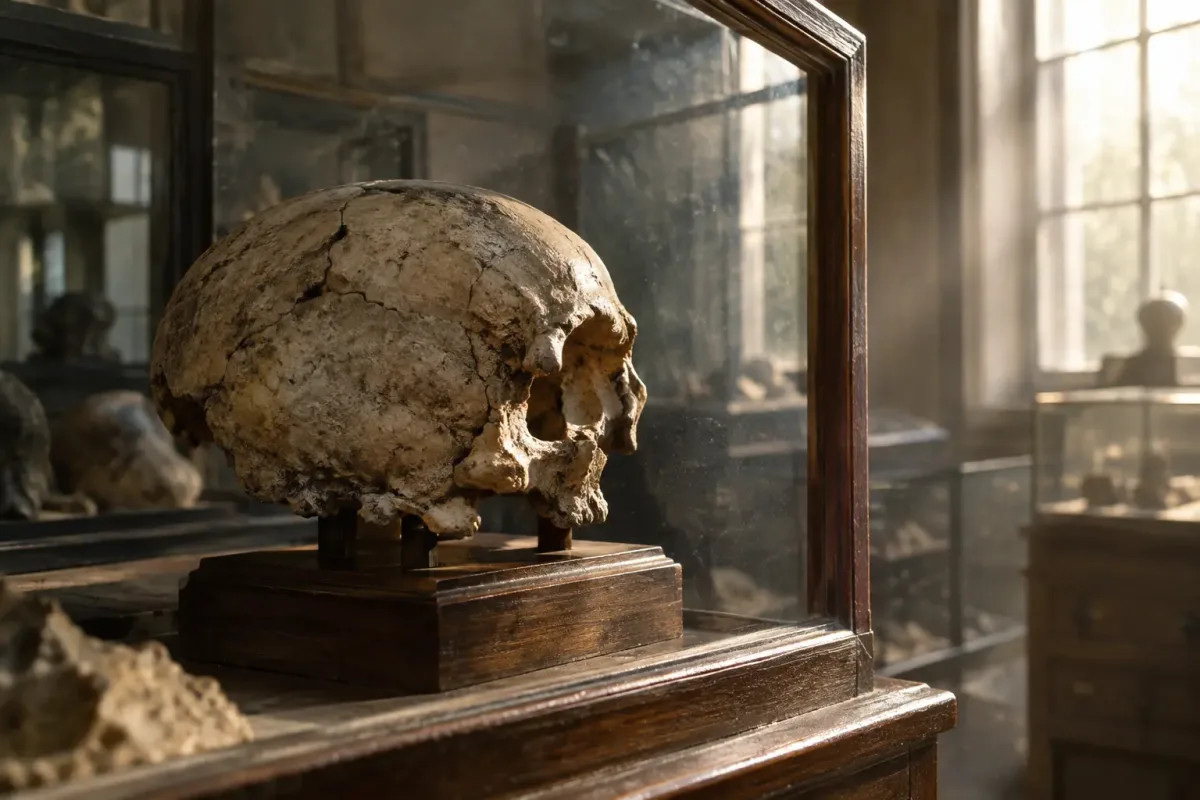
In December 1925, editors at the London journal Nature received a short letter. Its author was Robert Broom, a Scottish-born physician and paleontologist who had spent most of his career digging up fossils in South Africa.
He was reminding readers of a conclusion he'd reached seven years earlier. The skull's bone ran up to 0.6 inches (15 millimeters) thick in places, and its brain volume, he wrote, had convinced him back in 1918 to give it a rank of its own within the human family: Homo capensis.
That skull is known today as Boskop Man, named for the South African town near where it was dug up twelve years before.
Across dozens of ancient-mystery websites, the story still circulates as proof that a humanoid species smarter than modern humans once existed, one whose existence science supposedly kept quiet.
Records from scientific archives and journals tell a very different story.
- 1.How Boskop Man Got a Name Science No Longer Uses
- 2.A Childlike Face That Became a Literary Image, Not a Scientific Finding
- 3.How One Book Calculated an IQ of 149 for an Extinct Species
- 4.What Actually Happened in the 1950s, and Why It Wasn't a Cover-Up
- 5.Why the Story Still Circulates, From a Popular Book to Aliens
How Boskop Man Got a Name Science No Longer Uses
The story begins in the fall of 1913, on a farm near the town of Boskop in the Transvaal.
Two farmers, digging a drainage ditch, came across fragments of a skull and part of a jaw.
They weren't even sure the remains were human. They settled the dispute with a bet, turning to Frederick William Fitzsimons, director of the museum in Port Elizabeth, to make the call.
Fitzsimons immediately recognized the find's value and persuaded the farmers to donate the remains to the museum.
At first he linked them to Neanderthals because of the bone's thickness, even though the skull lacked the pronounced brow ridges typical of that species.
When the skull was sent to Cape Town for examination, paleontologist Sidney Haughton noted its similarities to Cro-Magnon man. A few years later, Broom took things a step further.
The 1913 find was incomplete. What survived were large sections of the frontal and parietal bones, part of the occipital bone, one temporal bone, and a lower jaw fragment about 6 inches wide and 8 inches long (150 by 205 millimeters).
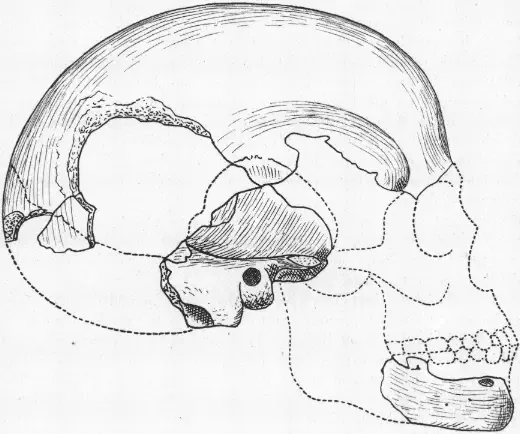
Similar large-boned finds turned up in the decades that followed, at Tsitsikamma, Matjes River, Fish Hoek, and the Springbok Flats site, convincing researchers they weren't looking at a single anomaly but at the remains of an entire, previously unknown race.
In a paper published in 1918, Broom declared the skull a representative of a brand-new species.
His estimate of its brain volume, corrected for the missing parts, came to about 1,980 cc.
Later estimates diverge: the Encyclopaedia Britannica puts it at around 1,800 cc, while paleoanthropologist John Hawks cites a range of 1,700 to 2,000 cc, depending on the measurement method, which the bone's thickness made especially tricky. The average human brain today measures about 1,350 cc.
Broom was no fringe figure looking for a sensation to build a career on.
The Royal Society elected him a fellow in 1920, and he's best known today for discoveries he made decades later: he described the species Paranthropus robustus in 1938, and in 1947 he found the skull known as "Mrs. Ples" in the Sterkfontein cave, one of the pivotal finds in the study of human origins.
When he wrote about the Boskop skull three decades earlier, he was working from a sample of just a handful of specimens and measurement methods that had yet to be refined, not out of any intent to manufacture a sensation.
The difference is real, but it isn't unique. Skulls of similar volume still turn up today within the normal range of variation among human males.
What set the Boskop skull apart from the wider pool of human remains wasn't just its size, but the thickness of its bone, which made measurements unreliable. As it would turn out, that was only the beginning of the problem.
A Childlike Face That Became a Literary Image, Not a Scientific Finding
Along with the skull's size, early researchers noticed something else: a face much smaller than they'd expect on such a large head.
Anthropology calls the tendency to retain childlike facial features into adulthood pedomorphism, and in a milder form, it's also what distinguishes a human face from an ape's.
Unlike a gorilla's, the human face stays relatively flat and small throughout development, rather than growing a pronounced muzzle with age.
The claim that the Boskop face took up only a fifth of the skull's surface, versus a third in the average European adult, doesn't come from Broom's scientific papers at all.
It was popularized by the American anthropologist and essayist Loren Eiseley, in a piece from his collection The Immense Journey (1957), where he described Boskop Man as a man of the future trapped in the distant past, with a face that was almost childlike.
Eiseley wasn't a specialist in fossil skulls. He was a writer known for his poetic style and his gift for turning scientific subjects into lyrical prose.
His portrait of Boskop Man was more a literary image than the result of measurements published in a peer-reviewed paper.
Half a century later, neuroscientists Gary Lynch and Richard Granger picked up that same image in their book Big Brain (2008), presenting it as a serious anthropological hypothesis.
How One Book Calculated an IQ of 149 for an Extinct Species
In Big Brain, Lynch and Granger calculated that a population with an average brain of 1,750 cc, about 30 percent larger than today's average, would have an average IQ of 149.
Discover magazine picked up the passage in 2009, carrying the claim to a far wider audience than the book alone would ever have reached.
The math rests on the assumption that brain size explains between 10 and 20 percent of the variation in intelligence test scores, and on a regression equation the authors never cited or explained anywhere.
Paleoanthropologist John Hawks responded on his blog that no human population has ever had an average brain of 1,750 cc, and that estimating IQ from a fossil skull makes no scientific sense, since IQ tests measure ability within a living population, not the volume of a bone.
More recent data backs up Hawks's skepticism.
The most comprehensive meta-analysis to date of the link between brain volume and IQ scores, published in 2022 in the journal Royal Society Open Science and drawing on more than 26,000 subjects across 194 independent samples, found a correlation coefficient centered between 0.20 and 0.25.
That's a weak-to-moderate relationship, enough to account for only part of the variation in IQ scores among living people, and nowhere near strong enough to support estimating the intelligence of an extinct population from skull volume alone.
Neither Lynch nor Granger is an anthropologist or a paleontologist. Both are researchers in neuroscience and cognitive science.
Their grasp of the brain isn't in question, but their reading of early-twentieth-century fossil finds, without accounting for research published after the 1940s, is.
Hawks described it as a book that presents 1920s anthropology as though it were the current state of the science.
There has been a genuine decline in average brain volume in part of the human population over the last ten thousand years, but the explanation has nothing to do with losing intelligence.
Hawks connects it to the energy cost of a large brain, the longer developmental period it takes to mature, and dietary changes after the rise of agriculture, when the average person's protein and fat intake declined.
None of those three factors supports the story of an extinct, more brilliant species.
What Actually Happened in the 1950s, and Why It Wasn't a Cover-Up
The idea of a distinct, big-skulled species didn't disappear because it made anyone uncomfortable. It disappeared because the evidence piled up against it.
In 1958, anthropologist Ronald Singer published a detailed review of every similar skull found up to that point.
He concluded there was no basis for carving out a separate group from the known range of variation in southern African populations, including the surviving population known today as the Khoisan.
Part of the problem was methodological. In their search for more Boskop-type specimens, researchers kept picking out the largest skulls from a much broader and more varied sample instead of comparing them against contemporary African populations.
Skulls found near Tsitsikamma in 1921 were classified as the Boskop type based solely on comparison with the original find, with no check against known Khoikhoi skulls, the population they ultimately turned out to belong to.
By 1963, anthropologist David Brothwell was able to conclude that the original Boskop skull was simply a large example of the Khoisan type, with nothing to justify separate-species status.
By the 1970s, the name "Boskopoid" survived in the scientific literature only as a historical label, with no connection to actual taxonomy.
Eiseley's literary essay about the man of the future appeared the same year Singer published his review.
While science was closing the book on a separate species, popular literature, quite independently, was just opening one.
Those two threads, the scientific and the literary, have periodically crossed paths ever since in writing about ancient mysteries, with an added layer about a suppressed science that never existed in the original reports.
Why the Story Still Circulates, From a Popular Book to Aliens
The myth of Boskop Man has survived for decades the same way many ancient-mystery stories do: through popular books and websites that recycle old, long-abandoned scientific hypotheses and present them as current knowledge.
Despite sharp criticism from experts, Big Brain has stayed in print and is still cited in articles about "lost species," often without a single reference to anything written after 1958.
Once science rejects an idea, it's easy to reshape it into a story of suppressed truth, especially when the original find is old, incomplete, and far removed from public view.
Some amateur writers fill that gap with speculation about Atlanteans or human-alien hybrids, even though there's no documented trace of any such claim, not in Broom's papers and not in any later scientific research.
A similar fate has befallen other fossil finds interpreted through the lens of a single incomplete skull.
Without a wider sample and modern comparison methods, any statistical outlier can easily turn into a story about a lost civilization.
What actually survives from the Boskop Man story, once you set the legend aside, is quite solid, though the two threads of evidence shouldn't be confused with each other.
Later anthropology, Singer's 1958 review and Brothwell's 1963 analysis, linked the Boskop skull and similar finds to the range of variation in southern African populations, above all to the ancestors of today's Khoisan peoples.
That's a historical conclusion based on morphology, reached by comparing skull shape and size, not by genetic analysis.
Separately, a 2020 genetic study from Uppsala University, based on twenty-five complete genomes from five Khoisan populations, showed that today's Khoisan peoples carry genetic lineages representing the deepest known split within Homo sapiens, older than any other branch of humanity.
That split happened 200,000 to 300,000 years ago, long before the ancestors of today's Europeans and Asians had even left Africa, and as much as a quarter of the genetic variants found in Khoisan populations exist nowhere else on Earth.
That study, however, is about living populations. The DNA from the actual 1913 skull was never sequenced, so this genetic finding can't be tied directly to that specific fossil, only to the population context that its morphology places it in.
What can be said with confidence is that the 1913 skull never belonged to a lost, more brilliant species.
It belonged to the range of variation within populations that genetics today credits with one of the deepest and oldest lineages in human history.
SOURCES
- Robert Broom, "The Boskop Skull", Nature, 1925
- Robert Broom, "The Evidence Afforded by the Boskop Skull of a New Species of Primitive Man (Homo capensis)", Anthropological Papers of the American Museum of Natural History, vol. 23, pt. 2, 1918, pp. 63-79, Fig. 5 (illustration source; public domain)
- John Hawks, "The 'amazing' Boskops"
- John Hawks, "Return of the 'amazing' Boskops"
- Gary Lynch and Richard Granger, "Who Were The Boskops And Were They Really Smarter Than Us?", Discover, 2009
- Jakob Pietschnig, Daniel Gerdesmann, Michael Zeiler, Martin Voracek, "Of differing methods, disputed estimates and discordant interpretations: the meta-analytical multiverse of brain volume and IQ associations", Royal Society Open Science, 2022
- Carina M. Schlebusch et al., "Khoe-San Genomes Reveal Unique Variation and Confirm the Deepest Population Divergence in Homo sapiens", Molecular Biology and Evolution, 2020
- Carina M. Schlebusch et al., "Southern African ancient genomes estimate modern human divergence to 350,000 to 260,000 years ago", Science, 2017
- "Boskop skull", Encyclopaedia Britannica
Aron Corvin
A researcher of the unknown who loves a good story. I won't sell you sensationalism just for a click. If you enjoy what I write, your support would mean a lot and help me keep going.