
Tesla and the Numbers 3, 6, 9: Why They Aren't the Key to the Universe
In the February 1919 issue of Electrical Experimenter, Nikola Tesla admitted in print that in his early youth, every action he repeated had to be divisible by three.
If he slipped up in a calculation, he'd start over, even if it took hours.
The admission appears in the first installment of his autobiography, on pages 696-697 and 743-747, sandwiched between lists of strange inclinations and aversions.
The sight of a peach would give him a fever, pearls nearly sent him into a fit, and a scrap of camphor anywhere in the house caused him severe discomfort.
The same passage says he counted his steps when he walked and worked out the volume of soup plates, coffee cups, and mouthfuls of food, because a meal gave him no pleasure otherwise.
Tesla says he can trace some of these habits to outside impressions and calls others inexplicable. The six and the nine play no role in that installment, and there's no key to the universe in it, either.
Eighteen Napkins at the Waldorf-Astoria
Biographer Margaret Cheney opens her book Tesla: Man Out of Time (1981) with a scene set in the Palm Room restaurant at the Waldorf-Astoria hotel.
Eighteen linen napkins are stacked beside Tesla's plate, and he uses them to polish silver and crystal that already sparkle, tossing one napkin after another aside until a heap builds up on the side table. The moment his food arrives, he works out its volume.
The scene is the biographer's reconstruction, not something Tesla wrote, and in it Cheney boils the habit down to a fondness for numbers divisible by three, which Tesla, she writes, couldn't have explained.
Eighteen divides evenly by three, by six, and by nine. Still, Cheney treats it as an example of threes, not as a message about sixes and nines. The internet also repeats that Tesla chose only hotel rooms whose numbers were divisible by three.
Retrospective interpretations go further than the habits themselves.
The same installment of the autobiography also mentions a complete nervous breakdown after his studies, and Cheney lists a fear of germs as well.
The abstract of a 2024 review paper, based on newspaper articles, autobiographies, and biographies, says that the descriptions of counting and cleanliness rituals point to probable obsessive-compulsive disorder, while acknowledging that the evidence is anecdotal.
That interpretation came more than eight decades after Tesla's death, and without anyone examining the patient.
Tesla and the Numbers 3, 6, and 9: The Quote With No Source
The line that circulates online goes something like this: "If you only knew the magnificence of the 3, 6 and 9, then you would have a key to the universe." Tesla's name sits underneath it.
In August 2021, the site Truth or Fiction followed the line's trail and concluded that it hasn't been reliably attributed to him.
The earliest versions it found don't come from a laboratory or an archive.
One is a time-management blog post from December 2009, where the three, six, and nine are rationalized by the face of a clock: the day divides into quarters of three hours each, and the digits of twelve add up to three.
The other is a comment under an unrelated photo on Flickr, added around 2010, where the line appeared alongside a claim that Tesla was causing earthquakes in 1899, on September 3, 6, and 9. Goodreads was crediting it to Tesla as early as June 2013.
The 3:6:9 ratio traces back further than anything Truth or Fiction found.
In Keely and His Discoveries (1893), Clara Bloomfield-Moore records that silver, gold, and platinum stand in "the proportions—3 : 6 : 9," which Keely calls "the primary relation of the modes of vibration," twenty-six years before Tesla's Electrical Experimenter piece.
The wording Dale Pond, who runs the archive of Keely's writings, ties to the "3, 6, and 9" line — "the relative frequency of all sympathetic streams is in the ratio 3:6:9" — comes from Keely's later material, not from that book.
Pond admits he doesn't know the source of the quote attributed to Tesla and has found no other reference to it anywhere.
A similar statement, the one about energy, frequency, and vibration, is listed by Wikiquote as disputed, and its earliest trace, according to Truth or Fiction, ends at a sales page.
In July 2011, a user on a physics forum asked why Tesla was so obsessed with the number three. He wrote that he'd read half of Tesla's autobiography and hadn't come across a single mention of the number three. The passage about divisibility by three is in the first installment.
On TikTok, that same line got tied to a second one: three is energy, six is frequency, and nine is vibration.
The claim turned up on Reddit in December 2020, though a user in the r/skeptic community was already asking for confirmation of it as far back as 2014, according to Truth or Fiction.
As of August 2021, the hashtags #369 and #369method had racked up hundreds of millions of views, and the most common variant is a manifestation method: you write your wish three times in the morning, six times in the afternoon, and nine times in the evening, according to Mental Floss.
The Math That Leaves 3, 6, and 9 Out
If 369 is still swirling around Tesla today, it's worth checking the arithmetic the story rests on, since that's the only part of it you can verify without anyone's testimony.
Take 1 and keep doubling: 2, 4, 8, 16, 32, 64. Add up the digits of each number until a single digit remains (that result is called the digital root), and the sequence reads 1, 2, 4, 8, 7, 5, then 1, 2, 4 again, and so on in a loop.
Three and six never enter that loop. Three doubled gives 6, six doubled gives 12, which reduces to 3, while nine gives 18, 36, 72, 144, and comes out as nine every time.
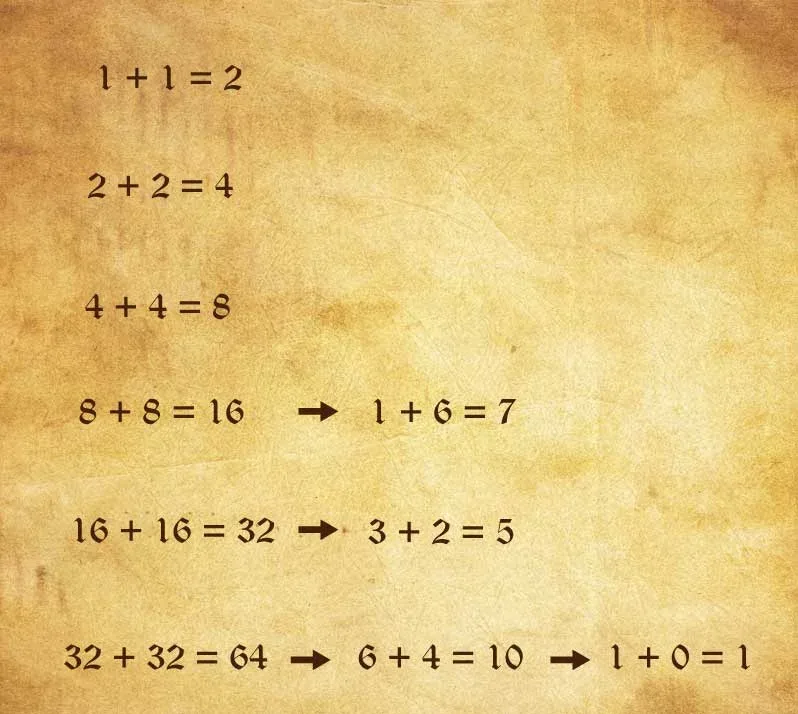
The arithmetic is correct, but the explanation is more mundane than any secret. A number's digital root leaves the same remainder when divided by nine as the number itself, and 3, 6, and 9 are precisely the digits that are multiples of three.
The rule is more general: no number that isn't divisible by three can have a digital root of 3, 6, or 9.
Powers of two have no factor of three, so doubling 1 never lands on a multiple of three.
Powers of five behave the same way, producing 1, 5, 7, 8, 4, 2, and so do powers of seven, which produce only 1, 7, 4.
If you use three in place of two, the sequence runs 1, 3, 9, 9, 9, and so on to the end. The technique known as casting out nines was used to check calculations for centuries before Tesla. It probably originated on the Indian subcontinent, reached Europe by way of the Arabs, and is described by Fibonacci in his book Liber Abaci.
It works because ten is one more than nine, so writing numbers in the decimal system is the precondition for the whole story.
In base 12, the same procedure casts out elevens, and doubling produces a loop of ten steps, 1, 2, 4, 8, 5, 10, 9, 7, 3, 6, in which three, six, and nine sit alongside every other number.
A similar circle, with the same numbers left out, also appears in modern vortex-based mathematics, which likewise gets linked to Tesla's name.
Marko Rodin, an American independent researcher and inventor, puts the 1, 2, 4, 8, 7, 5 circle at the foundation of what he calls vortex-based mathematics, and ties the three, six, and nine to a flow perpendicular to the plane of that circle.
By his own account, the system began as a religious calculation: the letters of the name Abhá in abjad, where each letter of the Arabic script has a numerical value, add up to nine.
The Natural Philosophy Wiki, which counts Rodin among dissident scientists, explicitly adds that this is not a Bahá'í doctrine.
A lot has been expected of that circle. The author of the Good Math/Bad Math blog lists what its followers credit it with: free energy from a coil, space propulsion, a cure for cancer.
That a string of digits shows a pattern, he notes, gives you no mathematical argument at all, only the assertion that the pattern must mean something.
In a 2010 paper that Rodin co-authored with Greg Volk, the authors themselves admit that there are no controlled quantitative studies of the coil.
The same wiki concludes that the arithmetic is real, but that it tells us about how we count, not about nature.
Tesla's own relationship with numbers remains what he himself wrote down: a tendency to make his actions divisible by three.
Three, six, and nine as a "code of the universe" don't come from his manuscripts but from this newer mythology.
The Number Three in Tesla's Patent
If you go looking for the number three in Tesla's engineering, the first place to check is U.S. Patent No. 381,968, filed on October 12, 1887, and granted on May 1, 1888. Most of the motor designs in it run on two independent circuits.
One of them, shown in Figure 13, has a generator with three windings and three circuits with six wires, and the patent seeks protection for motors with two or more independent circuits.
Summaries, such as the one in IEEE Spectrum, describe Tesla's motor from that period as two-phase, while the text of the patent also describes a version with three circuits.
That isn't a contradiction but a description of the same family of solutions: the motor Tesla actually built and demonstrated ran on two independent circuits, while the same patent, in other sections, also describes designs with more of them, including the one in Figure 13.
The rotating magnetic field these motors run on was developed independently by Galileo Ferraris and Tesla, and George Westinghouse bought Tesla's alternating-current patents in July 1888.
The first three-phase induction motor was built in 1889 by Mikhail Dolivo-Dobrovolsky, chief electrician at the German company AEG, and three-phase machines are still standard in industry today.
Seven Queens' Pyramids
Robert Bauval formally put forward the thesis in 1989 that the layout of the three great pyramids on the Giza plateau matches the arrangement of the three stars in Orion's Belt, and in 1994 he expanded it, together with Adrian Gilbert, in the book The Orion Mystery.
By the time that claim appeared, Tesla had been dead for 46 years.
That the Great Pyramid is very precisely aligned with the cardinal directions isn't in dispute. What's disputed is how the builders achieved it.
Astronomy magazine writes about the movement of the Sun, while some authors consider a daytime method using the shadow of a stick more likely.
In 2000, Kate Spence proposed a nighttime method in the journal Nature: the simultaneous transit of two circumpolar stars, Kochab and Mizar. Juan Antonio Belmonte took issue with her choice of those very stars.
The claim that the three pyramids mirror Orion's Belt is something else entirely. In archaeology it's considered a fringe idea, and the reasons are concrete.
Khufu's pyramid is the oldest and largest, with an average base side of about 755 feet, while Menkaure's is the last and smallest, at about 360 feet.
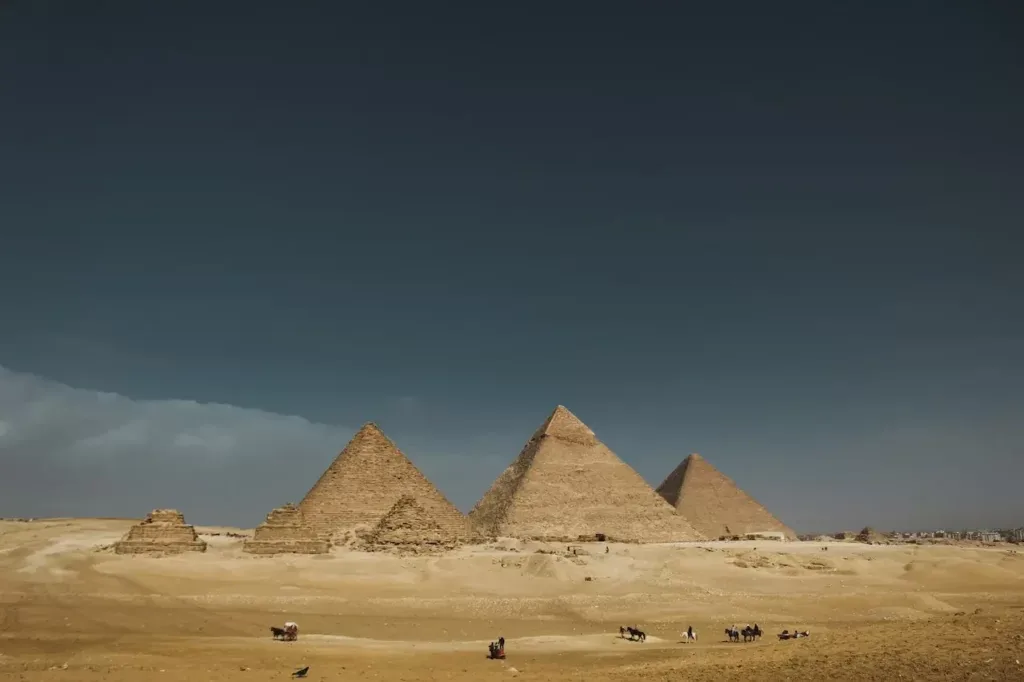
According to Astronomy magazine, Menkaure's pyramid, smaller and offset, looks to leading researchers like an afterthought, which means the three structures weren't planned all at once.
The stars of the Belt have shifted since the pyramids were built, so their arrangement relative to one another was different, too.
In 1999, astronomers used planetarium equipment to show that the layout of the pyramids and the Belt match only when one of them is flipped.
When some proponents push the date back to around 10,000 BCE, it turns out to be several thousand years before Egyptian culture even existed.
The six in this story comes from adding three large pyramids to three smaller ones. Egyptologist Zahi Hawass, in a chapter on the queens' pyramids, records seven: three beside Khufu's, one beside Khafre's, and three beside Menkaure's. You only get six if you limit the count to three large and three smaller ones.
Room 3327
From 1933 until his death in 1943, Tesla lived at the Hotel New Yorker in Manhattan, in two suites on the 33rd floor, 3327 and 3328. He died in the first of them on January 7, 1943. The number 3327 divides by three with no remainder: exactly 1,109 threes. The number 3328 doesn't.
SOURCES
- Nikola Tesla, "My Inventions I: My Early Life", Electrical Experimenter, February 1919 (Tesla Universe)
- Margaret Cheney, Tesla: Man Out of Time, Prentice Hall, 1981.
- Kim LaCapria, "Nikola Tesla '369 Theory'", Truth or Fiction, August 3, 2021
- Clara Bloomfield-Moore, Keely and His Discoveries, 1893 — Project Gutenberg
- Dale Pond, "14.35.1 - Keely 3 6 and 9", Sympathetic Vibratory Physics
- Eric W. Weisstein, "Casting Out Nines", MathWorld
- Good Math/Bad Math, "Zombie Math in the Vortex", January 2, 2018
- Natural Philosophy Wiki, "Marko Rodin"
- US Patent No. 381,968, "Electro-magnetic motor", Nikola Tesla, 1888
- IEEE Spectrum, "May 1888: Tesla Files His Patents for the Electric Motor"
- Engineering and Technology History Wiki, "Initial Tesla Polyphase / Three-Phase Alternating-Current Systems and Metering Development"
- Encyclopaedia Britannica, "Pyramids of Giza"
- Astronomy, "Are the Egyptian pyramids aligned with the stars?"
- The orientations of the Giza pyramids and associated structures, arXiv:1302.5622
- Thinking about Archeoastronomy, arXiv:1103.5600
- Akhet Khufu: archaeo-astronomical hints at a common project of the two main pyramids of Giza, Egypt, arXiv:0708.3632
- Vincenzo Orofino, Stato evolutivo delle stelle della Cintura di Orione ed implicazioni archeoastronomiche, arXiv:1109.3284
- Zahi Hawass, "The Queens' Pyramids of the Fourth Dynasty at Giza", in: Treasures of the Pyramids, White Star (Harvard Giza Project)
- Tesla Memorial Society of New York, "Plaque erected on Nikola Tesla's Room 3327 in Hotel New Yorker"
- Abstract of "A spark of genius and a flash of madness: Nikola Tesla and his struggles with mental illness", European Psychiatry, Cambridge University Press, 2024
- Mental Floss, "The Mystical Meaning of 369 and Its Link to Nikola Tesla", 2026
Aron Corvin
A researcher of the unknown who loves a good story. I won't sell you sensationalism just for a click. If you enjoy what I write, your support would mean a lot and help me keep going.