
Project Blue Beam: The Origins of the Hologram and New World Order Theory
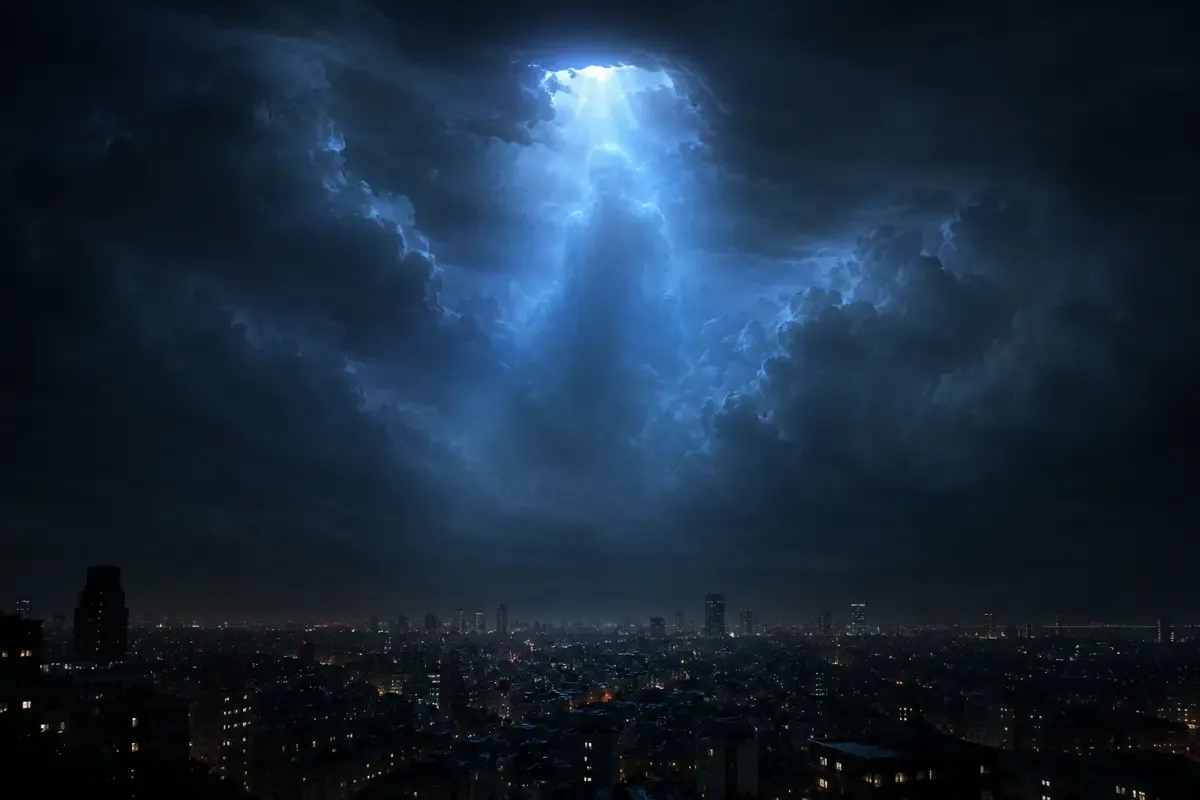
Montreal, 1994. A Canadian autumn draped in dampness and the fluorescent glare of newsrooms that never fully sleep.
Serge Monast, a journalist accustomed to looking for cracks in official narratives, sits at his typewriter. He begins drafting a document that will never pass editorial scrutiny, mostly because it doesn't belong to journalism in any traditional sense.
He is writing a prophecy. Technical, cold, and meticulously broken down into steps. He calls it Project Blue Beam.
There are no photographs. No insider sources from NASA, no leaked top-secret documents.
There is only text—dense with acronyms—promising that the world as we know it will end in four calculated steps, orchestrated by nameless "shadow masters".
Monast died in 1996, officially of a heart attack, just as his theory began circulating through photocopied newsletters and early internet message boards.
His death, as is often the case with such stories, became proof in itself. He knew too much, later followers of the theory would whisper. They silenced him before it was too late.
What Monast left behind wasn't evidence. It was a blueprint. A cartography of collective fear, neatly divided into phases, where each stage builds on the trauma of the last, until the final step leaves humanity defenseless beneath a sky it no longer recognizes.
Phase 1: The Collapse of Religion
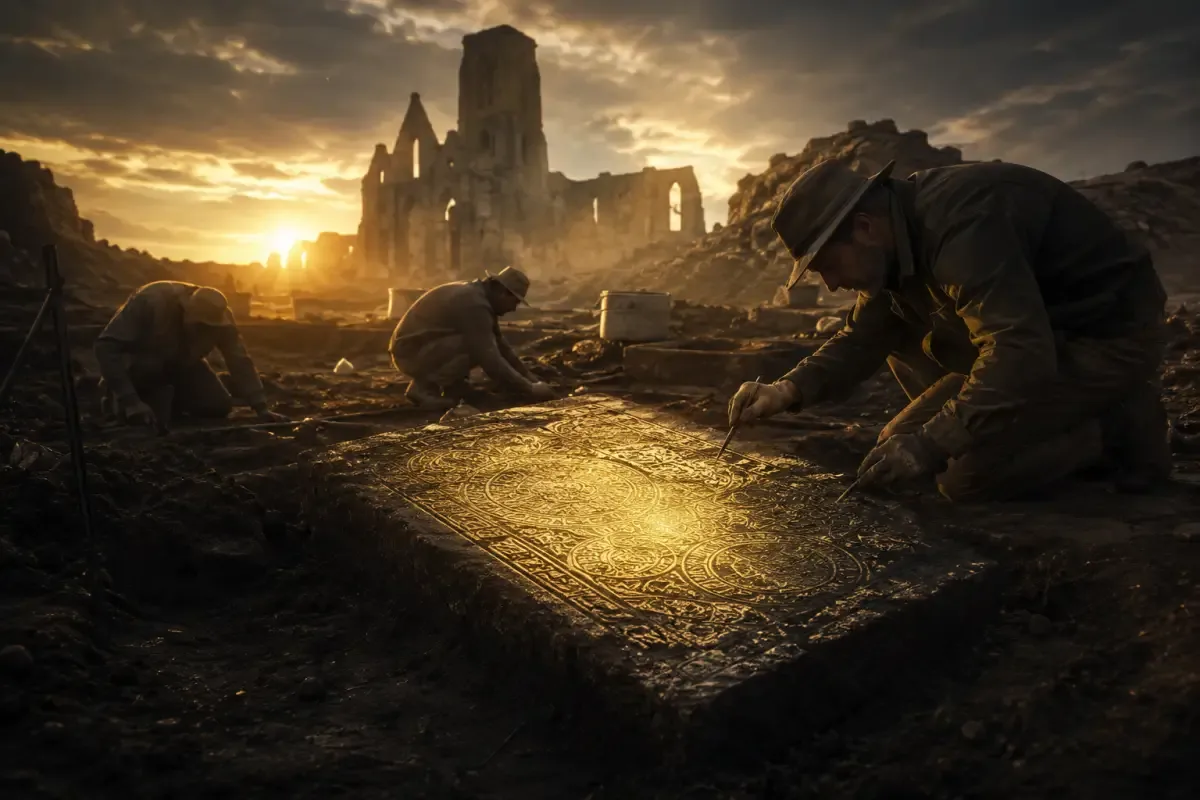
The first step doesn't come from above. It comes from the ground. According to the theory, military technologies capable of triggering controlled earthquakes would unearth archaeological discoveries—bones, temples, remnants of civilizations—deliberately planted to dismantle the foundations of the world's major religions.
There is no sudden strike. Just a slow, bureaucratic erosion of meaning, artifact by artifact, discovery by discovery, until faith becomes unsustainable under the weight of its own archaeology.
This idea taps into something deeper than the theory itself. Religion here isn't just a spiritual practice. It's the architecture of meaning, the backbone upon which civilizations build their understanding of death, suffering, and belonging.
To tear down that architecture doesn't just mean closing the temples. It means wiping out the coordinate system billions of people use to navigate a universe that suddenly feels far too vast.
Researchers of collective fear have long recognized this pattern. The loss of meaning is far more terrifying than the loss of safety. You can survive a war. The void is much harder to outlive.
Phase 2: The Sky as a Canvas
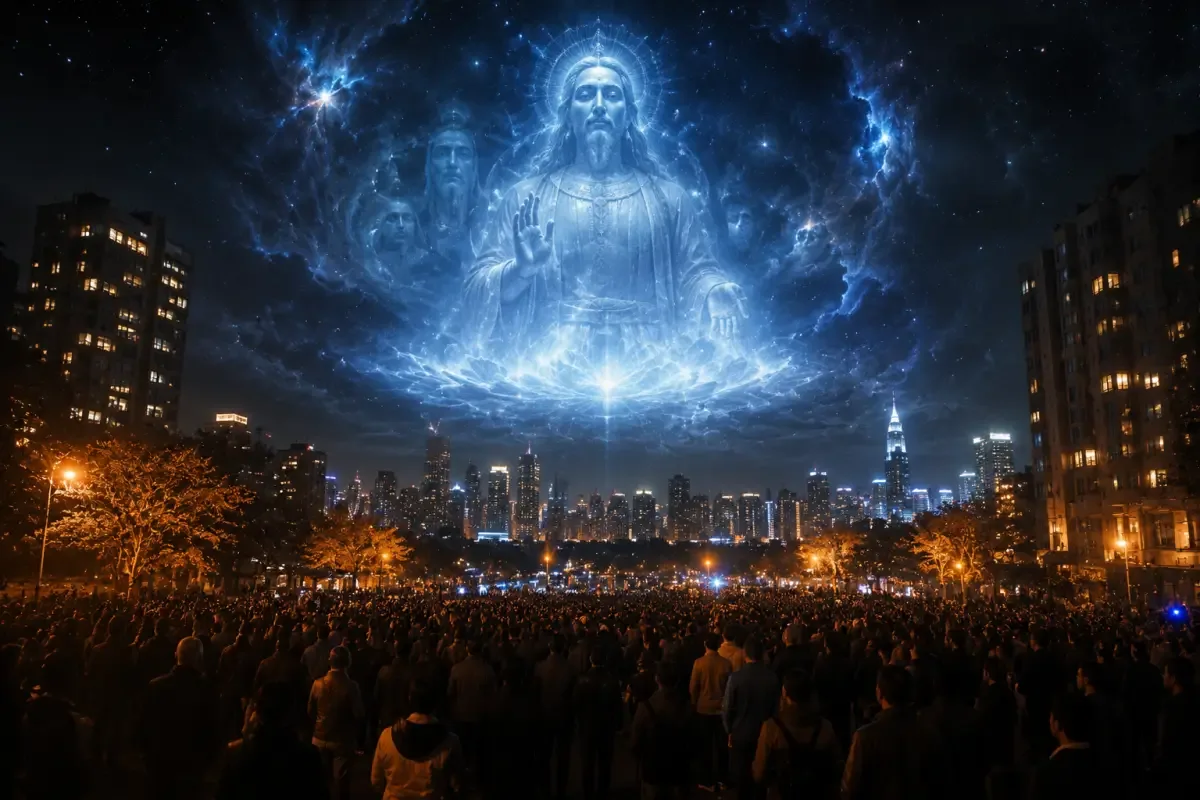
The second step of the scenario moves high above our heads. "The Great Space Spectacle"—a name that sounds almost circus-like, almost too harmless for what the theory claims would be the largest psychological operation in history.
Satellites, the hypothesis claims, would project a gigantic hologram directly onto the ionosphere, using the Earth's atmosphere as a canvas of unimaginable proportions.
Every region of the world would see its own deity. Christ over Rome. Allah over Mecca. Buddha over the Asian sky, motionless and shimmering.
Then comes the twist, cold and calculated. All these projections, according to the script, would gradually merge into a single figure.
A new messiah, a universal deity tailored to satisfy every faith simultaneously, yet truly belonging to none of them.
Imagine that image without a single word of explanation: a sky speaking the distinct language of every culture, while actually whispering the exact same message to everyone.
An illusion custom-built for the faith of each individual viewer. A deception that doesn't ask you to believe in something new, but simply to lean deeper into what you already believe, until it seamlessly guides you somewhere else entirely.
Phase 3: Voices from Within
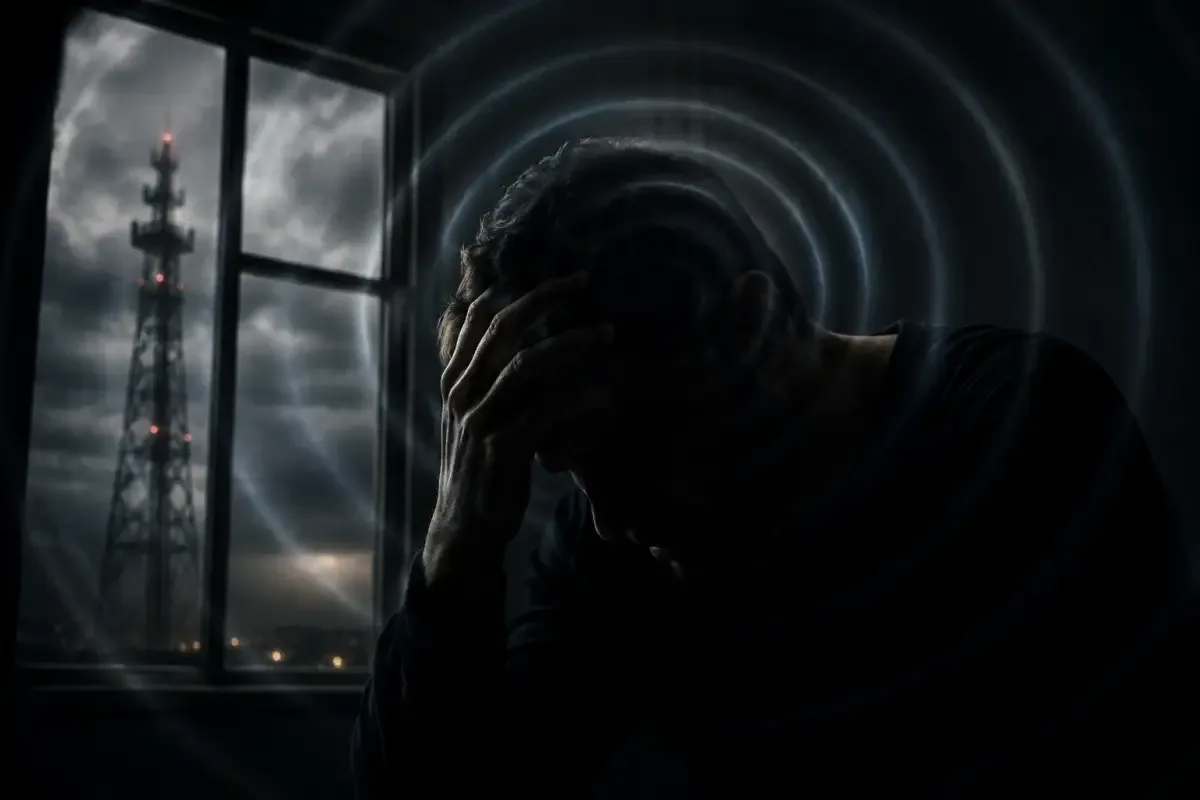
The third phase leaves the sky and enters straight into the skull. Low-frequency electromagnetic waves—LF, VLF, ELF—would allegedly be used to hijack brain activity and broadcast messages directly into an individual's consciousness, a phenomenon reminiscent of the microwave auditory effect.
Not through the ears. Through bone, through tissue, through something the victim would experience as their own intimate thought.
This is the darkest segment of the entire architecture, as it assaults the final refuge of privacy—the inner voice.
If it's possible to implant a thought that sounds like your own, the boundary between the mind and propaganda ceases to exist.
Skepticism, that final line of rational defense, is simply bypassed, as if it were never there in the first place.
Modern science confirms that electromagnetic waves at these frequencies exist and have long been studied, primarily for communicating with submarines and in military early-warning systems.
However, there is absolutely no credible evidence that these frequencies are being used to beam voices into the human mind.
Still, the mere thought of it—even if purely theoretical and never realized—is enough to plant a seed of unease that outlives any rational debunking. Fear does not require evidence.
Phase 4: The Final Illusion
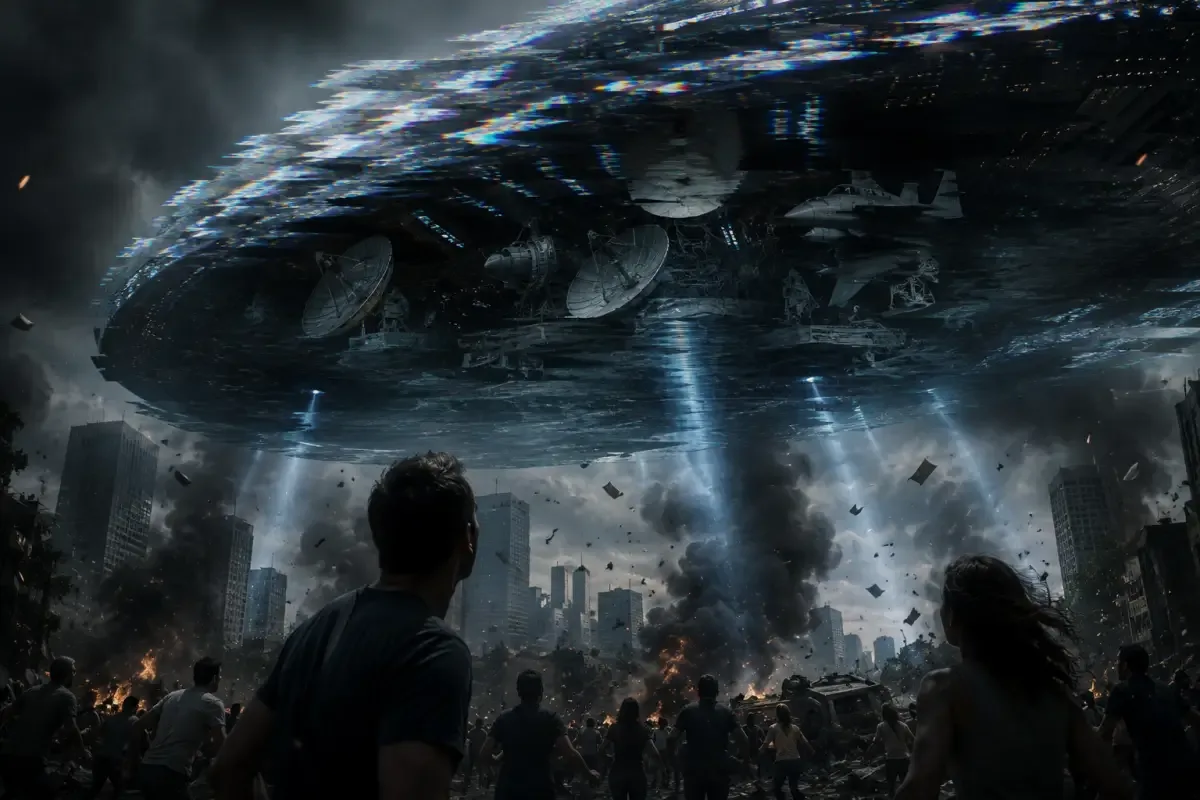
The final act ties everything together in one apocalyptic scene. Holograms and secret military aircraft, combined in the skies over the world's major metropolises, would stage an alien invasion.
Panic, the theory goes, would be immediate and inescapable. Nations, paralyzed by fear, would surrender their nuclear arsenals.
Sovereignty would be handed over. Security would become the only currency used to buy back freedom.
It's no coincidence that the script chooses an extraterrestrial threat for its grand finale. No other enemy unites humanity faster than the unknown lurking in the dark void of space.
No other fear renders borders, ideologies, and centuries-old differences so entirely irrelevant, almost overnight.
In this final tableau, humanity doesn't lose a war. It surrenders, completely voluntarily, out of sheer terror.
Unmasking the Myth
Here, the story has to hold up a mirror. Technology capable of projecting photorealistic hologram-gods across the entire ionosphere, capable of simultaneously reading and broadcasting thoughts into billions of minds, has not been documented in any available scientific or military source to date.
Not a single document, whistleblower, or patent has offered even a hint that such an infrastructure exists.
Project Blue Beam, in the literal form described by Monast, remains an unverified construct of anxiety rather than a documented plan.
But therein lies the paradox that explains why this theory still breathes three decades after it was written.
Its individual components, though exaggerated to the point of sci-fi fantasy, lean on phenomena that are entirely real and well-documented.
Deepfake technology today produces faces and voices that are incredibly difficult to distinguish from reality.
Social media algorithms shape what billions of people experience as absolute truth, filtering the world through the invisible criteria of profit rather than facts.
Mass surveillance, justified by the need for security, has long been normalized in dozens of countries—quietly, and without a single hologram in the sky.
Blue Beam, therefore, isn't a prediction of the future. It's a distorted mirror of the present. An exaggerated, almost mythical version of a process that is already well underway—not through space projections, but through algorithms, cameras, and the fiber-optic cables running beneath our cities. Completely invisible, yet entirely real.
The End
Serge Monast died believing he knew something the rest of the world didn't.
What is certain is that, even without a single satellite projecting gods into the sky, the line between what we see and what is actually real has become thinner than ever before.
Every screen in our pocket today carries the power to show us a world that doesn't exist, and it does so more convincingly than any ionospheric hologram ever could.
We don't need a big space show. A single algorithm is enough. One well-placed piece of disinformation is enough.
The silence in which we stop asking where our own thoughts come from is enough.
The sky above us, at least for now, remains empty and free of holographic gods. The screen in our hand, however, has long been projecting its own illusions, and rarely do any of us pause to check who is actually holding the projector.
SOURCES
- Knowable Magazine (Annual Reviews) – M. Mitchell Waldrop, "Synthetic media: The real trouble with deepfakes" (2020)
- Privacy International – "Mass Surveillance"
- Michael Barkun, A Culture of Conspiracy: Apocalyptic Visions in Contemporary America (University of California Press, 2003) — scholarly survey of New World Order and apocalyptic conspiracy narratives.
Aron Corvin
A researcher of the unknown who loves a good story, but doesn't sell sensationalism. I research every topic in detail before I publish it. If you enjoy what I write, your support would mean a lot and help me keep going.