
The Tisul Princess: How One Article Became an Archaeological Sensation
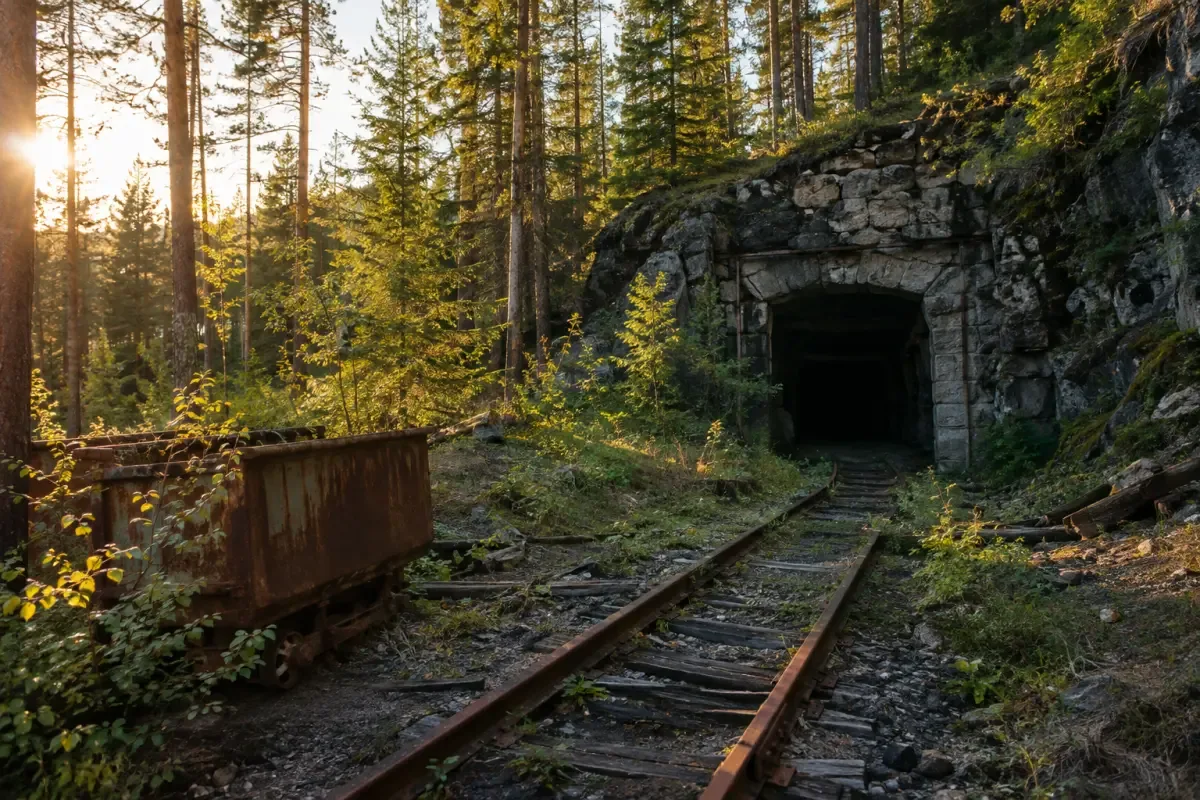
When a journalist from the Kemerovo outlet Sibdepo set out for the village of Rzhavchik in 2007 to check into a story nearly forty years old, he found exactly what you'd expect from such a cold trail.
Pine forest had reclaimed the abandoned mine, and a handful of villagers had only a hazy memory of something someone else had told them long ago.
The mine had closed in 1973. The man whose name is most often attached to the story, Alexander Karnaukhov, really did work at the site, except archival records show he was a blacksmith, not a miner.
That's essentially all of the Tisul Princess legend that can be verified on the ground.
The rest is a story that has spread in recent years across Russian news portals, YouTube channels, and paranormal sections worldwide, always with the same core.
In September 1969, at a coal mine near the village of Rzhavchik in the Kemerovo region, workers allegedly hit a marble sarcophagus at a depth of about 230 feet (70 meters).
Inside, according to the story, lay a young woman submerged in a pink liquid, untouched by time and dressed in a transparent gown made of some unknown fabric, with a black rectangular object resembling a cell phone beside her head.
The head of the mining division, named in the retellings as Alexander Masaligin, supposedly alerted the authorities, after which men in plain clothes arrived, sealed off the site, and flew the sarcophagus out by helicopter.
A scientist from Novosibirsk then, so the legend goes, estimated that the woman had been lying there for hundreds of millions of years, and the locals named her the Tisul Princess.
Where the Tisul Princess Story Actually Comes From
The trail to the story's source doesn't lead to an archive, a museum, or a scientific paper. It leads to a single newspaper article.
In September 2002, a journalist from Abakan, Oleg Kulishkin, who also wrote under the name Gonchar, published a piece in the newspaper Khakassia titled "The Lady Who Is 800 Million Years Old."
In it, he claims to have heard the story from a former KGB colonel he met by chance on a train, a man who he says had personally taken part in the operation to remove the sarcophagus.
He never gave a name, explaining that doing so could land him in prison.
There's no official record, no photograph from the site, no lab report to back up his account. Just someone else's secondhand memory, retold.
By 2003, the piece had already been reprinted in Novaya Zhizn, the local Tisul newspaper, and later picked up by publications devoted to alternative history, among them Arkaim.
The legend also claims that all the witnesses died under mysterious circumstances shortly after the discovery.
What's actually known about those deaths is far more mundane. Kulishkin himself writes that Karnaukhov died in a motorcycle accident, under the wheels of a KrAZ truck, and that Masaligin died in 1980 of a stomach ulcer.
When Roman Yanchenko, a journalist with the Kemerovo outlet Sibdepo, visited the site in 2007, he talked to people who had known them.
Excavator operator Nikolai Garmanov, who spent 33 years at that mine, said there had never been any sarcophagus or any find of any kind the whole time he worked there, though he confirmed that Karnaukhov and Masaligin had been real people, just working different jobs.
Karnaukhov's widow, Tatyana, confirmed that her husband had worked at the mine, but said she'd never once heard of a sarcophagus.
Kulishkin's article was later picked up by REN TV and Russia-1, channels known for their programming on aliens and unexplained phenomena, and from there the story spread to dozens of websites in both Russian and English.
Each new version of the story changes a detail or two along the way, a common sign that the source is retelling rather than documentation.
One widely shared version of the story puts the sarcophagus at 800,000 years old, while other accounts claim 800 million.
Still others claim genetic analysis showed a 100 percent match with modern Russians and that the woman belonged to an ancient Russian civilization, while others still suggest she might have been an alien envoy.
None of these sources names the institution that supposedly ran the analysis, or says where the sarcophagus is today.
Why the Math Doesn't Add Up
This is where the story starts to contradict itself.
Geologists date the coal seams of the Kuznetsk Basin, where Tisul sits, to the late Carboniferous and Permian periods, roughly 250 to 320 million years ago, according to radioisotopic dating of the basin's coal-bearing succession.
That's less than half the figure the legend usually claims.
Coal, moreover, forms primarily from the remains of land plants, and the first forests capable of producing deposits like this didn't appear until roughly 370 million years ago.
An 800-million-year-old sarcophagus embedded in a coal layer that couldn't have existed yet isn't just an unusual find. It's a logical impossibility: the layer it was supposedly placed in would have to predate the first coal deposits on Earth.
The Paleozoic era, where the story places the princess, only began 541 million years ago, so even that framing doesn't square with a figure of 800 million.
The mine itself doesn't match the description, either.
Records from the Kemerovo Regional State Archive, examined in 2017 by historian and archivist Nikolai Galkin for the newspaper Kuzbass, show that the coal lay close to the surface, with the deepest sections barely reaching 130 feet (40 meters).
Masaligin appears in the records as the mine's mechanic, not the head of a division.
Vladimir Lomekin, a former head of the Tisul district who worked as a driver at that mine in 1969, recalls even smaller numbers: the depth including overburden ran about 80 feet (24 meters), up to 90 feet (27 meters) in places, with a coal seam 16 to 20 feet (5 to 6 meters) thick.
The legend claims a depth of 230 feet and a coal seam 65 feet thick, so the story doesn't just fail on the age of the coal. It fails on the very scene it describes.
Real Siberian Surprises Come with Paperwork
Siberia genuinely does turn up finds that look, at first glance, like objects from the future.
At the Ala-Tey necropolis in the Republic of Tuva, archaeologists excavated a black rectangular object in 2016, inlaid with turquoise, carnelian, and mother-of-pearl, which they jokingly nicknamed "Natasha's iPhone."
An analysis of Chinese coins found alongside it dated the find to around 2,137 years old, from the era of the Xiongnu Empire, and archaeologist Pavel Leus and colleagues published the results in a peer-reviewed journal.
The object turned out to be a belt buckle, made of jet, a semiprecious stone formed from fossilized wood.
The difference between that story and the Tisul Princess isn't the strangeness of the object's shape. It's that every step, from excavation to dating, has a name, an institution, and a published paper behind it.
Tisul itself, for that matter, has its own archaeology, a far more modest one.
The town's history museum holds a horned anthropomorphic figurine carved from antler, attributed to the Bronze Age Okunev culture, described in a peer-reviewed journal by archaeologists V. V. Bobrov and P. V. German.
No sarcophagus, no princess. Just a small object whose origin nobody disputes.
A Motif as Old as the Fairy Tale
The image of a woman sleeping in a transparent coffin, untouched by death, isn't new to Russian culture, either.
Pushkin's fairy tale about the dead princess guarded by seven knights describes almost the same scene: a glass coffin, a mountain, the silence around it.
The comparison to Sleeping Beauty, which comes up constantly in tellings of the Tisul Princess story, ends up looking less like a hint of something extraordinary and more like a sign that the story borrowed its shape from a fairy tale nearly every Russian read as a child.
Of everything in the story, very little could actually be verified. Alexander Karnaukhov really did work in Rzhavchik, the mine really did exist, and it closed in 1973.
For the marble sarcophagus, the pink liquid, and the nameless colonel from the train, there's no document and no testimony to confirm any of it.
They exist only in a single article from 2002, and in everything that grew out of it.
SOURCES
- Silantiev, V. V., et al. (2025). "Revisiting the Permian Stratigraphy of the Kuznetsk Coal Basin (Siberia, Russia) Using Radioisotopic Data: Sedimentology, Biotic Events, and Palaeoclimate." Minerals, 15(6), 643.
- Роман Янченко, "Тисульский саркофаг", Sibdepo, November 7, 2007
- Николай Галкин, "Миф о «Тисульской принцессе»", Кузбасс, January 4, 2017
- Лариса Максименко, "Несказочная броня", Кузбасс, September 9, 2020
- Михаил Герштейн, "Русские в докембрии", Уфоком, October 2, 2021
- "Тисульская принцесса: была ли путешественницей во времени", Weekend Rambler
- "This Ancient Belt Buckle Retrieved from 'Russian Atlantis' Looks Like a Bedazzled iPhone Case", Live Science
- V. V. Bobrov, P. V. German, "Роговая антропоморфная фигурка из северных предгорий Кузнецкого Алатау", Археология, этнография и антропология Евразии, 2015, journal.archaeology.nsc.ru
Aron Corvin
A researcher of the unknown who loves a good story. I won't sell you sensationalism just for a click. If you enjoy what I write, your support would mean a lot and help me keep going.