
The Llullaillaco Maiden: A 500-Year-Old Mystery
The longest strands of hair found on the girl discovered beneath the summit of Llullaillaco hold a record of the final two years of her life.
Hair grows at a fairly steady rate, a bit under half an inch a month. That was enough for researchers led by Andrew Wilson of the University of Bradford to work through it one segment at a time, matching each piece to a specific month.
About twelve months before her death, the carbon and nitrogen values in her hair shift sharply. The team published these results in 2007 in the journal PNAS.
The isotopes reveal what she ate. Until that point, her diet had been based mainly on potatoes; afterward, her hair shows more corn and animal protein, possibly llama meat. At the same time, her coca intake rises sharply.
From this, Wilson concludes that the girl was chosen for the ritual twelve months before she died. That's an interpretation, but it's backed by two separate sets of measurements taken from the same strands of hair.
The amount of coca recorded in her hair spikes twice, twelve months and six months before death.
Reinhard has proposed a hypothesis: that the six-month gap corresponds to the solstice rites held in Cusco, where chronicles say some of the chosen girls were brought.
That remains just a hypothesis, though, since the gap could have other explanations.
She Wasn't a Typical Victim
The museum in the Argentine city of Salta calls her La Doncella; in scientific papers, she appears as the Llullaillaco Maiden. She was found in 1999 along with two other children.
All three were part of the capacocha, a state ritual of the Inca Empire meant to maintain ties with the gods, the ancestors, and sacred places.
According to the chronicles, the ritual began in Cusco, where envoys, priests, children, and their families gathered from the empire's four quarters.
Of the 28 capacocha victims found on high mountain peaks, twenty were between five and nine years old.
That's according to a paper by Dagmara Socha, Johan Reinhard, and Ruddy Chávez Perea on the victims found on the Ampato and Pichu Pichu volcanoes, published in 2021. The Maiden, then, was the exception.
The research is divided on her age, too: the 2007 and 2012 studies, along with the museum, put her at fifteen, while a 2013 paper estimates she was around thirteen.
Wilson considers it likely that she was an aclla, a girl the state set apart around puberty and raised under the supervision of priestesses.
The museum in Salta says the same, describing her as a sun virgin raised in an acllahuasi, a house for chosen women.
Still, that's a conclusion drawn from the chronicles, not a record of her actual life.
A Ritual in an Age of Imperial Expansion
Along with the three children, researchers found more than a hundred objects that had come from different corners of the empire.
Small figures made from spondylus shells had been brought from the coast; feather ornaments came from the Amazon basin.
Gold and silver figurines were dressed in miniature garments like those worn by members of the highest ranks of society.
Based on these finds, Wilson concludes that the ritual had backing at the very top, at the imperial level.
It was once thought that her death could only be placed somewhere in the broad window between 1430 and 1520.
In 2026, an international team published new dating results in the journal Archaeometry, based on remains of corn, manioc, and coca found among her grave goods.
According to the researchers, these plants had been harvested shortly before the ritual. That narrowed the range to a period between 1462 and 1507.
A statistical model points to the end of the fifteenth century, with the highest probability centered around 1499. Even that figure, though, isn't a confirmed year of death.
The southern Andes, including what's now northwestern Argentina, had only recently come under Inca rule by the time of the ritual.
That places the ritual squarely within the empire's expansion, which is why researchers link the capacocha to imperial growth and to the consolidation of power in distant provinces.
Campaigns and political consolidation in remote regions continued through the reigns of Topa Inca and his son, Huayna Capac.
No document ties this particular ritual to a specific event from that period. The connection to military campaigns and political consolidation therefore remains a hypothesis researchers have proposed, not a confirmed conclusion.
In the Northern Chamber, She Sat Cross-Legged, a Wad of Coca Between Her Teeth
In December 1952, two Chileans, Bión González and Juan Harseim, became the first people in modern times to reach the summit of Llullaillaco.
What they found were stone alignments of the kind Indigenous peoples had built before Columbus arrived.
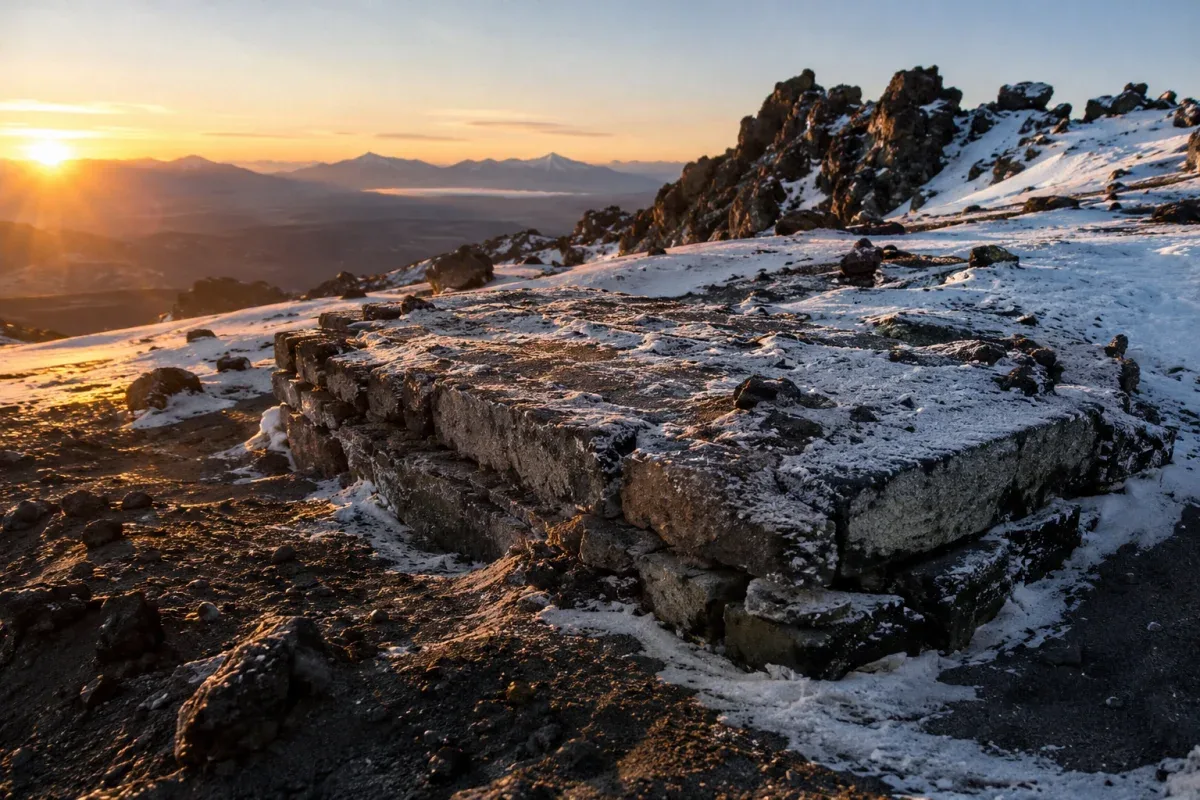
It wasn't until February and March 1999 that an expedition led by Johan Reinhard and Constanza Ceruti, fourteen climbers and archaeologists in all, found a platform just below the summit itself.
Three chambers sat just beneath the 22,110-foot (6,739-meter) peak, and the bodies were uncovered on March 16.
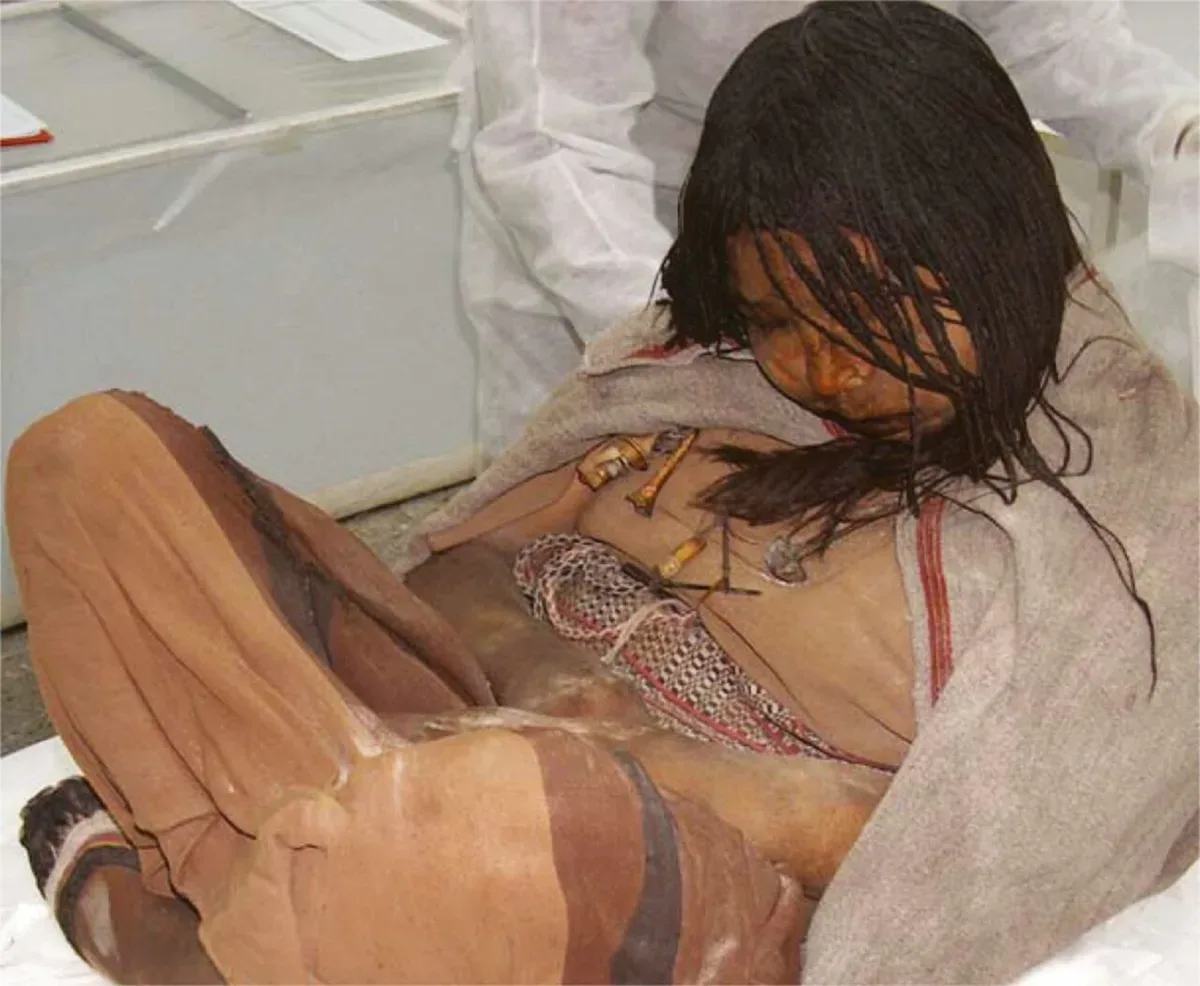
The Maiden was found in the north chamber. She was sitting cross-legged, her head bowed and her hands resting loosely in her lap.
Her hair was tightly braided, her face painted with red pigment, and she wore a headdress woven from Andean camelid wool with white feathers worked into it. The headdress had stayed intact and in place.
The chamber was filled with volcanic ash, and a layer of compacted snow soon sealed the grave. The cold, along with these conditions, kept her body from decomposing.
Wilson says she looks as though she had just fallen asleep.
Today she's kept in a sealed capsule at a controlled low temperature. For conservation reasons, the museum in Salta displays only one of the three children at a time.
The boy was found in the southwest chamber, lavishly dressed, with chest ornaments and bracelets made of gold, silver, and gilded copper alloy.
The girl from the east chamber bears signs of a lightning strike, which is how she came to be called the Lightning Girl.
A CT scan found a wad of chewed coca leaves, about 1.75 inches (44 millimeters) long, lodged in the Maiden's left cheek. Roughly half a cubic inch (7.5 cubic centimeters) of food remained in her stomach.
From this, Wilson and his colleagues estimate that she ate her last meal somewhere between two and seven hours before she died (PNAS, 2013).
Her hair showed traces of cocaine and its metabolites, pointing to coca use, along with markers of alcohol, most likely chicha, a corn beer.
Coca had been present over a longer stretch of time, while alcohol levels spiked sharply in the final weeks of her life.
Wilson places that spike somewhere between six and eight weeks before death.
The younger children had lower levels of both coca and alcohol markers.
The authors believe this may point to a greater need to sedate the older girl.
Her relaxed posture, along with the undisturbed objects placed beside her body, supports the idea that she was either heavily sedated or already dead by the time she was placed in the chamber.
No Finding Pins Down Her Cause of Death
The chronicles describe several ways the children were killed: a blow to the head, being buried alive, having the heart removed, or strangulation.
On the Ampato volcano in Peru, Reinhard and Miguel Zárate found a girl known as Juanita in 1995.
A CT scan showed she'd suffered a severe blow to the back of the skull. No such trauma was found on the bodies of the Llullaillaco children.
Science News reported in 2013 that the cause of their deaths remains unknown, while Wilson suspects the girl, after being heavily sedated, was left to die of exposure to the cold.
Two additional details round out the picture, though neither gives a definitive answer.
Angelique Corthals's team took swabs from her lips. They turned up proteins consistent with an immune response to a severe lung infection, along with DNA from bacteria in the genus Mycobacterium, the same genus that includes the bacteria behind tuberculosis (PLoS ONE, 2012).
An earlier CT scan had already revealed changes in the upper lobe of her right lung and a thickened lining in her left maxillary sinus.
The DNA sequence can't reliably pin down which species of bacteria was involved, and the findings describe her condition at the moment of death, not its cause.
The same study also found DNA from bacteria in the genus Bifidobacterium on her lips, which the authors interpret as a sign of vomiting shortly before death.
Socha and her colleagues recorded similar signs of vomiting in the other Llullaillaco children as well, noting that altitude sickness or intoxication are both possible explanations.
Unlike the Maiden, the boy had blood found on his cloak and on the fabric wrapped around his body, which led the authors of the 2013 paper to consider the possibility that he'd been suffocated.
The Chronicles Were Written by People Who Never Saw the Ritual
Reinhard points out that the Spanish chroniclers didn't witness the capacocha rituals firsthand; they wrote down what members of Inca society told them.
Some claimed that hundreds of children were sacrificed during major events.
Socha and her colleagues note that there's no archaeological evidence for claims like that, nor for heart removal, since no known victim has ever been found with the heart removed.
That doesn't mean the chronicles are necessarily wrong, but it does limit what can be reliably concluded from them.
None of the methods of death described above has been confirmed in the Maiden's case.
The ratio reflecting the simultaneous presence of coca and alcohol markers in her hair stood at 13.7 percent six months before her death.
In the final month and a half, that share climbed to 52.8 percent. After that point, her hair records nothing more.
SOURCES
- Wilson et al., "Stable isotope and DNA evidence for ritual sequences in Inca child sacrifice", PNAS 104(42), 2007, pp. 16456-16461 (doi:10.1073/pnas.0704276104)
- Wilson et al., "Archaeological, radiological, and biological evidence offer insight into Inca child sacrifice", PNAS 110(33), 2013, pp. 13322-13327 (doi:10.1073/pnas.1305117110)
- Corthals et al., "Detecting the Immune System Response of a 500 Year-Old Inca Mummy", PLoS ONE 7(7), 2012, e41244
- Socha, Reinhard, Chávez Perea, "Inca human sacrifices from the Ampato and Pichu Pichu volcanoes, Peru", Archaeological and Anthropological Sciences 13, 2021, art. 94
- Sieczkowska-Jacyna et al., "Timing the sacred: A multi-step chronological framework for the Llullaillaco Inca burial", Archaeometry, 2026, doi:10.1111/arcm.70172; summarized in Archaeology News Online Magazine, June 14, 2026
- Previgliano et al., "Radiologic Evaluation of the Llullaillaco Mummies", American Journal of Roentgenology 181(6), 2003, pp. 1473-1479
- Museum of High Altitude Archaeology (MAAM), Salta, Llullaillaco room
- Brian Handwerk, "Inca Child Sacrifice Victims Were Drugged", National Geographic, July 29, 2013
- Rachel Ehrenberg, "Mummified Incan teen drank, did drugs", Science News, July 29, 2013
- Science, "Llullaillaco Maiden May Have Been Drugged Before Sacrificed", 2013
- NBC News / LiveScience, "Final Moments of Incan Child Mummies' Lives Revealed", 2013
- National Geographic, "This Inca girl was frozen for 500 years. She just got a new face." (Juanita, Ampato)
- American Alpine Club, American Alpine Journal, "South America, Argentina, Andes" (first ascent of Llullaillaco, December 1, 1952)
- Guinness World Records, "Highest-altitude archaeological site" (date of discovery, March 16, 1999)
Aron Corvin
A researcher of the unknown who loves a good story, but doesn't sell sensationalism. I research every topic in detail before I publish it. If you enjoy what I write, your support would mean a lot and help me keep going.