
Stoned Ape: The Theory That Magic Mushrooms Awakened Human Consciousness
In late 1970, Dennis and Terence McKenna buried their mother. Early the next year, the brothers set off into the Colombian Amazon with three friends, searching for oo-koo-hé, a DMT-based plant brew used by Indigenous peoples of the region.
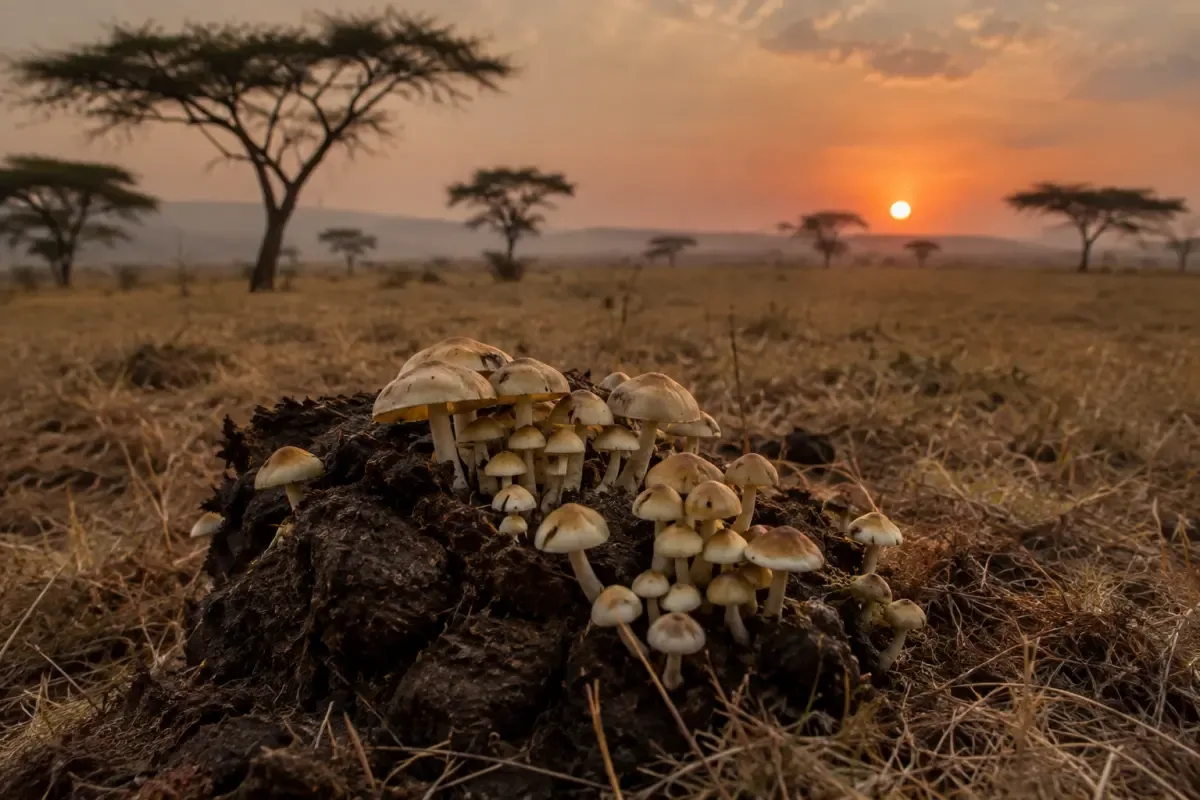
Instead, on a mission pasture in La Chorrera, they stumbled onto something they hadn't gone looking for: dense clusters of Psilocybe cubensis mushrooms sprouting straight out of cow dung.
Terence was twenty-four at the time, an ethnobotany student better known for dodging Interpol after a hashish bust in India than for any scholarly work.
The encounter at La Chorrera shaped the rest of his life, though it would take twenty years for that trip to bear fruit.
In August 1992, in a lecture at the Esalen Institute and in that year's Food of the Gods, McKenna laid out a claim that would outlive him: that those very mushrooms, a hundred thousand years ago, were what first woke up human consciousness.
It made him one of psychedelic culture's most recognizable public speakers.
Three Doses, Three Promises
McKenna's hypothesis, which he called the Stoned Ape theory, starts on the African savanna.
In his telling, Homo erectus followed herds of wild cattle across an increasingly arid landscape and came across mushrooms growing in their dung along the way. The effect depended on the dose.
A low dose, the theory holds, sharpened eyesight and made hunters more accurate.
A medium dose broke down social boundaries and encouraged mating within the group, widening the community's gene pool.
A high dose dissolved the ego and opened up room for abstract thought, language, and symbolism: everything we now call consciousness.
McKenna never presented this progression as established fact, only as a possibility that, in his view, the scientific community had never seriously considered.
The Fischer Study Doesn't Say What It's Credited With
As proof that a low dose of mushrooms sharpens eyesight, McKenna pointed to research by the pharmacologist Roland Fischer.
The reality is different. Fischer taught at Ohio State University from 1958 to 1971, and later at Georgetown and Johns Hopkins.
The 1970 paper lists him with Ohio State's Department of Psychiatry and Pharmacology, in the medical school, and he studied psilocybin together with coauthors Richard Hill, Karen Thatcher, and James Scheib, not alone.
Their 1970 paper, published in Agents and Actions under the title "Psilocybin-induced contraction of nearby visual space," doesn't measure visual acuity at all.
What it measures is a change in how subjects judge the distance of objects in the space ahead of them: the so-called abathic plane, the surface at which objects directly in front of the eyes appear undistorted.
Sam Woolfe, a writer and blogger who covers psychedelics and mental health, points out in his widely cited critique of the theory that Fischer and Hill never tested edge detection or visual acuity, and that the paper itself warns that the perceptual shift caused by a low dose of psilocybin might not even be useful for an organism's survival.
That's nearly the opposite of concluding that the mushroom would produce a better hunter.
Other reviews of the theory still repeat McKenna's version without that caveat, so the disagreement between sources remains unresolved.
The original paper itself, though, contains no claim about better hunting, whatever gets attributed to it.
Why Genetics Rules Out a Sudden Leap in Consciousness
Even if Fischer's findings had confirmed sharper eyesight, the theory would still run into an obstacle McKenna himself never managed to get around.
A change in an adult's brain, brought on by mushrooms eaten during that person's lifetime, doesn't get passed genetically to their offspring.
That's a Lamarckian model of inheritance, discredited as far back as the early twentieth century.
Lifting weights doesn't produce a child born with developed muscles. Learning a language doesn't produce a child who's born already speaking it.
The same rule applies to any expansion of consciousness the mushrooms might hypothetically have triggered in a single generation of hunter-gatherers.
The fossil record complicates the sudden-leap story even further. The limits of that record are exactly what the Silurian Hypothesis is built on.
According to a review of brain evolution in Scientific American, the skull of the genus Homo grew gradually over nearly two million years.
From just over 600 cubic centimeters in early Homo erectus 1.8 million years ago, it reached more than 1,000 cubic centimeters half a million years ago. Early Homo sapiens were already in a range close to today's.
That's a slow, continuous process, not the sudden doubling within a hundred-thousand-year window that popular accounts of the theory often claim.
There's no known archaeological, fossil, or biochemical evidence that hominids were eating psilocybin mushrooms during that period.
The Mushroom from Zimbabwean Dung
One of the standing objections to the theory is that Psilocybe cubensis, the very mushroom McKenna relies on, isn't even native to Africa.
As far back as 1983, the mycologist Gastón Guzmán proposed that the mushroom only reached the Americas along with cattle from Africa and Europe, sometime around 1500, but that its true ancestor originated on African soil.
That hypothesis went unverified for decades.
Research published in Proceedings of the Royal Society B partly changes that picture.
Mycologists found a previously unknown species, Psilocybe ochraceocentrata, in the dung of wild animals in Zimbabwe and South Africa: the closest wild relative of that very mushroom.
A molecular clock analysis places the split between the two species at roughly a million and a half years ago, with an estimated range of seven hundred thousand to two and a half million years, a period when savanna was spreading across East Africa and Homo erectus was spreading out of Africa.
The find doesn't prove hominids ate that mushroom. It only shows that mushrooms related to the psilocybin-producing kind were growing in African dung long before any human being ever walked those pastures.
The ecological premise McKenna builds his story on, then, isn't impossible in the way some critics have claimed.
What's still missing is any evidence that the actual encounter ever happened.
Not Genetics, But Culture
Once the problems with inheritance became obvious, some of McKenna's followers shifted the focus from genes to culture.
Among the theory's advocates, including the mycologist Paul Stamets, more recent versions of the story shift the emphasis from genes to epigenetics and neuroplasticity, though epigenetic inheritance remains a thin and contested thread of evidence.
A simpler version of the story, the one circulating in popular videos, reduces the mushrooms to a tool that never permanently changed anything in the brain, but instead, generation after generation, opened up experiences that people then passed on through language, ritual, and myth.
That simpler version has a deeply documented foundation, just not the one McKenna went looking for on the African savanna.
Between 1569 and 1582, the Franciscan friar Bernardino de Sahagún recorded rites of the Nahua people in which the mushrooms were called teonanácatl, "flesh of the gods."
The tradition survived centuries of colonial persecution and endured among the Mazatec people in the mountains of Oaxaca, where the healer María Sabina led nighttime ceremonies called veladas into the mid-twentieth century.
When the banker and ethnomycologist R. Gordon Wasson attended one such ceremony in 1955, and wrote about it two years later in Life magazine, the samples he brought back, collected by the French mycologist Roger Heim, were analyzed by the chemist Albert Hofmann, the same man who had synthesized LSD roughly twenty years earlier.
Modern neuroscience offers a third, completely different lead.
A study published in 2021 in Neuron showed that a single dose of psilocybin causes measurable, lasting growth of dendritic spines in the frontal cortex of mice, a change that persists for at least a month.
That doesn't prove McKenna's evolutionary story, but it does explain why the mushroom affects the brain more deeply, and for longer, than an ordinary high.
A Renaissance Without McKenna's Theory
The same substance that, according to McKenna, was supposed to have kick-started the evolution of consciousness is now making a comeback through medicine, entirely apart from his hypothesis.
In October 2018, the U.S. Food and Drug Administration granted psilocybin "breakthrough therapy" status for treatment-resistant depression, based on preliminary results from COMPASS Pathways.
A year later, the Usona Institute received the same designation for major depressive disorder.
A 2021 Johns Hopkins University study followed twenty-four participants with major depressive disorder.
71 percent showed a clinically significant response to the therapy after four weeks, and 54 percent were in remission.
According to a follow-up from the same team, the response held steady a year later in three-quarters of participants.
Two-thirds of them were still in full remission five years later, according to a five-year follow-up led by Ohio State University.
A direct comparison with conventional antidepressants isn't really possible, since the studies weren't run on the same protocol or the same populations.
The large American STAR*D study from the 2000s recorded a remission rate of about 30 percent after a first round of SSRI treatment.
STAR*D itself was later reexamined, after some researchers concluded that the published results were more favorable than the underlying data actually supported.
The difference in the numbers speaks for itself.
The Man Who Lived by His Mind
Terence McKenna died on April 3, 2000, from a brain tumor.
He'd spent his whole life living by his mind, by words, by thought. The disease struck that very organ, and three months before the end, he talked about it without a trace of bitterness.
"And I feel that death is close, and I feel strong because of the (psychedelic) community and these people and plants that it rests on, and the ancient practices that it rests on, and I am full of hope, not only for my own small problems, but for humanity in general." — Terence McKenna, Esalen, December 1999
SOURCES
- Dennis McKenna, The Experiment at La Chorrera: A 50-Year Retrospective, McKenna Academy.
- Fischer, R., Hill, R., Thatcher, K., Scheib, J., Psilocybin-induced contraction of nearby visual space, Agents and Actions, 1970.
- Sam Woolfe, A Critique of Terence McKenna's "Stoned Ape Theory".
- How Has the Human Brain Evolved?, Scientific American.
- Discovery of the closest free-living relative of the domesticated "magic mushroom" Psilocybe cubensis in Africa, Proceedings of the Royal Society B.
- Shao, L-X. et al., Psilocybin induces rapid and persistent growth of dendritic spines in frontal cortex in vivo, Neuron, 2021.
- Skalski, P., Pękacka-Falkowska, K., Pluto-Prądzyńska, A., Owecki, M. K., Psilocybin in Neuropsychiatric Disorders: Seeking Valuable Evidence in History, Pure Science, Clinical Trials and Real-World Data, Brain Sciences, 16(4):358, 2026.
- Milestone Study Shows Psychedelic Treatment with Psilocybin Relieves Major Depression, Johns Hopkins Medicine.
- Depression remission endures 5 years after psilocybin trial, Ohio State News.
- COMPASS Pathways receives FDA Breakthrough Therapy designation for psilocybin therapy for treatment-resistant depression, COMPASS Pathways, 2018.
- Study Looks at Treatment-Resistant Depression, NAMI.
- Pigott, H. E., The STAR*D Trial: It Is Time to Reexamine the Clinical Beliefs That Guide the Treatment of Major Depression, Canadian Journal of Psychiatry, 60(1):9–13, 2015.
- Dennis McKenna, Happy Birthday, Terry!, McKenna Academy, November 16, 2022 (death date: April 3, 2000).
- Archiving Terence McKenna, In Memoriam: Terence McKenna (April 3, 2000) – Excerpts from Esalen 1999 in 'Green Egg' Magazine, April 3, 2018 (cause of death and the Esalen quote).
Aron Corvin
A researcher of the unknown who loves a good story. I won't sell you sensationalism just for a click. If you enjoy what I write, your support would mean a lot and help me keep going.