
Calvine UFO Photo: The World's Best UFO Image Ever Taken?
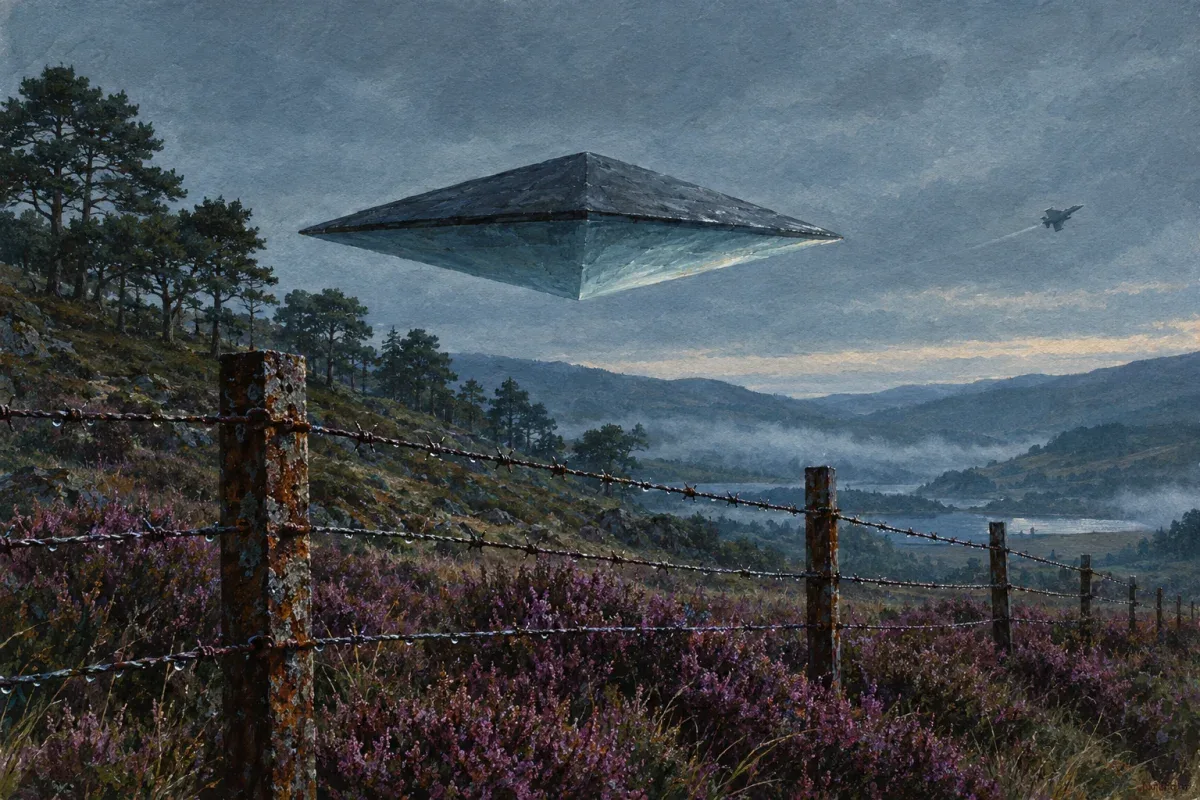
On August 4, 1990, two young men who were working that summer at a hotel in Pitlochry set out for a walk in the hills above the hamlet of Calvine, in the heart of the Scottish Highlands.
Shortly after 9 p.m., about twenty minutes before sunset, they spotted a motionless, diamond-shaped object hovering in the gray sky above a barbed-wire fence.
They took cover under some nearby pines and watched. By their account, the object hung there without moving for several minutes.
Then a military aircraft flew down the valley and began circling it, until the object suddenly accelerated straight up and vanished above the clouds.
One of the men managed to take six photographs.
Only one print survives. A photographic analysis by photographer and lecturer Andrew Robinson, first published in 2022 and updated in 2024, found no trace of compositing or later manipulation on it.
Even after three and a half decades, the identities of the two young men remain unknown.
The Photo the Newspaper Never Ran
The film was taken in for developing, and the pictures were sent to the Glasgow newspaper the Daily Record.
The paper's photo editor, Andy Allen, realized he was holding a big story, but he didn't publish it right away.
Several Royal Air Force (RAF) bases lie around Calvine, so he suspected the two men might have photographed something they weren't supposed to.
Instead of putting it on the front page, he sent a copy of the best photograph to an acquaintance in the RAF: Craig Lindsay, the press officer for Scotland, at the RAF Pitreavie Castle base near Edinburgh.
Lindsay passed the photo up the chain of command. Within a few hours, the case was taken over by the so-called UFO desk at Britain's Ministry of Defence, which asked for all six photographs, the negatives, and a chance to interview the witnesses.
Once he had filed his report, Lindsay was told to leave any further investigation to London, and he did.
Months later, during an official visit to the ministry, he happened to spot an enlarged copy of the same photograph pinned to the wall of an office, as if it were a subject of serious study.
The Daily Record never ran the story, even though for a newspaper it would have been the chance of a decade.
According to Lindsay's later statements, RAF photography experts had already examined the pictures back in 1990 and found no evidence of compositing or later manipulation. Three decades later, a civilian analyst, Andrew Robinson, would repeat that check using the surviving print. The methods and details of the RAF's analysis, however, remain unknown.
The File That Vanished for Three Decades
After the material reached the Ministry of Defence in 1990, the photograph wasn't seen in public for three decades. Among ufologists, the Calvine story circulated as little more than an unverified legend.
In 2009, investigative journalist David Clarke, who was then sorting through thousands of once-secret UFO files for the UK National Archives, came across a faded photocopy of a drawing showing an unidentified object next to a Harrier jet. It was the first trace of what would later become known as the Calvine case.
Clarke tried to track down the original photographs and negatives, but neither the Daily Record nor the Ministry of Defence could locate them.
The trail went cold for more than a decade.
The investigation only started up again years later, when Clarke, by his own account, got in touch with a former defense intelligence official.
According to an anonymous source Clarke spoke with, the case wasn't closed because investigators couldn't work out what the object was, but because they could. In that source's telling, it was an advanced military aircraft that did not belong to Britain at the time.
In 2021, Clarke finally tracked down Craig Lindsay himself, by then retired.
It turned out the former press officer had kept a copy of the photograph all along, in the envelope it arrived in from Glasgow in 1990.
What the Analysis Shows
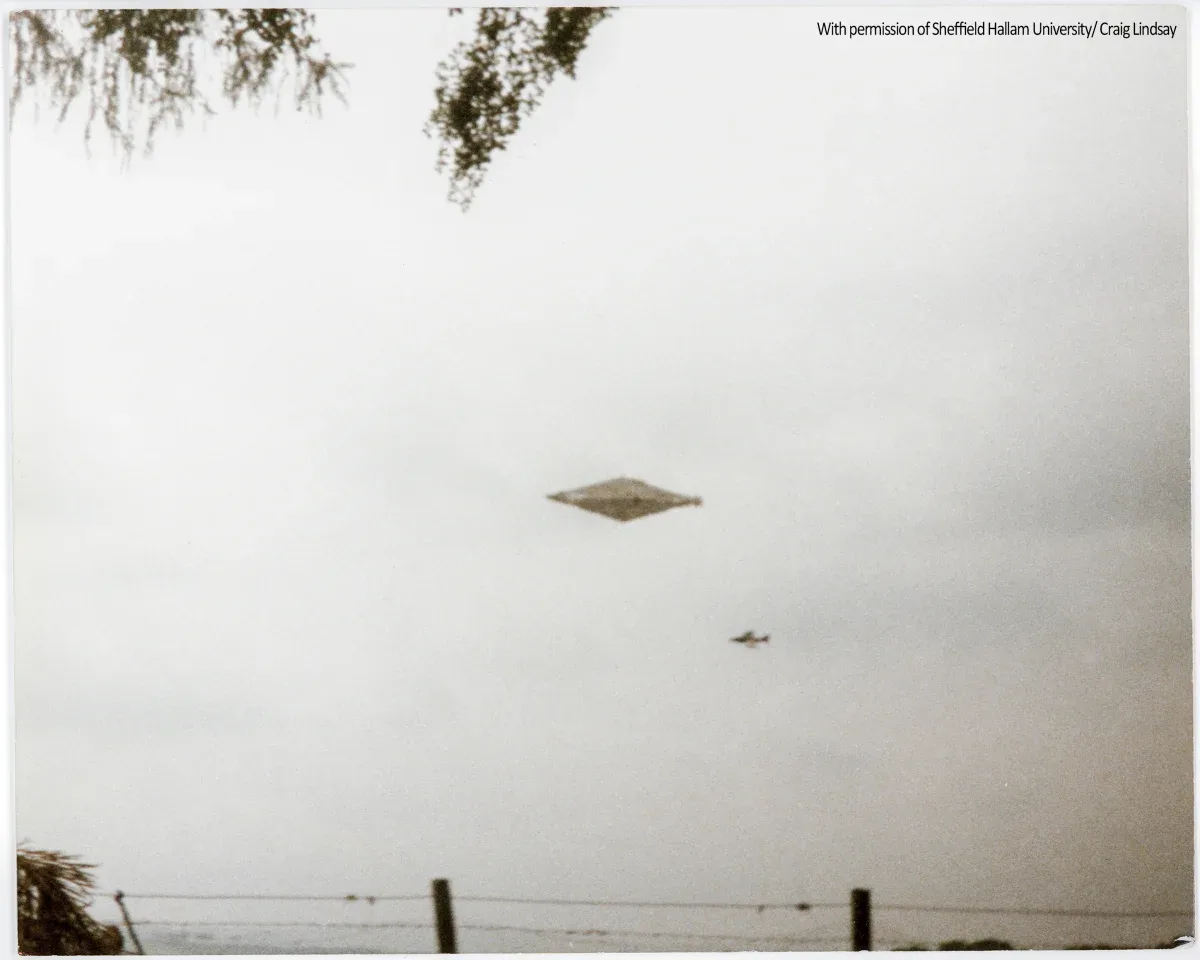
Clarke handed the surviving print to Andrew Robinson, a photography lecturer at Sheffield Hallam University, for analysis.
In his detailed photographic analysis, Robinson determined that the photographic paper and the envelope date from the right period, that the film grain is consistent across the entire image with no sign of splicing or later compositing, and that the weather visible in the photo matches the available meteorological records for central Scotland on August 4, 1990.
If the aircraft in the background really is a Harrier, and if the distance estimates are correct, Robinson calculated that the jet was about 2,500 feet (755 meters) from the camera, with the object roughly halfway between the fence and the plane. The object was estimated at about 100 to 130 feet long and 25 to 40 feet tall.
Robinson also suggested it could be a kite or a radio-controlled model, but with a condition: such an object would have to be at least 65 to 100 feet long.
He also considered whether it might be the reflection of a rock on the surface of a nearby lake, but ruled that out: the lower half of the object in the photo is lighter than the upper half, while a real reflection in water would be the other way around.
Robinson concludes that the scene was real and was physically in front of the camera. If anything was staged, it was staged within the scene itself.
Without the original negatives, though, a hoax staged in front of the lens can't be ruled out completely.
As for the nature of the object itself, Robinson writes, the available data supports no conclusion at all.
In 2026, Andreas Zätterqvist and Oskar Jungell published an analysis in the Swedish magazine UFO-Aktuellt claiming that the photo is a hoax built from models hung in the foreground, and that the RAF carried out no deeper technical check in the fall of 1990.
Robinson answered with a two-part article: most of the documentation is missing, he says, and the type of aircraft can't be determined with certainty.
Clarke concluded in 2021 that the photographs were probably a hoax, in 2022 that they showed a secret American program, and in 2023 that he no longer knew what to think.
The Men in Dark Suits
Former cook Richard Grieve told researchers that in the summer of 1990 he worked in the kitchen at Fisher's Hotel in Pitlochry, alongside two other cooks, one on breakfast and one on vegetables. He stayed in the job for ten months.
Grieve first came forward in July 2022 by contacting Philip Mantle, and his account is laid out in more detail in the documentary The Program.
By his account, one rainy evening while they were on a break, a black car pulled up outside the hotel.
Two men in dark suits got out, called the cooks over, and spoke with them outside in the rain.
His colleagues came back pale and shaken. Grieve says that after that they drank, took days off, and slept in their cars outside the hotel, and four weeks later they vanished without a trace.
In a 2024 article, Clarke notes a different detail: in Grieve's telling, three men came, and two of them introduced themselves as members of the Royal Navy.
Grieve also said that neither of the two cooks was Kevin Russell. To this day, Clarke hasn't been able to find them.
The only clue to anyone's identity is on the back of the print: the name "Kevin Russell," written there by Daily Record photographers in Glasgow just before they sent the picture to the RAF. It has not been confirmed that the name belonged to the person who took the photo.
The research team contacted more than 200 people by that name in Scotland and beyond, and looked more closely at about 140 men of the right age.
In 2023, they found a man who worked as a kitchen assistant at the Pitlochry Hydro hotel in 1990 and 1991.
He denies knowing anything about the sighting and can't explain why his name ended up on the back of the print.
Some thirty years later, the diamond-shaped object over Calvine has still not been convincingly linked to any publicly known military program.
Sealed Until 2076
According to Clarke, the UK National Archives released part of the Calvine documentation in 2009: two poor-quality photocopies made from transparencies.
The original file, DEFE 24/1940, remains closed. Under the Section 40 exemption of the Freedom of Information Act, which protects the personal data of third parties, it is set to open on January 1, 2076. A digital copy of the same file is available with the names blacked out.
Clarke warns that this is no exception: the names of witnesses, and of the officials who handled their reports, have been kept secret since 2005, sometimes for as long as eighty years. What's sealed is the identity, not the evidence.
The photograph has been public since 2022, when Clarke first published it. The names of the two young men remain unknown until 2076.
By then, nearly eighty-six years will have passed since that evening.
SOURCES
- Andrew Robinson, "Photographic Analysis of the Calvine UFO Photograph", version 5 (Sheffield Hallam University, 2024)
- Andrew Robinson, "STRING THEORY: Tangled up in Calvine", Parts I and II (2026)
- The National Archives (UK), DEFE 24/1940: UFO sighting reports, file closed until January 1, 2076.
- Andreas Zätterqvist and Oskar Jungell, "Ny undersökning av Calvinebilden", UFO-Aktuellt, no. 2/2026, pp. 4-10.
- Dr David Clarke, "The UFO that Never Was?: the Calvine photographs" (2021)
- Dr David Clarke, "The Calvine UFO photograph: revealed" (2022)
- Dr David Clarke, "The Calvine UFO photo: an unsolved mystery" (2023)
- Dr David Clarke, "Calvine UFO Revisited" (2024)
- Dr David Clarke, "Calvine Revisited" (2025)
- Daniel Lavelle, "The mystery behind the 'best' UFO picture ever seen", The Guardian / Taipei Times (2025)
- Centre for Contemporary Legend, Sheffield Hallam University: page devoted to the Calvine case
Aron Corvin
A researcher of the unknown who loves a good story, but doesn't sell sensationalism. I research every topic in detail before I publish it. If you enjoy what I write, your support would mean a lot and help me keep going.