
Ishi no Hoden: The 500-Ton Japanese Megalith That Was Never Finished
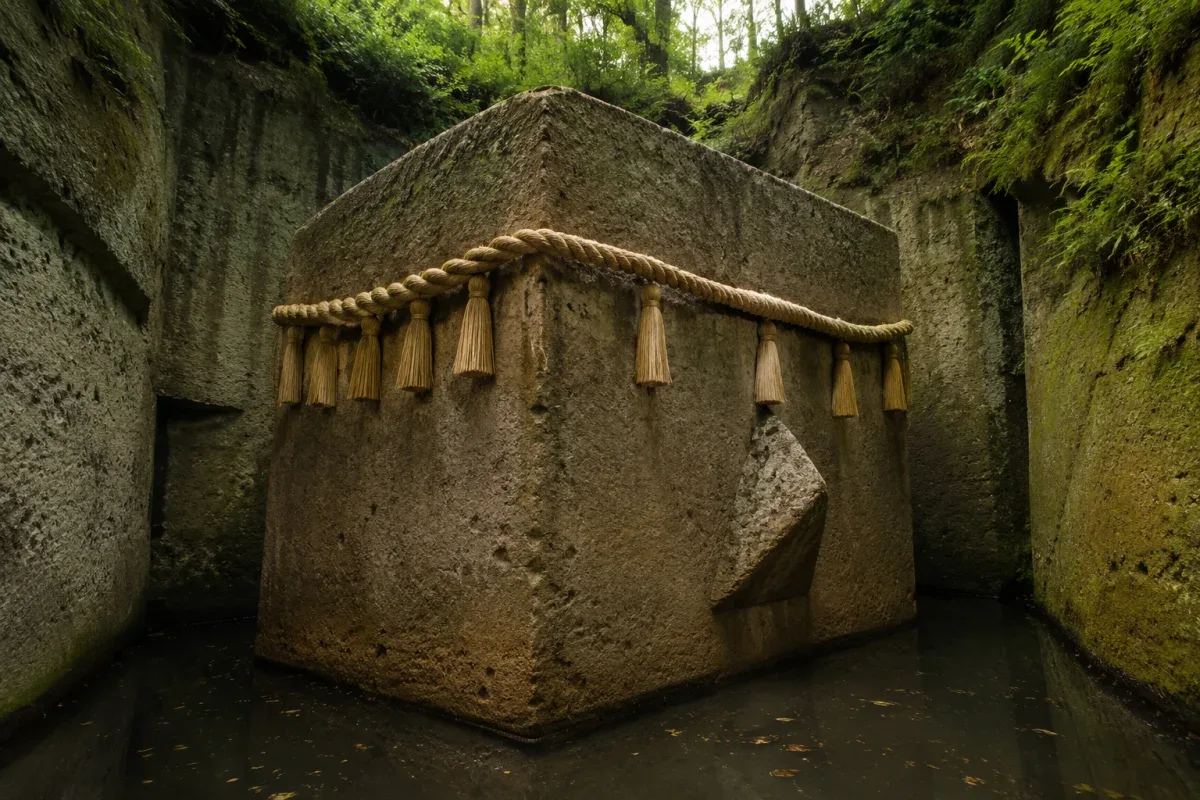
The stone is estimated to weigh about 453 tons — some sources round that figure to 500 — and it appears to float.
Walk the narrow passage around the back of Ōshiko Shrine in Takasago, Japan, and you'll find it: a rectangular block of rock, 6.4 meters wide and 5.7 meters tall, rising out of a shallow pond.
The illusion comes from a hidden central pillar, carved from the same mass, that connects the stone to the bedrock below the waterline and isn't visible at eye level.
Local tradition calls it Ame no Ukiishi — the floating stone. It has stood this way for at least 1,300 years, and nobody has ever explained why it was made.
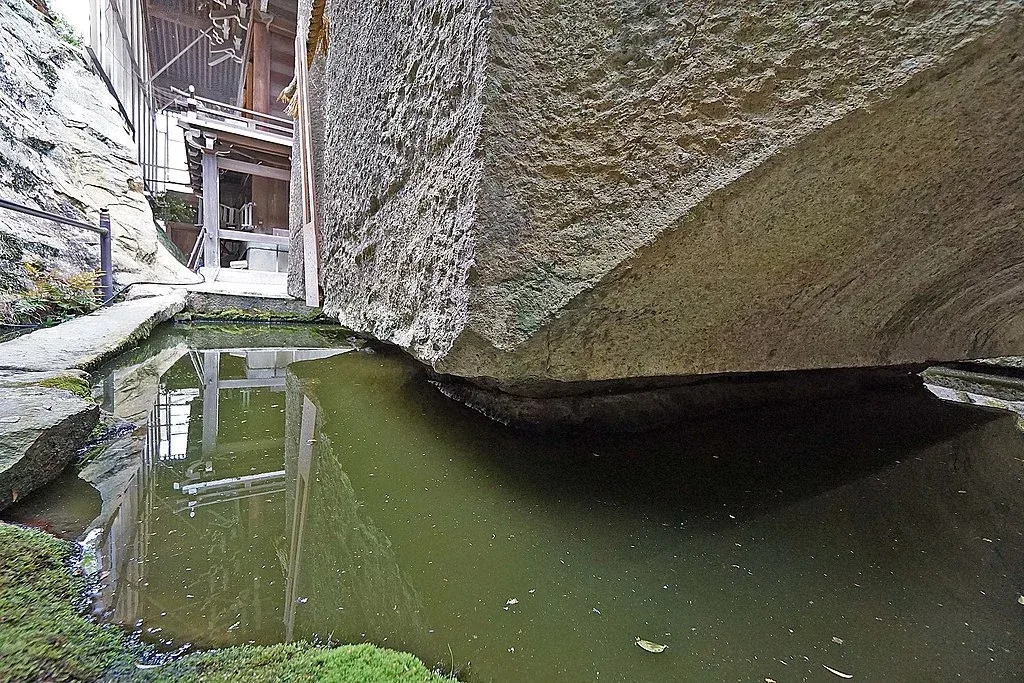
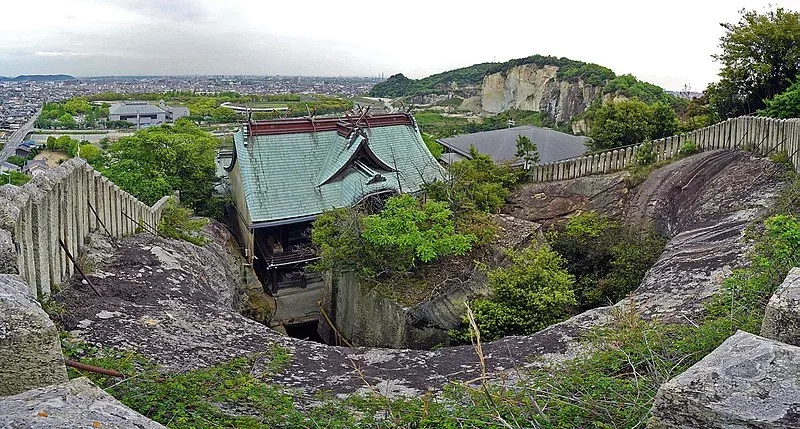
The Japanese name is Ishi no Hoden, "stone treasure house," and it is the sacred object of worship at Ōshiko Jinja, a Shinto shrine tucked into the base of Mount Hodenyama in Hyōgo Prefecture.
Unlike most megaliths, it wasn't assembled from separate blocks.
It was carved directly out of the hillside using a subtractive method: workers cut away the surrounding rock until a single freestanding mass remained, still attached to bedrock on three sides by only a narrow wall of unworked stone.
A Chronicle That Contradicts Itself
The earliest written reference to the stone appears in the Harima no Kuni Fudoki, a provincial gazetteer compiled sometime between 713 and 717 CE, early in the Nara period.
The text describes a "great house-shaped stone" and credits its construction to Mononobe no Moriya, acting on the orders of Prince Shōtoku.
There's a problem with that account, and Japanese historians have noted it for generations.
Moriya died in 587 CE. Shōtoku didn't become regent until nearly six years later.
The chronicle attributes the stone to a collaboration between two men who never overlapped in power — a detail that undermines the very source meant to explain the monument's origin.
A different story surfaces much later, in the local tradition.
In this version, two deities, Ōkuninushi and Sukunahikona, descended to earth and attempted to carve an entire stone palace in a single night.
Rebellion among local gods delayed the work, and dawn broke before they could finish.
The unfinished palace, in this telling, is the stone that remains today.
Neither account can be verified. Both are folklore layered onto something that was already old when the folklore was written down.
What the Rock Actually Is
The material is more traceable than the legends.
Ishi no Hoden is carved from Tatsuyama stone, a volcanic rock known as hyaloclastite, formed when magma came into sudden contact with cold water during the Late Cretaceous, roughly 90 to 100 million years ago.
The adjacent Tatsuyama quarry has been worked for more than 1,700 years, supplying material for stone sarcophagi as far back as the Kofun period — the era of Japan's earliest monumental tombs.
That continuity matters.
The official cultural heritage record for the site identifies the leading archaeological interpretation as an unfinished 7th-century stone burial chamber of the side-opening type known as yokoguchi-shiki sekkaku, conceptually related to another unfinished megalith in Nara Prefecture known as Masuda no Iwafune, the "rock ship."
The theory fits the geology, the quarrying tradition, and the era's known burial practices. It remains, by the same record's own framing, the leading hypothesis rather than a settled fact.
No tools used in the carving, and no inscription explaining its purpose, have ever been found.
Whatever record once existed of who commissioned the work, or why it stopped, didn't survive.
Centuries of Visitors, No Closer to an Answer
By the Edo period, the stone had become a recognized destination for visitors and regional feudal lords traveling through western Japan.
In 1836, the Himeji domain ordered an inscription — "a place for viewing the waves" — carved into a nearby cliff face, formalizing the site as a scenic destination.
Western scholarship caught up later.
The German physician and naturalist Philipp Franz von Siebold visited during his residence in Japan in the late 1820s and included sketches of the monolith in Nippon, his major work on the country, published beginning in 1832.
It stands as one of the first detailed Western records of the stone's existence.
Modern instruments have added precision without adding answers.
Between 2005 and 2006, the Takasago City Board of Education and the Otemae University Research Institute carried out a laser 3D survey of the monolith and its surrounding rock face, producing an exact model of its shape and the gap separating it from the bedrock.
In 2008, the Japanese Society for the Investigation of Cultural Heritage combined ground-penetrating radar with ultrasonic testing to check for a hidden cavity inside the block.
The results were inconclusive — neither confirming nor ruling out an internal void.
Bigger Than Giza's Heaviest Stone
The comparison researchers keep returning to is Egypt.
The heaviest granite blocks in the Great Pyramid, the ones forming the ceiling of the King's Chamber, weigh up to about 80 tons apiece, and they're the exception — most of the pyramid's roughly 2.3 million blocks average only a few tons each.
Ishi no Hoden, by contrast, is a single carved mass estimated at about 450 to 500 tons. It's not an assembly. It's one piece.
That fact alone has made the stone a magnet for both serious researchers and fringe theorists drawn to claims of lost advanced civilizations.
The scale invites speculation. The documentation doesn't support it.
In October 2014, Ishi no Hoden and the Tatsuyama quarries were jointly designated a National Historic Site of Japan — the first such designation in Takasago's history. The designation confirms what the historical and archaeological record can establish: the stone has been documented for at least 1,300 years, it was carved using techniques consistent with its period, and it belongs to a well-documented regional stoneworking tradition.
What the designation doesn't settle is intent.
Whether the carvers meant to build a tomb, an altar, or a divine palace is something archaeologists still can't state with confidence.
The stone sits above its still pond, finished enough to survive 13 centuries, never finished enough to say why anyone started it.
SOURCES
- Agency for Cultural Affairs, Japan — Cultural Heritage Online: "Ishi no Hōden oyobi Tatsuyama-ishi Saiseki Iseki"
- City of Takasago — official page on the National Historic Site
- Japan Tourism Agency — Ishi no Hoden (Stone Treasure Hall) listing
- Isomura, Yukio; Sakai, Hideya, Kokushitei Shiseki Jiten (National Historic Site Encyclopedia), Gakuseisha, 2012.
- Britannica — Great Pyramid of Giza
Aron Corvin
A researcher of the unknown who loves a good story, but doesn't sell sensationalism. I research every topic in detail before I publish it. If you enjoy what I write, your support would mean a lot and help me keep going.