
Nina Kulagina: The Woman Who Moved Objects With a Glance
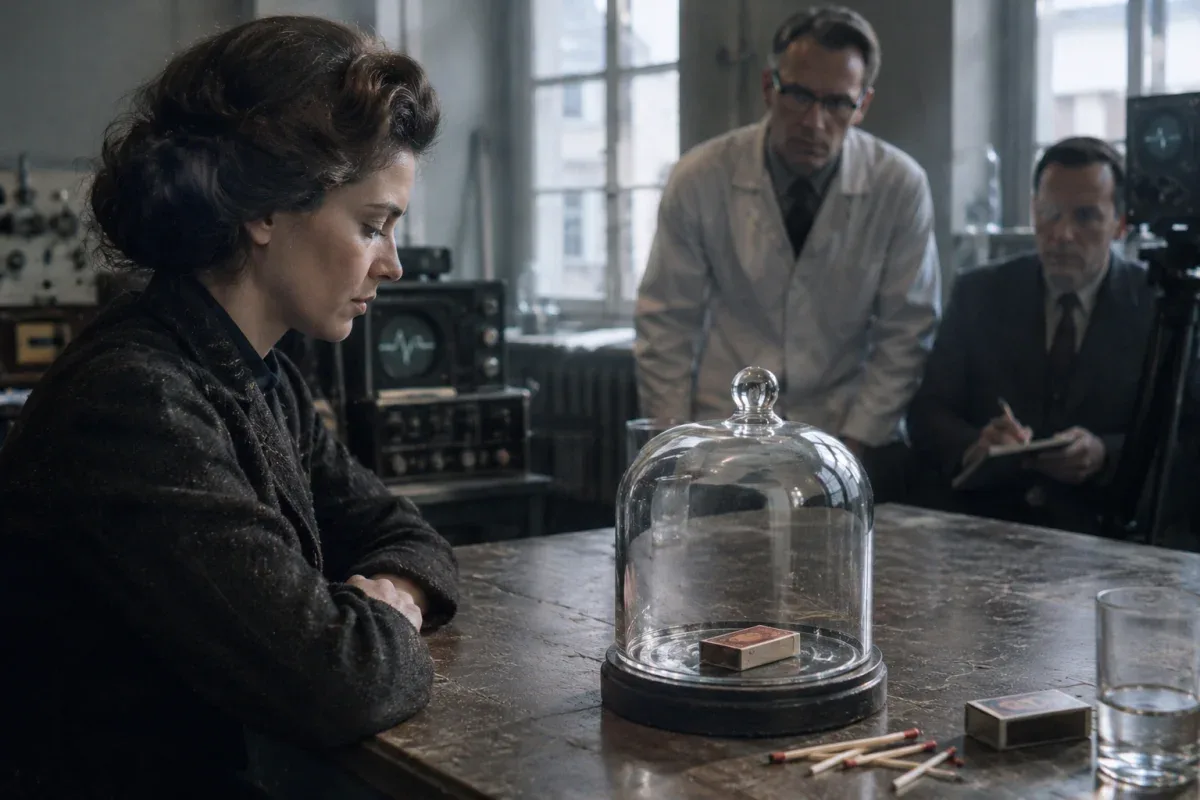
On a table in a Leningrad laboratory sits a box of matches, covered by a heavy glass dome. The woman sitting across from it touches nothing.
For a minute or two she simply watches the box. Then, one by one, the matches begin to slide across the table. Soviet scientists had been capturing this on film since the mid-1960s.
The woman's name is Ninel Sergeyevna Kulagina, née Mikhailova.
In the West, thanks to a small slip in how her name was transliterated, she became known as Nina Kulagina, though her real name was Ninel: "Lenin" spelled backward, a name Soviet families often gave their daughters after the revolution.
She was born on July 30, 1926, in Leningrad.
"Lenin" Spelled Backward
When German troops encircled the city in 1941, she was fifteen. The Siege of Leningrad lasted nearly nine hundred days and claimed hundreds of thousands of lives to starvation, cold, and relentless shelling.
Her father, brother, and sister went to the front. She soon followed, serving as a radio operator in a Red Army tank unit.
At seventeen she took a wound to the abdomen, survived the siege, and received a decoration and a military rank. After the war she married Viktor Kulagin, a naval engineer, and the couple had three children.
In the mid-1960s, while being treated in the hospital for a nervous breakdown (likely a lingering effect of her war wound and what we'd now call post-traumatic stress), she heard a radio program about a woman who could identify colors with her fingertips.
Her husband didn't believe it was possible, so she took out her bag of embroidery thread and, blindfolded, began pulling out the exact color he asked for.
A Bag of Thread
Her husband, an engineer by trade, bought a simple film camera and started recording small experiments at home.
They soon discovered something stranger still: when she got angry, objects would fly off the table on their own, spoons, glasses, small items, with no hand ever touching them.
When they mentioned it to a doctor during a routine checkup, word reached Leonid Vasiliev, a physiologist at Leningrad University and a pioneer of Soviet parapsychology research, who was the first to invite her into his laboratory.
Before anyone focused on moving objects, researchers first tested her earlier, "dermo-optical" ability.
In January 1964, a Leningrad commission, including S. G. Feinberg, who had discovered her, university rector A. T. Alexandrov, and Vasiliev himself, tested her with no magician in the room.
Blindfolded, she read from a magazine and correctly identified the dates on coins.
Kulagina wasn't the only such case in the Soviet Union at the time.
A few years earlier, a similar ability had been attributed to Rosa Kuleshova, a teacher from the Urals, and for a while Soviet researchers treated "finger vision" as a serious scientific question, before public interest faded.
For Kulagina, though, this was only the opening act. Her story was just beginning.
Under Glass, No Thread
Vasiliev died in 1966, before he could reach a final conclusion. His younger colleagues suspected he was being fooled by an invisible thread, and university administrators ordered the experiments stopped.
The research was picked up by Gennady Sergeyev, a physiologist at Leningrad's Ukhtomsky Military Institute, who tracked Kulagina for years using an electroencephalograph, an electrocardiograph, and Kirlian photography.
According to a report that later found its way into the archives of the U.S. Central Intelligence Agency, Sergeyev used a Kirlian camera to record a burst of light around her eyes at the exact moments objects began to move.
From this he developed a theory of "bioplasma," a kind of energy field the body supposedly emits and uses to act on its surroundings.
Western science never accepted the theory, but it intrigued American analysts enough to make it into their own reports.
The protocol grew stricter over time.
Before each session, her hands and clothing were inspected, and the table was cleared before she sat down.
Objects were placed under transparent domes and in four-inch (10-centimeter) plexiglass cubes, the magnetic field around her body was measured, and a technician would sometimes remove an object without warning, a check against any hidden thread.
Matches, a compass, a lit cigarette, an empty metal saltshaker, a wristwatch: according to the reports, all of it moved.
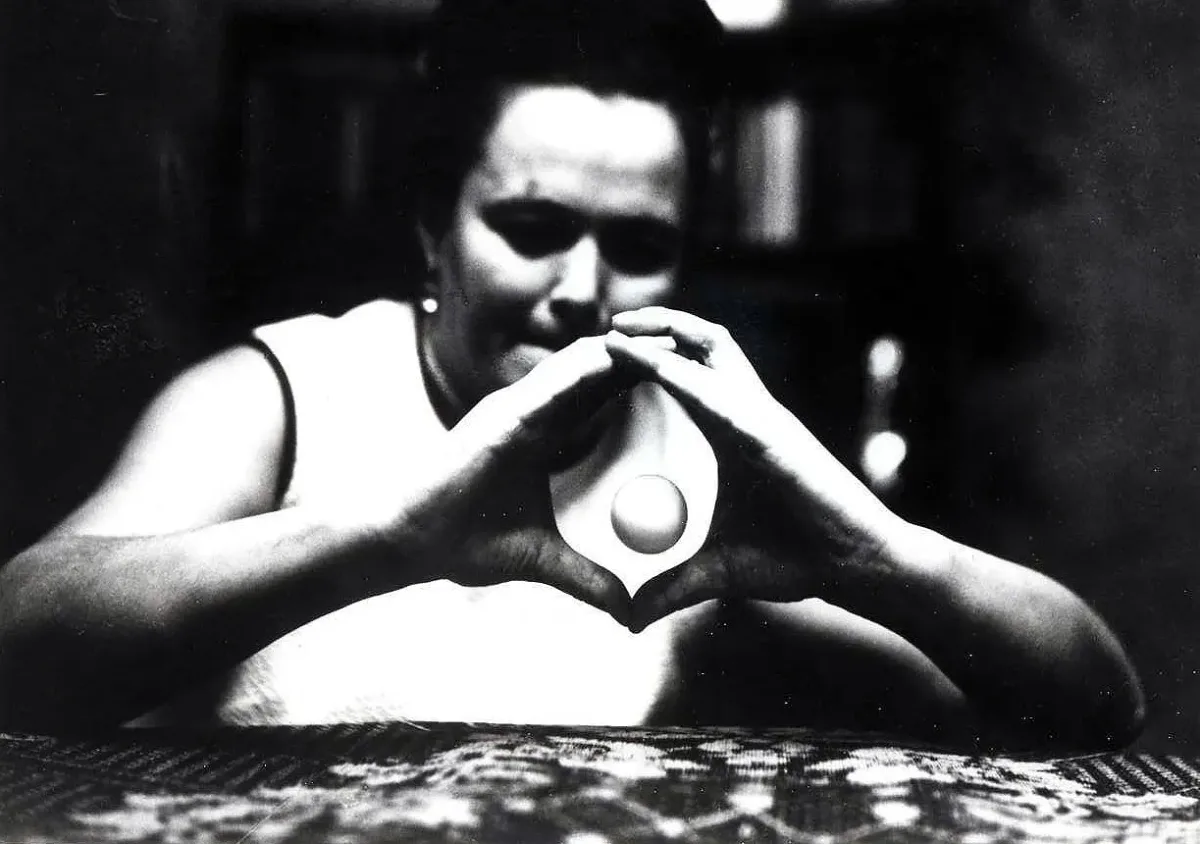
Rarely did just one institution have a seat at that table.
Representatives from Leningrad University, the Bekhterev Institute, the Institute of Radio Engineering and Electronics, the Soviet Academy of Sciences, and even the KGB rotated through as observers over the years.
None of them, according to the available records, ever publicly claimed to have caught her in a trick.
The list of unusual feats kept growing. Once, in a saline solution, she separated an egg's yolk from its white without ever touching the egg.
She could spin a compass needle through a full rotation, stop a pendulum or reverse its direction, and set a hydrometer floating in a wire-mesh-covered container into motion.
Sometimes objects moved as much as six feet, though the usual distance was closer to a foot and a half.
The one thing she never managed was moving an object sealed inside a vacuum.
The West Comes to Leningrad
In 1968, at the first major Soviet parapsychology conference in Moscow, a silent black-and-white film showing Kulagina moving objects was screened.
A few months earlier, in February, Czech military researcher Zdeněk Rejdak had visited her in Leningrad.
He passed a compass around her, the table, and the chair with no result, until she concentrated. Then the needle spun more than ten full turns, and she went on to set a matchbox and a lit cigarette moving as well.
The film opened doors.
Over the following decade, five Western scientists tested Kulagina: Australian Jürgen Keil of the University of Tasmania; Briton Benson Herbert, editor of the Journal of Paraphysics; American J. Gaither Pratt of the University of Virginia; New York psychiatrist Montague Ullman; and J. A. Fahler. Together they ran more than a hundred, possibly as many as two hundred, sessions over ten years, according to a review published in the Society for Psychical Research's archive.
When Keil and Pratt showed up unannounced at her apartment in April 1968, she welcomed them as guests, serving them dinner and, afterward, a small demonstration.
Two years later, American William A. McGary described a session at her dining table in which she set a wedding ring and a jar lid moving, making the ring spin on its axis as though mounted on an invisible shaft.
The Price of Concentration
Every successful attempt came at a physical cost.
During sessions, her pulse climbed as high as 240 beats a minute: the kind of rate an athlete might hit after a grueling workout, except she was sitting calmly at a table the whole time.
She lost up to four pounds (two kilograms) of fluid per session, more than physical exertion would burn off in the same amount of time.
Afterward she complained of exhaustion, dizziness, back pain, and a metallic taste in her mouth, and sometimes needed days to recover before her next session.
The most famous experiment took place on March 10, 1970, in a Leningrad laboratory.
An isolated frog's heart, submerged in the saline solution that normally keeps it beating for hours outside the body, was placed in front of her.
Sergeyev watched the cardiogram as the heartbeat, by his account, first sped up, then slowed, then stopped completely, after about seven minutes of concentration.
Critics point out that an isolated frog's heart will stop beating sooner or later on its own, which leaves open just how much she actually hastened the end and how much was simply well-timed coincidence.
A Burn Without Fire
British researcher Benson Herbert, editor of the journal mentioned above, described the touch of her hand as unbearably painful: when Kulagina ran her hand along his forearm, it left a burn that took eight days to heal.
Keil and Fahler experienced a milder version of the same thing: a mark on the skin, with no blistering and no real wound.
A thermometer placed between her skin and theirs, however, never registered any actual change in temperature.
In another attempt, she turned her attention to a doctor who had openly doubted her abilities.
Both of them were hooked up to an EKG, and within a few minutes his pulse, according to Soviet reports, reached a dangerous level, so the experiment was stopped immediately.
In informal retellings, the story later picked up a more dramatic ending, that the doctor supposedly died on the spot, but no documented source confirms that version.
Accusations That Were Never Confirmed
Cooperating with Western visitors didn't come without consequences on the Soviet side either.
Eduard Naumov, a scientist who worked with Kulagina and often met with foreign visitors, spent a year in a KGB labor camp, likely because of exactly those contacts.
That alone says enough about how seriously the state apparatus took what was happening around that table.
Suspicions of fraud followed her from the start.
In 1965, Moscow's Institute of Metrology announced that it had found small magnets hidden "in intimate areas" of her body, though a later analysis by Jürgen Keil found that the report actually documented nothing more than an elevated magnetic field around her body, with no search ever having actually been carried out.
Magicians and skeptics, including the well-known paranormal critic Martin Gardner, long insisted it was a classic thread-or-magnet trick. In 1968, Gardner also cited a New York Times article claiming that Kulagina, under the pseudonym Nelya Mikhailova, had once been caught with magnets hidden in her clothing and previously sentenced to four years in prison.
Pratt, who met her in Moscow in the 1970s, described her as a pleasant, smiling woman with an inexplicable ability, far from the "charlatan" portrayed in newspaper articles.
Naumov, testifying on her behalf, added that she never asked for fame or money for what she did.
When Keil and his colleagues published an extensive analysis in the Society for Psychical Research's journal in 1976, after ten years of observation, the conclusion was anything but triumphant.
It stated that, based on all available data, Kulagina didn't behave like someone trying to hide something, which isn't proof that the ability was real, only an absence of evidence that it was fraud.
Refrigerators, a Courtroom, and a Verdict
In 1966, she faced an entirely different kind of accusation, one that had nothing to do with her alleged powers and everything to do with business.
She'd taken money from neighbors, at a time when refrigerators and furniture were hard to come by in the USSR, promising to help them get hold of those items. The deal fell through, and a conviction followed.
Some sources describe the case as an honest business mistake by a woman with no real experience in trade, others as outright fraud with a predictable outcome. After a prominent scientist intervened on her behalf, her prison sentence was commuted to hospital treatment.
Critics would cite that case for decades afterward as proof that she couldn't generally be trusted, even though it had nothing to do with telekinesis.
Twenty years later, in 1986, she filed a lawsuit of her own, against the Soviet magazine Man and the Law, published by the Ministry of Justice, which had accused her of fraud.
Scientists, a journalist, and a documentary filmmaker who had observed her for years testified in court.
The jury ruled in her favor: the magazine had offered no tangible proof of fraud, and the court ordered it to publish a correction.
The court didn't officially confirm her abilities either. It simply rejected the claim that she was a fraud.
A File From the Other Side of the Ocean
Under the pseudonym Nelya Mikhailova, Kulagina turns up in dozens of declassified documents from the U.S. Central Intelligence Agency, now available in the agency's Freedom of Information Act electronic reading room.
One CIA report describes Sergeyev as having spent years conducting intensive lab research on "the outstanding PK psychic in Leningrad, Nina Kulagina."
Analysts weren't necessarily convinced telekinesis was real, but they took seriously the possibility that the Soviets were developing paranormal abilities for military use.
The Americans already had their own center for parapsychology research by then: J. B. Rhine's laboratory at Duke University, where Pratt had worked before moving on to Virginia.
Fear that the Soviets might get to a usable "psychic weapon" first helped spur the American Stargate program, which, decades later, once declassified, would confirm just how seriously Washington took what was happening around that table in Leningrad.
It's striking that across dozens of pages of these declassified reports, now publicly available in the CIA's electronic reading room, I never found the word "proven" or "fraud." Just long strings of observations, measurements, and institutions that refused to let the question go.
Author
Her health, meanwhile, kept declining.
By the 1980s she already had a series of heart problems, and the pain-free stretches between them kept getting shorter.
She died on April 11, 1990, at age sixty-three, of a heart attack, after a long period of poor health that the researchers who had followed her case partly attributed to those exhausting sessions.
What she left behind was a thick file: hundreds of sessions, scientists from at least five countries, declassified reports from two intelligence agencies, and a court ruling that found no evidence of fraud.
And there's still that thermometer from the Leningrad laboratory, the one that, placed between her skin and someone else's, never recorded a single degree of change, while skin just an inch or so away took a full eight days to heal.
SOURCES
- Ninel Sergejevna (Nina) Kulagina – Psi Encyclopedia, Society for Psychical Research
- Leonid Vasiliev – Psi Encyclopedia, Society for Psychical Research
- Keil, H.H.J., Herbert, B., Ullman, M., Pratt, J.G., Directly Observable Voluntary PK Effects: A Survey and Tentative Interpretation of Available Findings from Nina Kulagina, Proceedings of the Society for Psychical Research 56, 1976.
- New York Times, May 21, 1968: a news item about allegedly hidden magnets and an earlier four-year prison sentence (as cited in Gardner, M., Science: Good, Bad and Bogus, 1981, p. 244).
- Central Intelligence Agency, Controlled Offensive Behavior – USSR (U), Section IV: ESP and Psychokinesis, and related declassified documents, CIA Freedom of Information Act Electronic Reading Room (foia.cia.gov).
Aron Corvin
A researcher of the unknown who loves a good story, but doesn't sell sensationalism. I research every topic in detail before I publish it. If you enjoy what I write, your support would mean a lot and help me keep going.