
The Unsolved Disappearance of Three Lighthouse Keepers in Scotland, 1900
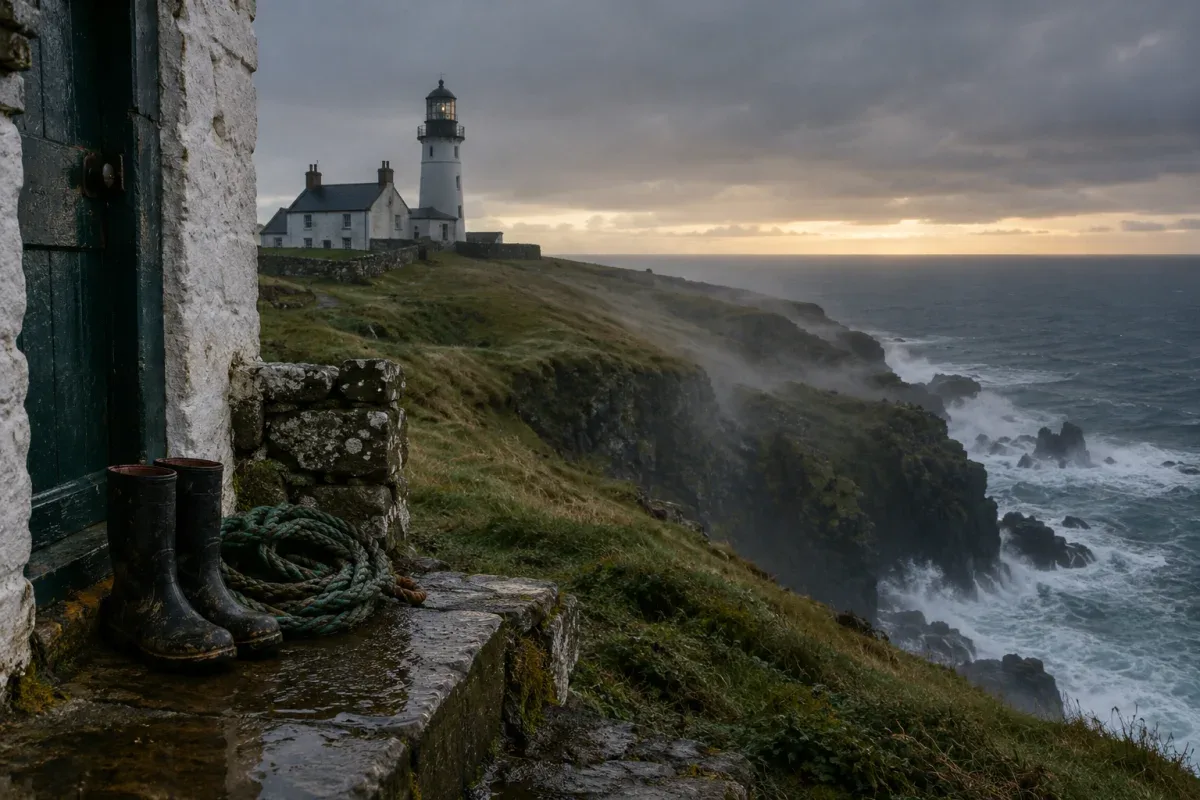
On January 8, 1901, Robert Muirhead sat down to finish his report on the most difficult case of his career.
A month earlier, he'd stood on the landing at Eilean Mòr, shaking hands with the three keepers before boarding the boat home.
In the report, he wrote that it was a sad thing to remember: he had been the last man to shake their hands and say goodbye.
Muirhead was a superintendent with the Northern Lighthouse Board, the authority that ran Scotland's lighthouses.
He returned to the island on December 29, 1900, accompanied by two keepers who'd been sent to relight the lamp.
His job was to find out what had happened to James Ducat, Thomas Marshall, and Donald McArthur, who had vanished from an island where there was no one else.
The paper trail is surprisingly clear. The telegram from the captain of the Hesperus on December 26, the letter from Assistant Lightkeeper Joseph Moore on December 28, and Muirhead's report on January 8 agree on nearly every detail.
The house was tidy, the day's work was done, and three men were gone.
How and why they went out, the documents don't say. Muirhead's conclusion came from the clothing that was missing and the damage at the West Landing.
Where the accounts part ways is the story that was later built on top of those documents.
- 1.A lighthouse that had been running for barely a year
- 2.A ship passed at midnight and saw no light
- 3.Moore found a tidy house, but no one was in it
- 4.The sea moved a block of stone weighing more than a ton
- 5.Ducat and Marshall dressed for the landing, McArthur left his coat behind
- 6.The "God Is Over All" diary never existed
- 7.A poem created the legend, and a film revived it
- 8.Moore's December 28 letter went on public display for the first time
A lighthouse that had been running for barely a year
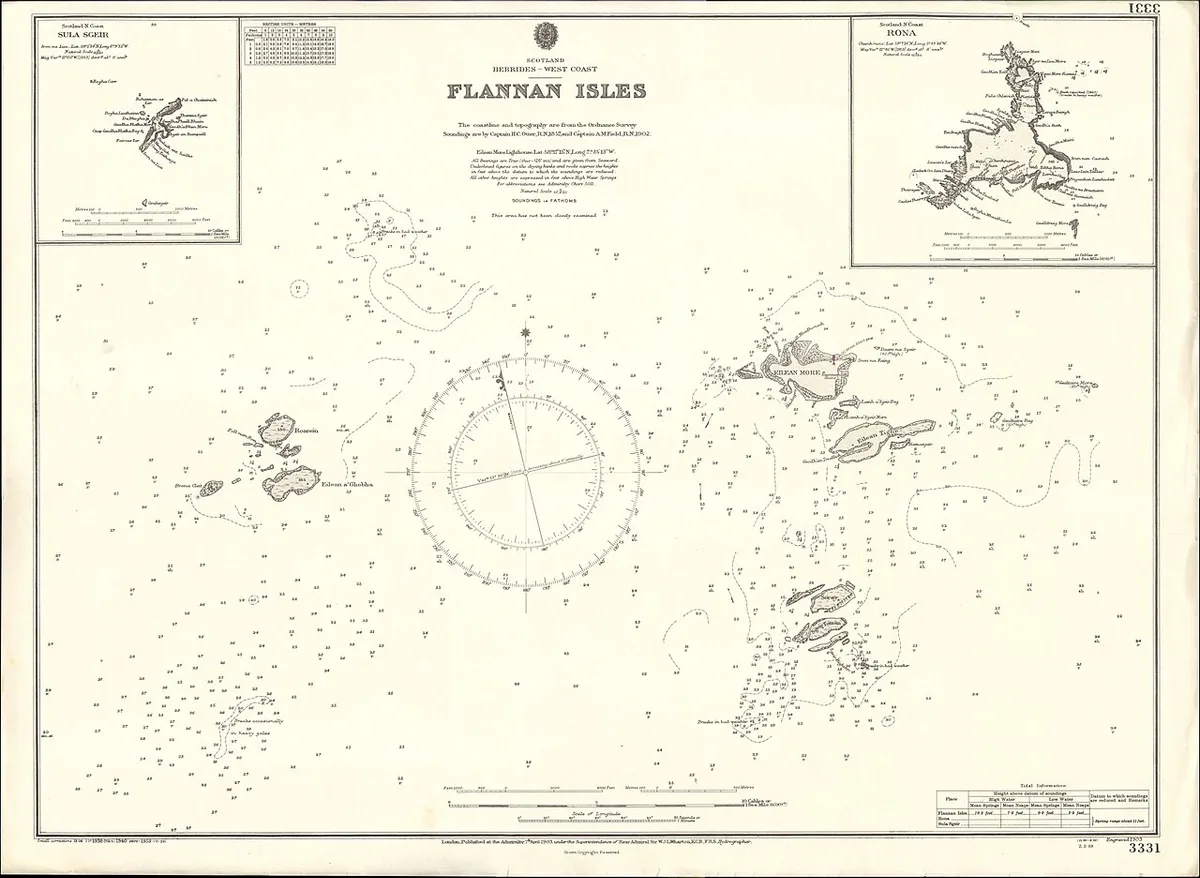
Eilean Mòr is the largest of the seven islands and rocks that make up the Flannan Isles, about 20 miles west of the Isle of Lewis.
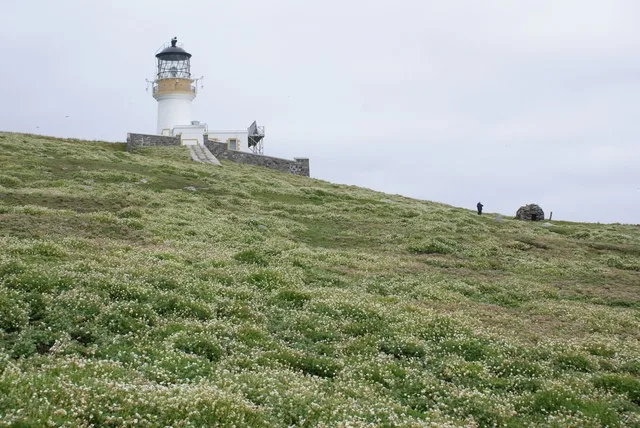
Its highest point stands about 290 feet (88 meters) above sea level, and that's exactly where the lighthouse was built.
The light first shone on December 7, 1899, a year and eight days before the keepers vanished.
It was designed by David Alan Stevenson, a member of the family that built most of Scotland's lighthouses, and the work was carried out by George Lawson of Rutherglen.
The whole project, including the landings and the steps cut into the rock, cost £6,914, 1 shilling, and 9 pence.
The tower is 75 feet tall, but the light sits about 330 feet above the sea.
It's visible from 20 nautical miles away and gives off two white flashes every 30 seconds.
The keepers lived in a house beside the tower, while the relief station was on the mainland, at Breasclete on Lewis.
A gamekeeper named Roderick MacKenzie was paid £8 a year to watch the lighthouse from Gallan Head and report right away if the light ever stopped working.
The keepers could signal using discs mounted on poles at the side of the tower, but only when they needed help. There was no routine signal to say that all was well.
Three keepers were on the island, each with his own role.
Ducat was the principal keeper and Marshall the second assistant. McArthur was an occasional keeper, filling in for William Ross, the first assistant, who was on sick leave.
A fourth keeper rotated in from shore. That December it was Moore, the third assistant, who was about to arrive on the island.
The Hesperus was supposed to leave Breasclete on December 20, but the weather wouldn't allow it. It didn't reach the island until noon on December 26, six days behind schedule.
A ship passed at midnight and saw no light
The first sign of trouble came from the sea.
The steamer Archtor, sailing from Philadelphia to Leith, passed the Flannan Isles at midnight on December 15. The crew saw no light from the lighthouse.
When the ship reached Leith on December 18, Captain Holman reported that the light had been out. It stayed dark until December 26.
Muirhead also pointed to a weakness in the shore-based watch. In his view, a lighthouse keeper like the one on Earraid, who kept an eye on Dubh Artach, would have noticed the problem sooner than a gamekeeper doing the job on the side.
The Hesperus anchored off the Flannan Isles. There was no flag on the flagstaff and no one on the landing.
Captain James Harvie sounded the ship's siren and whistle, then fired a rocket. Nobody appeared. A boat was lowered, and Moore went ashore.
Moore found a tidy house, but no one was in it
In his letter, Moore wrote that the entrance gate and the outer doors were closed, while the kitchen door stood open.
There was no fire in the grate, and it looked as if there hadn't been one for days. The beds were empty, just as the keepers had left them early that morning. Muirhead also noted that the clock had stopped.
The equipment in the lighthouse was in good order. The lamp had been cleaned, the oil fountain was full, and the lens and machinery were well kept.
The men who reached the island found that the last entry on the slate had been written by Ducat on the morning of Saturday, December 15, after he'd finished the day's work. The pots and pans had been washed and the kitchen put in order.
Later versions of the story mention a half-eaten meal and an overturned chair.
But those details appear in neither Moore's letter nor Muirhead's report. There were no signs of a struggle, no blood, and no broken doors either.
The sea moved a block of stone weighing more than a ton
The East Landing was untouched. Ropes that had been stowed there on December 7, at the last relief, were right where they'd been left. Muirhead checked this specifically.
The West Landing looked completely different. It sits in a narrow cleft in the rock, which Scots call a geo, ending in a cave. When the sea surges into the cleft, it rebounds with a powerful backwash.
On December 29, Muirhead managed to climb down only as far as the crane platform, about 70 feet above the sea. The waves were so violent that he couldn't go any farther.
The crane itself was intact. Its jib had been lowered and lashed to the rock, and the canvas over the wire rope was wrapped and secured.
Muirhead concluded there was no sign that any of the keepers had been working at the crane.
That matters because the first version of events, given in Harvie's telegram, was that the men had drowned while trying to secure it.
The marks left by the sea were much higher up. A wooden box holding mooring and hoisting ropes had been fixed in the cleft about 110 feet above the sea, roughly 40 feet above the crane platform. The box was gone.
Ropes lay scattered among the rocks and around the legs of the crane, but they were all neatly coiled and none had been untied.
The iron railings around the platform and along the steps were bent and out of position.
A larger block of stone, weighing more than a ton, had been torn out of the rock farther up the path and flung onto a concrete surface.
A life buoy that had been fastened to the railing at that same height of 110 feet was missing too.
The ropes that held it had not been touched, and scraps of canvas were still caught on them. The sea had ripped it away, not a man.
The height of this damage is especially important.
Walter Aldebert, who worked as a keeper on the Flannans from 1953 to 1957, photographed sea spray thrown up as high as the lighthouse, about 330 feet above the water.
On one occasion, a wave went right over the island's ridge, 250 feet up, and nearly swept him away.
Waves reaching 110 feet, then, are no myth. They're a real danger on this island.
Ducat and Marshall dressed for the landing, McArthur left his coat behind
From the clothing that was missing, Muirhead drew the conclusion that is still considered the most important clue.
Ducat's sea boots and his old waterproof coat were gone from the house. So were Marshall's sea boots and his oilskins, the waterproof clothing made of oiled cloth.
McArthur's "wearing coat" had been left behind. Moore noted in his letter that this suggested, as far as he knew, that McArthur had gone out in shirt sleeves, and that he had never worn any other coat on previous occasions.
Muirhead wrote that Moore had confirmed the keepers wore such gear only when going down to the landings.
For that reason, Muirhead believed the keepers had most likely set out for the landing or somewhere near it. Ducat and Marshall were dressed for the descent. McArthur wasn't.
It's possible McArthur followed them to warn them or to help, but the exact order of events isn't known.
Concern for the equipment may have played a part, too.
According to Mike Dash's research, which draws on the recollection of Anne Ducat, the keepers had been fined five shillings six months earlier after gear at the West Landing was damaged in a storm.
Muirhead thought the likeliest explanation was that the men went down to secure the ropes and were then swept away by a wave.
The bodies were never found, which leaves one question unanswered: how three experienced men could all have let their guard down at the same moment.
As with other disappearances that defy logic, the lack of bodies leaves room for all kinds of theories.
The "God Is Over All" diary never existed
One of the best-known parts of the legend is a set of supposed diary entries. In them, McArthur weeps, the men pray, and the final line reads: "Storm ended, sea calm. God is over all."
No such diary has ever been found. The Northern Lighthouse Board states that the log from the Flannan Isles lighthouse has not survived and that the documents on the case are held in the National Records of Scotland.
All that exists is the slate entry Ducat left on the morning of December 15.
Mike Dash's research revealed where the dramatic entries came from. They were published in the American magazine True Strange Stories as a tale credited to a man named Ernest Fallon, a name that almost certainly wasn't real.
The piece was written by the journalist John L. Spivak.
Later writers picked up the story as if it were an authentic document, and the entries found their way into encyclopedias, newspapers, and documentaries.
A poem created the legend, and a film revived it
Wilfrid Wilson Gibson published his poem "Flannan Isle" in 1912, in the collection Fires.
The poem opens with a ship approaching a lighthouse whose light can't be seen.
Generations of British schoolchildren studied it in school, so the image of an empty house on a rock was part of popular culture long before any films were made about the case.
In 2018, The Vanishing was filmed, starring Gerard Butler and Peter Mullan, and it sets its story of three keepers on the same island.
The film was never meant as a documentary reconstruction, but it does what the legend does: it fills in the gaps left by the surviving documents.

Moore's December 28 letter went on public display for the first time
Moore's letter, which describes the empty house and the cold hearth, had never been shown to the public before.
National Records of Scotland (NRS) included it in the exhibition "For the Safety of All: Scotland's Lighthouses," which opened on August 3, 2026, in the Adam Dome at General Register House in Edinburgh, as part of the Edinburgh Festival Fringe. It ran on weekdays through September 25 and reopened on September 26 for Doors Open Day. Admission was free.
The archive has no record of the letter having been displayed in a case before. The exhibition also covered the Bell Rock lighthouse.
"Scotland's coastal waters are among the most beautiful and treacherous in the world," said archivist Jessica Evershed. They've sustained communities for centuries, she added, but they've also claimed many lives.
One more detail appears at the end of Muirhead's report.
On December 7, while he was on the island, Ducat told him he'd like to see a need for signaling arise someday, just to find out how quickly the mainland would notice and how fast anyone would react.
Muirhead had considered introducing a daily signal by which the keepers would report that all was well, but he rejected the idea.
Between December 7 and December 29, no one could have seen such a daily signal anyway.
SOURCES
- Robert Muirhead, "Report by Superintendent on Disaster at Flannan Islands Lighthouse", Northern Lighthouse Board, January 8, 1901.
- Captain Harvie's telegram of December 26, 1900, and Joseph Moore's letter of December 28, 1900, transcripts from the Scottish Lighthouse Museum
- Northern Lighthouse Board, "Flannan Islands" (station history)
- Northern Lighthouse Board, "The Mystery of Flannan Isle" (information about the archive and the log)
- BBC News, "Letter on mystery of three missing lighthouse keepers to go on display", published June 3, 2026.
- National Records of Scotland, "For the Safety of All: Scotland's Lighthouses" (August 3 – September 25, 2026, Adam Dome, General Register House)
- Edinburgh Festival Fringe, "For the Safety of All: Scotland's Lighthouses" (exhibition listing)
- Mike Dash, "The Vanishing Lighthousemen of Eilean Mór", Fortean Studies 4, 1998.
- Mike Dash, True Strange Stories?, Fortean Times, 2017.
- Brian Dunning, "The Keepers of Flannan Light", Skeptoid #610, February 13, 2018.
Aron Corvin
A researcher of the unknown who loves a good story, but doesn't sell sensationalism. I research every topic in detail before I publish it. If you enjoy what I write, your support would mean a lot and help me keep going.