
Stećci: Bosnia's 60,000 Stone Books Nobody Has Read
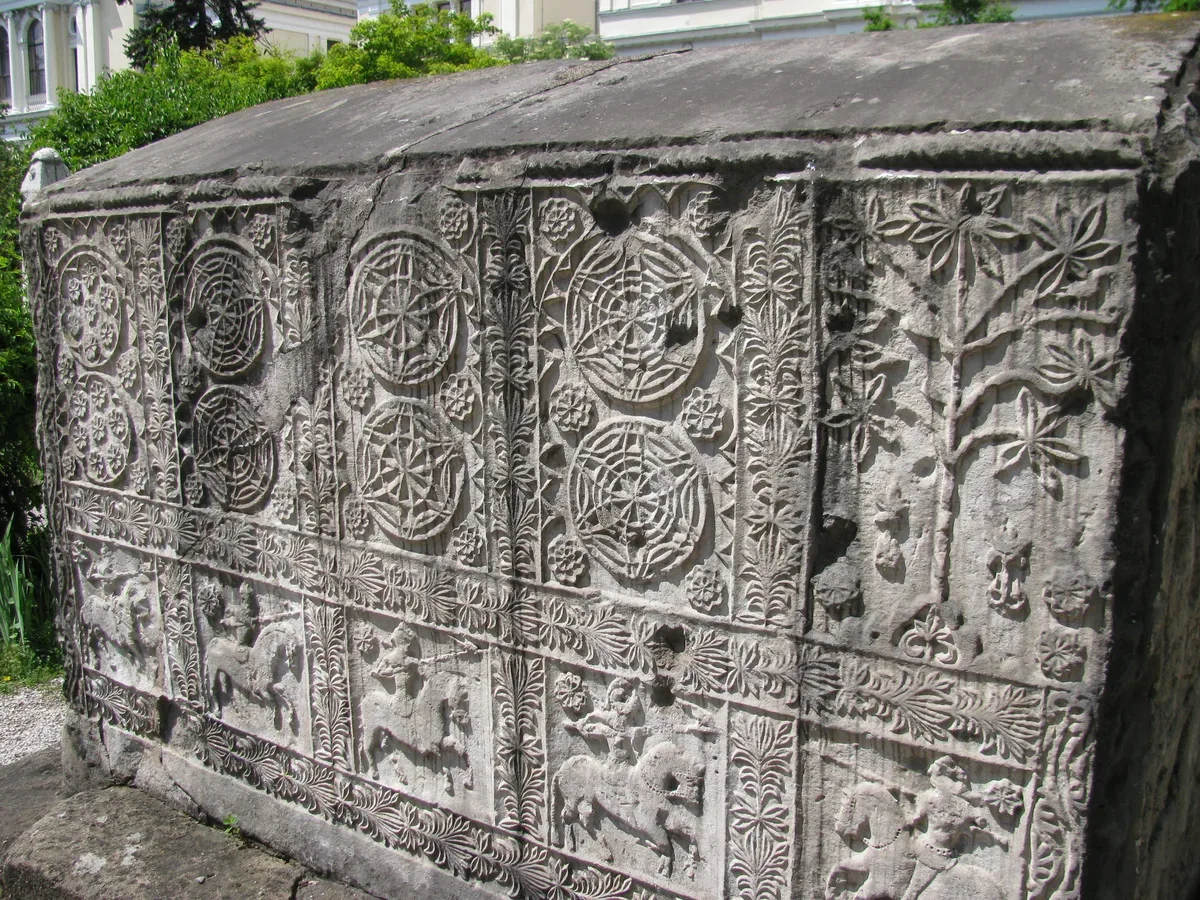
In the Botanical Garden of the National Museum in Sarajevo stands a stone whose capstone runs just over 10 feet (310 cm) long. Carved into it are a fortified town, horsemen, a hunting scene, and rosettes. The name of the person buried beneath it can't be read. Two small plaques once carried the inscription, but time has destroyed the letters.
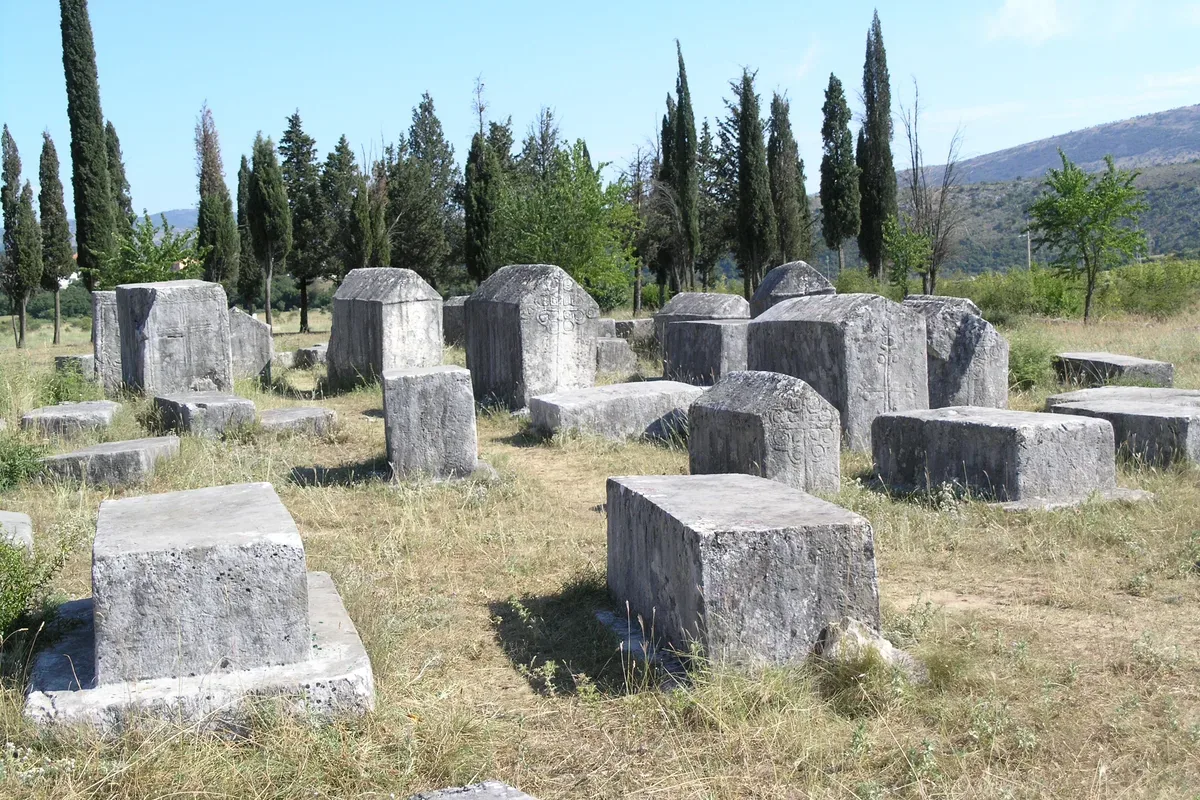
Stećci are medieval tombstones, each one carved from a single block of stone. Families placed them on graves from the 12th through the 16th century.
People call them stone books, but most of these books have no text. This particular stone has survived a relocation and several restorations, and tens of thousands of its relatives are scattered across Bosnia and Herzegovina.
- 1.Ćiro Truhelka Moved the Zgošća Stećak to Sarajevo in 1913
- 2.Bosnia and Herzegovina Is Home to About 60,000 Stećci
- 3.The Bogomil Story Was Born Out of 19th-Century Politics
- 4.The Cross on Stećci Undercuts an Exclusively Bogomil Origin
- 5.What Radimlja Reveals About What Medieval Carvers Left Behind
- 6.Most Stones Carry No Inscription, and the Reasons Aren't Clear-Cut
Ćiro Truhelka Moved the Zgošća Stećak to Sarajevo in 1913
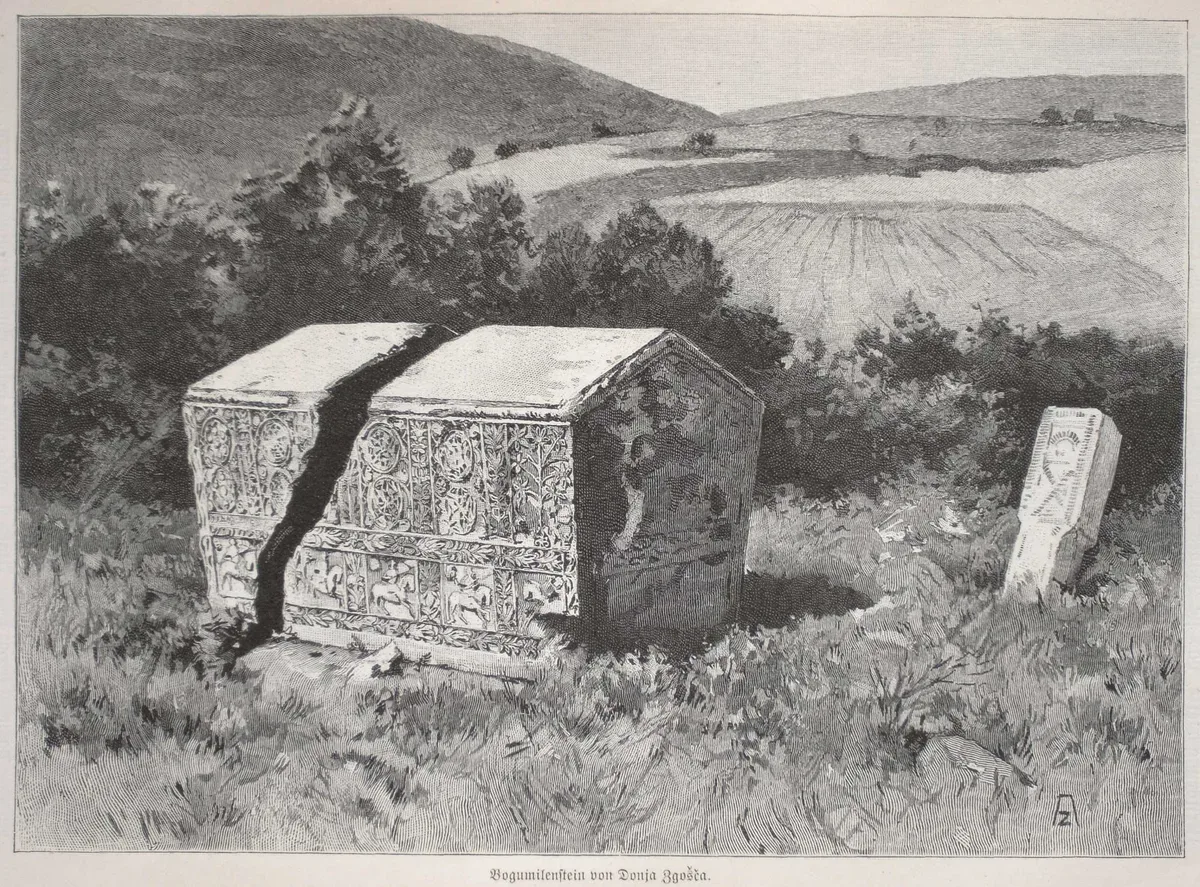
The Zgošća stećak is a gabled tombstone on a base. The sarcophagus itself stands about 4 feet 8 inches tall, 4 feet 6 inches wide, and 8 feet 2 inches long (142 x 136 x 248 cm). Its capstone measures roughly 10 feet 2 inches by 6 feet 8 inches and is about 13 inches thick (310 x 204 x 34 cm).
The Commission to Preserve National Monuments records that Ćiro Truhelka found the stone at the Crkvina necropolis in Donja Zgošća. At the time, Truhelka was working as a curator at the National Museum. The necropolis sits almost equidistant from the royal residences at Kraljeva Sutjeska and Bobovac.
The carvers covered all four sides of the sarcophagus with human and animal figures, plant and geometric motifs, and architectural scenes.
The east side shows a towered town with four figures; the lower band shows two men with horses; the north side shows five horsemen and a hunting scene. Two plaques remain from what was once an inscription, but time has erased the letters.
An older hypothesis from Đorđe Stratimirović attributed the stone to Stephen II Kotromanić. It has remained a hypothesis, never a confirmed fact.
Truhelka moved the stone to the museum, and in the process he also helped cement the idea that stećci were Bogomil graves.
War and time have both damaged the stone. Restorers rebuilt the damaged sections with cement. On June 26, 2019, the Commission declared the collection a national monument.
Bosnia and Herzegovina Is Home to About 60,000 Stećci
The German broadcaster Deutsche Welle reported in 2014 that about 70,000 stećci had been catalogued across the region, 60,000 of them in Bosnia and Herzegovina.
UNESCO lists more than 70,000 monuments at over 3,300 sites.
A 2023 survey puts the figure at about 70,000 monuments across more than 3,162 sites. A 2025 paper cites more than 72,000, most of them in Bosnia and Herzegovina.
In 2016, UNESCO added 28 necropolises to the World Heritage List. Twenty of them are in Bosnia and Herzegovina, two in Croatia, three in Serbia, and three in Montenegro. The combined site encompasses about 4,000 selected stećci.
UNESCO inscribed the stećci under criteria (iii) and (vi), covering exceptional testimony to a cultural tradition and a direct link to events, living traditions, ideas, and beliefs of universal significance. Most stećci were carved in the 14th and 15th centuries.
Radiocarbon dating of graves at the Krešić cemetery in Paoča suggests that burials under stećci may have continued into the 17th century. More recent research has pushed that boundary further still. The 2023 survey takes up the question of where, and why, the stećci tradition disappeared.
The gap between these estimates shows that cataloguing stećci is still unfinished work. Some monuments have vanished, some have been damaged or moved, and others have only been recorded in more recent surveys.
The Bogomil Story Was Born Out of 19th-Century Politics
The Austro-Hungarian administration occupied Bosnia and Herzegovina in 1878. Researchers such as Monika Milosavljević argue that linking stećci to the Bogomils was part of a broader political project under Benjámin Kállay.
Arthur Evans traveled through Bosnia in the late 19th century and promoted that connection. János Asbóth and Ćiro Truhelka went on to develop it further.
The theory fit neatly into a romantic image of a persecuted church guarding the secret of Bosnian identity. Miroslav Krleža took up the stećci in his writing, and Mak Dizdar devoted an entire poetry collection, Stone Sleeper, to them. Scholars briefly abandoned the theory in the early 20th century, then revived it in the 1990s in a new political context.
The decisive argument against the theory wasn't political, though. It was archaeological. The cross is one of the most common motifs on stećci, and that doesn't fit a story of exclusively Bogomil graves.
Srećko Džaja and Dubravko Lovrenović separated Bogomilism from the Bosnian Church. Lovrenović took the theory apart point by point.
The Cross on Stećci Undercuts an Exclusively Bogomil Origin
UNESCO describes stećci as an interfaith practice. Members of the Bosnian Church, Catholics, and Orthodox Christians all buried their dead beneath them.
That doesn't mean every stećak is the same. Some inscriptions name members of the Bosnian Church, some carry no religious marker at all, and others mention different faiths entirely.
More recent scholarship separates Bogomilism from the Bosnian Church outright. The Bosnian Church was a schismatic, autocephalous body in its own right.
Its members were buried under stećci, but the stećci were never theirs exclusively. The Church had its own krstjani and an administrative structure.
The Bogomil theory survived because it offered a simple answer to a complicated question. Stećci were visible, numerous, and mysterious, all at once.
The Bogomils were a persecuted group who fit neatly into a romantic narrative of Bosnian distinctiveness. National ideologies have each claimed the stećci for themselves, in their own way.
What Radimlja Reveals About What Medieval Carvers Left Behind
Radimlja, near Stolac, is one of the best-known necropolises in Bosnia and Herzegovina.
The Commission to Preserve National Monuments recorded 133 stećci there in 1967. Carvers decorated 63 of them. Inscriptions appear on five. These figures come from a single decision, not a final, all-time count.
The necropolis holds 36 slabs, 27 chests, and 24 chests on a base. There are also four tall chests, five tall chests on a base, two gabled tombstones, 31 gabled tombstones on a base, and three cross-shaped tombstones.
The carvers quarried their stone about half a mile (800 meters) to the northeast, where one unfinished stećak still remains. They roughed out the basic shapes at the quarry and did the finishing work at the necropolis itself.
The necropolis runs northwest to southeast, and its stone is limestone from that same nearby quarry. The Čapljina-Stolac road cuts straight through the necropolis. Road construction destroyed about 20 monuments and used them as roadbed material.
The same motifs recur across Radimlja: the sun, stars, a crescent moon, crosses, shields, swords, bows and arrows, hunting scenes, dances, and figures with one arm raised high.
Some researchers read the deer as a pre-Christian symbol, but that remains an interpretation, not proof. Radimlja is now part of the UNESCO World Heritage listing.
Most Stones Carry No Inscription, and the Reasons Aren't Clear-Cut
Inscriptions are rare. Marko Vego compiled most of the known texts into a collection that remains, to this day, an unmatched catalog.
Most are written in Bosnian Cyrillic script. These texts record names, prayers, and small details of the lives they commemorate.
Most stećci have no inscription at all. Time has destroyed some texts, and people have damaged others. For still more stones, there's no evidence letters were ever carved on them in the first place.
The Vlach theory was the other big story. It held that stećci were carried, both physically and culturally, by the Vlachs, a pastoral community found across the wider Balkans.
A 2025 critique by Monika Milosavljević shows that this theory leaned on outdated anthropological typologies, especially the idea of a "Dinaric type."
That doesn't mean the Vlachs weren't part of the story. It means they weren't the whole answer. Vlachs were part of the medieval society that produced stećci, and some were buried beneath them, but how large a role they played is still unclear.
Stećci aren't just an archaeological puzzle. They're also part of a UNESCO World Heritage site and an ongoing question of preservation. Time has destroyed many, museums have taken in others, and the rest still stand in meadows and along roadsides.
The Zgošća stećak is one of the most richly decorated stones in the country, carved with a town, horsemen, a hunt, rosettes, and two plaques that once carried a name.
Stratimirović could make out only the last two letters. The name itself has stayed unknown.
Cover photo: Matěj Baťha, BiH, Radimlja necropolis 5, CC BY-SA 3.0, via Wikimedia Commons.
SOURCES
- UNESCO World Heritage Centre, Stećci Medieval Tombstone Graveyards, list 1504
- Commission to Preserve National Monuments of BiH, Radimlja Stećci Necropolis near Stolac, decision
- Commission to Preserve National Monuments of BiH, Collection of Ancient and Medieval Stone Monuments at the National Museum in Sarajevo, decision
- National Museum of Bosnia and Herzegovina, The Zgošća Gable Tombstone
- Tatjana Mičević-Đurić and Edita Vučić, "Gdje su 'nestali' stećci?", Godišnjak Centra za balkanološka ispitivanja 52 (2023), 159-173
- Monika Milosavljević, "The Indigenous under the Stećci?", Etnoantropološki problemi 20(3) (2025)
- Dženan Dautović, "Crkva bosanska i stećci", Historijska misao 6 (2021), 11-44. DOI: 10.51558/2303-8543.2021.6.6.11. Wayback copy.
- Emir Musli, "Čiji su naši stećci?", Deutsche Welle, 23.11.2014
Aron Corvin
Curiosity draws me to stories that lie at the edge of the known and the unknown. I explore mysteries, unusual phenomena, and forgotten events, taking the time to research each subject thoroughly, without sensationalism or unfounded claims. Thank you for reading Anomyst. If you enjoy my work and would like to support it, your support means a great deal to me and helps me continue exploring and sharing new stories.