
The Basque Atlantis Legend: What the Blood, Bones, and Language Actually Show
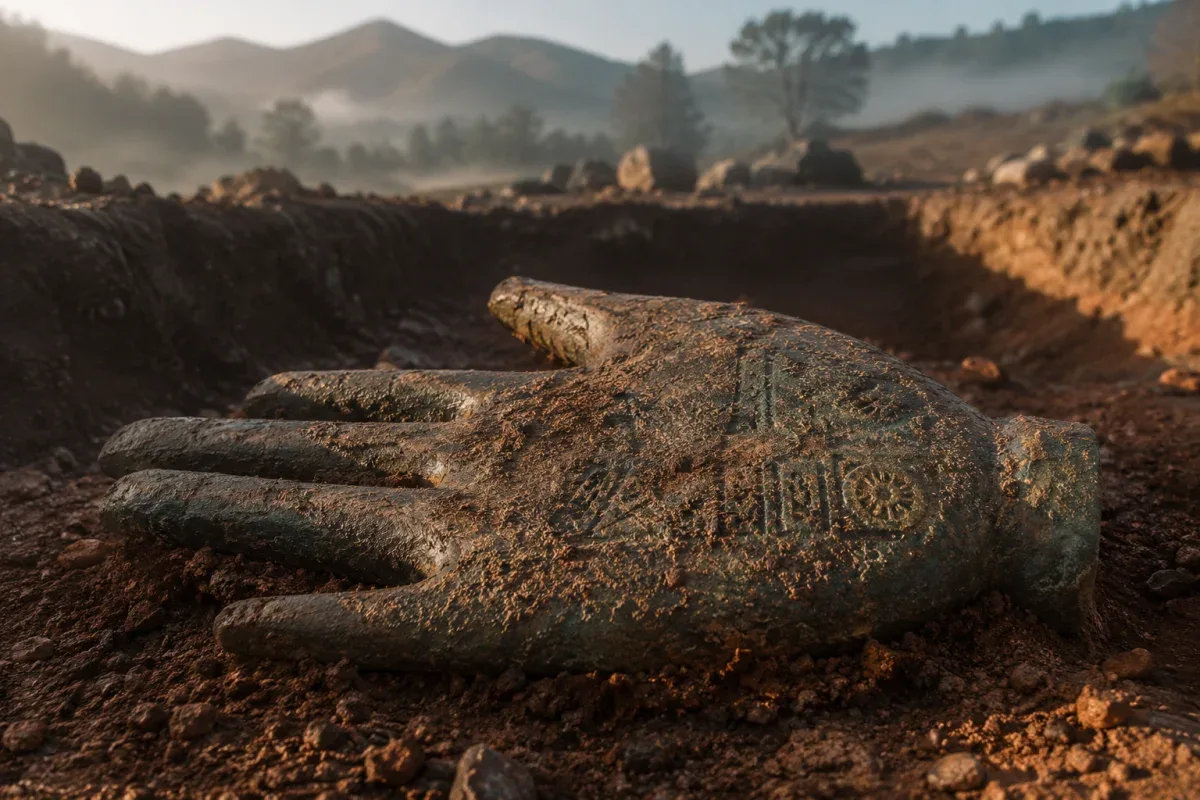
In June 2021, archaeologists digging on a hillside near Pamplona lifted a flat piece of bronze, shaped like an open right hand, out of the ash layer of a torched Iron Age settlement. It sat in storage through a long restoration process.
Only in late 2022, once conservators had cleaned away two thousand years of corrosion, did anyone notice four lines of carved symbols on the back of the hand, as Smithsonian Magazine later reported.
Epigraphers have proposed readings for two of the roughly five words on the hand, though both remain debated.
The 2024 paper in the journal Antiquity that formally described the find reads the opening word two different ways depending on which of two inscription techniques on the bronze is followed: "sorioneke" in the finer scratched text, "sorioneku" in a separate dotted version.
Either is close to the modern Basque "zorioneko," meaning good fortune, though the researchers call the exact suffix change unexpected and are still debating what it implies.
The same paper tentatively proposes a closing word, "eraukon," as a possible form of an old Basque verb meaning to give or offer — a reading the authors call more convincing than when they first floated it, but still short of settled.
Before this find, most linguists had assumed the pre-Roman Vascones left behind little to no epigraphic evidence of their own, using writing, if at all, mainly on coinage.
That bronze hand sits at the center of a much larger claim, one that circulates constantly online: that the Basque people of the western Pyrenees are the last descendants of Atlantis.
The pitch usually runs the same way.
Their language matches nothing else on Earth. Their blood carries a trait found almost nowhere else.
Their own folklore, some say, remembers a drowned homeland called Atlantica.
Two of those three claims hold up. The third has a much younger and far less mysterious origin than the legend admits.
The Empire Plato Invented
Around 360 BC, Plato described an island empire beyond the Pillars of Hercules — the Strait of Gibraltar in modern terms — ruled by ten kings descended from the sea god Poseidon.
Its capital, in his telling, was built as rings of land and water, its walls faced in a gleaming metal called orichalcum, its throne succession settled by a ritual bull hunt performed without weapons.
Earthquakes and flooding swallowed the whole island in a single day and night.
Plato's dialogues are the only surviving ancient texts that give the story in anything like full form, and Plato himself said it reached him secondhand, through a chain of retellings going back to Solon and an Egyptian temple archive, as Britannica's overview of the legend lays out.
No such Egyptian record has ever surfaced.
Most classicists today read Atlantis as a philosophical device rather than history, a fictional case study Plato built to warn against imperial overreach.
No physical ruins matching his description have turned up anywhere in the Atlantic, and scholars still cannot agree on where, if anywhere, he intended it to sit.
Real candidates have been proposed anyway.
One German researcher pointed to a site in the marshlands north of Cadiz using satellite imagery.
Decades earlier, historian Adolf Schulten suggested Plato drew on the vanished Iberian city of Tartessos.
Neither theory has produced physical confirmation strong enough to move Atlantis out of the category of literary myth.
Where "Atlantica" Actually Comes From
The idea that Basque tradition already remembered Atlantis did not start in the Basque Country.
The earliest widely documented written version traces to 1882, in a book called Atlantis: The Antediluvian World, by Ignatius Donnelly, a Minnesota politician with no training in linguistics or archaeology.
Donnelly argued that the Basque language's total isolation from every other tongue in Europe was best explained if Atlantis had once been a land bridge connecting Europe, Africa, and the Americas, and the Basques were what survived on the European end.
Historians and folklorists now generally classify his book as pseudoarchaeology rather than scholarship.
No Basque-language source predating Donnelly's book has turned up in the available research describing a lost homeland by that name, though a negative like that can never be fully proven, only left unrefuted.
The largest surviving collection of pre-Christian Basque folklore, compiled decades later by the ethnographer José Miguel Barandiaran, records local deities such as Mari and Sugaar, along with cave spirits and weather myths, but nothing resembling Plato's island empire.
Whether individual families were quietly telling flood stories before Donnelly's book reached a wide readership isn't something a search can settle either way.
What the documented record shows is closer to the reverse of the popular version: the term "Atlantica," used as a Basque self-description, gained real currency only after nineteenth-century Atlantis literature had already made the association popular.
The Blood That Should Have Disappeared
The genetic claim is the one part of the legend built on solid, peer-reviewed ground.
Karl Landsteiner and Alexander Wiener identified the Rh factor, a protein on the surface of red blood cells, in 1940.
People who lack it are Rh-negative, and the trait is recessive, meaning it can persist unnoticed for generations before showing up in a child.
Roughly 15 to 17 percent of Europeans are Rh-negative, and the rate drops below 1 percent through most of Asia and Africa.
A 2018 study in the European Journal of Human Genetics put a precise figure on it: the Basque population carries the RHD gene deletion — the mutation behind Rh-negative blood — at a frequency of 47.2 percent, the highest such allele frequency documented in any population studied.
That number describes the gene, not the person; because the trait is recessive, only someone who inherits the deletion from both parents actually has Rh-negative blood.
A separate, molecular reappraisal of French Basques published in Human Heredity in 2004 measured the RhD-negative phenotype directly and found it as high as 29 percent, well above the 15 to 17 percent typical of the rest of Europe and far above the under-1-percent rates seen through most of Asia and Africa.
The same researchers could not confirm that natural selection had actively favored the trait, despite an obvious biological cost: when an Rh-negative mother carries a second Rh-positive pregnancy, her immune system can attack the fetus, a condition called hemolytic disease of the newborn that was frequently fatal before treatments developed after the 1940s.
That cost makes the trait's persistence at such a high frequency counterintuitive, though population genetics allows for more than one route to that outcome — genetic drift, founder effects, and small population size can all push a costly recessive trait to unusually high frequency without any selective advantage at all.
The paper's authors leaned toward that kind of demographic explanation over an adaptive one, while stating plainly that neither hypothesis has been clearly demonstrated.
The Rest of the Case File
A few smaller claims often get folded into the Atlantis story, and each turns out to be thinner than advertised.
One holds that Basque whalers reached Newfoundland a century or more before Columbus.
Basque crews were unquestionably whaling and fishing off Newfoundland by the early 1500s, and some scattered tax and toponymic records have been read as evidence of a much earlier presence.
The historian Jean-Pierre Proulx, in a 1993 Parks Canada study on Basque whaling in Labrador, found no archival document placing Basques in North American waters before the early 1500s, and no Basque oral tradition, independent of the modern claim, of any earlier voyage.
The other holds that Basque fishing communities preserve names for valleys and hills now underwater in the Bay of Biscay.
Sea levels worldwide did sit around 400 feet lower during the last glacial maximum, so a submerged coastal landscape is geologically real.
No source outside Atlantis-themed popular writing could be found cataloguing specific Basque names for that seabed, suggesting this detail grew out of the same later literature as the Atlantica legend rather than any independently documented oral tradition.
A third claim concerns bone, not blood or water.
In the 1930s, the discovery of Paleolithic-era remains at the Urtiaga site in Gipuzkoa led two Basque researchers, Telesforo de Aranzadi and José Miguel Barandiaran, to propose in 1948 that the "Basque type" of skull reflected a direct, unbroken local descent from Cro-Magnon populations.
A later radiocarbon reassessment of the Urtiaga skulls, published in the journal Munibe, pushed the key remains to a far more recent period than the original researchers assumed, undercutting the specific evidence the hypothesis rested on.
Physical anthropologists no longer treat a distinct, continuous "Basque skull type" as an established fact, though the idea still circulates in Atlantis-adjacent writing decades after the dating that complicated it.
A Language With No Relatives
Basque genuinely is a language isolate, with no confirmed relative in any language family on Earth.
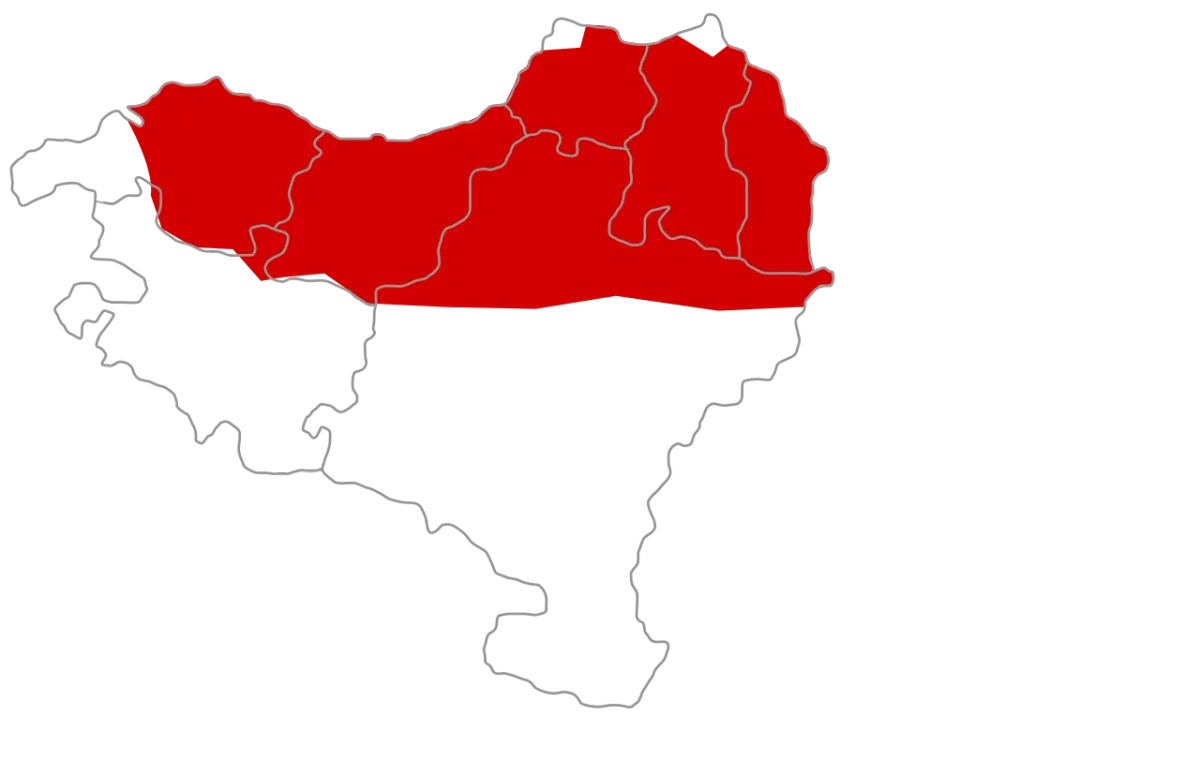
It predates the arrival of Indo-European languages in Western Europe and outlasted Roman rule, Visigothic rule, and centuries of Moorish presence in Iberia.
Under Francisco Franco, the pressure on it turned from cultural erosion into official policy: on May 29, 1937, the military command in San Sebastián ordered that anyone caught speaking a language other than Spanish in public be reported, and similar restrictions on Basque in schools, churches, civil registries, and public life spread across Basque territory as Franco's forces took control of it, holding through most of his 1939–1975 dictatorship.
The language survived that period mainly at home, taught quietly from parent to child rather than in any classroom.
After Spain's transition to democracy, Basque returned to public life and became co-official in its home region under the 1979 Statute of Autonomy.
Some geneticists have linked the region's long isolation to its status as one of Europe's glacial refuges during the last ice age, a period when a small, cut-off population could plausibly have preserved both an unusual language and an unusual gene pool.
That link is a hypothesis about timing, not a settled account of where Basque itself originally came from — a question linguists still cannot answer.
Basque's isolation has invited comparisons with almost every unrelated language family going.
Twentieth-century linguists including René Lafon and Antonio Tovar argued for shared roots with Georgian and the wider Kartvelian family of the Caucasus, based on typological features like ergative grammar.
Two of the most influential Basque specialists of the last century, Luis Michelena and R. L. Trask, later rejected the Caucasian connection outright, and mainstream historical linguistics has not revived it.
Fringe proposals linking Basque to Iberian, Berber, and even a hypothetical global proto-language have followed, none meeting the standard of systematic sound correspondence that would make the case.
What the Hand Still Won't Say
More than four years after its discovery, the Hand of Irulegi hangs in a rebuilt prehistoric gallery of the Museum of Navarre, five and a half inches of bronze carrying four lines of script.
The 2024 Antiquity paper, by the same University of the Basque Country and University of Barcelona researchers who first studied it, could offer tentative Basque-language readings for only two of its five word groups — the opening "sorioneke" or "sorioneku," and the closing "eraukon" — and even those come with open questions its own authors have not resolved.
The rest of the inscription, more than half of it by word count, remains without an agreed meaning, sitting in a case in Pamplona, still waiting on a translation nobody currently alive can finish.
SOURCES
- Words Etched Into an Ancient Bronze Hand Hint at the Mysterious Origins of the Basque Language, Smithsonian Magazine
- Aiestaran, M., Velaza, J., Gorrochategui, J., et al., "A Vasconic inscription on a bronze hand: writing and rituality in the Iron Age Irulegi settlement in the Ebro Valley," Antiquity, 2024
- Flores-Bello, A., et al., "Sequence diversity of the Rh blood group system in Basques," European Journal of Human Genetics, 2018
- Touinssi, M., et al., "Distribution of Rhesus Blood Group System in the French Basques: A Reappraisal Using the Allele-Specific Primers PCR Method," Human Heredity, 2004 — summary via ResearchGate
- Atlantis, Britannica
- Ignatius Donnelly, Atlantis: The Antediluvian World, Harper & Brothers, 1882 — Project Gutenberg edition
- "La persecución al euskera durante el franquismo," Sabino Arana Fundazioa (primary text of the May 29, 1937 military order)
- Basque Whalers, Virtual Museum of New France / Canadian Museum of History
- Proulx, Jean-Pierre, Basque Whaling in Labrador in the 16th Century, Parks Service, Environment Canada, 1993 — listing via Google Books
- Aranzadi, T., and Barandiarán, J.M., "Exploración de la cueva de Urtiaga (Itziar, Guipúzcoa) II," 1948; redating discussed in "Revisión de los cráneos prehistóricos de Urtiaga," Munibe
- "Basque and Georgian – are they related?", European studies blog, British Library
- Sea Level Rise, Smithsonian Ocean
Aron Corvin
A researcher of the unknown who loves a good story, but doesn't sell sensationalism. I research every topic in detail before I publish it. If you enjoy what I write, your support would mean a lot and help me keep going.