
Michio Kushi: The Man Who Said He Could See Behind Reality
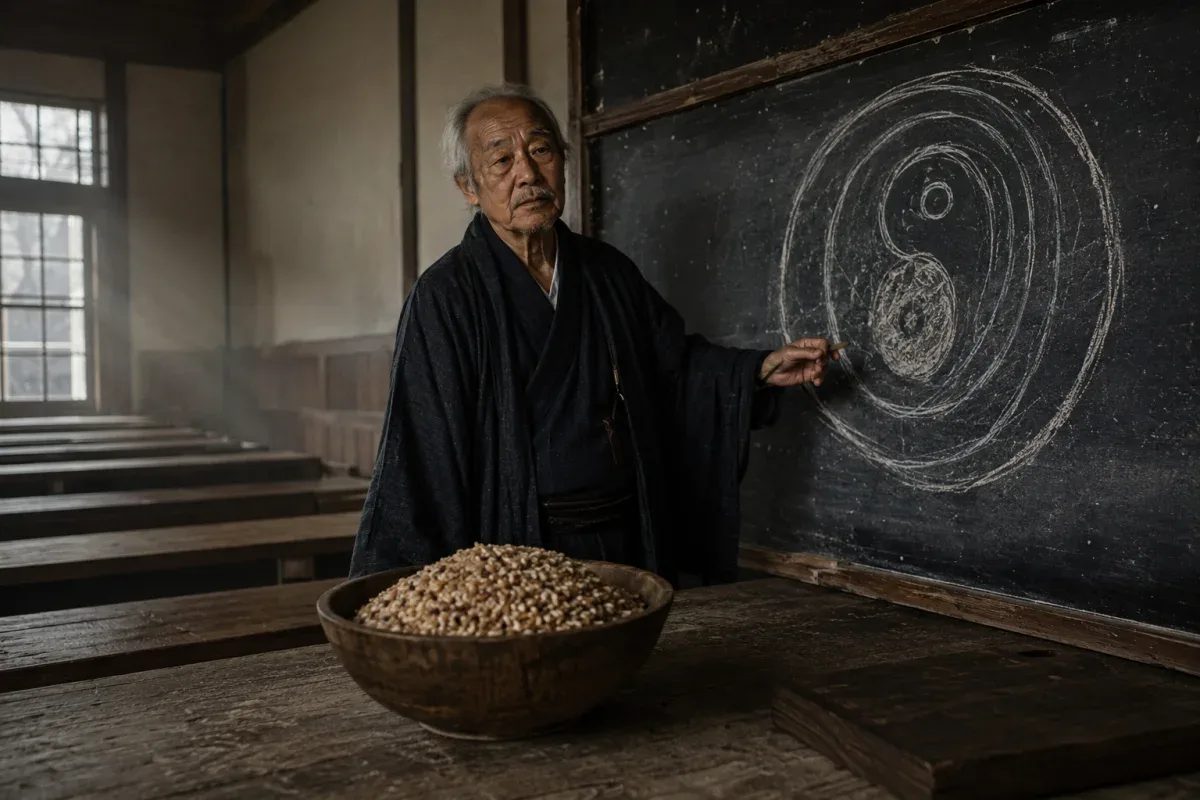
Michio Kushi asked the student to close his eyes and stop thinking. Then he told him to picture the woman he loved. Then he told him to picture war.
When the exercise ended, Kushi explained himself. Every image the mind produces, he said, leaves the body as energy and never truly disappears.
It was a strange demonstration, closer to a Zen koan than a health lecture, and it captured something essential about the man delivering it.
For nearly sixty years, Kushi moved between two identities that rarely coexist in one career: the philosopher who claimed to see the mechanics behind reality, and the practical evangelist who helped persuade generations of Americans to take brown rice and whole foods seriously.
He would go on to co-found one of the most consequential health-food ventures in American retail history.
He would also build, on the same foundation, a theory of cancer treatment that the American Cancer Society rejected as unproven. Both things are true, and neither one cancels out the other.
From a Ruined Country to a New Philosophy
Kushi was born in 1926 in Kokawa, in Japan's Wakayama Prefecture, and came of age during the Second World War.
He studied law and international relations at the University of Tokyo, then continued his education at Columbia University after arriving in the United States in 1949.
The devastation he witnessed as a young man, colleagues later said, pushed him toward an unusual combination of interests: the political project of world peace, and the conviction that peace had to start with what people put on their plates.
In postwar Japan, Kushi encountered George Ohsawa, a writer and teacher who had spent decades developing his own philosophy of diet and cosmology, one built on the East Asian concept of yin and yang.
Ohsawa had been publishing on the subject since the 1930s, arguing that a return to whole, unprocessed grains could restore both physical and social harmony.
Kushi absorbed this framework and, over the following decades, rebuilt it into something more systematic. He called it macrobiotics — from the Greek for "long life."
During his years in New York, Kushi also studied international relations at Columbia and, by his own later account, crossed paths with figures including Albert Einstein and the novelist Thomas Mann, part of a broader effort to place his food philosophy inside a larger project of averting war.
That ambition never left him.
Decades later he would still frame a bowl of rice as a small act of diplomacy, one meal at a time, standing between a society and the aggressive impulses he believed a Western diet encouraged.
In the early 1960s, Kushi and his wife, Aveline, opened a small natural-foods outlet in Boston that would grow into Erewhon, widely credited as the first health-food store of its kind in the United States.
From that starting point, the couple built an entire institutional apparatus: the East West Journal, the East West Foundation, the Kushi Foundation, and eventually the Kushi Institute, founded in Brookline, Massachusetts, in 1978.
A second campus followed in the Berkshire hills of western Massachusetts in 1985. Kushi lectured constantly, wrote or co-wrote dozens of books, and by his own account addressed audiences at the United Nations and the World Health Organization on the subject of food and peace.
Recognition followed at a scale unusual for a dietary movement.
Kushi received an award from the United Nations Society of Writers.
The Smithsonian's National Museum of American History opened a permanent archive named for Michio and Aveline Kushi, and the U.S. House of Representatives passed a citation honoring Kushi's work.
The couple also received the Peace Abbey's Courage of Conscience Award.
None of that institutional recognition, however, addressed the medical claims building underneath the movement's more mainstream achievements.
A Cosmology Built on Grain
Kushi's teaching never stayed confined to nutrition.
It extended into a full cosmology, one in which the same forces that shaped a bowl of rice also shaped a solar system.
In some of his recorded lectures, he described human existence as a rounding error against galactic time — a single lifetime measured against the roughly 230-million-year orbit of the sun around the center of the Milky Way, a figure drawn from real astronomical estimates that Kushi then used to argue that no single human decision, including the arrangement of a school system or a career, was as fixed or as natural as it appeared.
Nobody chooses school, a job, or retirement at sixty-five on their own, he argued; people are born into that schedule the same way they are born into a nationality.
He described the pattern almost literally: a person spends a lifetime selling their hours by the clock, and the moment nobody wants to buy them anymore, the system calls it retirement.
It was social criticism wrapped in cosmic language, and it is one of the reasons Kushi's lectures reached audiences well beyond people who cared about diet.
When Food Becomes a Verdict
For Kushi, illness was never simply an external event.
A virus, he taught, might enter the body, but it could only take hold if the body's internal condition allowed it.
There is a kernel of accepted medical reality inside that claim — immune resilience genuinely affects how an infection unfolds — but Kushi extended it much further, arguing that disease was ultimately the direct consequence of diet and personal choice.
This is where his teaching moved from philosophy into the specific practice he called macrobiotics.
Meat, he argued, stirred images of war and conflict inside the body. Sugar and dairy fed sentimentality and grief.
Whole grains — brown rice, barley, wheat, corn — worked in the opposite direction, calming the mind and, in his words, bringing a person closer to what he called paradise.
The logic ran on the same yin-yang framework as his cosmology: meat and sugar were classified as excessively yang or excessively yin, pulling the body and mind out of balance, while whole grains sat naturally at the center of that scale.
From that same logic came smaller, oddly specific claims that sounded testable even when they never were.
Kushi taught that mosquitoes avoided people whose blood had thickened through proper macrobiotic eating.
Claims like this were never studied under controlled conditions, but their sheer concreteness is part of what made his teaching feel more persuasive than typical spiritual literature.
Vague promises of wellbeing are easy to dismiss; a specific claim about mosquitoes invites a listener to test it against their own life.
In practical terms, the standard macrobiotic diet Kushi taught centered on whole cereal grains, making up roughly half of a given meal, alongside locally grown vegetables, beans, and mineral-rich sea vegetables such as nori, kombu, and wakame.
Meat, dairy, refined sugar, and tropical or heavily processed foods were minimized or avoided entirely, along with, in stricter versions, tomatoes, potatoes, and other nightshade vegetables that Kushi's system classified as excessively yin.
Followers were also taught to chew thoroughly, cook with specific methods believed to balance a food's energetic properties, and adjust their eating with the seasons — practices that, independent of the cosmology behind them, resemble general nutritional advice offered by mainstream dietitians today.
The same movement that produced these dietary guidelines also drew accusations of being something closer to a cult.
Critics pointed to practices such as diagnosing a person's health or character from their place and time of birth, a method modern medicine has no basis for accepting.
Supporters countered that the label ignored the plain, testable value of eating more vegetables and less processed food, whatever cosmology surrounded the advice.
The Claim That Divided His Legacy
That same reasoning produced Kushi's most controversial belief.
Disease, including cancer, was not something that arrived from outside a person, in his framework, but a consequence of individual choices and what he termed "self-centered thinking."
In one recorded lecture, he illustrated the idea with a first-person story about a woman who believed sugar and cheese were healthy foods and later developed breast cancer.
The fault, he concluded in that story, belonged not to a virus or to chance, but to her own perception of reality.
This is precisely where Kushi's teaching parted ways with organized medicine.
The American Cancer Society addressed the macrobiotic diet directly in a 1984 review published in CA: A Cancer Journal for Clinicians, concluding after examining the available literature that it had found no evidence that macrobiotic diets produced any objective benefit in treating cancer, and urging people with the disease not to rely on the approach.
The Society added a further warning: stricter versions of the diet could pose a serious hazard to health in their own right.
Cancer Research UK maintains a similar position today, stating plainly that no scientific evidence supports macrobiotics as a cure for cancer, and warning that some of the diet's stricter historical forms caused severe malnutrition.
The Doctor Who Made Macrobiotics Famous
Much of macrobiotics' reputation as a "cancer cure" traces back to a single, highly publicized case.
Anthony Sattilaro was the chief executive of Methodist Hospital in Philadelphia when he was diagnosed with prostate cancer that had already spread to his bones.
According to his own 1982 memoir, Recalled by Life, he picked up two hitchhikers on the New Jersey Turnpike shortly after his diagnosis, who introduced him to macrobiotic eating.
Follow-up scans, he wrote, later showed his bone lesions had resolved.
The book became a bestseller, selling more than 300,000 copies and drawing national magazine coverage, and it sent a wave of new patients toward Kushi's institute.
Sattilaro continued to promote the diet through television appearances, including a national spot on The Merv Griffin Show, and a second book, Living Well Naturally, in 1984.
He was not the first such case Kushi's circle had publicized; a 1979 memoir by a music professor named Jean Kohler had already described an apparent recovery from pancreatic cancer through the same diet.
Sattilaro's own apparent remission, however, did not prove permanent. He died of cancer in 1989, a detail that received far less attention in macrobiotic circles than his earlier recovery had.
The Son Who Studied His Father's Claims
Few figures were better positioned to evaluate macrobiotics scientifically than Kushi's own son, Lawrence (also known as Haruo) Kushi, who became an epidemiologist.
In a 2001 review published in the Journal of Nutrition, he and his co-authors concluded that a macrobiotic-style diet — heavy in vegetables, light in meat, high in fiber — probably lowered cancer risk simply because it shared features with any generally recommended healthy diet.
But the scientific basis for using it as a treatment for existing cancer, they wrote, remained limited, and any confident recommendation in either direction likely reflected the biases of whoever was making it.
Lawrence Kushi later tried to do something more demanding than argue the point: track, patient by patient, the people who had come to his father's office with cancer between 1981 and 1984.
The project never reached completion.
One account holds that the funding fell through and that an earlier grant covering similar ground had been rejected by reviewers who considered macrobiotics unworthy of investigation; the same account suggests the study was to have been led not by Kushi but by a fellow co-author of the 2001 review.
The details of the proposed project are difficult to reconstruct from the surviving public record, and accounts differ over how it was meant to proceed.
The uncertainty his father built a career denying was, in the end, the same uncertainty his son spent a career trying to measure.
What Survived, and What Didn't
Very little of today's health-food culture openly credits Kushi's movement, but the debt runs deep.
The idea that food should be whole, seasonal, and minimally processed — a position that one former director of the Kushi Institute has said was once considered entirely marginal — now sits at the foundation of nearly every popular diet trend, from paleo to plant-based eating.
The habit of tying food choices to identity and moral virtue, an idea Kushi repeated for decades before it became an industry unto itself, followed the same path into the mainstream.
Even his critique of conventional work and retirement echoes today in movements built around simple living and early financial independence, aimed at an entirely new generation.
Erewhon itself is the clearest thread connecting Kushi's 1960s storefront to contemporary culture.
The chain his wife opened as a small outlet selling brown rice and miso has, decades later, become a Los Angeles-based grocery brand known for collaborations with celebrities and viral, expensive smoothies — a transformation almost nobody involved in the original macrobiotic movement could have anticipated, and one that has little to do with the medical claims that once defined the Kushis' work.
The Kushis sold the company in 1983, so the thread from their 1960s storefront to today's Los Angeles brand runs through different hands — a continuity of name and lineage rather than of ownership.
What did not survive the transition into wider culture was the claim sitting at the very center of Kushi's original teaching: that diet could substitute for medicine.
Cancer organizations today reject that idea explicitly, and even macrobiotics' own modern advocates tend to speak in the language of probability and further research rather than certainty and promises.
The gap between those two positions — food as one factor among many, versus food as the deciding factor in life and death — is the same gap that separated Kushi from his own son's research for decades, and it has never fully closed.
Boston, December 2014
Kushi delivered lectures like the one about war and love for decades, always returning to the same central claim: that diet was the primary cause of disease, and that the right food choices could prevent it, or even reverse it.
The institute that bears his name described its program, in wording reported by The Daily Meal in 2015, as a path to "extraordinary health" that could help with cancer, diabetes, psoriasis, and more.
His wife, Aveline, co-founder of Erewhon and of the entire movement built around it, died in 2001 of cervical cancer, nine years after her diagnosis.
She underwent standard medical treatment first; only after being told that conventional options were exhausted did she turn to acupuncture and other Eastern approaches.
Their daughter had died of cancer in 1995. Michio Kushi died on December 28, 2014, in Boston, at the age of 88.
The Kushi Institute confirmed the cause: pancreatic cancer.
Recordings of his lectures, including the one that opened with closed eyes and an imagined war, still circulate online, more than a decade after his death.
His son Lawrence, the epidemiologist who spent years studying the link between diet and cancer, told The New York Times at the time that many different factors contribute to cancer, and that a great deal about the disease still isn't understood.
The Kushi Institute's own website once promised, in the present tense, that following the founder's program could help prevent and relieve the illness that ultimately killed him.
SOURCES
- American Cancer Society, Unproven methods of cancer management: macrobiotic diets, CA: A Cancer Journal for Clinicians, 1984.
- Cancer Research UK — Macrobiotic diet
- Kushi LH, Cunningham JE, Hebert JR, et al., The Macrobiotic Diet in Cancer, Journal of Nutrition, 2001.
- Natural Foods Pioneer Michio Kushi Dies at 88, Rafu Shimpo, 2015.
- Retrobituaries: Michio Kushi, Natural Foods Pioneer, Mental Floss, 2016.
- Remembering Michio Kushi, Physicians Committee for Responsible Medicine, 2015.
- Douglas Martin, Aveline Kushi, 78, Advocate of Macrobiotic Diet for Health, The New York Times, July 23, 2001.
- Tamar Lewin, Michio Kushi, Advocate of Natural Foods in the U.S., Dies at 88, The New York Times, January 5, 2015.
- Michio Kushi, Scholar Who Popularized America's Natural Foods Movement, Has Died At 88, The Daily Meal, 2015.
- Anthony J. Sattilaro with Tom Monte, Recalled by Life: The Story of My Recovery from Cancer, Houghton Mifflin, 1982.
- Michio Kushi (ed. Edward Esko), Macrobiotic Seminars of Michio Kushi, One Peaceful World Press, 1998.
- Michio and Aveline Kushi Macrobiotics Collection, Archives Center, National Museum of American History, Smithsonian Institution.
- Questionable Cancer Therapies, Quackwatch.
Aron Corvin
A researcher of the unknown who loves a good story, but doesn't sell sensationalism. I research every topic in detail before I publish it. If you enjoy what I write, your support would mean a lot and help me keep going.