
The Baalbek Megaliths: The 1,650-Ton Stone the Romans Left Behind
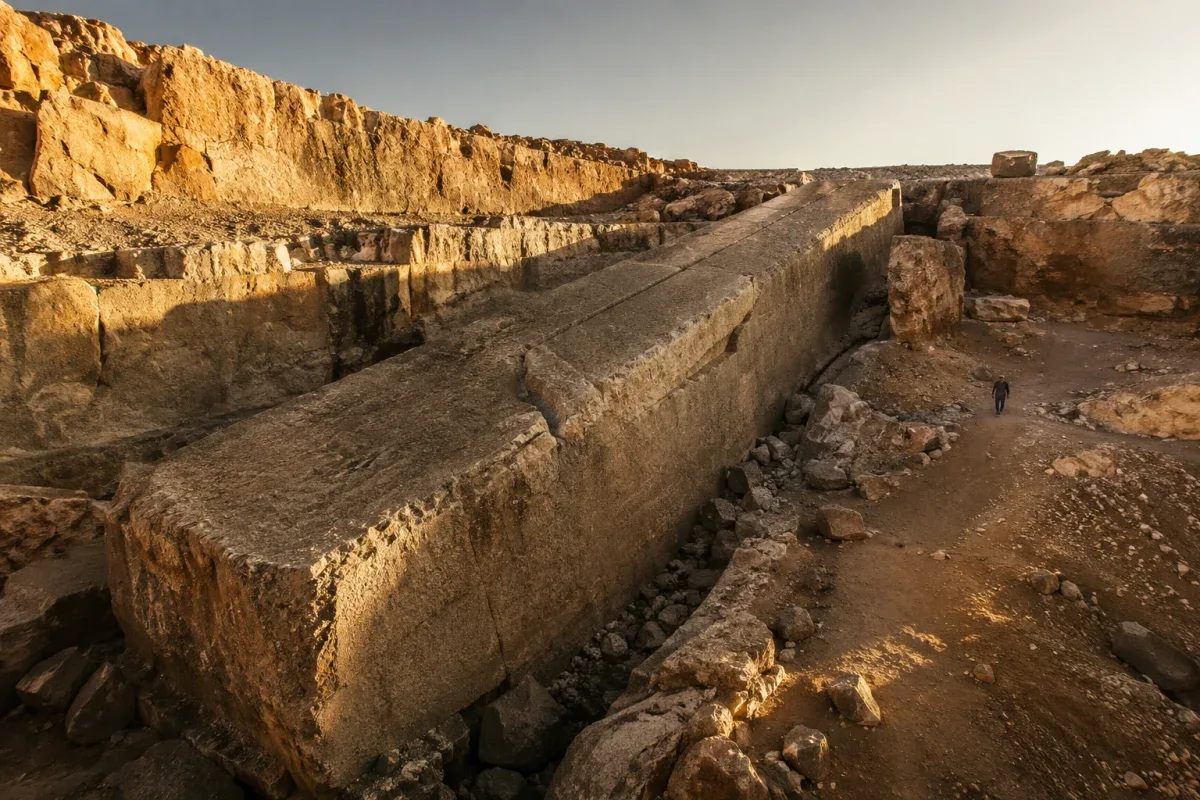
In a quarry southeast of Baalbek, in Lebanon's Bekaa Valley, a block of limestone longer than a city bus has sat half-cut from the bedrock for nearly two thousand years — smoothed on three faces, shaped for hauling, then abandoned. Locals call it Hajjar al-Hibla, the Stone of the Pregnant Woman.
At an estimated 1,000 tons, it isn't even the biggest stone in the pit. A second block, unearthed in 2014, weighs roughly 1,650 tons — the largest cut stone documented anywhere in antiquity.
No Roman text explains how any of it was supposed to move, or why a platform this size needed stones this large in the first place.
A City Older Than Rome
Baalbek has been inhabited more or less continuously since the Neolithic, drawn by the fertile soil and abundant springs of the Bekaa Valley.
Beneath the Roman courtyard, archaeologists have found traces of an earlier terrace, possibly the remains of an older sanctuary later buried under the Roman platform.
The city carried the Greek name Heliopolis, City of the Sun, for centuries — a label that took hold sometime in the Hellenistic period.
It's not clear Alexander the Great personally bestowed it after conquering the region in 334 BCE; the name more likely settled in slightly later, under Ptolemaic rule of Egypt.
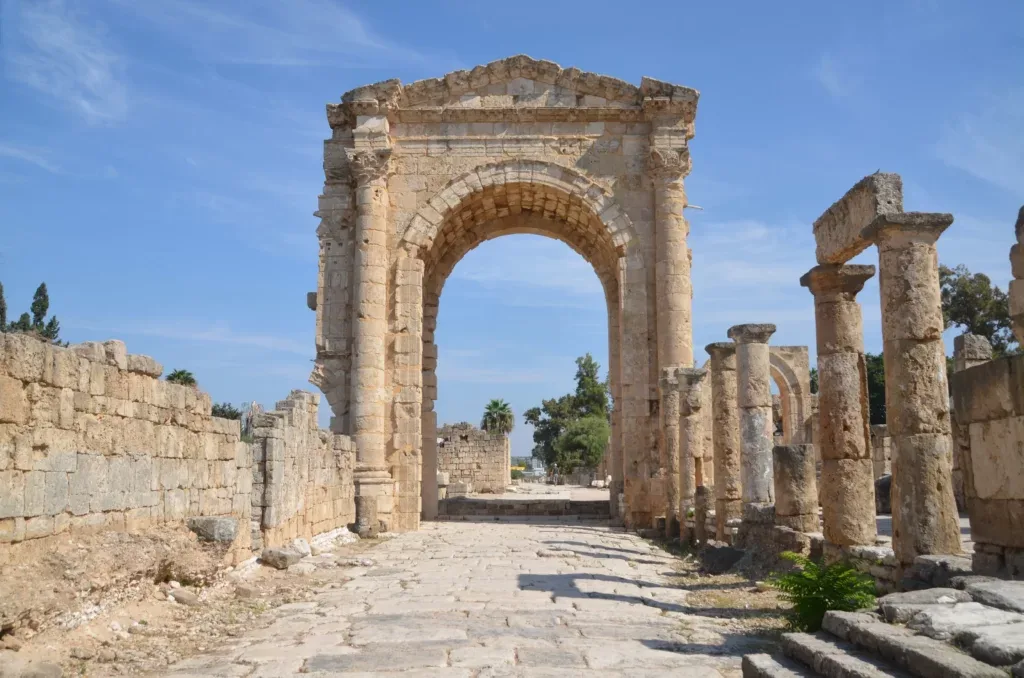
What visitors see today is almost entirely Roman: temples to Jupiter, Bacchus, and Venus, raised between the first century BCE and the third century CE.
Work on the Temple of Jupiter probably began around 16 BCE, under Augustus, and a stonemason's inscription on one column dates the building to near-completion by August of 60 CE.
After the Arab conquest in the seventh century, the name Heliopolis faded and the older name, Baalbek, returned.
The complex didn't stop at the Temple of Jupiter.
A great court in front of it, expanded under Trajan, was ringed by roughly eighty granite columns shipped in from Aswan, Egypt.
Next door stands the better-preserved Temple of Bacchus — larger than the Parthenon in Athens — its doorway carved with vines and grape clusters.
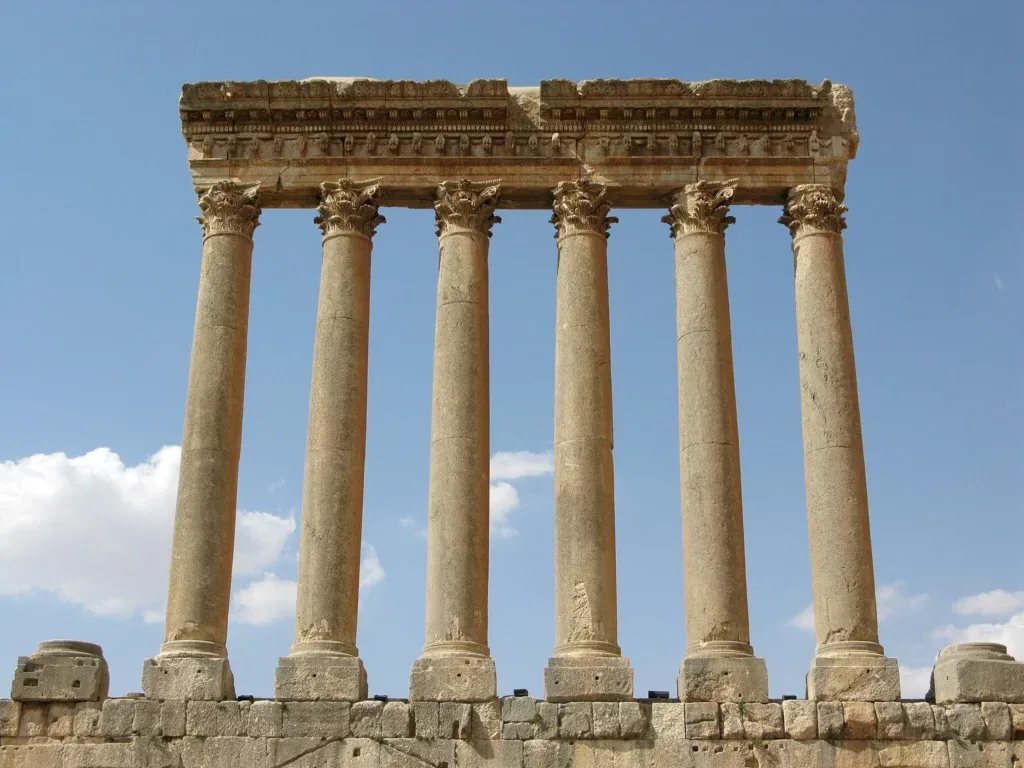
An earthquake in 1759 toppled three of the Temple of Jupiter's last nine standing columns, leaving six. Centuries earlier, under the Byzantine emperor Justinian, eight of the temple's granite columns had already been dismantled and shipped to Constantinople for the Hagia Sophia.
Systematic study of the site predates professional archaeology by more than a century.
In 1757, the British antiquarian Robert Wood published an illustrated volume on Baalbek's ruins that helped fuel a European fascination with the site and left its mark on neoclassical architecture across Britain, Europe, and North America.
The first true excavation didn't begin until 1898, when a German expedition spent five years systematically digging and documenting the ruins.
Research continued in waves through the twentieth century, interrupted by the Lebanese civil war from 1975 to 1990.
UNESCO added the complex to its World Heritage list in 1984, citing it as one of the finest surviving examples of Imperial Roman architecture.
That status mattered again decades later: during Israel's 2024 military campaign against Hezbollah in Lebanon, air strikes landed close enough to the ruins that UNESCO granted Baalbek and dozens of other Lebanese sites emergency enhanced protection, a wartime designation layered on top of the World Heritage status the site has held since 1984.
The Stone That Was Too Big
The quarry sits a short walk from the temple complex, on ground slightly higher than the temple platform — a detail that would have let workers roll finished blocks downhill rather than up.
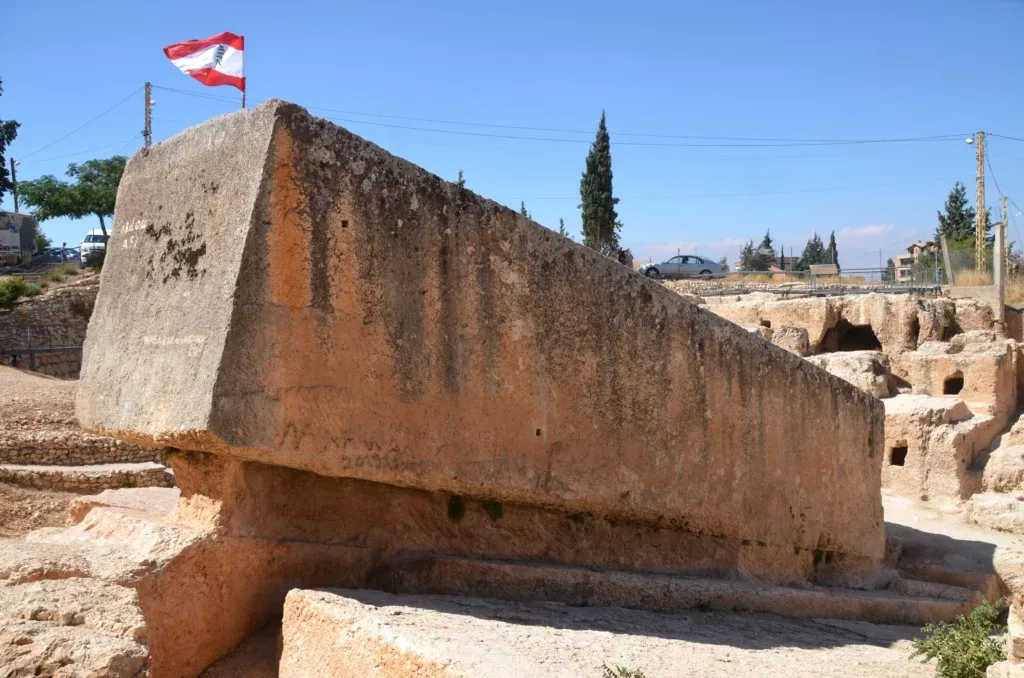
The Stone of the Pregnant Woman itself runs nearly 70 feet long, with tool marks visible on three of its faces where workers began, then abandoned, the job of smoothing its surface.
It isn't the only giant down there.
During a 2014 dig, a team from the German Archaeological Institute, working alongside Lebanese researchers, uncovered a second monolith buried beneath centuries of accumulated debris.
This one had already been cut free from the bedrock on its exposed sides and smoothed as though ready to travel intact, at an estimated 1,650 tons. Three more blocks from this same quarry, at about 800 tons each, did make the trip: they form the base of the Temple of Jupiter, standing 800 meters away.
Popular accounts often say the Stone of the Pregnant Woman was left behind simply because it was too heavy to move.
The German team's own findings tell a narrower story: examining tool marks along one edge of the block, researchers concluded the stone quality there was poor enough to risk cracking during transport, and that flaw, not the raw weight, is the likelier reason it stayed put.
The larger stone found in 2014 posed its own unanswered question, because excavation had to stop before the team could determine why it, too, was abandoned.
Abandoning a flawed block wasn't unique to Baalbek. In Aswan, Egypt, roughly 700 miles away, a granite obelisk of about 1,200 tons — known as the Unfinished Obelisk — sits half-carved in its own quarry after workers found a crack running through the stone partway through the job.
At both sites, masons appear to have made the same call: cut losses rather than risk a finished monument that might fail later.
Dating any of this precisely is difficult, since limestone can't be radiocarbon dated the way organic material can.
Archaeologists instead study debris in the quarry's old waste heaps — broken pottery and other small, datable finds — to work out roughly when the cutting took place.
It's an indirect method, and it leaves real gaps in the timeline.
The Scottish traveler David Urquhart visited the site around 1850 and recorded his reaction in a diary later published as The Lebanon: A History and a Diary (1860). Seeing the stones, he wrote, left him paralyzed by the impossibility of any solution.
Generations of archaeologists since have felt something like that, even after ruling out the more outlandish explanations.
How to Move a Mountain Without a Crane
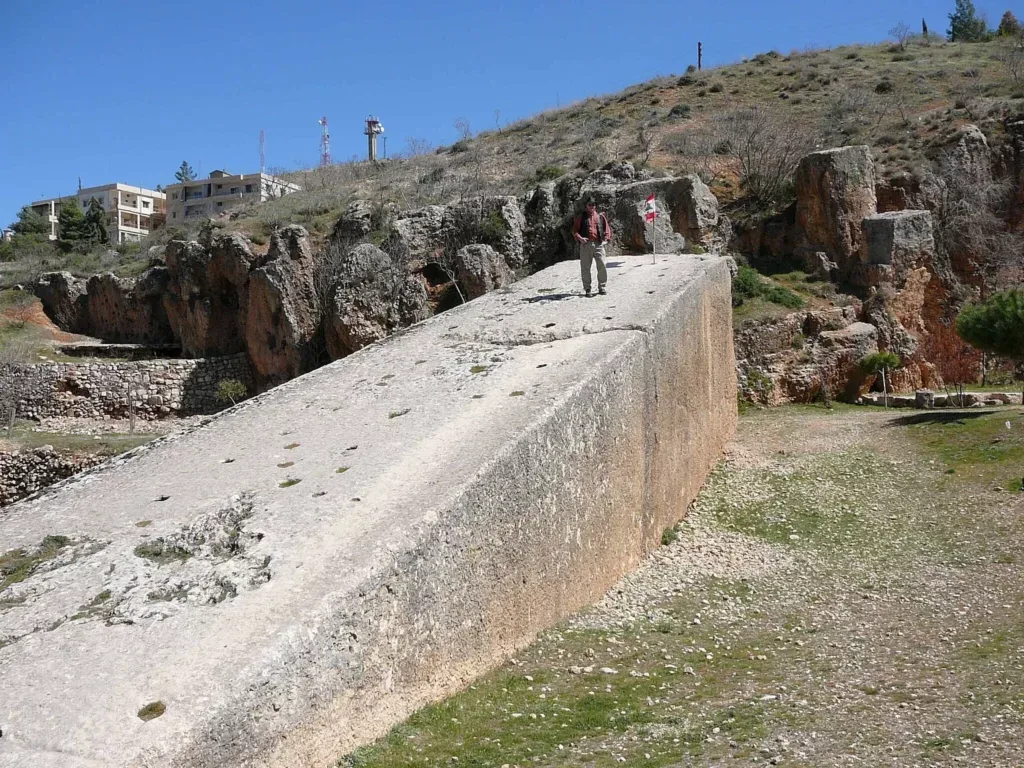
However the Romans planned to shift these blocks, the cutting method is reasonably well understood.
Workers chalked the outline of the intended stone onto the rock face, drilled a line of sockets along it, and drove in wedges until the block sheared free along the marked seam — a technique with a rough parallel in how the people of Rapa Nui later carved their moai.
The archaeologist Margarete van Ess, of the German Archaeological Institute, has argued that the Baalbek blocks were cut using the same methods documented at the Pont du Gard, the Roman aqueduct in southern France.
On the Stone of the Pregnant Woman itself, the shallow marks of that splitting technique are still visible along its edges, next to deeper gouges left by the abandoned attempt to smooth its surface.
Transport is the harder question, since no surviving Roman text describes the method used at this particular site.
In 1977, the French archaeologist Jean-Pierre Adam published a detailed study proposing that the blocks moved on wooden rollers, hauled by capstans and pulley systems — a setup he calculated could shift a 557-ton block using roughly 512 workers.
That's smaller than the Trilithon blocks, let alone the 1,650-ton stone found in 2014, and the math only gets steeper as the weight climbs.
Other researchers have proposed oiled or water-lubricated sledges, and ox teams working with earthen ramps, to explain how the blocks that did leave the quarry reached their destination.
None of these methods has been confirmed by direct evidence at the site itself; they are reconstructions built from Roman building practice documented elsewhere in the empire.
What is documented is that known Roman cranes generally weren't built to lift loads in the tens of tons, let alone hundreds.
Blocks in the 300-to-800-ton range would have needed purpose-built rigging, or several systems working together — and no ancient author bothered to write down which.
Giants, Genies, and the Rockets That Never Existed
Stones this size have fed legend for as long as people have stood in front of them.
One local story holds that the Stone of the Pregnant Woman takes its name from an expectant woman who promised to reveal the secret of moving the blocks, provided the townspeople fed her until she gave birth.
The tale explains the name. It does nothing to explain the engineering.
Other traditions credit the biblical Cain, or King Solomon, said to have built a palace here for the Queen of Sheba with help from genies who supposedly walked off the job mid-strike.
The Maronite patriarch Estfan Doweihi recorded a tradition holding that Baalbek's fortress was the oldest building on Earth.
None of this reflects a lack of imagination so much as a genuine hole in the record: no ancient writer recorded who commissioned the temples, who designed them, or why this particular site was chosen for the largest temple the empire ever built.
Legend tends to fill exactly that kind of silence, and Baalbek's scale made it unusually fertile ground.
In the twentieth century, that silence acquired a new tenant: extraterrestrials.
In his 1980 book The Stairway to Heaven, the author Zecharia Sitchin argued that Baalbek's platform served as a launch pad for spacecraft belonging to Sumerian deities he called the Anunnaki, and claimed the Epic of Gilgamesh backed the theory.
Assyriologists and cuneiform specialists have rejected the claim outright.
The Gilgamesh epic mentions no rockets anywhere in its text, and Sitchin's translations of Sumerian and Akkadian sources aren't considered reliable within the field that actually studies them.
What survives all of this is the real scale of the temple itself.
With 54 columns once standing nearly 65 feet tall, cut from Aswan granite shipped in from Egypt, the Temple of Jupiter was the largest Roman temple ever built.
A platform built to carry that kind of load is a far more mundane explanation for its oversized foundation stones than anyone's need for a landing strip — and a far better supported one.
What the Romans Never Wrote Down
Strip away the giants and the spacecraft, and archaeologists are left with a narrower puzzle that's still genuinely open.
I've read three separate accounts of why the Stone of the Pregnant Woman stayed in the ground, and they don't fully agree: a flaw in the stone, its sheer weight, or some mix the 2014 excavation never got the chance to sort out before the trench grew too deep and unstable to keep digging.
The exact mechanism Roman workers used to move blocks weighing hundreds of tons has never turned up in any surviving text.
Every reconstruction, Adam's included, is built by comparison with other Roman construction sites, not from direct evidence recovered at the quarry itself.
There's a further open question about the platform's age.
Researchers studying the lower courses of the temple podium have noted the same alternating pattern of long and short blocks, and the same style of edge-dressing, found in Herodian construction at Jerusalem's Temple Mount.
That resemblance has led some archaeologists to propose that the earliest layer of Baalbek's platform may predate the main Roman building program by a matter of decades, raised while the region was still settling into life as a Roman province.
It's a case built on architectural comparison, not proven by an inscription or document, and it remains a live question among specialists rather than a settled fact.
The Stone of the Pregnant Woman is still exactly where its carvers left it, half-freed from ground it never fully left.
The Romans knew how to raise a city whose foundations outweigh a small fleet of aircraft. They simply didn't leave instructions for how they did it.
SOURCES
- Smithsonian Magazine — "The Largest Manmade Block Ever Was Just Discovered in Lebanon"
- Margarete van Ess, Baalbek, Libanon: Forschungen im Steinbruch, German Archaeological Institute, iDAI.publications
- Jean-Pierre Adam, "À propos du trilithon de Baalbek: le transport et la mise en oeuvre des mégalithes," Syria 54 (1977), pp. 31–63 — record via Semantic Scholar
- David Urquhart, The Lebanon (Mount Souria): A History and a Diary, Thomas Cautley Newby, 1860 — full text via Internet Archive
- Andreas J. M. Kropp and Daniel Lohmann, "'Master, look at the size of those stones!' Analogies in Construction Techniques Between the Temples at Heliopolis (Baalbek) and Jerusalem," Levant 43, no. 1 (2011) — journal record
- French Ministry for Europe and Foreign Affairs, "UNESCO/Lebanon: Enhanced protection for 34 Lebanese archaeological sites", November 19, 2024
- Zecharia Sitchin, The Stairway to Heaven, St. Martin's Press, 1980
- Michael S. Heiser, "Zecharia Sitchin's Errors", sitchiniswrong.com
Aron Corvin
A researcher of the unknown who loves a good story, but doesn't sell sensationalism. I research every topic in detail before I publish it. If you enjoy what I write, your support would mean a lot and help me keep going.