
The Sabu Disk: Ancient Egypt's Most Puzzling Artifact
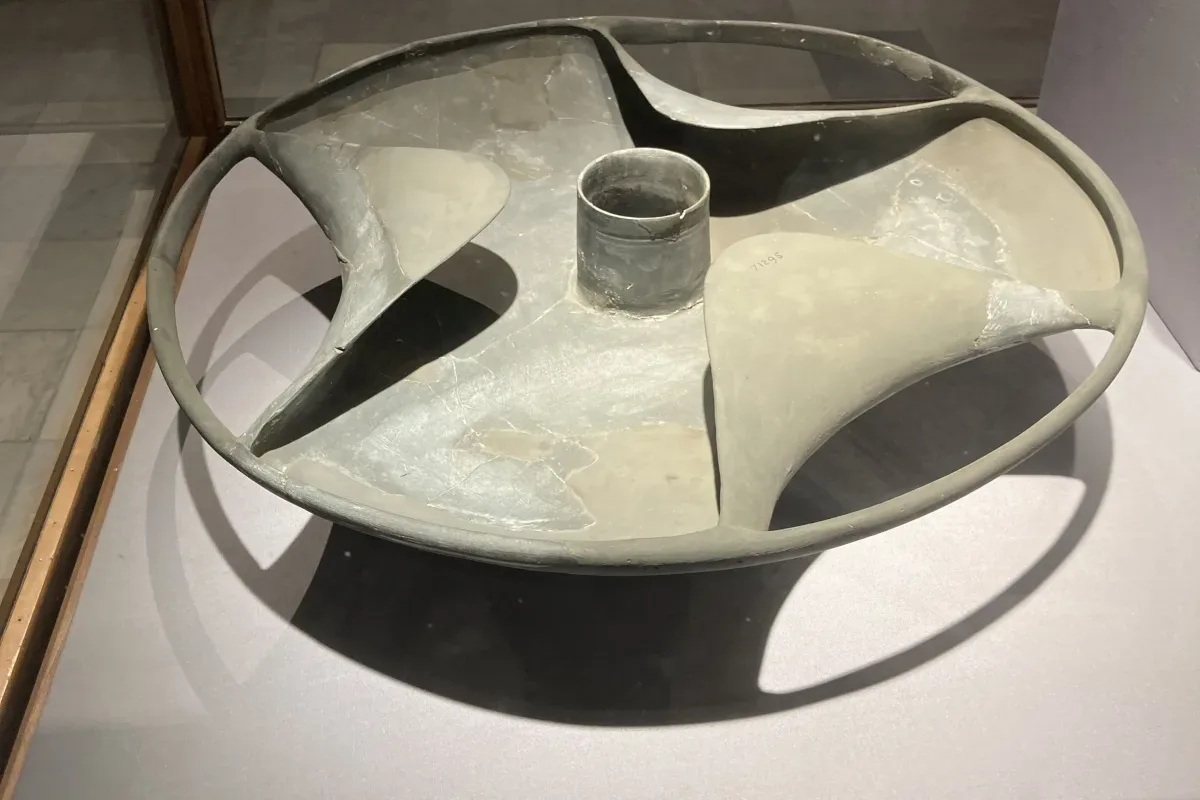
In January 1936, Walter Bryan Emery and his team spent a full week sifting sand in the central burial chamber of mastaba S3111, in the Saqqara necropolis. They were piecing together fragments of an object that had shattered and scattered across the floor, right next to the tomb owner's skeleton.
Once reassembled, it turned out to be the Sabu disk: a tri-lobed stone vessel with no known parallel among Egyptian burial finds up to that point.
The tomb had been looted long before Emery arrived.
Jewelry and other precious-metal objects were gone without a trace, but the rest of the burial assemblage survived. Most of the tomb's 48 stone vessels had been smashed.
The skeleton of an official named Sabu lay in a wooden coffin, undisturbed in its original spot, surrounded by dozens of vessels, flint and copper tools, and the remains of two cattle.
Amid all of it, the shattered disk stood out for its strange shape.
Sabu and His Mastaba
According to Emery's records, Sabu was a high-ranking official who lived under the pharaohs Den and Anedjib (also known as Enezib or Adjib), rulers of the First Dynasty, between roughly 3100 and 3000 BCE.
Seal impressions bearing Den's name turned up in the mastaba's first chamber, and others carrying Anedjib's name in the sixth chamber. These finds helped date the tomb and establish its historical context.
Mastaba S3111 was a rectangular mudbrick tomb with deeply cut niches along its facade.
That facade was originally painted yellow and decorated with geometric patterns imitating woven matting. The tomb itself sat on the northern edge of the Saqqara plateau.
A niched facade like this was, in the First Dynasty, a marker of high social standing.
The burial chamber yielded 48 stone vessels: 39 of travertine, seven of metasiltstone, and two of volcanic tuff.
The Sabu disk was one of the seven metasiltstone vessels.
A Shape That Doesn't Fit
Emery described the reconstructed find as "an ornamental tri-lobed bowl of schist."
The term "schist" was standard in Egyptology at the time, though it isn't quite accurate geologically. Today the material is identified as metasiltstone: a siltstone that underwent light metamorphism.
That kind of rock is denser and more cohesive than unaltered sedimentary stone, but it lacks the pronounced layering and clean fracture planes that define true schist.
The reconstructed disk measures about 24 inches (61 centimeters) across and stands roughly 4 inches (10 centimeters) tall. Three thin, curved blades extend from the rim toward the center, meeting at an opening ringed by a circular collar.
As a whole, it looks something like a ship's propeller, or a steering wheel. Among known Egyptian objects from the First Dynasty, nothing matches that shape, not from earlier periods and not from later ones either.
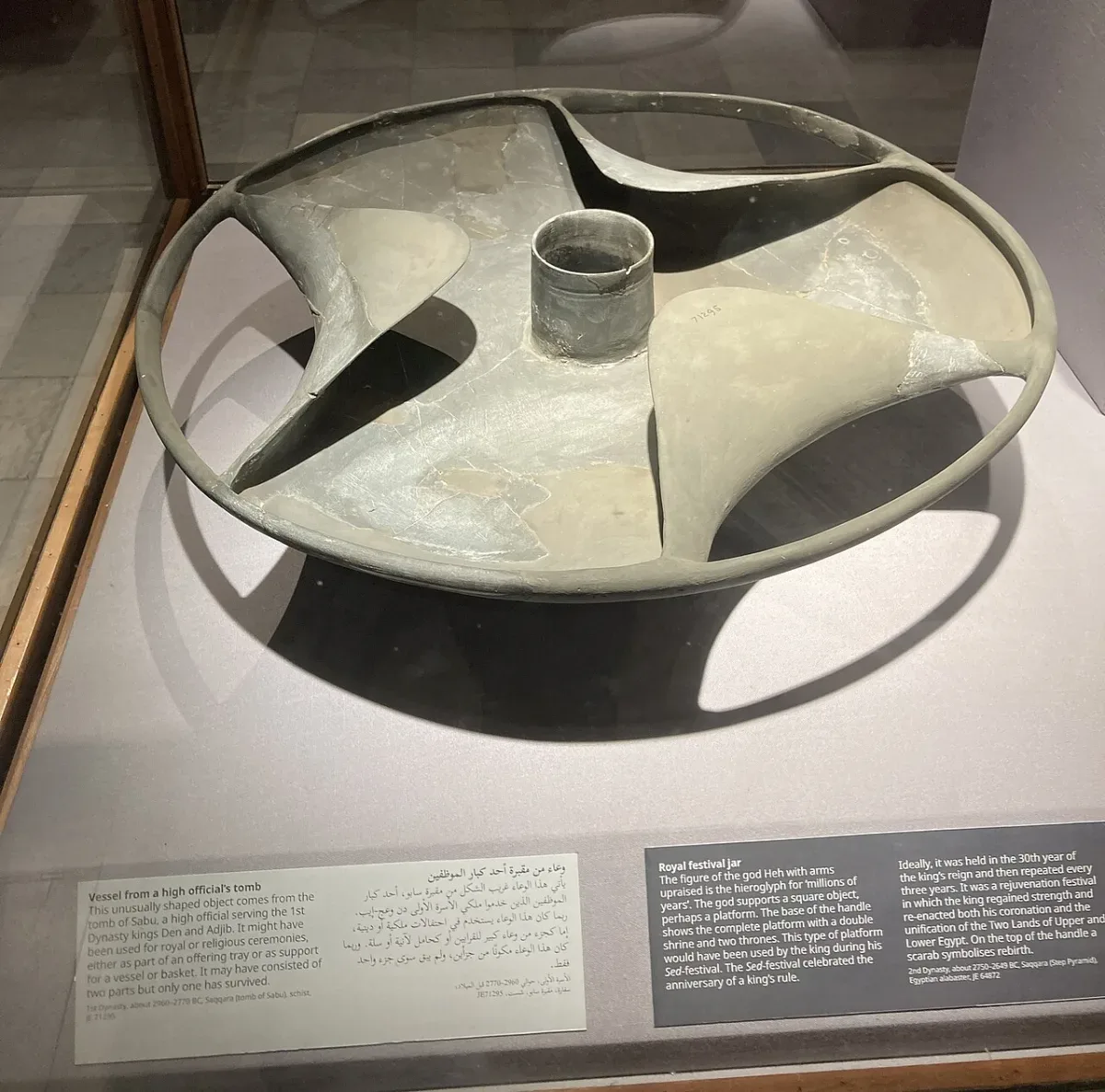
The Egyptian archaeologist Ali El-Khouli cataloged thousands of stone vessels from this period in Egyptian Stone Vessels: Predynastic Period to Dynasty III.
Shallow, wide stone bowls were common enough, but the Sabu disk doesn't fit neatly into any of the recognized categories.
The Sabu Disk and Egyptian Stone-Carving Tradition
Metasiltstone differs from true schist in its structure: it has no strong tendency to split along flat planes.
Light metamorphism strengthens the bonds between mineral grains, which can affect how the stone responds to carving.
Even so, the material alone doesn't fully explain how the Sabu disk was made, or why it took such an unusual shape.
A tomb relief from the 5th or 6th Dynasty, found at Saqqara shows craftsmen working stone with drills and abrasive sand.
According to the same source, the figure-eight stone drill bit was in use as early as the First Dynasty.
Experiments with reconstructed tools showed that a skilled craftsman could carve a limestone vessel in about 22.5 hours.
That result says a lot about the skill of Egyptian stonemasons, but it doesn't translate directly to the Sabu disk, given the differences in material and shape.
The claim that Egyptians of that era "couldn't have" made the Sabu disk doesn't square with what we know about their stone-carving skills.
The real open question isn't whether they could make it. It's why they chose that particular shape, one that, as far as the known evidence shows, was never repeated on any other object.
An Imitation, a Lamp, or Something Else?
In his 1972 book Archaic Egypt, Emery raised the possibility that the disk was modeled on a metal vessel that hasn't survived.
Such an object would have been fairly simple to make in metal, while producing a similar shape in stone demanded real skill.
Substituting stone copies for metal objects is a known practice in Egyptian funerary tradition, so this idea isn't without basis.
Still, there's no proof that the Sabu disk is actually a copy of a metal original.
A second theory holds that the disk may have served as a kind of multi-wick oil lamp.
Set horizontally on a stand, it could have held reed wicks arranged along its curved blades.
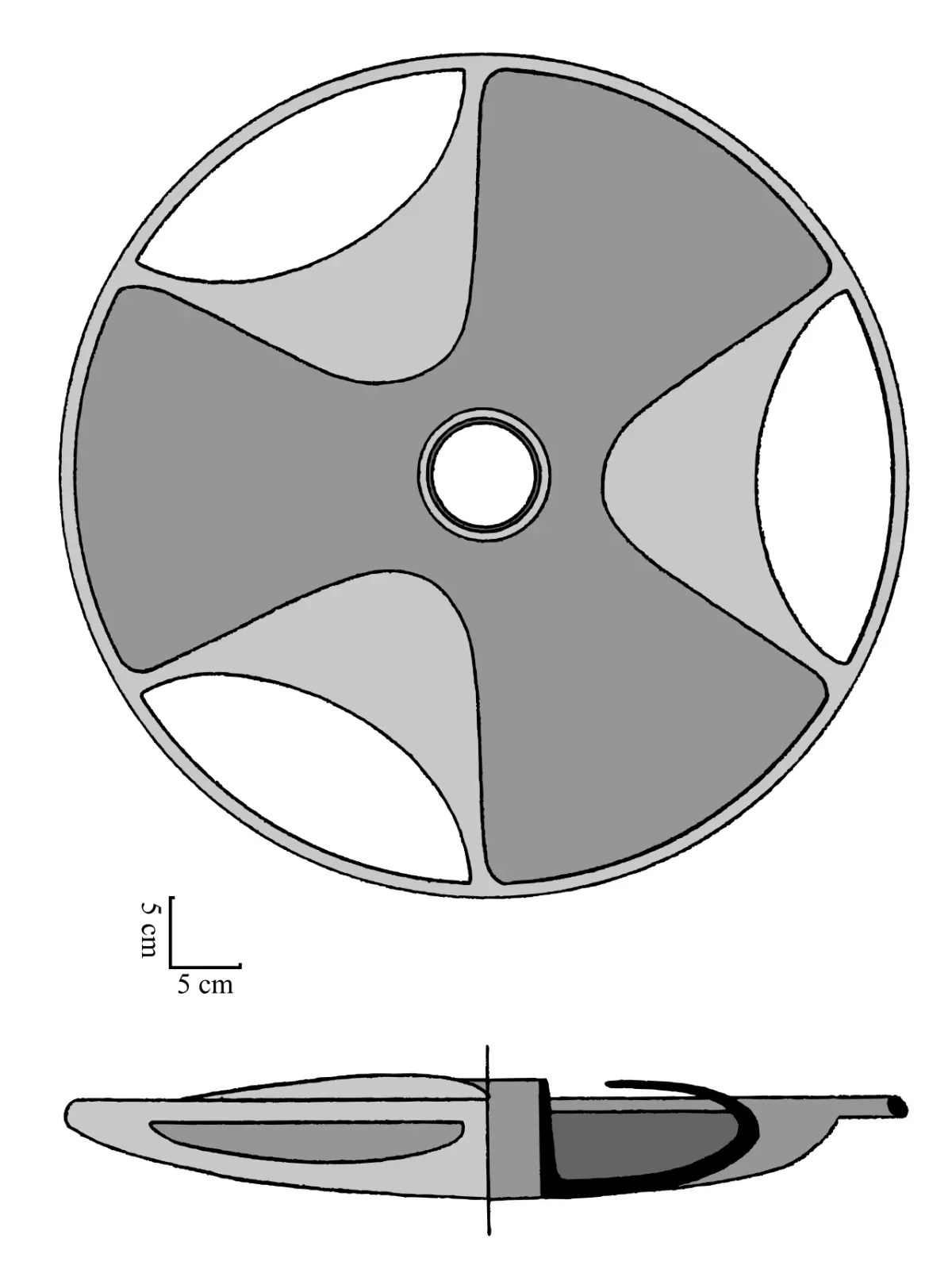
That interpretation, however, isn't backed up by any traces of oil, soot, or burning.
Speculation about an extraterrestrial origin for the Sabu disk turns up in popular literature, but it finds no support in the scholarly sources reviewed here.
Theories like that overlook the well-documented skill of ancient Egyptian craftsmen, and the simple fact that not knowing what an object was for isn't evidence that it's strange, let alone alien.
What We Still Don't Know
The Sabu disk is housed today in the Egyptian Museum in Cairo. Its function has never been reliably established.
Among the finds known so far from Saqqara and other Egyptian sites, no earlier prototype or later object of the same shape has ever turned up.
Since mastaba S3111 was looted, it's possible that related objects, perhaps made of metal, disappeared along with the jewelry and other valuables.
That could explain why the disk is unique, but for now there's no evidence to support it.
What we do know for certain is that this is an unusually shaped stone vessel, found in the tomb of a high-ranking First Dynasty official and reconstructed from fragments.
Its purpose remains an open question.
And that's exactly what makes the Sabu disk so compelling: not because it proves some sensational theory, but because it's a genuinely one-of-a-kind object whose purpose we still can't explain with any certainty.
SOURCES
- Walter Bryan Emery, "The mystery of Sabu's tomb, a unique and inexplicable vessel," The Illustrated London News, February 1937, p. 349.
- Walter Bryan Emery, Great Tombs of the First Dynasty: Excavations at Saqqara, vol. 1, Egypt Exploration Society, 1949.
- Walter Bryan Emery, Archaic Egypt, Penguin Books, 1972.
- Ali El-Khouli, Egyptian Stone Vessels: Predynastic Period to Dynasty III, Mainz am Rhein: Philipp von Zabern, 1978.
- Cyril Aldred, Egypt to the End of the Old Kingdom, Thames and Hudson, 1965.
- Denys A. Stocks, "Making stone vessels in ancient Mesopotamia and Egypt," Antiquity 67 (1993): 596–603.
- The Tomb of Sabu and the Tri-lobed "Schist" Bowl – Hall of Maat (cites Emery 1949 and El-Khouli 1978)
- Emily Teeter, "Cats. 46–49: Hard Stone Vessels," in Ancient Egyptian Art at the Art Institute of Chicago, Art Institute of Chicago, 2025.
- "Stone and stone working in Ancient Egypt: vessels" – UCL Digital Egypt, University College London.
Aron Corvin
A researcher of the unknown who loves a good story, but doesn't sell sensationalism. I research every topic in detail before I publish it. If you enjoy what I write, your support would mean a lot and help me keep going.