
Is Your Déjà Vu a Signal From a Parallel You? Here's What Science Says

Before bed, tens of thousands of TikTok users cue up the same kind of video: a droning sound in the background, instructions to count backward from a hundred, and a promise that you'll wake up living a different life.
They call the practice "shifting": consciously moving your awareness into a parallel version of your own reality.
The community got its start on Reddit in 2014, and by 2020 it had grown into a full subculture on TikTok, where the hashtag #shiftingrealities now counts billions of views, according to the internet culture archive Know Your Meme.
Popular destinations, according to the communities' own descriptions, include the worlds of movies and shows like Harry Potter or the Marvel universe, though increasingly people are just as likely to aim for a "better" version of their own everyday life: more confidence, more money, more peace of mind.
By 2021, the phenomenon had made its way into academic psychology, too.
A team of researchers led by clinical psychologist Eli Somer of the University of Haifa described it as a practice related to hypnosis, dissociation, and so-called maladaptive daydreaming, one that emerged abruptly during the first months of the COVID-19 pandemic.
Behind the movement lies an idea that has spread well beyond TikTok in recent years: that another version of you exists somewhere, and that it's sending you signs.
Countless YouTube videos, narrated in the same calm, soothing voice and often set to meditation music, walk viewers through how to recognize those signs.
Déjà vu. Dreams that feel more real than waking life. A sudden urge to change jobs, move to a new city, or pick up a new hobby, for no clear reason.
According to these videos, all of it is communication from a parallel dimension, and the connection supposedly gets stronger through "raising your vibration": gratitude, meditation, mindful eating, and being deliberate about your thoughts.
These videos are nearly interchangeable: a soothing voice, quiet ambient sound in the background, the same list of signs repeated from one video to the next, often in almost the same order: déjà vu, then dreams, then the sudden urge to change something in your life.
The word "vibration" has a longer history in this context than you might think.
American writer William Walker Atkinson used it as far back as 1906, in his book Thought Vibration, or the Law of Attraction in the Thought World, in which the New Thought movement first systematically linked human thought to energetic vibration.
Quantum physics, which these same videos often cite as proof, did not exist yet even as a formal theory. It was born about twenty years later, and the many-worlds interpretation that stories about parallel versions of yourself most often invoke did not arrive until 1957.
The techniques these videos recommend (picturing a desired outcome as if it has already happened, or journaling a detailed account of a future day as though it has already unfolded) come from that same tradition.
They were popularized by American mystic Neville Goddard in the mid-twentieth century, who instructed people to live out the desired scene in the first person, as a genuine memory rather than something watched from the outside.
Goddard's vocabulary (the belief that feeling is the secret to success and that a person should live as though the wish has already come true) forms the backbone of nearly every modern piece of content about manifestation and parallel versions of yourself today, even when his name never comes up.
Of all the signs these videos list, déjà vu comes up most often, and it's the only one that has been seriously studied in a lab for decades.
When the Brain Catches Its Own Mistake
Akira O'Connor, a psychologist at the University of St Andrews and one of the world's few real experts on the subject, has spent years studying the feeling, and argues it isn't a memory glitch at all: it's memory working exactly as it should.
According to his findings, the brain regions responsible for recognition sometimes send a false signal of familiarity, and the frontal lobe (the very same region that checks memories for accuracy) disputes that signal almost instantly.
Déjà vu, in other words, is the moment your brain catches itself making a mistake and corrects it on the spot.
That also explains a seemingly odd pattern spotted by Anne Cleary, a psychologist who runs one of the world's leading research programs on the subject at Colorado State University: déjà vu happens more often in younger, healthier people, and less often as we age.
Cleary has also shown that the sense of prediction that sometimes accompanies déjà vu is just that, a feeling, not any real ability to foresee what's coming.
In people with dementia, the opposite happens. The frontal lobe stops reliably checking familiarity signals, so the feeling of "having seen this before" shows up much more often. At that point, though, it's no longer a sign of a healthy brain. It's a symptom of a disease that erodes the ability to tell an old memory apart from a new experience.
The same circle of researchers also studies the opposite phenomenon, known as jamais vu: the moment something deeply familiar, like your own name written out several times in a row, suddenly sounds strange and foreign, as if you're seeing it for the first time.
Cognitive neuropsychologist Chris Moulin of Grenoble Alpes University, who collaborates with O'Connor on exactly this subject and whose joint research won an Ig Nobel Prize in 2023, reads jamais vu as a sign that the brain occasionally double-checks even the things that should be automatic.
Seen together, the two phenomena don't look like a system malfunction. They look like proof that the system is constantly checking itself, in both directions.
Déjà vu, then, has an explanation that requires neither parallel dimensions nor a shift in vibration.
The other "sign" that parallel-reality content likes to mention (repeating numbers, chance encounters, the feeling that everything suddenly makes sense) leads into a completely different area of psychology, one almost as old as the discipline itself.
The Scarab at the Window
That feeling has had a name since 1952.
Swiss psychiatrist Carl Gustav Jung called it synchronicity: a meaningful coincidence between an inner state (a thought, a dream, a feeling) and an outer event, with no causal link between the two.
The best-known case remains that of a patient who was describing a dream about a golden scarab to him at the very moment a real beetle from a related family began tapping against his office window.
Jung caught the insect and handed it to her, and by his own account, that moment broke through years of resistance to therapy.

The essay in which Jung first laid out the concept in detail was published in 1952, in a book he co-wrote with physicist Wolfgang Pauli, a Nobel laureate who had been Jung's therapy patient and shared his own dreams with him.
The two of them spent decades debating by letter whether mind and matter might be two faces of the same deeper reality, a question that neither physics nor psychology has definitively answered to this day.
Synchronicity, then, is a real and well-documented concept, but it's a clinical tool for interpreting inner experience, not proof of a connection to a parallel universe.
Psychologists call this human tendency pattern recognition: the brain's built-in drive to find structure in random information, even when none exists.
Parallel-reality content turns that tendency into a literal technology, where every coincidence becomes a message from some other version of you, rather than a pattern that the human mind naturally notices and remembers better than the thousands of random moments that pass completely unnoticed.
That filter runs constantly, and mostly unnoticed: the mind automatically discards thousands of small mismatches over the course of a day, and holds onto the rare moment when a thought and an event line up.
Once that selective memory pairs up with the belief that something out there is sending messages, even the most ordinary coincidence starts to look like proof.
Instinct, Not a Message From Another World
Parallel-reality content also pays close attention to sudden urges: the feeling that you should change jobs, move somewhere new, or walk away from something familiar for no clear reason.
It reads these urges as messages sent by a version of you who has already taken that step in another reality.
Cognitive science recognizes the same phenomenon under a different name, intuition, and has spent decades studying it as a concrete mental process rather than a sixth sense.
Cognitive psychologist Gary Klein, studying fireground commanders in the field, named this mechanism "recognition-primed decision-making." An experienced firefighter who "senses" that a room is about to catch fire isn't receiving a signal from outside. His brain has already seen some version of that scenario dozens of times, and it recognizes the pattern faster than conscious thought can name it.
The same mechanism is at work when someone seems to suddenly want a career change: the mind has spent days or months gathering small signs of fatigue and dissatisfaction, and the decision only feels sudden because conscious awareness shows up at the very end of that process.
That reliability has its limits, though.
Klein and psychologist Daniel Kahneman, longtime academic rivals over how far intuition can be trusted, agreed on the conditions in a 2009 joint paper in the journal American Psychologist: intuition is reliable only in environments with clear, learnable patterns, and only for someone who has had enough chances to learn those patterns through fast feedback.
In one-off, rare decisions like changing careers or moving to a new city, that condition isn't met, so a feeling that seems to "know" can be wrong just as often as it's right.
That doesn't mean the urge should be ignored. It just means it's worth examining, rather than immediately read as a message from another reality.
Something similar applies to dreams that leave behind a vivid, almost-real impression.
The brain processes waking experience during sleep, so it isn't unusual for a solution to surface in a dream for a problem that has been simmering in the background of consciousness for days.
The sense that a dream is a "message" usually shows up afterward, the moment the waking mind tries to assign it meaning. It doesn't come from the dream itself.
What Physics Actually Says About Parallel Worlds
In this content, quantum physics plays the role of scientific alibi: if particles can exist in multiple states at once, the reasoning goes, then reality itself must have multiple versions that a person can supposedly choose between through vibration.
That leap is wrong, but the starting point isn't made up.
Quantum mechanics really does include a serious, widely recognized interpretation involving multiple worlds. Physicist Hugh Everett formulated it in 1957, and Bryce DeWitt gave it its name in the 1970s.
Picture the famous thought experiment with Schrödinger's cat, sealed in a box alongside a device that has a fifty percent chance of releasing poison gas.
The standard interpretation says that until the box is opened, the cat is simultaneously alive and dead.
The many-worlds interpretation resolves that ambiguity differently: at the moment a measurement would theoretically occur, the universe doesn't "collapse" into a single outcome. It branches into two: in one, the cat survives; in the other, it doesn't. Both versions are equally real, just inaccessible to each other.
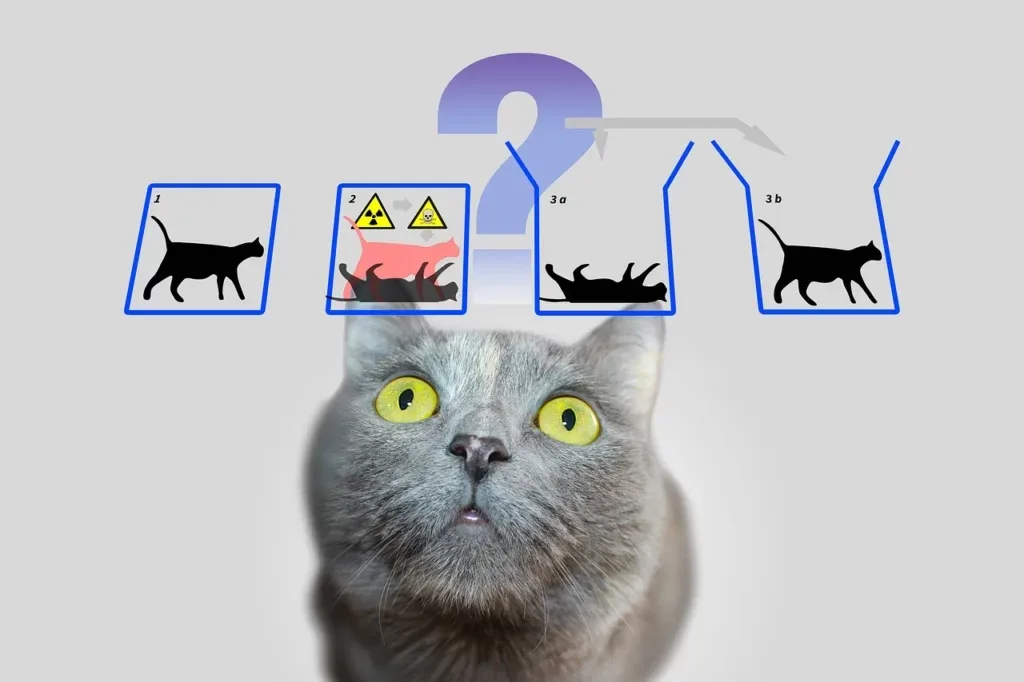
According to the Stanford Encyclopedia of Philosophy, the many-worlds interpretation resolves one of the oldest problems in quantum mechanics, the so-called measurement problem, by holding that at every point of measurement the universe branches into all possible outcomes at once. Every outcome genuinely happens, each in its own branch, rather than collapsing into just one.
The word "measurement" here doesn't require human consciousness. Any physical interaction between systems is enough, even two particles meeting with no observer anywhere nearby.
That's a crucial difference from how parallel-reality content uses the word "observer," as though human intention physically selects the outcome.
Even physicists haven't reached full consensus on this: to this day, no experiment exists that could distinguish the many-worlds interpretation from competing readings of the same math, so the theory remains a matter of interpretation rather than a proven fact.
What the interpretation definitely does not claim is that a person can choose which branch they end up in through conscious effort, gratitude, or meditation.
No known physical mechanism in the theory connects human intention to which branch of the universe gets "experienced," and physicists who take this interpretation seriously almost never write about any such connection, for a simple reason: the theory has no mechanism that would allow it.
A Third of People Believe They Can Attract Success
While physicists argue over branches of the universe, psychologists decided to measure something more tangible: what actually happens to people who believe they can "attract" the reality they want.
A team at the University of Queensland, led by researcher Lucas Dixon, developed what they called the Manifestation Scale in 2023 and applied it to 1,023 participants across three separate studies.
The results, published in the journal Personality and Social Psychology Bulletin, show that more than a third of respondents believe their thoughts and what researchers call "Cosmic Collaboration" can shape real-life outcomes.
People who scored high on the scale felt more successful and more optimistic about the future, but objectively they didn't earn more money, nor were they better educated than other respondents.
Instead, researchers found the opposite pattern: a greater tendency toward risky financial moves, a higher likelihood of owning cryptocurrency, and more reported bankruptcies.
Manifestation doesn't make people more successful, the authors conclude. It makes them more convinced that success will arrive on its own, which pulls attention away from the concrete steps that actually lead to the goal.
The authors acknowledge this is a correlation, not proven causation. The study can't establish that believing in manifestation causes risky financial decisions, only that the two tend to show up together.
It's possible that people inclined toward magical thinking are simply drawn to both manifestation content and risky investing to begin with, rather than one causing the other.
Psychologists do warn about a second, harder-to-measure side of the same pattern: when the belief doesn't pan out, it can easily curdle into self-blame, into the idea that a bad outcome means the person "didn't believe hard enough" or was putting out the wrong vibration.
In other words, the same logic that promises control over reality can end up shifting the blame for an illness, a job loss, or a tragedy onto the person who lived through it.
That same belief underlies the "shifting" community mentioned at the start of this piece: the conviction that a desired reality can be summoned through an inner state rather than outward action.
Therapist Grace Warwick, according to i-D magazine, has described the experience as similar to the state right before falling asleep, when the brain loosens the boundary between imagination and perception.
That doesn't make the experience fake, or dangerous on its own. It just makes it something psychology has long known under a different, far less mysterious name.
A Healthy Brain, Not a Crack in Reality
Let's return to the very feeling this piece opened with.
According to O'Connor's findings, déjà vu shows up most often in young, healthy people whose brains are doing a thorough job of checking their own memory.
In people with dementia, where that mechanism starts to fail, the feeling of "having seen this before" becomes frequent and unsettling, because the brain can no longer correct the mistake it just made.
Millions of people search every night for a sign that a better version of themselves exists somewhere else. The only measurable signal science has found so far is that, in that very moment, their brain is working exactly the way it's supposed to.
SOURCES
- Dixon, Hornsey, and Hartley, "'The Secret' to Success? The Psychology of Belief in Manifestation," Personality and Social Psychology Bulletin, 2023.
- Somer, Cardeña, Figueiredo Catelan, and Soffer-Dudek, "Reality Shifting: Psychological Features of an Emergent Online Daydreaming Culture," Current Psychology, 2021.
- Kahneman and Klein, "Conditions for Intuitive Expertise: A Failure to Disagree," American Psychologist, 2009.
- Colorado State University – "Déjà vu and feelings of prediction: They're just feelings."
- International Association for Analytical Psychology – "Synchronicity: An Acausal Connecting Principle."
- Stanford Encyclopedia of Philosophy – "Many-Worlds Interpretation of Quantum Mechanics."
- Know Your Meme – "Reality Shifting."
- William Walker Atkinson, Thought Vibration, or the Law of Attraction in the Thought World, 1906. Available on Internet Archive.
Aron Corvin
A researcher of the unknown who loves a good story. I won't sell you sensationalism just for a click. If you enjoy what I write, your support would mean a lot and help me keep going.