
Cash-Landrum: The UFO Case That Landed in an American Courtroom
On August 17, 1981, in Building 2102 at Bergstrom Air Force Base in Austin, Captain John Camp asked Betty Cash to write down the words she had seen on the helicopters. Cash picked up a pencil.
Before she could finish, Vickie Landrum's seven-year-old grandson, Colby, cut in to ask whether she meant the helicopter that had landed in Dayton. Landrum shushed him.
That moment is preserved on the recording of the Bergstrom interview. Camp, Captain Terry Davis, and Pat Wolf were listening to three people who were seeking compensation from the U.S. military.
The Cash-Landrum case, one of the rare ones in which people claimed to have been injured by a UFO, an unidentified flying object, was then eight months old.
The question that neither a court nor decades of investigation have settled is this: what burned three people on a rural Texas road that night?
The Road Between New Caney and Huffman
Betty Cash was 51 and ran a restaurant. Vickie Landrum, who waited tables for her, was 57, and Vickie's grandson Colby was seven.
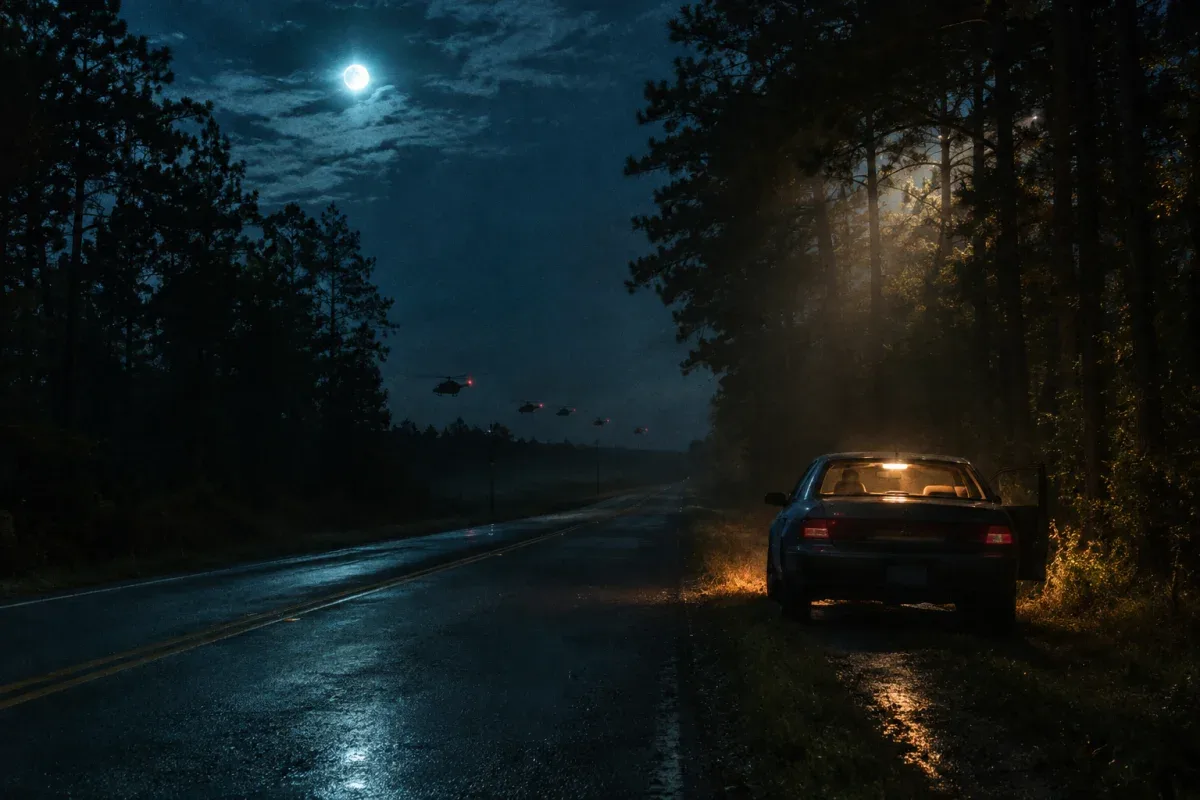
They were headed home to Dayton, the small town where they lived, after dinner out, and they turned onto a narrow road between New Caney and Huffman, roughly 20 to 25 miles northeast of Houston.
An object the size of a water tower hovered above the trees. The witnesses described it as an enormous, metallic silver diamond with a flame shooting out of its underside. Heat came through the windshield.
Betty got out for a better look. When she climbed back in, the door handle was too hot to touch with a bare hand, so she opened the door through the sleeve of her coat.
Vickie pressed her palm against the dashboard, and the imprint of her fingers stayed in the softened plastic.
The diamond shape wasn't part of the shared description from the start.
In the earliest recordings, made in the hospital a few weeks later, Betty stresses the light and the heat and says nothing about a flame, while Vickie says the road lit up like a fire. In those statements, only Colby mentioned the diamond shape.
Researcher Curt Collins thinks the women may have picked up the shape from Schuessler's report, but he notes that it's hard to tell which details come from their original memories and which surfaced later.

In later statements, both women maintained that they hadn't seen an alien ship. They believed they were looking at an experimental device belonging to the U.S. government, as Gary Posner records in his chapter on the case.
All the Tests, and Nothing to Show for Them
Symptoms began that same night: nausea, vomiting, diarrhea, weakness, and stinging eyes.
Colby developed blisters on one side of his face. Betty ended up in the hospital, where she spent about two weeks; her hair fell out, and later her nails did, too.
The doctor who admitted her, Dr. Shenoy, called in specialists. The results didn't explain the swelling, the burns, or the hair loss.
As Allan Hendry of the Center for UFO Studies recorded, no test pinned down the cause, from blood counts and eye exams to skin tests and a biopsy.
Radiologist Dr. Peter Rank summarized Betty's findings for the investigators, and that medical summary was published later.
The Fund for UFO Research approved money for a special hospital examination, but it was never carried out.
Radiation That Would Have Killed in Days
The story usually comes down to one word: radiation.
The timeline doesn't support that, Gary Posner argues.
Burns and wounds that didn't heal for a year and a half would, if they came from ionizing radiation, require a dose large enough to kill a person within a few weeks.
The same is true of diarrhea that lasts longer than a few days.
Whether the radiation was superficial, which wouldn't explain the nausea or the diarrhea, or penetrating, Betty went on to live another eighteen years.
Physicist Brad Sparks, who studied the case in 1999, concluded that the symptoms don't match ionizing radiation and leans toward a chemical substance as the explanation.
Other researchers disagreed about the cause and floated everything from a celestial body to an aircraft landing light or a balloon.
A field check followed.
According to Texas Department of Health records, in September 1981 Russ Meyer drove that stretch of road with a detector and took soil samples. He found no trace of radiation.
He said that if there had been contamination in large amounts, some of it would have remained.
He added that ultraviolet light, infrared radiation, or low-energy X-rays don't necessarily leave a trace.
What's missing is just as interesting. In his report for the Fund for UFO Research, Allan Hendry wrote that the flame occasionally spread toward the road, yet a later inspection found no marks on the asphalt.
No one has ever established the exact location of the event, yet the claim that the spot had been found and investigated was long a cornerstone of the whole story.
Twenty-Three Helicopters Nobody Could Find
When the object rose, the sky filled with helicopters. Betty and Vickie counted them. Once they said there were 23, another time 26.
Some had two rotors, like the CH-47 Chinook military transport helicopter.
No unit reported a flight that night, and for years investigators couldn't link a single helicopter to the event.
The Army acknowledged that it owns Chinooks but couldn't find a single one that had been there.
Tracking down a fleet of twenty-three Chinooks over Texas should have been easy, but no one managed it.
At Bergstrom, Captain Camp asked Betty to write down the lettering on the helicopters. That's when Colby remembered a helicopter that had landed in Dayton.
For skeptics, that interruption was proof that the detail about the lettering emerged later, once the women were seeking compensation, as Brian Dunning's investigation describes.
Vickie stuck to her story, and in 1981, under hypnosis on a TV show, she repeated the same description.
The Lawsuit That Ended Without a Verdict
Cash and Landrum turned to the government for help. Senator Lloyd Bentsen advised them, and Representative Larry Browder asked the Texas Department of Health to look into the case.
Attorney Peter Gersten represented them pro bono, and the lawsuit sought $20 million in damages from the U.S. government (Case No. H-84-348).
In 1986, the court dismissed the case. There was no evidence the government was involved, it wasn't proven that the helicopters were military, and no agency had a craft matching the diamond-shaped one the witnesses described.
What remained was testimony, and testimony, however sincere, couldn't answer the question of what burned three people.
John Schuessler, an engineer who worked as a contractor for NASA's Johnson Space Center and who investigated the case more than anyone, kept the medical records closed even after Betty's death. Without them, even the most detailed descriptions of the symptoms remained just a story.
How the Secret Craft Story Took Shape
During the 1980s, Richard Doty, an agent with the Air Force Office of Special Investigations, entered the story.
Through the ufologist Bill Moore, the case acquired its own label: The Secret Craft from Project Snowbird.
The 1988 show "UFO Cover-Up?... Live!" presented Doty in silhouette under the name "Falcon," claiming the craft was extraterrestrial but flown by American military pilots.
In 1989, Moore admitted at a MUFON symposium that the government had recruited him to spread disinformation.
The name Snowbird comes from the so-called MJ-12 documents, which the FBI keeps in its public archive and whose origins researchers question.
Schuessler himself wrote that year that there was no evidence for any of those explanations.
After the encounter, Vickie Landrum lost her nails. She saved each one, marked and labeled, waiting for an examination that was never carried out.
SOURCES
- Transcript of the interview at Bergstrom Air Force Base, August 17, 1981.
- Court file of the lawsuit against the United States, Case No. H-84-348, U.S. District Court for the Southern District of Texas (documents released by the USAF in July 1993).
- Colonel Sarran, memorandum from the Department of the Army Inspector General (DAIG) on the case, 1982.
- Curt Collins, "The Cash-Landrum Incident: The Suppressed Case Files", Blue Blurry Lines, 2013.
- Curt Collins, "Betty Cash's Medical Records", Blue Blurry Lines, 2013.
- Curt Collins, "Flaming UFO: An Examination of the Cash-Landrum Original Testimony", Blue Blurry Lines, 2013.
- Gary P. Posner, "The Legendary Cash-Landrum Case: Radiation Sickness from a Close Encounter?", in: Ballester-Olmos and Heiden (eds.), The Reliability of UFO Witness Testimony, UPIAR, 2023.
- Robert Sheaffer, "Between a Beer Joint and a Highway Warning Sign: The 'Classic' Cash-Landrum Case Unravels", Skeptical Inquirer 38(2), 2014.
- Brian Dunning, "The Cash-Landrum UFO Incident", Skeptoid #652, 2018.
- Curt Collins, "Cash-Landrum UFO Disinformation: Rick Doty & Bill Moore", Blue Blurry Lines, 2022.
- Pamela Colloff, "Close Encounters of the Lone Star Kind", Texas Monthly.
- FBI Vault: Majestic 12
Aron Corvin
A researcher of the unknown who loves a good story, but doesn't sell sensationalism. I research every topic in detail before I publish it. If you enjoy what I write, your support would mean a lot and help me keep going.