
The Devil's Footprints: What Crossed Devon's Snow in 1855?
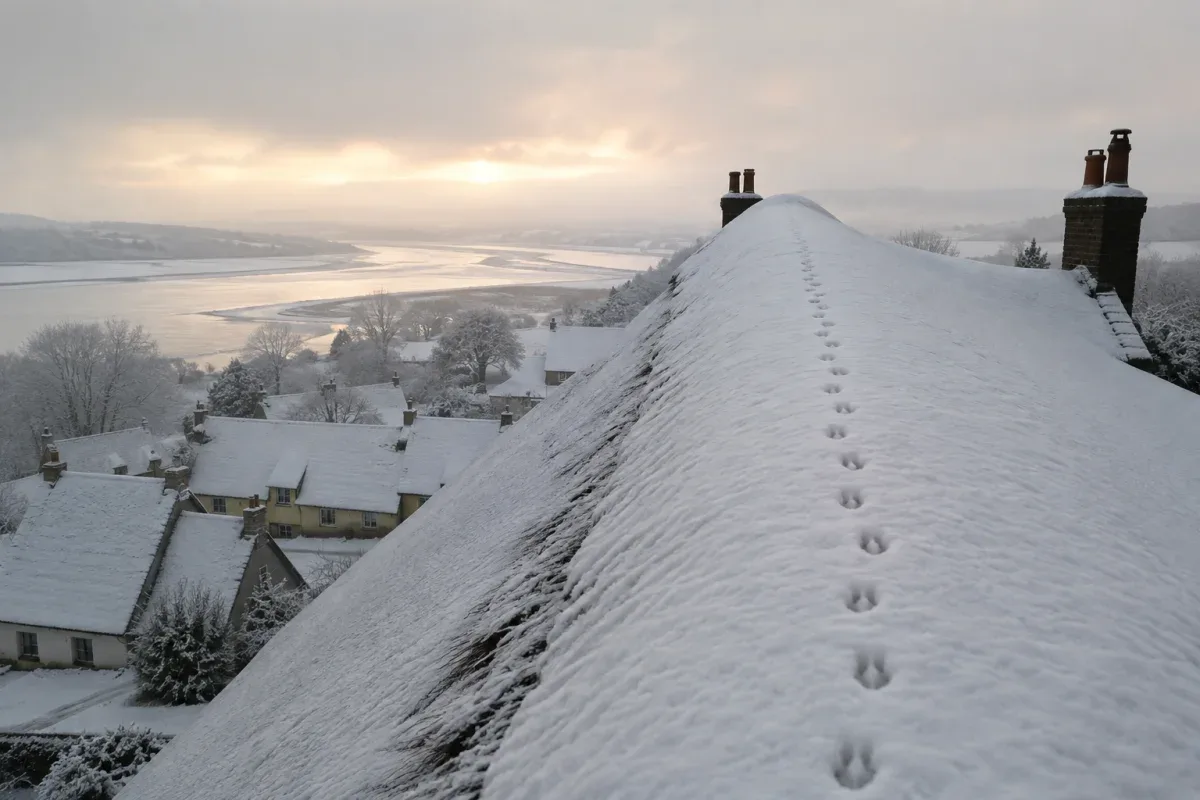
On the morning of February 9, 1855, a group of tradesmen in Dawlish picked up guns and cudgels and went looking for whatever had walked through their town overnight, an episode later recorded in the Exeter Flying Post.
They followed a line of small, hoof-shaped prints from Dawlish toward Luscombe, then on to Dawlishwater and Oaklands.
After a long search, they turned back with nothing to show for it.
They were not alone.
Villages up and down the coast of East and South Devon woke to the same discovery that morning.
A single trail of marks pressed into fresh snow ran across rooftops, garden walls, and open fields, as if no obstacle had been in its way.
By afternoon, most people had settled on one explanation. The devil had walked through Devon overnight.
A letter that circulated through the local press, later reprinted in The Times, described the prints as belonging to some strange and mysterious animal, endowed with the power of ubiquity, since they turned up in places no ordinary creature should have been able to reach.
Word spread fast. Within two weeks the story had crossed from parish gossip into the national papers, and clergy in several towns were mentioning it from the pulpit.
The Shape and Scale of the Devil's Footprints
Most witnesses described a similar shape: a mark about four inches long and roughly three inches across (about 10 by 7.5 centimeters), split down the middle like a cloven hoof, spaced eight to sixteen inches apart (20 to 40 centimeters).
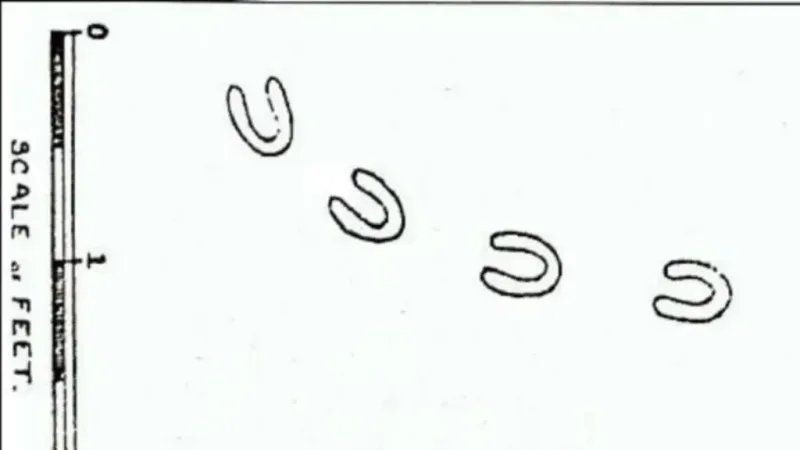
Many accounts described the prints as running in a single file, though, as later analysis would show, this was a composite picture built from many separate observers rather than a single trail anyone actually walked start to finish.
Reports eventually came in from more than thirty locations across Devon, with a couple more just over the county line in Dorset.
Adding up every account gives a combined trail somewhere between forty and over a hundred miles (roughly 60 to over 160 kilometers), though that figure comes from stitching together dozens of separate local sightings rather than tracing one continuous path.
The winter itself made the whole thing stranger.
January and February of 1855 had been unusually cold, cold enough to freeze the Exe and the Teign rivers solid, so each new snowfall simply added another layer on top of ice and older snow that had never had a chance to thaw.
The Vicar's Kangaroo
Among the clergy trying to calm frightened parishioners was the Reverend G. M. Musgrave, vicar of Withycombe Raleigh.
In a letter to the Illustrated London News, he mentioned a rumor going around that a pair of kangaroos had escaped from a private menagerie in Sidmouth.
Nobody seems to have checked whether the kangaroos had actually gone missing, and nobody explained how they might have crossed the frozen Exe estuary to leave matching prints on both banks.
In private letters preserved among the Ellacombe papers, Musgrave later made clear that he had never believed the kangaroo explanation himself.
His aim, he explained, had been to calm his frightened parishioners and give them an everyday story, rather than let the devil rumor stand unchallenged.
Badgers, a Balloon, and a Line That Won't Bend
That same year, the anatomist Richard Owen offered a more scientific-sounding guess, though it was still his own argument rather than an established fact.
In a letter to the Illustrated London News, Owen claimed that badgers were the only plantigrade animal native to Britain and argued that their prints could look larger than the animal itself, especially once freezing and thawing had reshaped the snow around them.
Several badgers hunting for food on the same cold night, he proposed, could account for the sheer number of prints.
Critics at the time and since have pointed out that badgers walk on four feet spaced well apart, which does not easily produce a single-file line, and that badgers are not known for crossing rooftops or wide stretches of open water.
Decades later, the novelist Geoffrey Household put forward a very different, and far less documented, story.
Writing in 1985, he said his source was a man named Major Carter, who claimed his grandfather had worked at the Devonport Dockyard at the time of the footprints.
According to that secondhand, decades-old account, an experimental balloon broke loose one night and dragged a mooring shackle across the snow as it drifted, striking the ground again and again before finally coming down near Honiton.
Carter said the episode had been hushed up because the balloon wrecked several greenhouses along the way.
Unlike Owen's letter or Musgrave's, published within weeks of the event, Household's balloon story exists only as an anecdote passed down through one family and printed more than a century after 1855, with no contemporary record to check it against.
Neither account explains why so many of the reports describe a trail running in a straight line for long stretches.
What a Modern Study Actually Found
No physical evidence survived from 1855 beyond a handful of letters and sketches, and even those went missing for almost a century.
They resurfaced in 1950, after the Transactions of the Devonshire Association asked its readers for information and the papers of the Reverend H. T. Ellacombe, vicar of Clyst St George, turned up among a relative's belongings.
Among them were Musgrave's letters marked "not for publication," along with tracings of the prints themselves.
The researcher Mike Dash worked through that material for a 1994 paper in the journal Fortean Studies, and his findings undercut much of the popular version of the story.
The prints, he showed, were not all the same size, and they were not all made on the same night.
That means the tidy image of one continuous, ruler-straight line crossing an entire county in a single night is itself a later exaggeration.
It was built up as newspapers combined separate reports, rather than traced from any one documented trail.
The real question Dash's work leaves open is narrower: what left broadly similar marks in dozens of different places, on more than one night, during the same cold week.
Dash's own answer was that there probably wasn't one answer.
Some tracks were likely hoaxed. Some were probably ordinary animals such as donkeys and ponies.
Some, especially on rooftops, may have come from wood mice, whose bounding gait leaves a pair of prints that can fuse into something resembling a cloven hoof in soft snow.
Even so, Dash acknowledged that this combination of explanations does not cover every report on file, and concluded plainly that the mystery remains.
The case has continued to draw scholarly interest since then.
In 2021, the Devonshire Association's own journal published a further review of the evidence by researcher Brian V. Ridout.
Its specific findings were not accessible for this article.
One detail from the 1855 reports still resists any of these explanations: several accounts describe similar prints turning up on both sides of the Exe, a river that was frozen over at the time.
Given how uneven and secondhand the surviving reports are, this should be read as a puzzling detail in the record rather than a settled fact.
Still, it is the one detail that no single proposed cause, hoax, badger, balloon, or rodent, fully accounts for.
A separate and much older case is sometimes mentioned alongside the Devon story, though it involves a different location, a different century, and no established connection to the 1855 events.
The monk Ralph of Coggeshall, writing in the early thirteenth century, recorded that hoof-shaped tracks appeared in soft ground during the summer of 1205, following a violent electrical storm.
Beyond the surface resemblance, cloven-shaped marks appearing after an unusual event, there is nothing to tie the two cases together.
What happened in Devon over those February nights in 1855 has a partial explanation, not a complete one.
Enough of the record points to mundane animals, human hoaxing, and exaggeration in the retelling that no single supernatural or exotic cause is needed to account for most of it.
What no one has done, in 1994 or since, is account for all of it.
SOURCES
- Mike Dash, "The Devil's Hoofmarks: Source Material on the Great Devon Mystery of 1855," Fortean Studies, 1994
- Peter Moore, "The Curious Case of the Devil's Foot-Prints (or the Great Devon Mystery of 1855)"
- David Castleton, "The Devil's Footprints: Devon's Diabolical Hoofmarks in the Snow"
- Brian V. Ridout, "The Devil's Footprints Revisited," Report and Transactions of the Devonshire Association, vol. 153, The Devonshire Association, 2021, pp. 291–306.
- Geoffrey Household (ed.), The Devil's Footprints: The Great Devon Mystery as It Was Reported in the Newspapers of 1855, Devon Books, 1985.
- Rev. G. M. Musgrave, letter to the Illustrated London News, 1855.
- Richard Owen, letter to the Illustrated London News, March 4, 1855.
- "Mysterious Footprints," The Times (London), February 16, 1855.
- Ralph of Coggeshall, Chronicon Anglicanum, early 13th century.
Aron Corvin
A researcher of the unknown who loves a good story, but doesn't sell sensationalism. I research every topic in detail before I publish it. If you enjoy what I write, your support would mean a lot and help me keep going.