
The Nampa Image: The Figurine That Was Supposed to Be Two Million Years Old
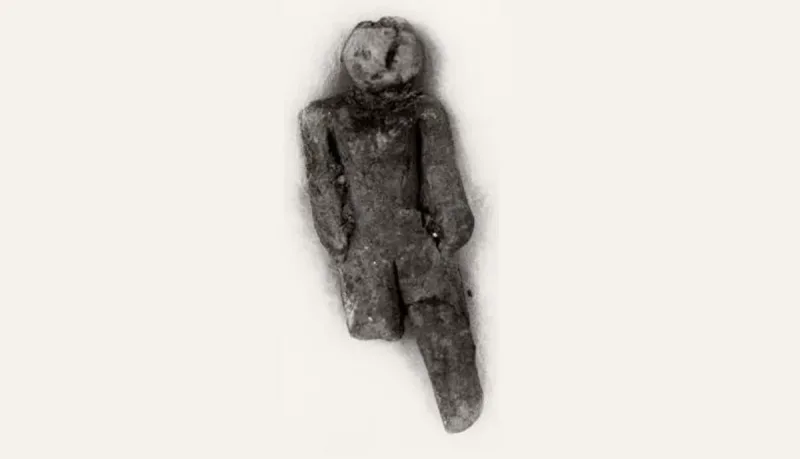
In early August 1889, a small figurine came up along with the sand from an artesian well in Nampa, Idaho. It stood about an inch and a half tall, had no hands or feet, and its face looked crudely shaped. M. A. Kurtz, one of the well's owners, spotted it in the sand the pump had thrown out.
The well passed through lake-bed deposits of clay and sand now known as the Glenns Ferry Formation, which geologists date to the Pliocene and early Pleistocene. Above them lay a layer of basalt 12 to 15 feet thick (3.7 to 4.6 meters). Kurtz claimed the figurine had been pulled up from a depth of about 320 feet (97.5 meters).
What Came Up the Pipe
The figurine stood one and a half inches tall (about 3.8 centimeters). It depicts a female body with no hands or feet, its right leg broken off above the knee. The examiner concluded it had been shaped from soft, moldable clay, then fired.
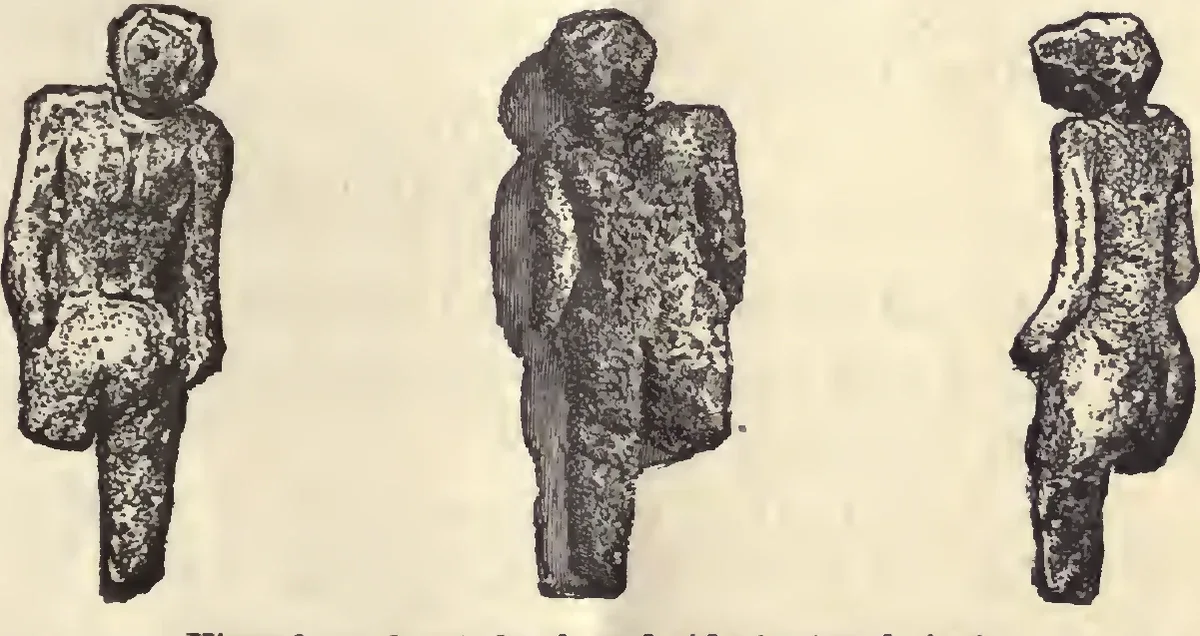
Word of the find reached Union Pacific president Charles Francis Adams, who wrote to geologist G. Frederick Wright in Oberlin on September 8, 1889.
Wright then corresponded with Kurtz and collected statements from witnesses, including Alex Duffes and engineer H. B. Grumbley. He sent the figurine to be examined by Albert Allen Wright, a professor of natural history at Oberlin, and chemist F. F. Jewett.
He published the entire correspondence in the Proceedings of the Boston Society of Natural History.
Kurtz said he couldn't hand the figurine over to Harvard or any other institution, but he sent it to Wright by express mail. Wright kept it in his hands for almost three months.
An Age Based on Depth Alone
If the figurine really did come from that layer, it could be millions of years old. As far as anyone knows, though, it has never been dated.
The figurine's assumed age comes entirely from the age of the soil layer, based on the claim about the depth it had been pulled from.
The layer dates to the Pliocene and early Pleistocene, meaning several million years, but that age was never measured on the figurine. The two-million-year figure is simply the layer's age, carried over to the object.
In their correspondence, Wright voiced doubts about the figurine's authenticity. Kurtz responded by offering statements from four witnesses. A specific fraud theory also surfaced: that someone had slipped the figurine into the pump overnight.
Union Pacific's general manager for that district vouched for the character of Kurtz and Duffes, but that was no evidence of where the figurine came from.
Geologist John Wesley Powell wrote in 1893 that he had seen the figurine in Boise back in 1889 and considered it a joke; local Native American children, he said, played with dolls just like it.
On November 9, 1889, Scientific American covered Wright's lecture at the Brooklyn Institute.
According to the magazine, Putnam and Haynes concluded the figurine wasn't clay at all, but light pumice, and both men were convinced of its authenticity. Albert Allen Wright flatly rejected that idea. In his view, the material had been shaped from soft, moldable clay and then fired.
At a meeting of the Boston Society of Natural History on January 1, 1890, two opposing interpretations were presented.
F. W. Putnam, the society's president, believed that iron oxide deposits and quartz grains cemented beneath the figurine's right arm pointed to its age.
Albert Allen Wright argued the opposite in his report: those grains weren't a later deposit at all, but part of the material the figurine was made from. H. W. Haynes considered the figurine important evidence for a very old human presence in the Americas.
In 1912, G. F. Wright wrote that the layer didn't have to be more than a few thousand years old, since sand and clay can be deposited very quickly.
The Experiment That Challenged That Argument
Albert Allen Wright took a ball of clay that had come up from the same well, crushed it, dampened it, and carved a similar figurine with a knife, then fired it in a porcelain dish over a burner.
The imitation turned out far better than he expected. Nearly every surface feature of the original could be reproduced on the copy.
That doesn't prove the original came from the Pliocene, but it shows it could have been made on-site, from clay out of the same well, with a knife and fire.
On the figurine's face, he noticed cut marks and concluded the face had been reworked not long before the figurine came into his hands. The tool marks on the original were just as sharp and fresh as the ones on his own copy.
The only difference was a slightly more intense red color in one or two spots on the original.
SOURCES
- G. Frederick Wright, The Nampa Image: Correspondence Relating to Its Discovery, with Explanatory Comments, etc., Proceedings of the Boston Society of Natural History, vol. 24, 1890.
- "The Nampa Image", Scientific American 61, no. 19 (November 9, 1889), p. 292.
- John Wesley Powell, "Are There Evidences of Man in the Glacial Gravels?", Popular Science Monthly 43 (July 1893), pp. 316–326.
- G. Frederick Wright, Origin and Antiquity of Man, D. Appleton, 1912, pp. 276–277.
- Waldemar Lindgren and N. F. Drake, Description of the Nampa Quadrangle, Geologic Atlas of the United States, Folio 103, USGS, 1904.
- C. A. Repenning, T. R. Weasma, and G. R. Scott, The early Pleistocene (latest Blancan-earliest Irvingtonian) Froman Ferry fauna and history of the Glenns Ferry Formation, southwestern Idaho, USGS Bulletin 2105, 1995.
Aron Corvin
A researcher of the unknown who loves a good story, but doesn't sell sensationalism. I research every topic in detail before I publish it. If you enjoy what I write, your support would mean a lot and help me keep going.