
The Dogon and Sirius B: Did They Know About a Hidden Star?
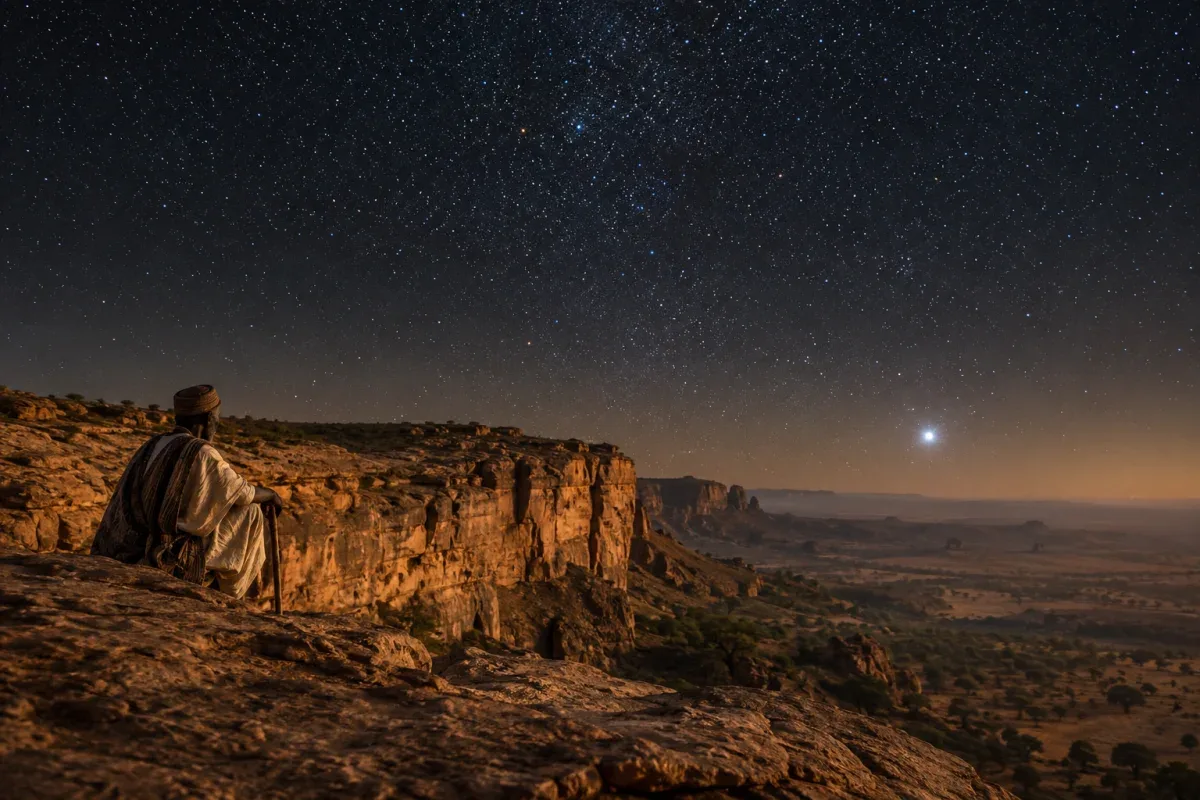
The Dogon people have lived along the Bandiagara Escarpment in central Mali for centuries, without telescopes, observatories, or any written astronomical tradition.
And yet, according to the records of French ethnologist Marcel Griaule from 1950, they knew about a star invisible to the naked eye: that it was small, impossibly dense, and that it orbited the visible Sirius roughly every fifty years.
Astronomically, all of it checks out. Sirius B, a white dwarf not directly observed until 1862, fits that description closely.
The question that has remained open is not astronomical but anthropological: was that knowledge genuinely part of Dogon tradition, or did Griaule, without realizing it, introduce it himself?
Nearly Half a Century Between Two Researchers
The Dogon are a people of several hundred thousand, with a developed cosmology, a rich tradition of sculpture, and a ceremonial calendar passed down through generations.

Marcel Griaule, a French ethnologist and anthropologist, began fieldwork in Bandiagara in 1931 as part of the Dakar-Djibouti Mission (1931-1933).
His student Germaine Dieterlen joined the research during the 1930s.
The pivotal phase of that work began in 1946, when an elder named Ogotemmeli spent thirty-three days in conversation with Griaule. Those discussions became the foundation of Griaule's book Dieu d'eau (1948).
Several years later, Griaule and Dieterlen published a separate study on the Sirius system, drawing on accounts from four principal Dogon informants: Innekouzou Dolo, Ongnonlou Dolo, Yébéné, and Manda. Ogotemmeli, Griaule's 1946 interlocutor, was not among them.
In that paper, published in 1950 in the Journal de la Société des Africanistes, they claimed that the Dogon knew of a small, invisible companion to Sirius, which they called "po tolo," named after the seed they consider the tiniest and heaviest of all, and that it circled the visible Sirius every fifty years and was extraordinarily dense.
One detail in those records was never adequately explained.
According to Griaule's account, the great Sigui ceremony was held on a sixty-year cycle, which did not match the approximately fifty-year orbital period attributed to Sirius's companion.
Neither Griaule nor the later authors who relied on his work ever offered a convincing explanation for that discrepancy.
The Wobbling Star: Sirius B and the Discovery That Followed
Friedrich Wilhelm Bessel, director of the Königsberg Observatory, noticed in 1844 that Sirius did not travel a straight path but wobbled slightly. He concluded it must have an invisible companion whose gravity was disturbing its motion, and he estimated the orbital period at roughly fifty years. Bessel died in 1846, never seeing his hypothesis confirmed.
Alvan Graham Clark found that companion on January 31, 1862, while testing an 18.5-inch refractor his family's firm had built for the Dearborn Observatory.
What he saw was a white dwarf — a type of star with a mass nearly equal to the Sun's, compressed into a volume smaller than Earth's.
The radius of Sirius B is about 3,500 miles (5,634 kilometers), slightly less than Earth's. Its surface temperature runs around 25,000 Kelvin, and its orbital period is approximately 50.1 years.
Its density is so extreme that, according to data published in a 2017 paper by Bond and colleagues, a teaspoon of its material would weigh roughly 13 tons on Earth.
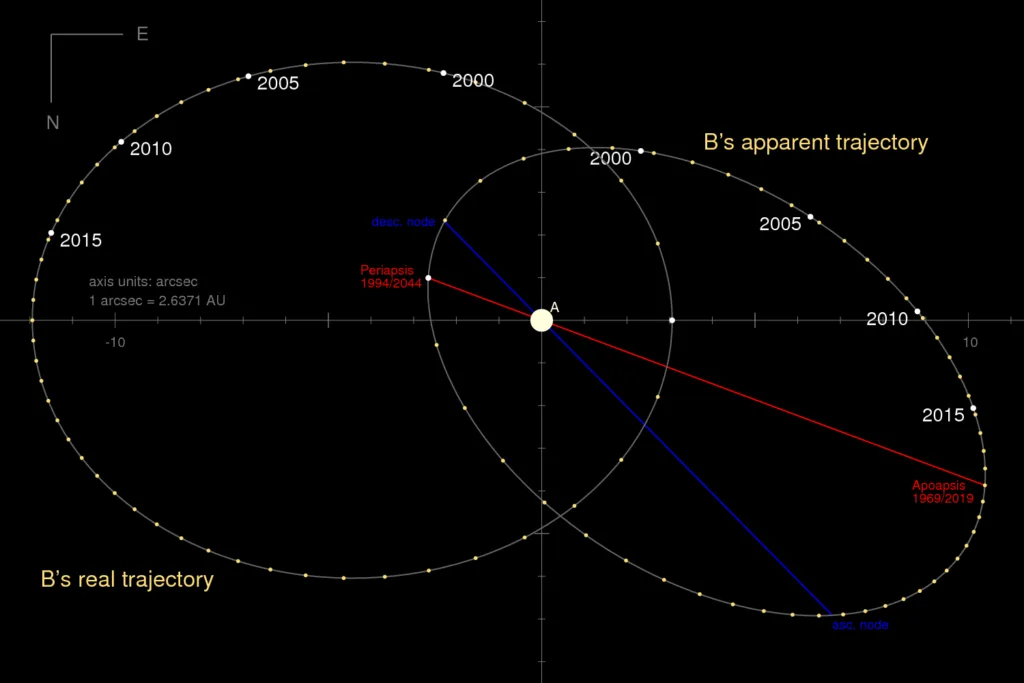
Irving Lindenblad launched a long-term photographic monitoring program of Sirius in 1965, using the 26-inch (66-centimeter) refractor at the U.S. Naval Observatory; the program ran through 1984.
The Dogon, as Griaule recorded, described Sirius's companion as small, invisible, and extraordinarily dense, with an orbital period of fifty years.
Astronomically, the description matches the actual properties of Sirius B in its essential points.
But the question remains: where did that knowledge come from, and was it part of Dogon tradition before European researchers reached Mali?
The Book That Ignited the Debate
Robert Temple published The Sirius Mystery in 1976 (New York: St. Martin's Press) and offered one answer: the Dogon had been visited by beings from the Sirius system.
Temple read Griaule's findings as evidence that amphibious beings called the Nommos had passed astronomical knowledge to ancient peoples, and that the Dogon had inherited it.
The book spread quickly through alternative history circles and made the Nommos a fixture of that world.
Ian Ridpath published a detailed critique of Temple's claims in the fall 1978 issue of the Skeptical Inquirer. He concluded that the Dogon tradition about Sirius, read literally, contained so many inconsistencies and factual errors that it could not be treated as coherent astronomical knowledge.
He pointed to contemporary contact, rather than ancient tradition, as the most likely source.
Carl Sagan, in Broca's Brain (Random House, 1979), offered a considerably simpler explanation: some of that knowledge may have reached the Dogon through contact with Europeans. Sirius B had been in astronomy textbooks since 1862.
Both critics pressed the same important point. By the 1930s, when Griaule was making his trips to Mali, Sirius B was no secret among educated Europeans: Arthur Eddington had described it in 1927, in his popular book Stars and Atoms, as a star whose matter was thousands of times denser than anything previously known.
Van Beek's Return
Van Beek's paper "Dogon Restudied: A Field Evaluation of the Work of Marcel Griaule" drew sharp reactions from anthropological circles.
Van Beek concluded that among the Dogon he worked with, he could find no knowledge of a stellar companion to Sirius of the kind Griaule had described.
His argument was that Griaule had probably, through unconsciously leading questions, shaped the answers his informants gave, and that the Dogon of the 1940s, faced with the authority of a foreign researcher, provided answers they assumed were expected of them.
Van Beek traced this to three interlocking factors: the researcher's confrontational style, the colonial context of the encounter, and a culture inclined to accommodate its interlocutors and absorb outside elements.
Geneviève Calame-Griaule, Griaule's daughter and collaborator, rejected this criticism in a later issue of the same journal.
Her position was that Van Beek had not reached a sufficient level of initiation into Dogon esoteric tradition for the elders to share deeper knowledge with him at all. The anthropologist Luc de Heusch took a more measured stance in "On Griaule on Trial." Van Beek held to his conclusion.
Sirius C and the End of the Search
Dogon tradition also speaks of a third star in the Sirius system, around which the Nommos' home planet would orbit. When Daniel Benest and J. L. Duvent published "Is Sirius a Triple Star?" in 1995 (Astronomy and Astrophysics, Vol. 299, pp. 621-628), the idea acquired an astronomical reference.
Analyzing orbital residuals in the motion of Sirius A and B, Benest and Duvent concluded that a companion of no more than about 50 Jupiter masses could orbit Sirius A with a period of roughly 6.3 years.
Christian Thalmann's team published the results of a high-contrast direct imaging search of the Sirius system in 2011 in Astrophysical Journal Letters, using the Subaru Telescope.
None of the data sets produced a candidate above the five-sigma threshold. The authors concluded that a Sirius C of the kind predicted by the 1995 analysis probably does not exist. If it does, it would be considerably less massive than assumed.
Dogon cosmology, in any case, is not a fabrication. It is a genuine and rich tradition, documented across decades of fieldwork.
What remains disputed is only the claim about Sirius B. It rests on accounts from a single group of informants in 1950, and no independent confirmation has ever been found.
Van Beek's 1991 paper runs to roughly thirty pages documenting what happened when a researcher returned to the field and tried to verify Griaule's claims.
The results were far less dramatic: among the Dogon, he found no clear confirmation of the extraordinary astronomical knowledge attributed to them.
SOURCES
- Van Beek, Walter E. A. "Dogon Restudied: A Field Evaluation of the Work of Marcel Griaule." Current Anthropology, Vol. 32, no. 2, April 1991, pp. 139-167. doi:10.1086/203932 · full text (PDF)
- Griaule, Marcel, and Germaine Dieterlen. "Un Système Soudanais de Sirius." Journal de la Société des Africanistes, Vol. 20, no. 2, 1950, pp. 273-294. doi:10.3406/jafr.1950.2611
- Griaule, Marcel. Dieu d'eau. Entretiens avec Ogotemmêli. Paris: Éditions du Chêne, 1948. (English edition Conversations with Ogotemmêli, 1965)
- Bessel, Friedrich Wilhelm. Astronomische Nachrichten, Vol. 22, no. 514, 1844, pp. 145-160.
- Eddington, Arthur S. Stars and Atoms. Oxford: Clarendon Press, 1927.
- Benest, D., and J. L. Duvent. "Is Sirius a Triple Star?" Astronomy and Astrophysics, Vol. 299, 1995, pp. 621-628. VizieR J/A+A/299/621
- Thalmann, Christian, et al. "Piercing the Glare: A Direct Imaging Search for Planets in the Sirius System." Astrophysical Journal Letters, Vol. 732, L34, 2011. doi:10.1088/2041-8205/732/2/L34
- Bond, Howard E., et al. "The Sirius System and its Astrophysical Puzzles: Hubble Space Telescope and Ground-Based Astrometry." The Astrophysical Journal, Vol. 840, no. 2, 2017. doi:10.3847/1538-4357/aa6af8
- Calame-Griaule, Geneviève. "On the Dogon Restudied." Current Anthropology, Vol. 32, no. 5, December 1991, pp. 575-577. doi:10.1086/204001
- De Heusch, Luc. "On Griaule on Trial." Current Anthropology, Vol. 32, no. 4, 1991, pp. 434-437. doi:10.1086/203978
- Temple, Robert K. The Sirius Mystery. New York: St. Martin's Press, 1976.
- Ridpath, Ian. "Investigating the Sirius 'Mystery.'" Skeptical Inquirer, Fall 1978.
- Sagan, Carl. Broca's Brain: Reflections on the Romance of Science. New York: Random House, 1979.
Aron Corvin
A researcher of the unknown who loves a good story, but doesn't sell sensationalism. I research every topic in detail before I publish it. If you enjoy what I write, your support would mean a lot and help me keep going.