
The Hour That Never Happened: What Physics Knows About the Illusion We Call Time
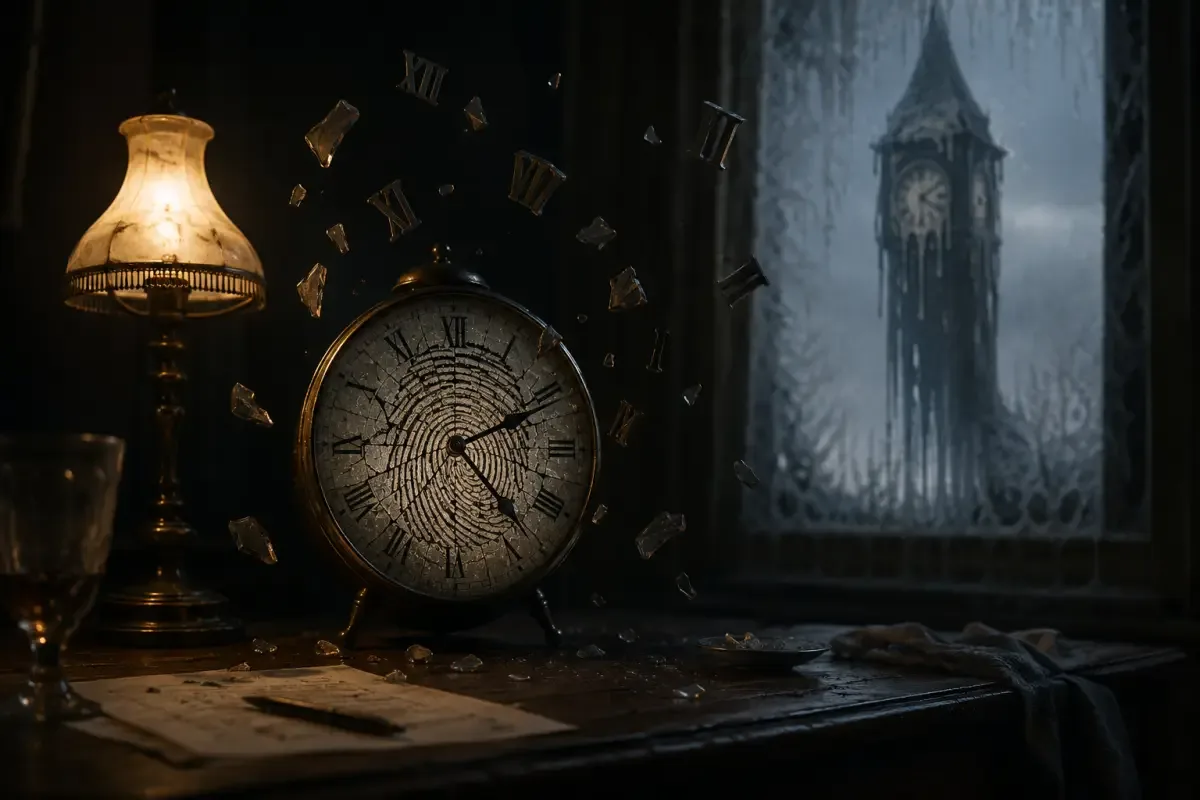
You feel it right now, reading this sentence. A forward pull, steady as a heartbeat, dragging you from the word you just read into the one that's coming.
It feels as solid as gravity. It feels like the one thing in the universe you can actually count on.
It isn't.
In 1851, a man wandered into a German village speaking a language no one had ever heard. He called it Laksarian.
He called himself Jophar Vorin, and he said he came from a place called Sakria, somewhere out past the edges of the known map, and that a shipwreck had stranded him here while he searched for a brother lost long ago.
The villagers wrote down what they could of his strange, lyrical speech.
Nobody ever placed Sakria on a chart. Nobody ever found Laksarian in any family of languages, living or dead.
He simply appears in the record, fully formed, a man out of nowhere. And then the record goes quiet.
I tried to track down the original German chronicle that recorded Vorin's appearance. The trail goes cold fast: a mention in a local history journal from the 1920s, a footnote in an obscure linguistics paper, and then nothing.
If the full account exists in a library somewhere, I couldn't find it.
A century and change later, in 1986, a Spaniard named Pedro Oliva Ramirez drove the familiar road from Seville toward the town of Alcalá de Guadaíra, a route he'd taken more times than he could count.
He rounded a curve he knew by heart. On the other side of it was a six-lane highway that had no business existing: buildings he'd never seen, signage in a layout that didn't match anything in his memory.
He drove it for nearly an hour, watching for something familiar, until a sign pointed him toward three destinations: Malaga, Sevilla, and a third name, Alcabala, that meant nothing to him.
He took the Sevilla exit. Minutes later he was parked outside his own house, in the town he'd never actually left, according to everyone who knew him.
He spent the rest of his life trying to find that curve again.
He never did.
Then there's Lerina Garcia Gordo, who woke up one ordinary morning in 2008 to sheets she didn't recognize and pajamas she'd never owned. She went to work and found herself reporting to a different department, under a manager she had never met in her life.
Her boyfriend was waiting for her, except he was the boyfriend she'd broken up with months earlier. The man she'd actually been dating for the past several months had simply ceased to exist in anyone's memory but her own.
Doctors examined her. She was healthy, lucid, entirely herself. The only thing wrong was the world.
What strikes me about these cases isn't the grand, cinematic weirdness of it: it's how small the dislocation is.
Nobody wakes up on Mars. Nobody meets a dinosaur.
The horror is in the five percent. A road that's ninety-five percent right. A boyfriend who's ninety-five percent the same life, just rewound by one decision.
That kind of glitch is far more unsettling than total strangeness, because it suggests not a different universe, but a crease in this one.
I honestly don't know what to make of these stories. I've reread them more times than I can count. Every time I come away with the same feeling: not belief, not disbelief, just a kind of quiet unease that sits with me for days.
So we should ask the obvious, unfashionable question: what actually is time? Is it the thing a clock measures, or is the clock just a very convincing liar?
The Philosopher's Clock and Newton's Iron Rule
Aristotle got there first, in the Physics, and his answer was almost disappointingly modest: time is "the measure of change."
Walk out the door, walk back two hours later: the two hours are the walk, recorded. No motion, no time.
It's a clean, almost mechanical idea, and it raises an obvious problem: lie perfectly still in a dark room, eyes shut, body unmoving, and you can still feel the minutes crawl.
Aristotle had an answer for that too. The body doesn't have to move for time to pass: the mind does. Thought itself is motion enough.
Time, he wrote, is bound to change of some kind, anywhere it occurs, even behind closed eyes.
Then, nearly two thousand years later, Isaac Newton tore that idea up and replaced it with something far more rigid.
In the Principia, Newton proposed absolute time: a single universal clock ticking the same way everywhere, indifferent to observers, indifferent to motion, indifferent to whether a single atom in the cosmos so much as twitched.
Stop every object in the universe, freeze every mind, and time would keep flowing regardless, a river with no banks and no need of water in it.
He gave this abstraction a symbol, the letter t, and dropped it into his equations of motion. That single variable went on to colonize the next two centuries of physics.
Every formula that followed assumed Newton's t was real, fixed, and the same for everyone everywhere.
Not everyone bought it. Gottfried Leibniz fought Newton bitterly on this point, insisting time was nothing more than the relations between events: no events, no time, full stop.
There's a charming, probably apocryphal story that Leibniz dropped the "t" from the end of his own surname, which had originally been spelled "Leibnitz," partly as a quiet rebellion against Newton's absolute-time orthodoxy.
True or not, it captures how personal this argument got. Two of the smartest men alive were having a centuries-spanning fight about whether the universe runs on a master clock.
The rest of physics had to pick a side.
The Crisis of the Constant and Einstein's Trade
By the late 1800s, Newton's side looked unbeatable, until two American physicists tried to catch the universe's wind.
If you're riding a train doing 50 meters per second and you roll a ball forward at 3 meters per second, someone standing on the platform sees that ball moving at 53 meters per second. Velocities add.
That's common sense, and it had never failed anyone.
So in 1887, Albert Michelson and Edward Morley set out to measure the speed of light the same way: comparing it against Earth's own motion through space, hunting for the faint headwind or tailwind that common sense demanded must be there.
They found nothing. No headwind, no tailwind. Light moved at the same speed no matter which direction Earth was traveling relative to it.
The experiment that was supposed to confirm the existence of a cosmic medium — the "ether" physicists assumed light traveled through — instead delivered the most famous null result in the history of science.
The ether wasn't there.
The "common sense" addition of velocities had simply failed, for the first time anyone had ever caught it failing.
This is where Einstein walked in and made a trade nobody had thought to offer.
If the speed of light truly will not budge — if a beam of light leaves a flashlight at the same speed whether you're standing still or sprinting toward the wall — then something else has to bend to keep the math honest.
Einstein decided that something would be time and space themselves, fused into a single fabric he called spacetime.
Velocity addition doesn't fail because of some hidden flaw in measurement. It fails because moving clocks genuinely run slower, and moving rulers genuinely shrink, exactly enough to keep light's speed locked in place for every observer, no matter how fast they're moving.
Time and space are not the stage on which physics happens. They are part of the play, and they bend when the actors move.
Special relativity, in 1905, established that clocks in motion tick slower than clocks at rest.
A decade later, general relativity extended the same logic to gravity: clocks deeper in a gravitational well — closer to a massive object — run slower than clocks farther out.
Your head, fractionally farther from Earth's center than your feet, is technically aging faster than your feet are, right now. By an amount so small no instrument built before the 1970s could have caught it.
I should mention I wrote most of this article in a café that plays the same three jazz albums on rotation.
By the time I got to general relativity, I knew every saxophone solo by heart.
I don't know why I'm telling you this except that it feels dishonest not to. Writing about time makes you pay attention to how you spend it. I spent a lot of this one listening to "'Round Midnight."
Proof, Measured in Billionths of a Second
In October 1971, physicist Joseph Hafele and astronomer Richard Keating decided to catch it anyway.
They carried four cesium-beam atomic clocks aboard ordinary commercial airliners: devices so precise that one built in Germany would later run for 187 million years without drifting a single second.
They flew once eastward around the world and once westward, then compared the results against a reference clock that stayed put at the U.S. Naval Observatory.
The two trips weren't symmetrical, because Earth itself is spinning eastward.
A plane flying east adds its speed to the planet's own rotation; a plane flying west subtracts from it.
Special relativity says faster motion means slower time. General relativity says higher altitude (weaker gravity) means faster time.
Both effects were live at once, fighting each other in different proportions on each flight.
When the clocks came home, the eastbound clock had lost 59 nanoseconds compared to the ground reference.
The westbound clock had gained 273 nanoseconds, actually, I've seen this reported as 273 in the original Science paper and 275 in a later analysis that uses a slightly different relativistic correction.
Let's say 273 and move on. The margin between the two is smaller than any of this really matters for the point.
Both numbers landed almost exactly where Einstein's equations said they would.
I had to sit with that number for a while: 59 nanoseconds. It's not philosophy.
It's a measurement someone wrote down on a clipboard and checked against a prediction.
It's worth sitting with how small that margin is, because the GPS system in your pocket runs on it.
Satellite clocks in orbit gain roughly 38 microseconds a day relative to clocks on the ground.
Without daily correction for that drift, the system would pile up position errors of about ten meters within a single day.
Forty-four years later, NASA ran a version of the same experiment on a human body.
Astronaut Scott Kelly spent 340 days aboard the International Space Station while his identical twin, Mark, stayed on Earth: a natural control group, genetically matched down to the letter.
Researchers tracked Scott's telomeres: the protective caps of repetitive DNA sequence sitting at the ends of chromosomes that ordinarily shorten a little with every cell division, acting as a kind of biological odometer.
What they found surprised them: Scott's telomeres actually grew longer during his time in orbit, the opposite of the expected aging signature, likely tied to shifts in diet, exercise load, and younger stem cells entering his bloodstream.
Within roughly 48 hours of touching back down on Earth, that lengthening reversed itself sharply.
His telomere length spent the following months settling back toward — and in some measures slightly below — where it had started.
Mark's, on the ground, barely moved the whole time.
As for the relativistic time dilation itself — the actual Einsteinian effect of Scott's orbital speed — it amounted to a few milliseconds over the entire year. Real, measured, and utterly dwarfed by the biology happening around it.
A Universe Where Nothing Is Actually Moving
If both relativity theories hold, a stranger picture follows.
In 2015, MIT philosopher Bradford Skow laid out what's now called the Block Universe: which is basically just a fancy way of saying everything that ever happened or will happen is already there, sitting at its own coordinates, and you're just catching up to it.
Nothing in the block is moving. There's no flow, no river, no ticking forward. Every moment that ever happens or will happen already sits at its own address, permanently.
That raises an uncomfortable question immediately: if 2050 already exists in the same sense that yesterday does, what's left of free will? Or of the felt difference between "already decided" and "still open"?
Physicist Max Tegmark — whose parallel universe taxonomy I explored in a separate article — and physicist-philosopher Julian Barbour have offered a similar answer from different directions: the sensation of time passing is a production of the brain, not a property of the universe.
Your neurons are built to record the past and stay blind to the future, which manufactures the illusion of forward motion. Press play on a film and the film "moves", but only because you're watching it in sequence.
The block itself just sits there, complete.
The British engineer and amateur philosopher J.W. Dunne got to a related idea by a stranger road, through years of cataloguing his own precognitive dreams.
In 1934 he proposed "serialism": the notion that consciousness exists in nested layers of time, the body anchored to one dimension while some higher self watches from a level outside it, untouched by the body's death. Mainstream physics never adopted it.
But it's hard not to notice the family resemblance to Skow's block, decades before Skow gave the idea a name.
The Riverbed Beneath the River
I almost left this next section out.
It doesn't add anything to the physics: it doesn't explain time dilation or the Block Universe.
But every time I came back to it, I couldn't bring myself to cut it. So here it is.
Long before any of this had words like spacetime attached to it, there's a story from the life of the Buddha that assumes the same architecture without needing the equations.
After King Virudhaka seized the throne, he set his army against the Shakya clan: the Buddha's own birth family.
Three times, by tradition, the Buddha sat directly in the road his enemy's soldiers had to march down.
Three times the king turned his troops around rather than pass him by.
The fourth time, the Buddha didn't move to stop them, and the Shakya clan was destroyed.
When his disciple Mogallana asked why, the Buddha is said to have answered with a story reaching back lifetimes: that Virudhaka had once, long before, been a great fish in a river, eaten by the very people who would become the Shakya clan.
He himself, as a child in that earlier life, had struck the fish three times on the head out of pure curiosity, which is why, tradition holds, he suffered head pain for three days after his own enlightenment.
Cause, in this telling, doesn't expire. It waits.
And the Buddha is said to have predicted that within seven days, Virudhaka and his army would be destroyed in turn, which, as the story goes, a sudden storm accomplished exactly on schedule.
Strip away the supernatural framing and what's left is a claim that would feel at home in Skow's lecture hall: that past action and future consequence are not separated by an empty gap called "waiting," but are connected points on a single structure, visible all at once to anyone standing outside it.
The Buddha's vantage, in the old telling, wasn't prophecy. It was simply a wider window onto a block that was already complete.
That, perhaps, is the most honest place to leave this.
Whether the universe is a river or a block, whether Jophar Vorin slipped through a crease in spacetime or just made up a story no record could later disprove, the math and the myth keep arriving at the same uncomfortable suggestion.
The clock on your wall isn't measuring something fundamental. It's measuring how well your brain manages to forget the future and remember the past, and calling the gap between them "now."
I don't know about you, but I haven't looked at a clock the same way since I first stumbled into this rabbit hole.
Maybe that's the point. Or maybe I've just spent too long reading about time and lost all perspective.
SOURCES
- Hafele, J.C. & Keating, R.E. (1972). "Around-the-World Atomic Clocks: Predicted Relativistic Time Gains" and "Observed Relativistic Time Gains," Science, 177(4044), 166–170.
- U.S. Naval Observatory, "USNO Marks 50 Year Anniversary of Breakthrough Relativity Experiment," DVIDS, 2021.
- Wikipedia, "Hafele–Keating Experiment" (overview of methodology and published results).
- NASA, "NASA's Twins Study Results Published," NASA Human Research Program, 2019.
- NASA, "NASA Twins Study Confirms Preliminary Findings," NASA.gov.
- National Institute on Aging, "NASA Twins Study Reveals Health Effects of Space Flight," NIA News, 2022.
- Garrett-Bakelman, F.E. et al. (2019). "The NASA Twins Study: A multidimensional analysis of a year-long human spaceflight," Science, 364(6436).
- Smithsonian Magazine, "NASA's Study of Astronaut Twins Creates a Portrait of What a Year in Space Does to the Human Body," 2019.
- Aristotle, Physics, Book IV (on time as "the measure of change/motion").
- Newton, Isaac, Philosophiæ Naturalis Principia Mathematica (1687), on absolute time and space.
- Einstein, Albert (1905). "Zur Elektrodynamik bewegter Körper" ("On the Electrodynamics of Moving Bodies"), Annalen der Physik — the founding paper of special relativity.
- Einstein, Albert (1915–1916). Field equations of general relativity, Annalen der Physik.
- Michelson, A.A. & Morley, E.W. (1887). "On the Relative Motion of the Earth and the Luminiferous Ether," American Journal of Science.
- Skow, Bradford (2015). Objective Becoming, Oxford University Press — the philosophical case for the Block Universe.
- Tegmark, Max (2014). Our Mathematical Universe: My Quest for the Ultimate Nature of Reality, Knopf.
- Barbour, Julian (1999). The End of Time: The Next Revolution in Physics, Oxford University Press.
- Dunne, J.W. (1934). The Serial Universe, Faber & Faber.
- Anguttara Nikāya and traditional Buddhist commentarial sources on the destruction of the Shakya clan and the karmic account given by the Buddha to Mahāmoggallāna.
Aron Corvin
A researcher of the unknown who loves a good story. I won't sell you sensationalism just for a click. If you enjoy what I write, your support would mean a lot and help me keep going.