
Twelve Minutes of Silence: What Happened to Flight 823?
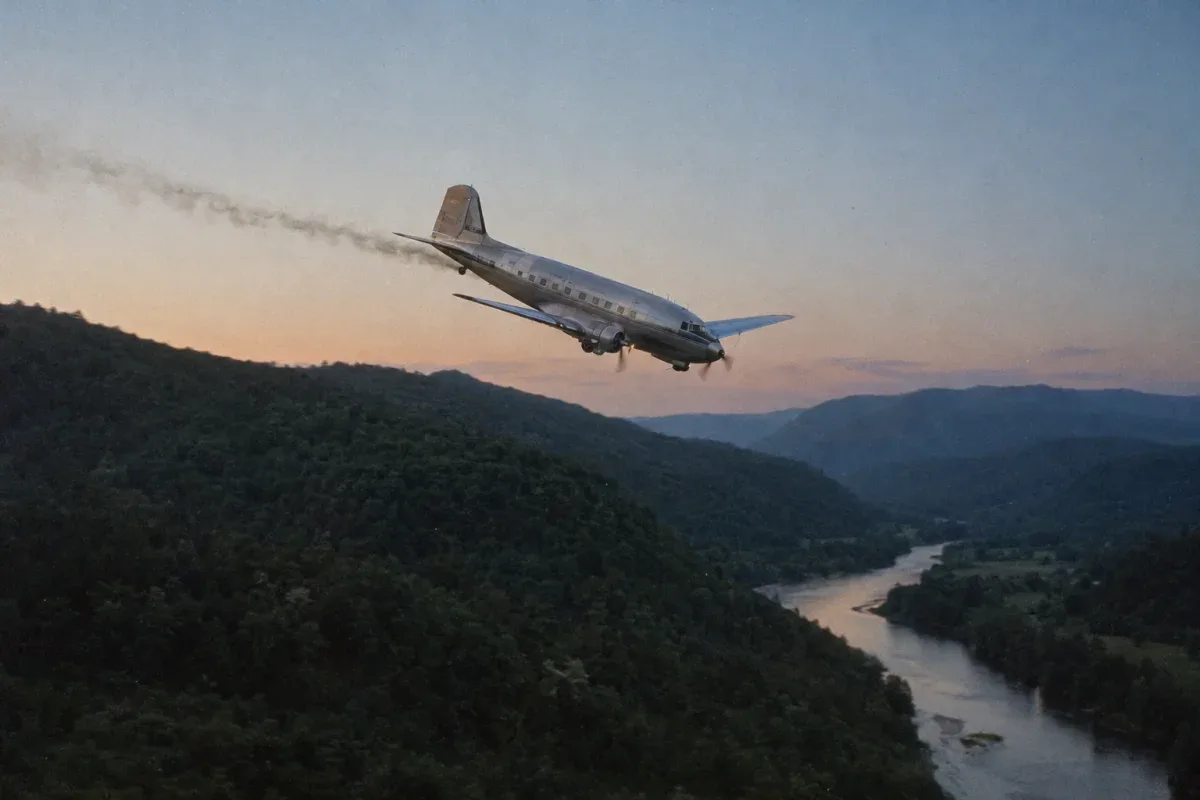
At 6:02 p.m. on Thursday, July 9, 1964, the crew of United Airlines Flight 823 confirmed their final message to the air traffic controller in Atlanta with a single word: "OK."
The aircraft, a turboprop Vickers Viscount 745D registered N7405, had just canceled its instrument flight plan and continued on visually toward Knoxville, Tennessee.
Twelve minutes later, it crashed into a wooded hillside near Parrottsville, killing all 39 people on board. The cause was never determined.
During those twelve minutes, no one on the ground heard a single word about trouble in the cockpit.
Witnesses saw the plane flying dangerously low, trailing smoke behind it.
What happened inside has remained, largely, a reconstruction built from soot traces, switch positions, and fragments of wreckage.
A Viscount for Appalachia
The Vickers Viscount, the first turboprop airliner built for mass production, entered series production in Britain in 1953, at a time when airlines were looking for a reliable aircraft for shorter, regularly scheduled routes.
The 745D model, the version flown by United Airlines, was built for exactly those kinds of routes.
Aircraft N7405 was built in 1955 and had logged 23,804 flight hours by the day of the crash.
Flight 823 that day was a routine run: departure from Philadelphia at 3:13 p.m., landing in Washington at 3:54 p.m., then on toward Knoxville at 4:36 p.m., with a final destination of Huntsville, Alabama. There were 35 passengers and four crew members aboard.
Captain Oliver Sabatke, 41, held ratings for several aircraft types and had recently renewed his training on the Viscount.
First Officer Charles Young, 37, was a former B-26 bomber crew member from the Korean War, with more than 7,700 flight hours, 2,100 of them on the Viscount.
The weather was clear, the day sunny, and no report from earlier flights had mentioned any mechanical problem.
Red Light and Smoke
After passing the Holston Mountain navigation fix at 5:57 p.m., the crew requested a descent to the lowest available altitude.
Three minutes later, they canceled their instrument flight plan, a routine step before landing under visual flight rules.
The message at 6:02 p.m. was the last one, and there was nothing unusual in it.
At some point before radar contact was lost, the plane drifted south of its planned V16 corridor, onto a path that ran along a nearby river.
Investigators never determined why the crew had departed from their course.
The first witness to notice anything was about 11 miles from the crash site. She saw a violet-red light on the plane's fuselage, but no smoke.
Five miles closer, a second witness described smoke trailing from the tail section, with patches on the fuselage that looked like peeling paint.
About a mile and a quarter from the point of impact, the plane was already trailing thick black smoke.
At that point, one passenger fell from the plane through emergency window No. 4, above the left wing. Farther along the flight path, window No. 9 came off as well.
The plane then pitched up sharply, rolled onto its left wing, and plunged into a steep, wooded slope at a 45-degree angle, where it exploded and set the surrounding trees on fire.
Six Days on the Hillside
The crash happened right next to the Trentham family farm, where Mae Trentham's thirteen-year-old son, Kenneth, was milking cows when he heard a whistling sound and looked up just in time to see the plane hit the first tree.
No road led to the crash site, so one had to be cut through the woods to allow access.
The Trentham family opened their yard to more than twenty ambulances, along with teams from the Cocke County Sheriff's Office and a local rescue squad. The farmhouse served as the unofficial headquarters of the operation over the following days.
Newell "Hop" Byrd, then a member of the rescue squad, later described climbing the steep slope with a bucket of water strapped to his back.
He said that of the thirty-nine people on the flight, only one body remained intact. According to witness accounts, firefighters and locals had to turn away onlookers who tried to carry off wallets and personal belongings from the site.
A temporary morgue was set up in the Cocke County Memorial Building in nearby Newport, which at the time also served as the local National Guard armory.
County coroner Everett Roberts, who was also the local funeral director, insisted that the bodies not leave the county before processing.
Cleanup of the site was largely finished by July 15, six days after the crash.
Remains that couldn't be identified were buried together in a single casket at Union Cemetery in Newport.
For years, the grave had no marker. As Tip Brown, the ambulance driver who was first on the scene, told Newport Plain Talk in 2024, "the agreement with United Airlines was that the grave would never be marked."
A memorial wasn't placed until 2014, on the fiftieth anniversary of the crash.
Among the victims was Durant da Ponte, a professor of American literature and assistant dean at the University of Tennessee.
Also on board were a twelve-year-old girl traveling alone and a five-year-old boy being treated for leukemia.
A Report Without Answers
The investigation was complicated by the fact that the flight data recorder was destroyed in the fire: its housing crushed, its tape melted.
It was the first recorded case of fire destroying the tape in this model of Lockheed recorder.
Without it, investigators from the Civil Aeronautics Board had to rely on soot traces, switch positions, and laboratory tests, with help from experts at the Federal Bureau of Investigation (FBI), the Massachusetts Institute of Technology, and the British company that had designed the aircraft.
They examined several possible sources of ignition.
The hydraulic fluid reservoir was found empty, but the damage to it didn't match a fire that had started before impact.
A can of paint thinner was found crushed, but with no trace of fire.
One battery showed signs of arcing, but no further evidence of failure. The possibility that someone had brought flammable material aboard, whether by accident or on purpose, could never be either confirmed or ruled out.
Outside the official investigation, locals offered their own theories: one local pilot thought lightning might have started the fire, while another witness suspected a battery failure. Neither theory was ever confirmed.
The final report, released in 1966, concluded that the loss of control resulted from an uncontrolled fire in the aircraft's fuselage whose origin was never determined.
The Board stated that it was unable to identify the source of fuel, the ignition point of the fire, or the reason for the final maneuver.
According to the report's analysis, the crew spent their final minutes clearly trying anything that offered even the smallest chance of help, including opening the cockpit windows and activating the baggage compartment's fire extinguishing system, even though no fire had ever developed there.
The identity of the passenger who fell from the plane was never made public in the official report. The document refers to him only as the "free-fall victim."
Popular retellings of the crash often claim he was a lawyer who was afraid of flying and always sat next to the emergency exit, but that claim appears neither in the Board's report nor in local newspaper coverage from the time. It remains a piece of oral tradition rather than a confirmed fact.
Forensic findings on his body showed burns to the hands, face, and neck that occurred before he hit the ground, but only five percent carbon monoxide in his blood, a level suggesting he had left the smoke-filled cabin before the smoke could fully overcome him.
Cocke County has kept the memory of the crash alive for decades.
Newport author Tom Dier spent years researching archives and family testimonies, work that led to the 2018 book The Last Flight of United Air Lines 823. Yet even that book, despite its extensive research, ultimately offers theories rather than a definitive answer.
Next to the body of the man who fell from the plane, investigators found a cigarette lighter with a clear plastic reservoir, filled to seven-eighths capacity.
The report lists it simply as one of the items recovered at the scene, with no interpretation and no conclusion about whose it was or what it meant. Sixty-two years later, it remains the only object found with him.
SOURCES
- Civil Aeronautics Board, Aviation Accident Report: United Air Lines Flight 823 (1966)
- Kathy Hemsworth, "'Something you don't forget,' 60 years later, 'horrific' United Airlines Flight 823 crash still evokes emotions," Newport Plain Talk (2024)
- "The terrible plane crash of 1964," As It Was Give To Me, Newport Plain Talk (2014)
- Tom Dier, The Last Flight of United Air Lines 823, CreateSpace, 2018.
- Bureau of Aircraft Accidents Archives (baaa-acro.com), accident record near Parrottsville, 1964.
Aron Corvin
A researcher of the unknown who loves a good story, but doesn't sell sensationalism. I research every topic in detail before I publish it. If you enjoy what I write, your support would mean a lot and help me keep going.