
The Kozyrev Mirrors: What a Soviet Time Experiment Actually Recorded
Some of the scientists who worked closest to the device wouldn't enter the room alone.
They described a wave of dread that started roughly three meters from the machine and lifted the instant they stepped back over that line, as if the fear itself had a boundary.
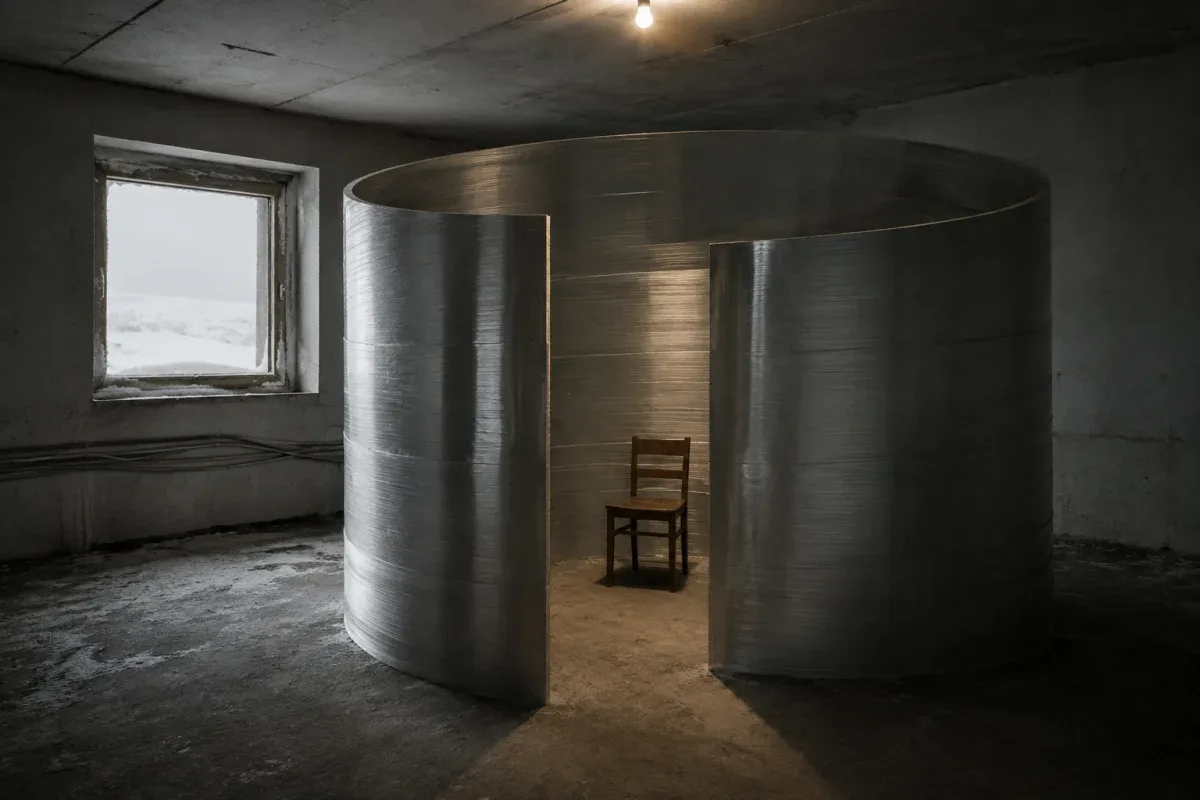
The machine was a chamber built from curved sheets of polished aluminum, coiled into a tight spiral just wide enough to hold a person and a chair.
Researchers assembled it on Dikson Island, deep inside the Russian Arctic, in December 1990.
They called it a Kozyrev mirror, after the astrophysicist whose decades-old theory of time it was built to test.
A Physicist Who Missed Einstein
Nikolai Kozyrev was twenty-eight and already one of Soviet Russia's most promising astrophysicists when the trouble found him.
He had joined the Pulkovo Observatory outside Leningrad in 1931, publishing his first scientific paper at seventeen and building a reputation among the country's most capable young astronomers.
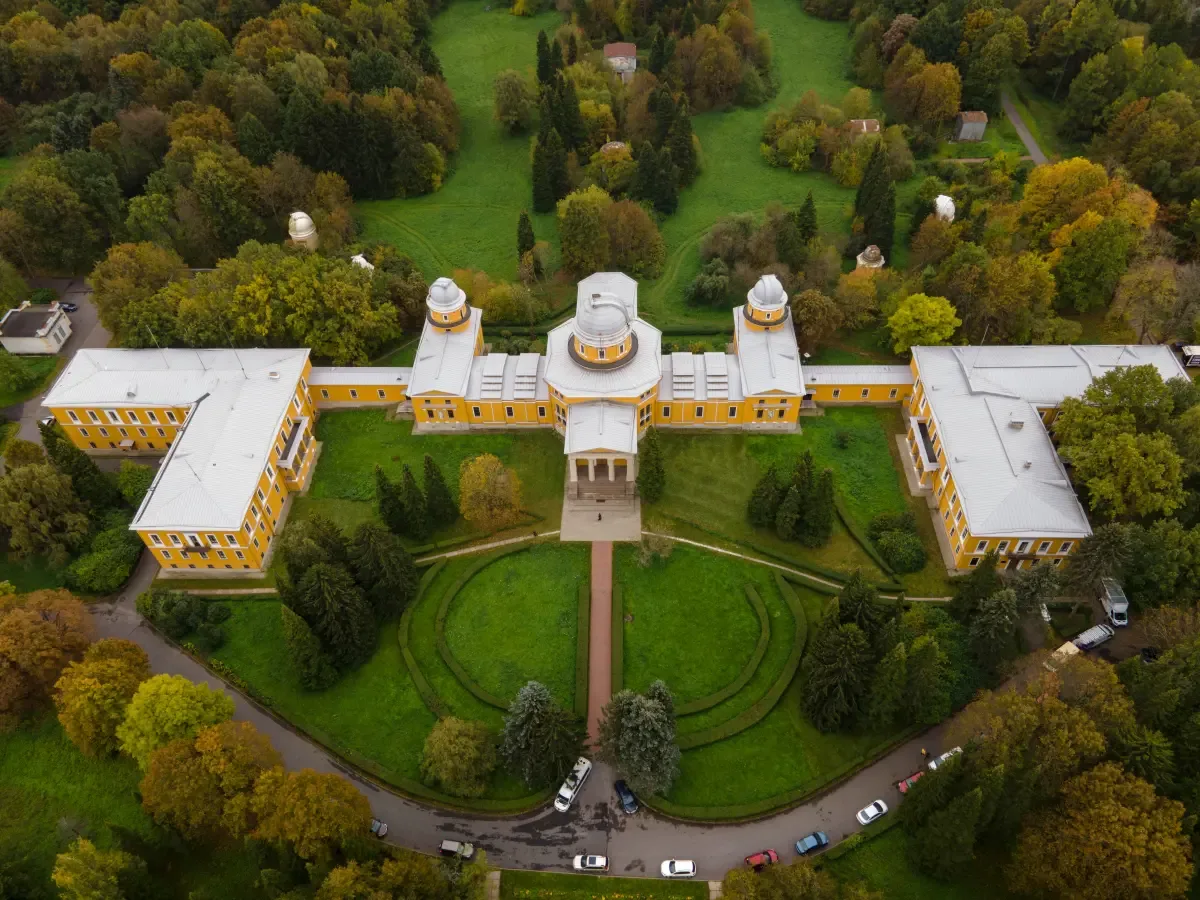
Stalin's purges reached Pulkovo in 1936, and Kozyrev was swept up along with much of the observatory's staff.
He was arrested that November and sentenced to ten years for counterrevolutionary activity.
A second ten-year sentence followed in 1941, this one for "hostile propaganda."
He served roughly a decade before colleagues secured his early release in December 1946 — a stretch of imprisonment later noted in Alexander Solzhenitsyn's The Gulag Archipelago.
Cut off from the wider scientific world, Kozyrev missed much of the mid-century debate over general relativity and nuclear astrophysics.
He returned to Pulkovo already convinced that time itself behaved like a form of energy.
It could flow at different densities, speed up or slow down under certain physical conditions, and — crucially for what came later — be reflected, the way a mirror redirects light.
He spent the rest of his career building that idea into a framework he called Causal Mechanics.
He was not simply a crank.
In 1958 Kozyrev reported evidence of volcanic outgassing inside the Moon's Alphonsus crater, a claim that drew open ridicule.
The gas emission he recorded — carbon, in its C2 Swan bands — is now widely accepted, but his interpretation of it as volcanic activity has remained disputed rather than confirmed.
His theory of time received no equivalent vindication.
In January 1960 the Soviet Academy of Sciences convened a commission to examine Causal Mechanics, and it concluded the theory did not meet the evidentiary and logical standards a physical theory requires.
Kozyrev kept working on it anyway, until his death in 1983.
Building the Mirror
The device at Dikson came from a different scientist.
Vlail Kaznacheev was a decorated Siberian physician, not a physicist — an academician who had spent the 1960s and 1970s studying how the human body adapts to the Arctic, and who founded Novosibirsk's Institute of Clinical and Experimental Medicine in 1980.
By the late 1980s, deep into an already decorated career, he had turned to a stranger question: whether Kozyrev's "time energy" could be focused the way a concave lens focuses light, and used to move information between minds.
Kaznacheev directed the research.
A younger colleague, Alexander Trofimov, built the hardware and ran the experiments on site.
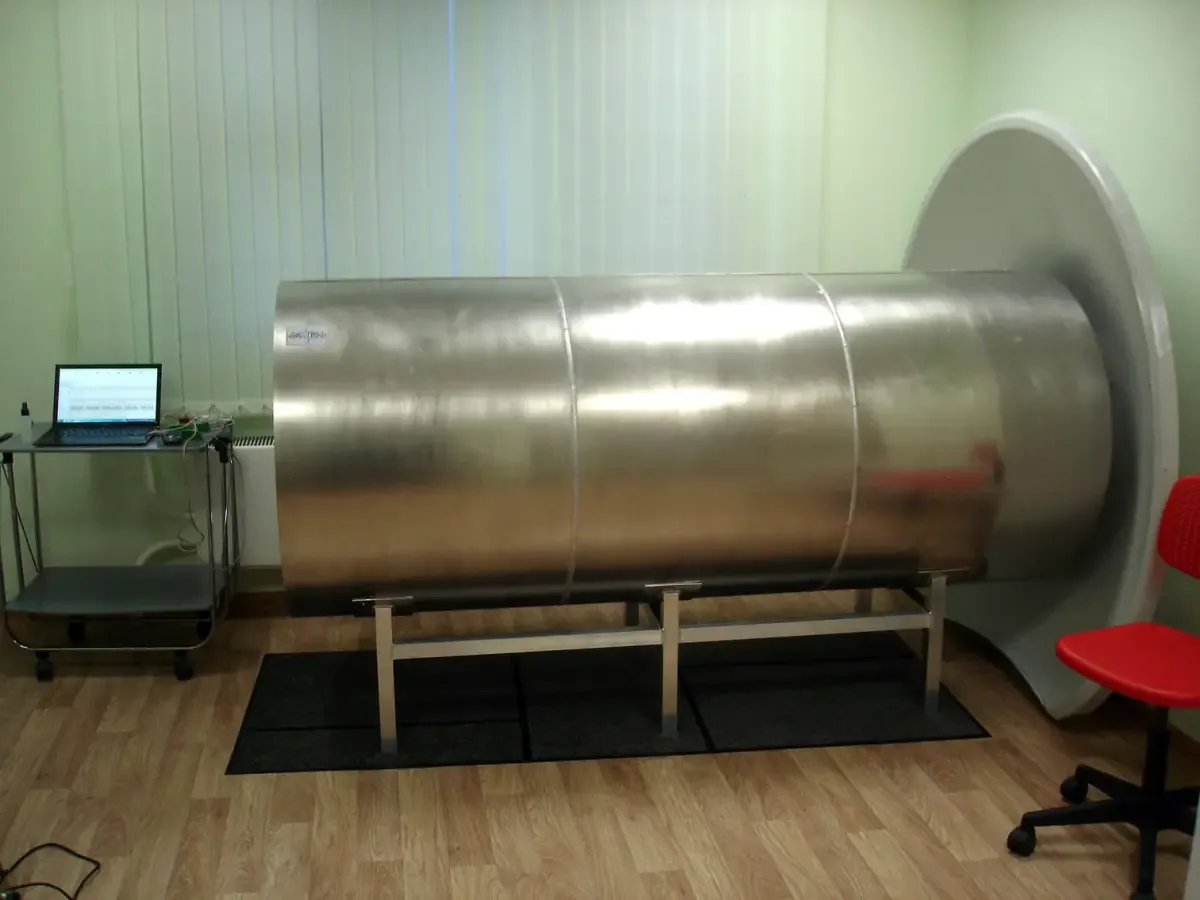
The team settled on polished aluminum curved into a spiral of roughly one and a half turns, with just enough room inside for a chair and a bank of instruments.
The first working version was tested in December 1990.
They chose Dikson for a specific, measurable reason.
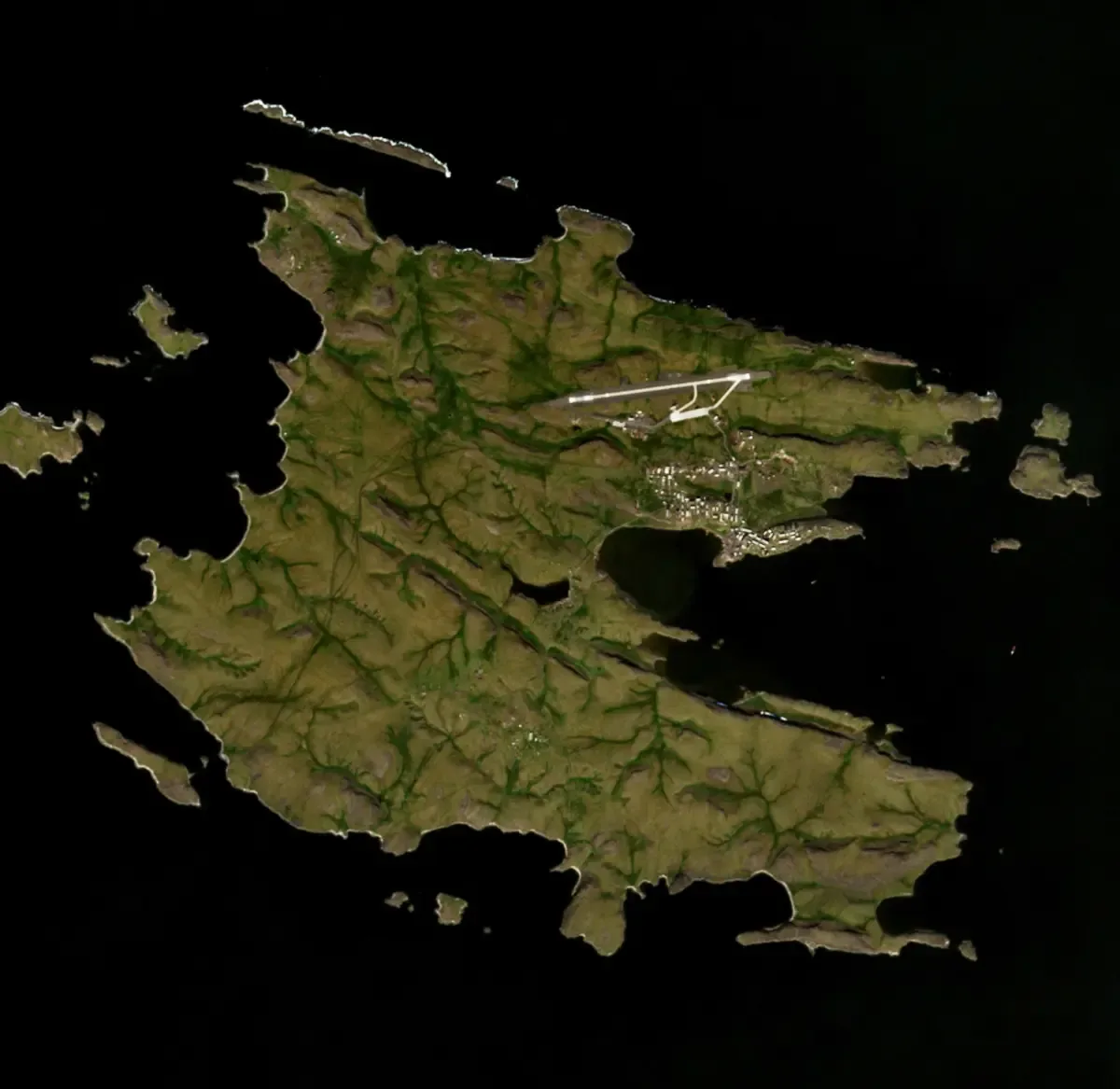
Kozyrev claimed to have detected a change in a spinning weight's behavior above roughly 73 degrees north latitude, which he associated with a shift in the local flow of time energy.
Dikson sits at 73°30′ north — close enough to Kozyrev's own line that Kaznacheev's team treated it as a natural laboratory rather than an arbitrary outpost.
What the Volunteers Reported
Kaznacheev and Trofimov published their results in 1992, in a book titled Cosmic Consciousness of Humanity.
It describes a nationwide test in which thousands of volunteers tried to mentally receive a shared set of symbols broadcast by a single sender seated inside the Dikson mirror, and it reports the reception rate climbing from 14.8 percent without the device to 69 percent with it.
No laboratory outside the project has ever reproduced those figures.
The people who actually sat inside the mirror reported something more immediate.
In one phase of the project, 47 volunteers passed through the chamber, and the book states that 83 percent experienced what the researchers termed unusual psychophysical phenomena: altered awareness of their own body's shape, a sense of split identity, sudden and vivid memories that felt like childhood or, in some accounts, past lives.
Some of this testimony was recorded right after a session.
Some of it surfaced only under hypnotic regression, a technique now widely considered unreliable in mainstream psychology because it can produce false memories as easily as recover real ones.
Many participants also described a recurring human figure, dressed in white, whom researchers and subjects alike began calling "the white stranger."
It reportedly spoke to at least one volunteer, saying only, "good morning, it is me," and was generally described as calm rather than threatening.
Others reported specific symbols — circles, spirals, a repeated eye-within-a-circle — appearing in their minds, with several participants sketching near-identical shapes despite not having spoken to one another beforehand.
Over several days that December, researchers and Dikson residents also reported unidentified objects moving across the sky, alongside an unusually intense aurora.
None of it left any trace in an independent record. It exists only inside the team's own account.
Trofimov later pushed the claims further still.
In a Russian interview, he described sessions in which volunteers appeared to receive symbols hours before a computer had even generated them at random, which he offered as proof that in the far north "the future is present in the Present."
He has never published an accuracy rate for that specific result, or explained what ruled out a simpler possibility: that a late guess, made during an hours-long open broadcast window, was simply matched afterward against whichever transmission it happened to resemble.
A Paper Trail in Moscow and Washington
Kozyrev's claim that time carries energy has never found a foothold in mainstream physics, and a related, better-known strand of Soviet-era research fared even worse.
A separate group promoting so-called torsion field devices was investigated by the Russian Academy of Sciences in the early 1990s and formally declared fraudulent, its state funding cut by government decree in 1991.
Kaznacheev and Trofimov's mirror was never part of that specific inquiry, but it drew on the same rejected physics, and no mainstream physics institution has evaluated it on its own terms since.
Someone in Washington was paying attention regardless.
A CIA dispatch from April 1991, released in 2020 after a Freedom of Information Act request from researcher John Greenewald, takes note of both men. It names Kaznacheev as a "well-known authority on ESP" whose volunteers in Novosibirsk and Leningrad tried to transmit geometric shapes to one another by mind alone.
The mirror-based method it describes, however, belonged to a different researcher, Konstantin Buteyko, who seated volunteers between two concave mirrors believed to focus psychic energy.
The document offers no judgment on whether the research worked.
It simply confirms that American intelligence had, at some point, thought it worth watching Soviet scientists who believed they could harness the mind — and, in Kaznacheev's case, bend time.
The institute Trofimov built around Kaznacheev's name is still active.
It has since renamed its devices "MNIIKA Mirrors" and, according to Trofimov, presented data at an international disaster-forecasting congress in Melbourne in 2018, claiming the ability to predict earthquakes a week in advance.
That claim, like the others, has not been independently verified.
The book's appendix yields no single figure that settles the question — but it does yield this:
Among the symbols volunteers reported perceiving from inside the mirror — offered in the book as evidence that something real was being transmitted, not imagined — was a design of three circles set inside a larger ring.
Researchers called it the banner of peace.
It was also the exact image they had placed on a sheet of paper inside the mirror before the experiment ever began.
SOURCES
- Kozyrev, Nikolai Alexandrovich — Biographical Encyclopedia of Astronomers (Springer)
- Chigarev, B.N., "N.A. Kozyrev's Causal Mechanics Seen by an Orthodox Physicist," in On the Way to Understanding the Time Phenomenon (World Scientific, 1996), DOI: 10.1142/9789812797292_0004
- Wills, M., "The Case of the Volcano on the Moon," JSTOR Daily, based on: Doel, R.E., "The Kozyrev-Kuiper Controversy over Lunar Volcanism"
- Cohen, A.J., "Source of Evolution of Gas from the Lunar Crater Alphonsus," Nature 201, 626 (1964)
- Neustroeva, T.S., "Academician of the RAS V.P. Kaznacheev," Siberian Research, 2019 — siberes.ru
- Kaznacheev, V.P. & Trofimov, A.V., Cosmic Consciousness of Humanity, Novosibirsk, 1992.
- Kozyrev's Mirror: reflections on "Cosmic Consciousness"
- Kozyrev Mirrors, Psychics, Time Travel, and the CIA — translated interview with Alexander Trofimov
- Dikson Island station data — Network for the Detection of Atmospheric Composition Change
- EOM-2019-01044 — declassified CIA cable, 24 April 1991, approved for release 4 November 2020 (The Black Vault / John Greenewald Jr., FOIA)
- Rubakov, V.A., "The Theory of Physical Vacuum. Theory, Experiments, and Technologies by G I Shipov" [book review], Physics-Uspekhi 43, 309–310 (2000)
- Trofimov, A.V., conference paper, OMICS International Conference Proceedings, Melbourne 2018 (OMICS publisher was found in 2019 to have misrepresented its peer-review process — this source only shows the claim was made, not that it was verified)
Aron Corvin
A researcher of the unknown who loves a good story, but doesn't sell sensationalism. I research every topic in detail before I publish it. If you enjoy what I write, your support would mean a lot and help me keep going.