
Who Made the Klerksdorp Spheres, Nearly 3 Billion Years Old?
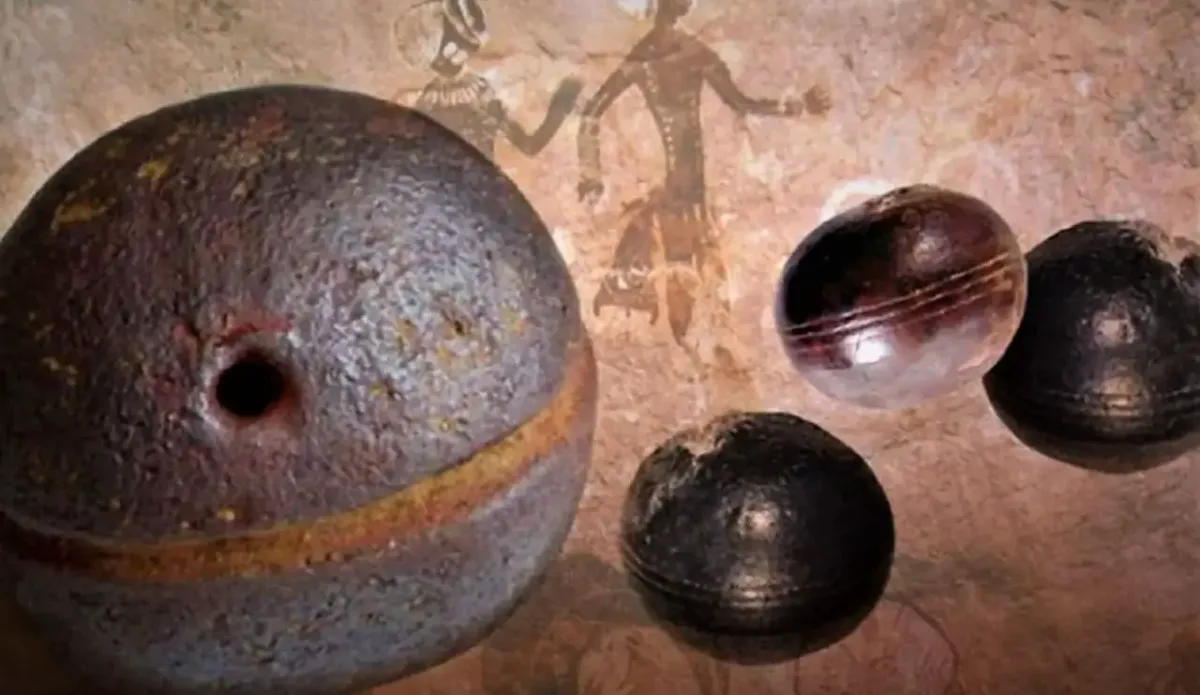
Deep in the pyrophyllite mines near the small South African town of Ottosdal, miners have occasionally turned up something that doesn't look like ordinary rock for almost a hundred years now. These are small, nearly perfectly round balls, usually somewhere between 0.2 and 4 inches across (5 to 100 millimeters), most commonly in the 1.2 to 2 inch range (30 to 50 millimeters), marked with fine, parallel grooves running around their middle, like the seam on a cricket ball.
They're called Klerksdorp spheres, after the museum in the nearby town of Klerksdorp where part of the collection is on display, and ever since they were first described in the 1930s, they keep resurfacing in stories about ancient civilizations, lost technology, and alien visitors.
What makes this story especially interesting isn't just how they look, but how old they are. The spheres turn up in a layer of pyrophyllite rock roughly three billion years old, dating to a period called the Mesoarchean.
At that time, according to geological research published in Earth and Planetary Science Letters, these sediments were forming at the bottom of volcanic lakes, back when nothing more complex than microorganisms existed anywhere on Earth.
That combination, an object that looks "manufactured" sitting inside rock older than any known form of intelligent life, is exactly what made the spheres such perfect material for stories claiming someone (or something) was here long before we were.
What the Spheres Actually Are
When geologists cut the spheres open and analyze them, they find no unknown material and no trace of tooling. They're made mostly of hematite (iron oxide), wollastonite (calcium silicate), and, in unoxidized specimens, pyrite. These are all common minerals that frequently occur in nature as rounded lumps known as concretions.
A concretion forms when minerals in water precipitate in layers around a tiny core inside a sediment, much like a pearl inside a shell, until a rounded body takes shape that's harder than the rock surrounding it.
The famous grooves running around the spheres' "equator," the detail that most resembles something machine-made, get a similar explanation from geologists: as the concretion grew through thin, alternating layers of sediment, growth slowed slightly within certain thin laminae compared to the layers next to them, leaving behind a pattern of regular, concentric ridges.
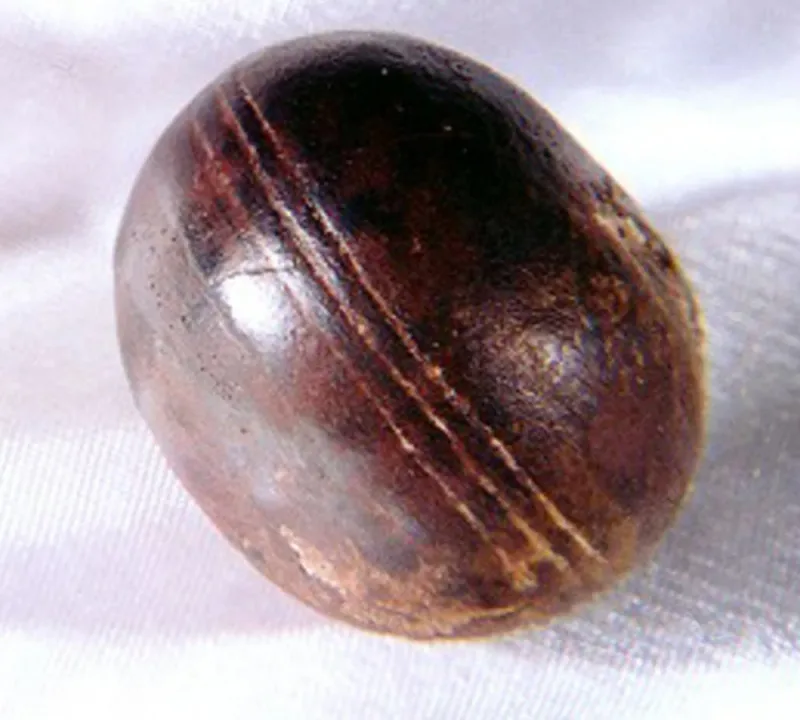
This phenomenon isn't unique to Ottosdal, either. Very similar "striped" concretions have turned up at several sites around the world, including much younger deposits in the United States, where no one claims they're artifacts.
The claim that the spheres are "harder than steel" was made on several occasions by Roelf Marx, the longtime curator of the Klerksdorp Museum.
A detailed look into this claim shows that the comparison was never precisely measured with any instrument. It came from the impression that the spheres couldn't be scratched with the same objects that easily scratch the soft pyrophyllite they're found in (which has a hardness of only about 1 to 2 on the Mohs scale).
Hematite, wollastonite, and pyrite really are much harder than pyrophyllite, but that doesn't make them harder than steel in any strict, measurable sense. They're only harder than the rock around them, which is exactly what you'd expect from an ordinary geological concretion. Heinrich examined five specimens, and none measured harder than 4.0 to 5.0 on the Mohs scale, while hardened steel typically comes in at 7 to 8.
The Story of NASA Scientists and "Perfect Balance"
The most dramatic part of the Klerksdorp spheres legend claims that one sphere was so perfectly balanced that it "exceeded the limits of measuring technology," confirmed, supposedly, by scientists who build gyrocompasses for NASA. That story traces back to a letter from South African collector John Hund, briefly posted on the Klerksdorp Museum's website in 2002. Hund claimed he'd brought a sphere to the California Space Institute, a research unit at the University of California, for testing.
What rarely gets repeated is what happened next. While investigating the story, geologist Paul V. Heinrich got in direct contact with a scientist from that institute who remembered examining the specimen Hund had lent him, but flatly denied ever telling anyone the object had any extraordinary properties.
The scientist also stressed that the claim about the California Space Institute building gyroscopes for NASA wasn't true at all. The institute itself later officially withdrew the statement from the museum's website, saying a "communication error" had occurred and that Hund had misunderstood what he'd been told. In other words, the story about "exceeding the limits of measuring technology" was never scientifically confirmed. It rests entirely on a single letter whose content was later disputed by the very person it was attributed to.
Who's Behind the "Pre-Human Civilization" Theory
The idea that the spheres are artificial isn't new. The oldest known piece making that claim appeared all the way back on October 2, 1979, in the American tabloid National Enquirer, under a headline about "new evidence of intelligent life on Earth billions of years ago."
Among the best-known later proponents of this interpretation is Michael Cremo, who covered the topic with Richard L. Thompson in the book Forbidden Archeology (1993).
It's worth saying who Cremo actually was. He wasn't a geologist or an archaeologist by training, but a longtime member of the Hare Krishna movement (ISKCON), known within that community by his spiritual name, Drutakarma dāsa. His thesis, grounded in Vedic texts describing immensely long time cycles, held that anatomically modern humans had existed on Earth for tens, even hundreds of millions of years, and that mainstream science was deliberately suppressing that fact.
This interpretation has never been accepted within the geological or archaeological professions. Critics fault it for ignoring the context of the finds and for assuming its conclusion up front, then working backward to support it. (Cremo, incidentally, died in October 2026.)
What's Left After All of This
Strip away the layers of legend, and what's left is a fairly ordinary, if still fascinating, geological story: tiny balls of iron and calcium minerals that took shape through slow, gradual deposition inside the rock of volcanic lakes almost three billion years old, long before any more complex form of life existed on Earth at all.
Science actually knows quite a lot about them: their composition, how they formed, the geological context. Almost none of it leaves any room for a story about a tool, a machine, or a message.
What remains unexplained isn't where the spheres came from. It's why one unverified letter from 2002 became a more lasting part of the story than every published geological analysis combined.
SOURCES
- Agangi, A., Hofmann, A., Ossa Ossa, F., Paprika, D. & Bekker, A., "Mesoarchaean acidic volcanic lakes: A critical ecological niche in early land colonisation", Earth and Planetary Science Letters, 556, 2021 (open access)
- Heinrich, P.V., "The Mysterious 'Spheres' of Ottosdal, South Africa", Reports of the National Center for Science Education, 28(1), 2008, pp. 28–33
- Dunning, B., "The Klerksdorp Spheres", Skeptoid, episode 894
Aron Corvin
Curiosity draws me to stories that lie at the edge of the known and the unknown. I explore mysteries, unusual phenomena, and forgotten events, taking the time to research each subject thoroughly, without sensationalism or unfounded claims. Thank you for reading Anomyst. If you enjoy my work and would like to support it, your support means a great deal to me and helps me continue exploring and sharing new stories.