
5 Lost Civilizations You've Probably Never Heard Of
When most of us think of lost civilizations, the Maya, the Inca, the Egyptians, or the ancient Greeks usually come to mind first. But human history runs far stranger and richer than anything we learned in school.
Today, armed with satellite imagery and LIDAR technology that can peer straight through dense jungle canopy and uncover entire forgotten cities, we're living through a golden age of archaeology — uncovering kingdoms that traded across continents, raised monuments that still defy easy explanation, and then simply vanished.
In this piece, we'll look at five such civilizations, spanning Africa, Asia, and Europe, that left a far deeper mark on the world than most people realize.
"Vanished" doesn't necessarily mean these peoples disappeared outright — their kingdoms, cities, and once-distinctive cultures simply lost their old shape and standing over time.
The Kingdom of Aksum
"There are four great kingdoms on earth," the Persian prophet Mani wrote back in the 3rd century.
"The first is the kingdom of Babylon and Persia. The second is the kingdom of Rome. The third is the Kingdom of Aksum. The fourth is the kingdom of China."
Mani's third choice was directed at a civilization that ranked among the most powerful in the 1st millennium CE, only to fade into relative obscurity in the centuries that followed.
Founded around 100 CE, the Kingdom of Aksum became one of the first African states to mint its own currency — gold, silver, and bronze coins stamped with the faces of its rulers, a clear sign of the economic muscle it wielded at the time.
Rising in what's now northern Ethiopia and Eritrea, Aksum came to dominate the Red Sea coast, making itself a critical link in the trade route connecting Asia and Europe.
It exported ivory, gemstones, incense, and live animals, and imported silk, spices, and glassware.
The civilization's history was not without its violent chapters.
Aksum found itself pulled into political and military conflicts over control of southern Arabia, where its interests repeatedly clashed with those of Sasanian Persia.
The kingdom also became the first sub-Saharan state to adopt Christianity.
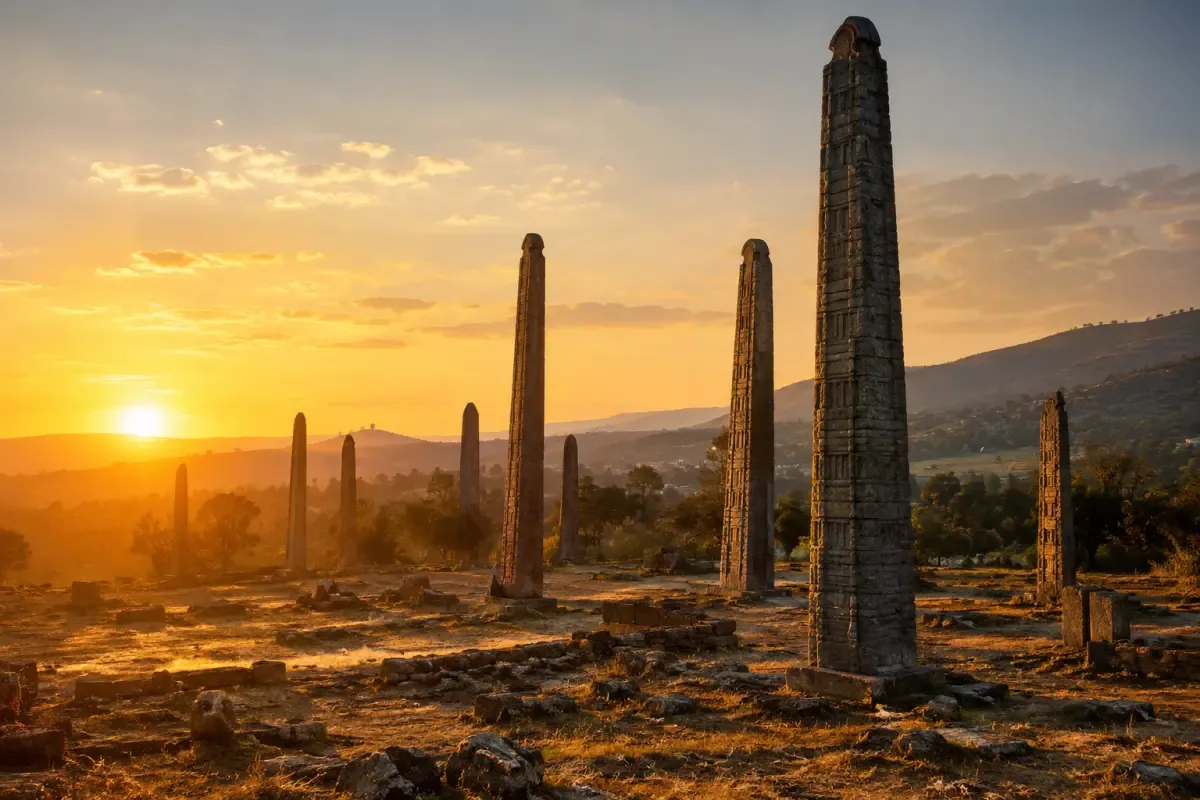
Visitors to Aksum's ancient capital in Ethiopia today can still see relics of this lost civilization, including the towering obelisks that mark its royal tombs.
The most famous of them, the 80-foot (24-meter) Obelisk of Aksum, was carried off to Italy by Benito Mussolini in 1937 and wasn't returned to Ethiopia until 2005, after decades of negotiations.
The city is also home to the Church of Our Lady Mary of Zion, founded by the Aksumites and believed by many to house the Ark of the Covenant.
Aksum's decline began in the 7th century, when Islamic conquests rerouted the major trade routes away from the Red Sea.
Economic isolation and a gradual decline followed, weakening the kingdom and stripping it of the regional importance it once held.
The Caral Civilization
Thousands of years before the Maya's golden age in Central America, another civilization was flourishing further south, in what's now Peru.
It existed between 2600 and 2000 BCE and is generally regarded as the oldest known civilization anywhere in the Americas.
Its capital, the Sacred City of Caral-Supe, sits in the Supe Valley, about 125 miles north of Lima.
Serious archaeological investigation began in 1996 under Peruvian archaeologist Ruth Shady Solís, who discovered that this civilization was contemporary with the pyramids of Giza and ancient Mesopotamia.
A few things set this mysterious, lost world apart.
Unlike many other ancient civilizations, the people of Caral left behind few known examples of figurative art, and their culture was pre-ceramic.
Archaeologists haven't found any evidence of pottery used for food storage.
Caral's largest structure, the Pirámide Mayor, rises about 90 feet (28 meters) high, with a base stretching roughly 490 feet (150 meters) long.
This pyramid, an estimated 5,000 years old, is contemporary with the Great Pyramid of Giza, hinting that complex societies were emerging on different continents around the same time.
Meanwhile, the people of this civilization clearly had a taste for music, if flutes carved from animal bone are anything to go by.
Evidence also suggests they tracked the sun's cycles and timed their agriculture to astronomical observations.
They're recognized today as remarkably accomplished architects.
The remains of pyramids, sunken circular plazas, a circular amphitheater, and residential structures still bear witness to their achievements.
Research into the Caral civilization has fundamentally reshaped our understanding of human history in the Americas, proving that complex societies go back much further than experts originally assumed.
Peru's deserts hold other puzzles that resist easy explanation to this day, most famously the Nazca Lines, whose giant geoglyphs still divide researchers.
The Nabataeans
The Nabataeans first emerged as a distinct civilization in the 4th century BCE, having started out as a nomadic tribe in the Arabian desert.
Over time, they built a kingdom that wielded enormous power across the region.
Control of the routes used by merchants traveling between Arabia and the Mediterranean made the Nabataeans extraordinarily wealthy — and they were formidable fighters, too.
One famous episode tells of how they wiped out thousands of Macedonian soldiers, led by one of Alexander the Great's own generals, who had set their sights on Nabataean territory.
What makes the Nabataeans especially fascinating is their engineering genius in the desert.
They built a sophisticated network of dams, underground cisterns, and channels to capture rainwater — in a region that gets just a few inches of rain a year.
Without that system, great cities like Petra couldn't have survived.
The Nabataean capital was originally called Raqmu; today we know it as Petra. Located in Jordan, it's a remarkable monument to a vanished society, reachable only through a narrow gorge called the Siq.
Walking that rugged, winding path leads visitors into the heart of Petra, where ornate buildings are carved straight into the sandstone cliffs.
Among them stands the most famous Nabataean landmark of all: Al-Khazneh, the temple better known to movie fans as the hiding place of the Holy Grail in Indiana Jones and the Last Crusade.
The Nabataean Kingdom came to an end in 106 CE, when the Roman emperor Trajan annexed their territory and folded it into the new province of Arabia Petraea, where Petra remained an important city even as its influence slowly waned. Shifting trade routes and a series of major earthquakes in the 4th and 6th centuries CE left the city gradually shrinking and fading in significance, though it was never completely abandoned.
The Western world wouldn't rediscover it until 1812, when the Swiss explorer Johann Ludwig Burckhardt, disguised as an Arab traveler, made his way to the hidden city.
The Cucuteni–Trypillia Culture
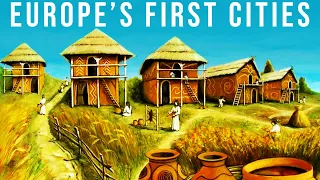
Emerging between the 6th and 3rd millennia BCE, the Cucuteni–Trypillia culture — often just called Trypillia — played a significant role in shaping the course of European civilization.
Their territory stretched across present-day Moldova and parts of modern Romania and Ukraine, where the Trypillians mastered farming and animal husbandry.
What sets Trypillia apart from other Neolithic cultures is the sheer scale of their settlements.
The town of Talianki, in what's now Ukraine, had an estimated 15,000 residents, making it one of the largest settlements anywhere in the world during the Eneolithic period (roughly 4000 to 3500 BCE).
They also displayed real skill in textiles and pottery. Sophisticated kilns turned out pots, bowls, and other artifacts marked by distinctive, swirling designs.
They also crafted ceramic "goddess" figurines that likely carried religious or spiritual significance.
Interestingly, archaeologists have found evidence at many of the culture's settlements of periodic burning and rebuilding, roughly every 60 to 80 years. Homes were often burned to the ground and then rebuilt, for reasons historians and archaeologists still debate.
Proposed explanations range from ritual and symbolic motives to community renewal, along with more practical theories involving hygiene, pests, or the deteriorating condition of older structures.
It's even possible they believed their dwellings carried a kind of life force of their own.
The Sanxingdui Civilization
In 1986, the discovery of treasure-filled pits in Sichuan province fundamentally changed our understanding of China's past.
Although the first artifacts — jade pieces — were stumbled upon by a local farmer as far back as the late 1920s, Sanxingdui's true significance wasn't recognized until decades later.
Major excavations in 1986 uncovered pits containing thousands of gold, bronze, and jade artifacts, and fresh digs in 2020 and 2021 brought more than 10,000 additional objects to light.
Jade, gold treasures, elephant tusks, and enormous, stunning bronze artworks all point to a long-lost civilization that once existed within a walled city.
The site, Sanxingdui, sat roughly 800 miles from the historical heartland of the Shang dynasty, which existed during the 2nd millennium BCE and is officially recognized as China's earliest confirmed dynasty.
In other words, the excavations at Sanxingdui reveal that an entirely separate, independent society existed far from where Chinese civilization supposedly began.
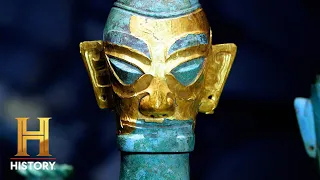
Flourishing at roughly the same time as the Shang dynasty, the Sanxingdui people are perhaps best known today for their extraordinary bronze masks and sculptures — strange faces with bulging eyes, giant wing-shaped ears, and other striking features that set them apart as unique within Chinese culture.
Inevitably, some have excitedly theorized that these artworks depict ancient aliens who may have visited the region.
Mainstream historians, meanwhile, believe these are, in fact, masterfully crafted depictions of ancient rulers and deities, used in rituals whose exact details we'll probably never know for certain.
Sanxingdui was abandoned around 1100 BCE. Possible causes include natural disaster — an earthquake or flood — or military defeat, but the exact cause remains unknown.
What we do know is that this civilization's connections reached surprisingly far: seashells from the Indian Ocean and ivory have been found at the site, pointing to extensive trade networks linking the region to distant lands.
What Can Lost Civilizations Teach Us?
The five stories in this piece end in different ways: Aksum's coins and obelisks outlasted the centuries, the Nabataean capital retreated into the desert, Trypillia's houses burned down only to rise again, and Sanxingdui's bronze masks lay buried until a farmer's field returned them to the world.
"Vanished," in the end, really just means "changed": these people didn't disappear — only their names, temples, and plazas gave way to others.
Our job isn't to crack some grand mystery, but to recognize those layers — from Göbekli Tepe to the megacities of the Maya — with the help of LIDAR, satellites, and the occasional shovel, before a new age buries them for good.
Asking how completely a vanished civilization can disappear from the record is, in its most extreme form, the question behind the Silurian Hypothesis — whether any trace of an earlier advanced society could survive deep in the geological record.
SOURCES
- UNESCO World Heritage Centre: Aksum
- World History Encyclopedia: Kingdom of Axum
- Munro-Hay, S. C. (1991). Aksum: An African Civilisation of Late Antiquity. Edinburgh University Press.
- Bowersock, G. W. (2013). The Throne of Adulis: Red Sea Wars on the Eve of Islam. Oxford University Press.
- UNESCO World Heritage Centre: Sacred City of Caral-Supe
- Smithsonian Magazine: First City in the New World?
- Shady, R., Haas, J. & Creamer, W. (2001). "Dating Caral, a Preceramic Site in the Supe Valley on the Central Coast of Peru." Science 292(5517): 723–726. DOI
- UNESCO World Heritage Centre: Petra
- Ortloff, C. R. (2014). "Water engineering at Petra (Jordan): recreating the decision process underlying hydraulic engineering of the Wadi Mataha pipeline system." Journal of Archaeological Science 45: 91–97. DOI
- Müller, J., Rassmann, K. & Videiko, M. (eds.). (2016). Trypillia Mega-Sites and European Prehistory: 4100–3400 BCE. Routledge. DOI
- UNESCO World Heritage Centre: Archaeological Sites of the Ancient Shu State: Sanxingdui
- Sun, H. (2013). "The Sanxingdui Culture of the Sichuan Basin." In A Companion to Chinese Archaeology. Wiley. DOI
- (2023). "The sacrificial area at the Sanxingdui site in Guanghan, Sichuan." Chinese Archaeology. DOI
- Flad, R. & Chen, P. (2013). Ancient Central China: Centers and Peripheries Along the Yangtze River. Cambridge University Press. DOI
Aron Corvin
A researcher of the unknown who loves a good story, but doesn't sell sensationalism. I research every topic in detail before I publish it. If you enjoy what I write, your support would mean a lot and help me keep going.