
Time Travel Already Exists. The Question Is Whether It Works Backward

In 1941, physicists Bruno Rossi and David Hall measured something classical physics couldn't explain. At a high-altitude research station near Echo Lake in Colorado's Rocky Mountains, nearly 10,500 feet (3,200 meters) above sea level, they counted subatomic particles called muons, which form when cosmic rays collide with the upper atmosphere.
A muon decays extremely fast, in roughly 2.2 millionths of a second, so by the calculations of the day, only a tiny fraction of the particles created at the top of the atmosphere should have made it to the ground.
Rossi and Hall detected far more of them at ground level than classical physics predicted, a result consistent with the muons living longer than expected.
The explanation lay in special relativity, which Albert Einstein had published almost four decades earlier.
The muons were traveling at about 98 percent of the speed of light, and at speeds like that, time passes more slowly for the moving object than for an observer standing still.
For a muon racing through the atmosphere, far less time passed on its own "clock" than was recorded on Earth.
The Rossi-Hall finding, published in Physical Review, became one of the first experimental proofs that time doesn't pass at the same rate for everyone.
The phenomenon they were measuring rests on a discovery made roughly three decades earlier.
In 1912, during a series of balloon ascents, Austrian physicist Victor Hess showed that radiation intensity rises with altitude instead of falling, proving that its source wasn't the Sun but space itself.
He won the Nobel Prize in 1936 for discovering cosmic rays, and it was that very work that led a generation of physicists, Rossi among them, to set up laboratories high in the mountains, where particles like muons can be measured before the atmosphere absorbs them completely.
One Pencil Tip Lower, and the Clock Runs Slow
The Rossi-Hall experiment wasn't a one-off.
In the mid-1960s, in a CERN accelerator near Geneva, muons were sped up to 99.7 percent of the speed of light and guided around a circular track known as a storage ring.
Their lifespans stretched twelvefold compared with muons at rest, just as the theory predicted. Later, more precise measurements by Bailey and colleagues in 1977 confirmed time dilation to within about 0.2 percent.
In 1971, physicists Joseph Hafele and Richard Keating ran a test that didn't require an accelerator.
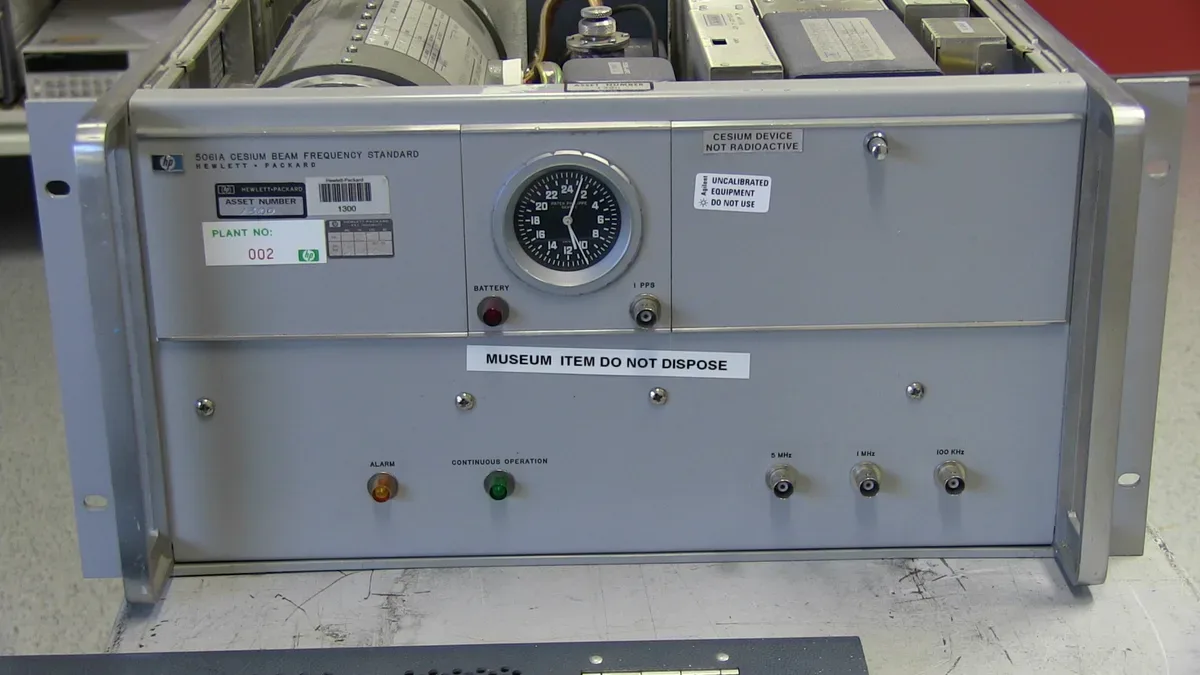
They loaded four cesium atomic clocks onto regularly scheduled commercial flights and flew them around the world, once eastward and once westward, then compared them with identical clocks that had stayed on the ground.
The differences, measured in tens and hundreds of nanoseconds, matched the predictions of both special and general relativity at once: partly because of the planes' speed, and partly because of weaker gravity at high altitude.
Getting humans up to speeds where an effect like this would become noticeable, though, remains far beyond anything we can do today.
By a simple calculation, a 155-pound (70-kilogram) person accelerated to 99.99 percent of the speed of light would have kinetic energy on the order of 1020 joules, roughly the amount of energy humanity uses in three quarters of a year.
A similar effect, though vastly smaller, has been measured in humans too.
Astronaut Scott Kelly spent about 520 days in orbit in total, while his twin brother Mark, also a former NASA astronaut, spent 54 days in space.
After Scott's year aboard the International Space Station (ISS), where he traveled at about 17,500 miles (28,000 kilometers) per hour, the age difference between the brothers changed.
The twins were born six minutes apart, with Mark the older, and the relativistic effect of Scott's year in orbit added roughly five milliseconds to that gap.
In 2016, at a conference on ISS research, Mark said he was now older than his brother by six minutes and five milliseconds.
Satellite navigation systems rely on the same phenomenon every day.
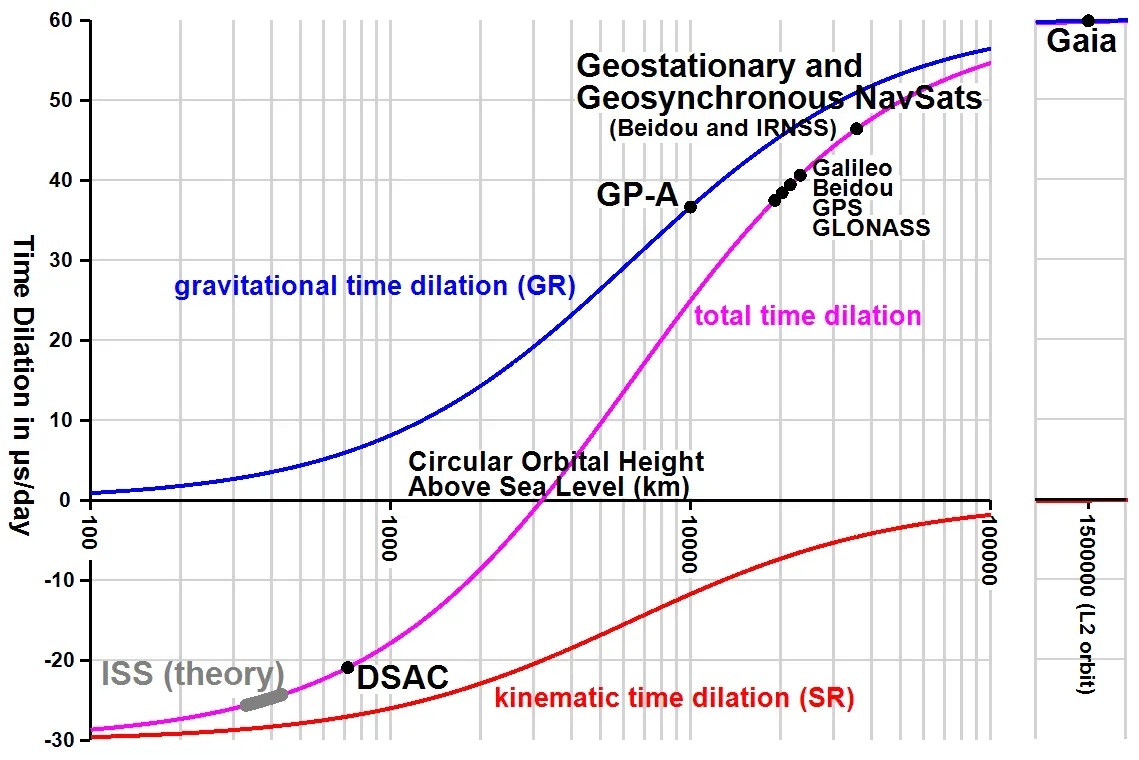
Satellites carry atomic clocks that have to be corrected constantly, both for their speed and for the weaker pull of Earth's gravity at that altitude. Without relativistic corrections, a satellite navigation system would quickly start piling up large errors in position.
Measurement precision has since gone even further.
In 2022, a team of physicists at the JILA institute in Colorado measured time dilation between two atomic clocks just 0.04 inches (1 millimeter) apart, about the width of a pencil tip.
According to the published results, the lower clock ticked measurably slower than the upper one, in line with general relativity.
Taken together, these experiments leave little room for doubt.
Time travel into the future isn't a hypothesis. It's a measured, repeatable phenomenon, confirmed everywhere from cosmic rays to Earth's orbit.
Time Travel Into the Past Plays by Different Rules
The question of traveling into the past stands on entirely different foundations.
Where travel to the future relies on physics that has already been confirmed, a return to the past remains a mathematical possibility with no experimental support whatsoever.
The idea traces back to 1908, when the German mathematician Hermann Minkowski showed that the three dimensions of space and the one dimension of time could be treated as a single geometric whole.
Minkowski's geometry gave rise to a picture of the universe known as the block universe, in which space and time can be described mathematically as one four-dimensional structure.
The philosophical view that the past, present, and future all exist equally is known as eternalism, while its rival, presentism, holds that only the present moment exists. Ancient thinkers were already debating the nature of time, and in the 4th century CE, the Roman philosopher Augustine of Hippo wrote about how the present constantly slips away between a past that no longer exists and a future that doesn't exist yet.
Einstein's general theory of relativity, published in 1915, is built on exactly this mathematical picture of spacetime as a single whole.
Massive objects curve it, and that curvature is what we experience as gravity.
The path of any object through spacetime, known as its worldline, normally runs in only one direction: forward, from the past to the future.
The equations of general relativity, however, don't explicitly forbid that line from curving so far that it loops back to an earlier point on itself.
The first to show this mathematically was the Dutch physicist Willem Jacob van Stockum, in a 1937 paper on the gravitational field of a rotating distribution of particles.
His work demonstrated that general relativity permits what are known as closed timelike curves: solutions in which a worldline closes back on itself.
The problem is that such solutions require extremely exotic physical conditions and spacetime geometries that aren't known to be physically realizable.
The curve itself, meanwhile, stays timelike: locally, an object can follow it at less than the speed of light, so what makes it problematic isn't speed but geometry.
The 60 Nanoseconds That Shook CERN
In September 2011, physicists from the OPERA experiment, housed deep beneath the Gran Sasso mountain massif in Italy, announced a result that briefly shook the foundations of modern physics.
According to their measurements, neutrinos sent from CERN near Geneva to the detector in Italy, about 450 miles (730 kilometers) away, had arrived roughly 60 nanoseconds sooner than the speed of light would allow.
Had the finding been confirmed, it would have opened up the theoretical possibility of traveling into the past, because motion faster than light could, according to special relativity, upset the very order of cause and effect.
Analysis soon showed, however, that it was an equipment error: a loosely fastened fiber-optic cable and a clock oscillator that ticked too fast introduced exactly as much deviation as the supposed signal amounted to.
By mid-2012, CERN had officially confirmed that neutrinos obey the cosmic speed limit.
The episode shows just how valuable, and how elusive in the lab, any hint of a departure from the speed of light would be.
To this day, no particle accelerated in a laboratory has exceeded that threshold.
Wormholes and the Price of Going Back in Time
If faster-than-light travel is off the table, physicists have gone looking for detours.
One is to bend the light cone itself rather than break through it.
In 1974, the American physicist Frank Tipler calculated that a rotating cylinder of infinite length could warp the spacetime around it enough to make a path back into the past mathematically possible.
The problem was a practical one: Tipler's solution required extremely fast rotation and an enormous density of matter, conditions found nowhere in the known universe.
In the 1980s and 1990s, Stephen Hawking showed that a finite, more practical cylinder would require enormous amounts of what's known as negative energy, a phenomenon that quantum mechanics allows, but only in tiny, short-lived amounts.
Such a phenomenon does exist in nature: the Casimir effect, confirmed experimentally in the lab, shows that two metal plates separated by a nanometer-scale gap can locally push the energy of the vacuum below zero.
The gap between that effect and what it would take to hold a wormhole open, or to sustain Tipler's cylinder, is measured in orders of magnitude, from nanometer-scale gaps to structures the size of stars.
In other words, the negative energy that quantum mechanics allows at tiny scales isn't a macroscopic source that could sustain a wormhole.
That is why physicists' attention shifted, alongside cylinders, to another idea: wormholes, tunnels that could connect two distant points in spacetime.
The concept entered physics almost by accident.
While working on his novel Contact in the mid-1980s, astronomer Carl Sagan needed a way to get his heroine to the star Vega without breaking the speed-of-light limit.
He turned to physicist Kip Thorne for advice, and Thorne suggested a wormhole: a shortcut through bent spacetime.
Thorne's calculations, however, turned up something unplanned. The same wormhole that shortens the trip through space could, with the right maneuvering of one of its ends at a speed close to the speed of light, also serve in theory as a path backward through time.
To stay open at all, a wormhole would again need negative energy or some other mechanism nobody has identified yet.
None of the proposed methods, from exotic matter to the cosmic strings that Richard Gott and William Hiscock studied in 1985, has ever been demonstrated experimentally at a macroscopic scale.
Wormholes remain a solution to Einstein's equations on paper, not an object anyone has found in the universe.
Time Travel Paradoxes Physics Still Hasn't Solved
Even if returning to the past were physically possible, a question of logic would remain. The best known is the grandfather paradox: a time traveler goes back and prevents his own parent from being born, wiping out the conditions for his own existence, including the very trip that made it possible.
A related puzzle is the bootstrap paradox, in which an object or a piece of information has no real origin: a traveler from the future brings back something that, it turns out, he received earlier from his own older self, in a loop with no beginning.
In 1992, Stephen Hawking proposed what's known as the chronology protection conjecture: the claim that nature itself prevents travel into the past, through mechanisms that would destroy any time loop before it could become macroscopically possible.
Igor Novikov, on the other hand, proposed a self-consistency principle: travel into the past is possible, but any attempt to change what has already happened is foiled in advance by the very logic of events.
Novikov's principle, however, doesn't resolve every version of the problem.
In a series of papers published between 2020 and 2023, physicist Barak Shoshany, together with collaborators Jacob Hauser and Jared Wogan, described mathematical examples of paradoxes that self-consistency can't resolve: cases in which the same object, after passing through a time loop, would have to both keep and change one of its properties at the same time.
The proposed solution requires that a time traveler who enters the past not return to the same timeline he left, but arrive in a parallel branch of events, mathematically separate from the original, although the authors themselves concede that no concrete mechanism for how such branches arise has been worked out yet.
There's also a third approach to resolving the paradoxes, one built directly on quantum mechanics.
In 1991, the British physicist David Deutsch proposed a model in which a particle traveling around a closed timelike curve could exist in a quantum superposition of several mutually consistent histories instead of committing to just one.
In such a model, the grandfather paradox loses its sting, because the question of whether an event really happened is replaced by a probability spread across several outcomes at once.
The model remains mathematically consistent, but like the other solutions, it has never been tested experimentally on an actual closed timelike curve, because no such curve has ever been found or built.
The idea of parallel branches of time isn't new.
In 1957, physicist Hugh Everett III proposed that whenever a quantum system has several possible outcomes, the universe doesn't settle on just one of them but splits so that all of them come to pass.
Bryce DeWitt popularized the idea in the early 1970s, arguing that every quantum transition in every star and galaxy in the universe splits our local world into countless new copies of itself.
Physicist John Wheeler, who initially supported the idea, later distanced himself from it, judging that it carried too much metaphysical baggage.
The many-worlds interpretation has an even stranger consequence, known in the physics and philosophy literature as quantum immortality.
The idea is simple: if the universe splits into every possible outcome at each quantum measurement, then there's always at least one branch in which an observer survives even an event that would, statistically speaking, almost certainly kill him.
Most physicists treat the idea as a logic puzzle rather than a serious prediction, because it requires an observer's personal consciousness to be identified only with the branches in which he survives, something the theory itself never demands.
All of this, though, rests on just one of several competing interpretations of quantum mechanics, one with no consensus among physicists and no experiment that could tell it apart from the alternatives.
Any link between many worlds and time travel therefore depends on a theory that has not itself been confirmed experimentally.
The tally remains lopsided.
Travel into the future is measured every day: in muons that reach the ground, in atomic clocks separated by the width of a pencil tip, in a five-millisecond difference between a pair of twin brothers.
Travel into the past, by contrast, exists only in equations: in rotating cylinders that would have to be infinite, in wormholes no one has ever seen, in parallel timelines that remain a mathematical model with no physical trace.
No experiment to date has recorded a single signal that arrived before it was sent.
SOURCES
- B. Rossi and D. B. Hall, "Variation of the Rate of Decay of Mesotrons with Momentum", Physical Review 59, 1941.
- Mount Evans and Echo Lake – Historic Physics Site, American Physical Society.
- JILA Atomic Clocks Measure Einstein's General Relativity at Millimeter Scale, NIST/JILA, 2022.
- J. C. Hafele and R. E. Keating, "Around-the-World Atomic Clocks", Science 177, 1972.
- J. Bailey et al., "Measurements of relativistic time dilatation for positive and negative muons in a circular orbit", Nature 268, 1977.
- NASA Twins Study, NASA, 2019.
- J. Hauser and B. Shoshany, "Time Travel Paradoxes and Multiple Histories", Physical Review D 102, 2020.
- B. Shoshany and J. Wogan, "Wormhole Time Machines and Multiple Histories", General Relativity and Gravitation 55, 2023.
- F. J. Tipler, "Rotating Cylinders and the Possibility of Global Causality Violation", Physical Review D 9, 1974.
- S. W. Hawking, "Chronology protection conjecture", Physical Review D 46, 1992.
- Time travel could be possible, but only with parallel timelines, Barak Shoshany, The Conversation, 2022.
- The Many-Worlds Theory, Explained, The MIT Press Reader, 2021.
- OPERA experiment reports anomaly in flight time of neutrinos from CERN to Gran Sasso, CERN, 2011.
Aron Corvin
A researcher of the unknown who loves a good story. I won't sell you sensationalism just for a click. If you enjoy what I write, your support would mean a lot and help me keep going.