
Zawyet el-Aryan: The Pyramid That Was Never Finished
In 1904, Alessandro Barsanti climbed down a staircase cut into limestone and stepped onto a granite floor. The blocks beneath his feet ran about 15 feet (4.5 meters) long, and some weighed close to 10 tons (9 metric tons).
Carved into one of them was an oval tub, its lid still resting in place.
Neither Barsanti, the Italian archaeologist leading the excavation, nor Gaston Maspero, then director of the Egyptian Antiquities Service, knew what the tub was for.
The site is called Zawyet el-Aryan, on the west bank of the Nile, about 3 miles south of Giza, roughly halfway to Abusir.
There, on the edge of the desert plateau, stand two structures that were meant to be pyramids. Little remains of either, and one never even got its capstone.
- 1.What Zawyet el-Aryan Is Hiding: A Base With No Pyramid, and a Pyramid With No Owner
- 2.The Oval Tub and the Seal: What Barsanti Found on March 12, 1905
- 3.Bikheris, Baka, or Setka: A Name No One Can Read
- 4.A Power Plant, a Measurement, and an Empty Tub
- 5.Blamed on Atlantis: Technology That Leaves No Trace in the Record
- 6.From Film Set to Military Dump
What Zawyet el-Aryan Is Hiding: A Base With No Pyramid, and a Pyramid With No Owner
Archaeologists call the southern structure the Layer Pyramid. Built during the Third Dynasty out of mud brick and natural rock, it was designed to have five steps and stand between about 140 and 150 feet (42 to 45 meters) tall.
What's left today is a mound about 56 feet (17 meters) high, with a base roughly 276 feet (84 meters) across. A corridor runs through the interior lined with 32 side chambers, likely meant to hold burial equipment.
Excavations in the early twentieth century turned up no objects and no trace of a burial, so it's unclear whether the pyramid was ever used as a tomb or abandoned after the king died prematurely.
Most Egyptologists attribute it to the pharaoh Khaba, since stone vessels bearing his name turned up in the nearby Mastaba Z500.
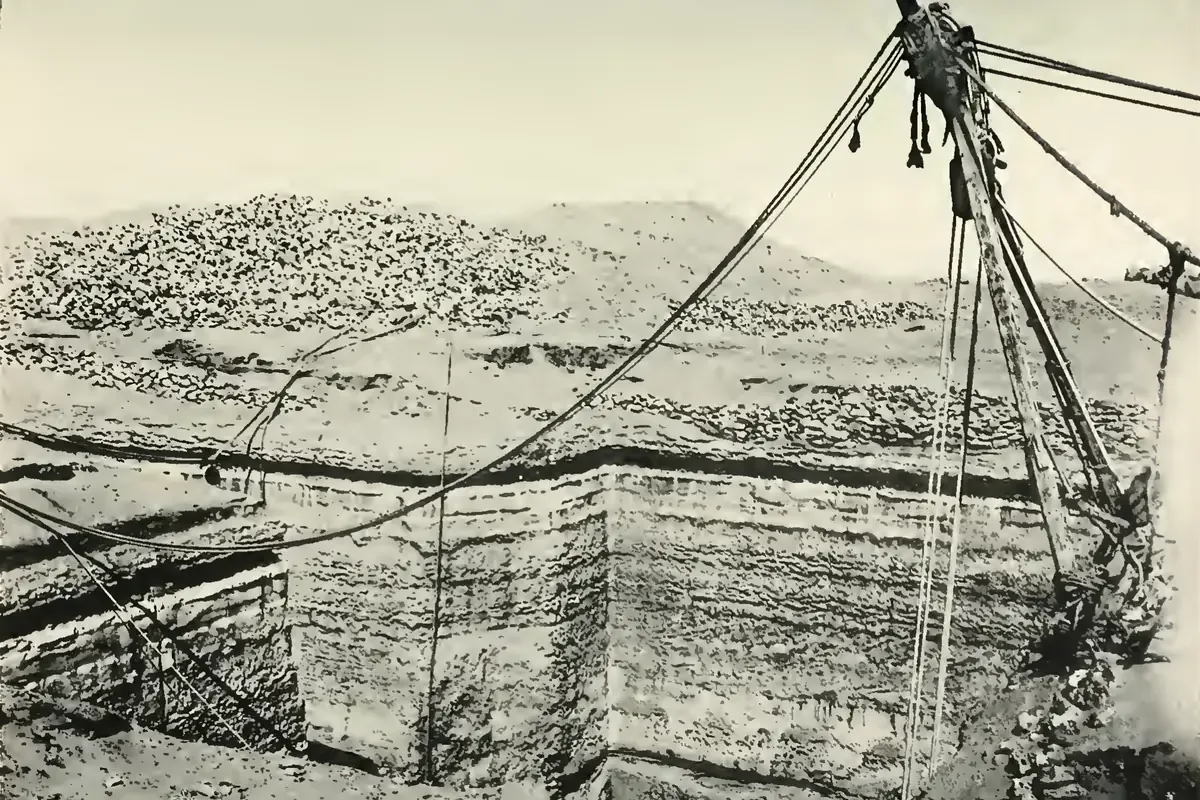
The North Pyramid is bigger and stranger. Karl Richard Lepsius described it between 1842 and 1846 and catalogued it as number XIII in his Denkmäler aus Aegypten und Aethiopien. Only the base was ever finished: a square cut into natural limestone, about 656 feet (200 meters) on a side.
The surface still shows traces of a platform meant to carry a limestone casing, but the casing blocks themselves were never found, and neither was a capstone, so the pyramid's final height and slope can't be calculated.
Even the base measurement is disputed: Wolfgang Helck and some other Egyptologists believe it was originally meant to be considerably smaller than Barsanti estimated.
Besides the pyramids, the site includes five cemeteries from different periods, ranging from the First Dynasty to Roman times.
A sarcophagus of pink granite, possibly from a later period, was found in a trench cutting across the structure.
The Oval Tub and the Seal: What Barsanti Found on March 12, 1905
Barsanti's report on the 1904 and 1905 excavation was published in 1906, in volume seven of the Annales du Service des Antiquités de l'Égypte: Maspero's introduction runs from pages 257 to 259, and Barsanti's own report from 260 to 286.
Barsanti worked for the Egyptian Antiquities Service and published two reports on the monument, in 1902 and 1906.
According to Barsanti's 1906 report, the interior formed a T-shaped shaft: a corridor ran north-south, and a chamber ran east-west.
A steep staircase led downward, interrupted halfway along its length by a flat landing of unknown purpose.
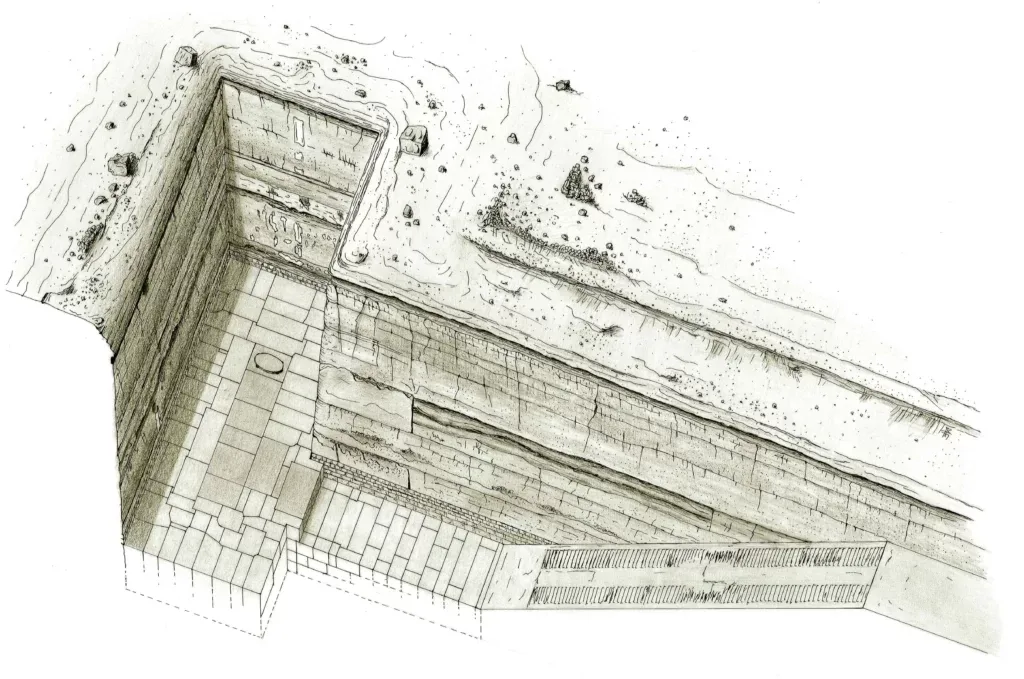
The shaft's walls were smooth, but never faced with stone, and the chamber itself was left unfinished.
Only the floor was finished, paved with granite blocks about 15 feet (4.5 meters) long and 8 feet (2.5 meters) thick, weighing close to 10 tons (9 metric tons) apiece.
The shaft has no roof today, and it's possible it never had one.
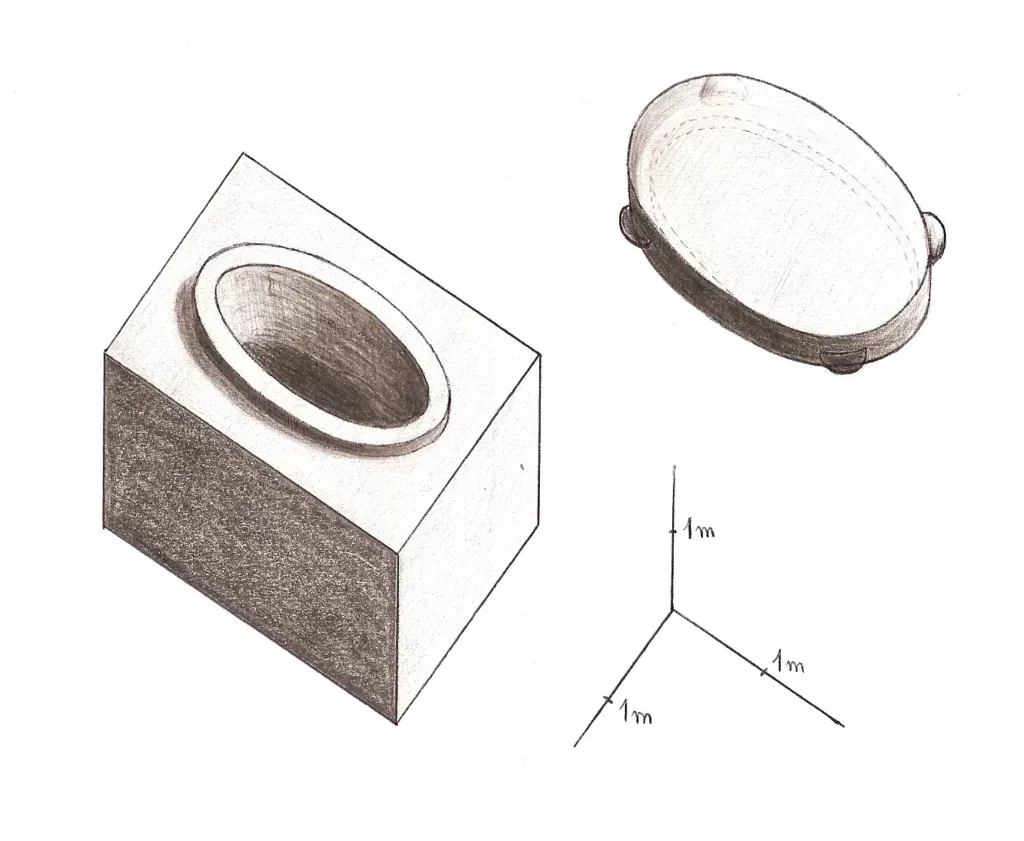
Near the western end of the chamber, an oval tub had been carved into one of the floor blocks.
Barsanti's report gives its interior depth as about 3.4 feet (1.05 meters), while the outer dimensions, according to later sources (Verner, pp. 270-272) and Barsanti's own drawing on p. 286 (fig. 10), come to roughly 10.3 feet long, 7.3 feet wide, and 4.9 feet deep (3.15, 2.22, and 1.5 meters).
Since it was too large to fit through the passage leading into the chamber, it was carved in place, while the space was still open to the sky.
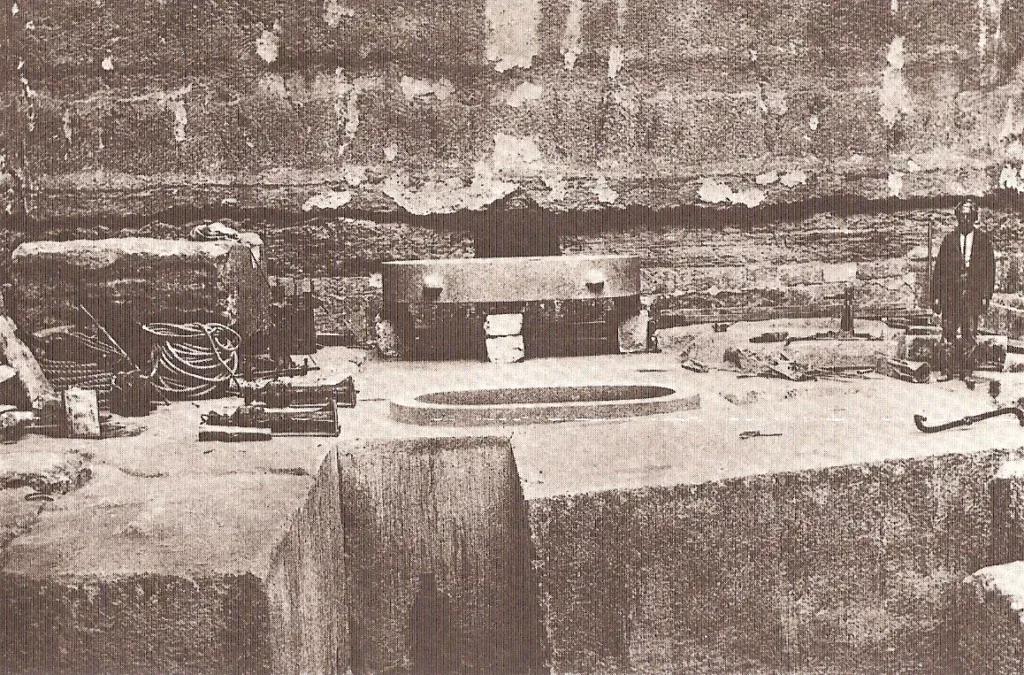
Its oval lid had been sealed to the tub with gypsum plaster, and it was still sitting in place.
On March 12, 1905, while searching for a hidden door behind a 33-ton (30-metric-ton) granite block, Barsanti found the tub (p. 282).
He never found the door. When he lifted the lid, he found the inside empty: the only trace was a dark band, about 4 inches (10 centimeters) tall, running along the side walls.
Barsanti guessed it was residue from some liquid that had once sat in the tub as an offering or libation.
He dismissed the idea that the tub was simply an unused sarcophagus. The care taken to seal it, he argued, proved that something had been inside, and the dark residue pointed to the nature of that content.
Maspero's introduction (pp. 257-259) gives a sense of what the structure left on a visitor.
The scale and richness of the material, the perfection of the cuts and joints, the flawless finish of the granite tub, the boldness of the lines, the height of the walls: all of it, he wrote, combined into a single, unified impression. The effect, he added, was one you never forgot.
There's nothing supernatural in his account; Maspero is writing about the skill of Egyptian builders.
In his report, Barsanti noted that his foreman, Ibrahim, found a small greenish schist tablet bearing the cartouche of King Djedefre in one of the ancient workers' huts (p. 282).
The tablet was never published, and some Egyptologists doubt its authenticity. If genuine, it would point to the Fourth Dynasty.
Bikheris, Baka, or Setka: A Name No One Can Read
The pyramid's owner is unknown. Workers' graffiti found in the structure include a cartouche, but it hasn't survived intact, and whoever first copied it did so with an unsteady hand.
The name can't be matched to any contemporary document or to the Ramesside king lists, so every identification remains a guess.
So interpretations diverge.
Miroslav Verner and some other Egyptologists see a king known by the Greek name Bikheris, possibly a rendering of the Egyptian name Baka. Aidan Dodson reads the sign differently, as "Seth-Ka," and believes the pyramid was planned as the tomb of Prince Setka, a son of King Djedefre; both ideas place the structure in the Fourth Dynasty. Kurt Sethe, Nabil Swelim, and Wolfgang Helck push it back into the late Third Dynasty.
One argument for the earlier dating is that using cut granite as flooring in royal tombs was already a tradition going back to Khasekhemwy, the last pharaoh of the Second Dynasty.
Supporters of a Fourth Dynasty date counter that granite blocks of that size weren't used before Khufu.
The name stays contested, but the era doesn't: this is the Old Kingdom, the third millennium BCE. There's no real dispute that construction began in the third millennium, not the twelfth.
A Power Plant, a Measurement, and an Empty Tub
An empty container with a sealed lid leaves room for anything, and over time a handful of stories have grown up around it that Barsanti's report knows nothing about.
Each one is more colorful than the last, and they're worth following all the way through, because that's the only way to see exactly where they run out of road.
The oldest claim is that the pyramid isn't a tomb at all but a machine. The idea isn't Egyptian: it was born in the twentieth century, far from Egypt.
In the 1930s, the French writer Antoine Bovis claimed that cardboard pyramid models could mummify small animals and preserve meat and fish.
The story often attributed to him, about undecayed carcasses turning up in a trash can inside Khufu's chamber, was tacked on later; Bovis never even claimed to have visited Egypt.
About twenty years later, the Czech radio engineer Karel Drbal filed a patent, in 1949, for a pyramid-shaped razor blade holder. The patent was granted in 1959, and the explanation was specific: the blade had to sit inside a hollow cardboard or plastic pyramid, oriented to align with the lines of Earth's magnetic field.
The idea wasn't new. People had already been writing about razor blades lasting longer in a magnetic field back in 1933.
The story made its way into bestsellers and picked up a name: pyramid power. Experiments were run, and none of them confirmed anything.
In 1973, Alter and Simmons showed that pyramid-shaped containers preserved neither flowers nor meat any better than containers of any other shape, and that razor blades inside them didn't get any sharper.
In his 2003 book on pseudoscience, Terence Hines filed the whole episode under claims that keep getting repeated without ever being confirmed.
A more recent story concerns measurements. In 2025, the International Journal of Applied Mathematics published a paper that puts this pyramid's base, estimated at about 656 feet (200 meters), into a harmonious ratio with Earth's diameter and with the Great Pyramid of Giza.
The author herself calls the reconstruction hypothetical and asks that it be checked.
That's exactly the problem: the base isn't a measured number. Only the square cut into the bedrock was ever finished, with no casing and no capstone, and even that figure is disputed, since some Egyptologists consider Barsanti's estimate too high.
Building further calculations on an unconfirmed number means building on sand, no matter how neat the ratio looks on paper.
A third version remains, the quietest of the three: that the tub once held something that powered something else.
It does rest on something real, Barsanti's own line about the thin dark layer on the walls, but he never called that liquid a power source. He called it an offering: a sacrifice or a libation, one that evaporated over the years.
Everything beyond that is an addition the original document never makes. It's more reliable, then, to stick with what the report actually says: the container was empty, the lid was sealed, and its purpose is unknown.
The remaining claims, about Atlantis, monuments supposedly blown apart, and coffins modern technology couldn't reproduce, leave a much clearer trail in the documentary record, which brings the story back down to earth.
Blamed on Atlantis: Technology That Leaves No Trace in the Record
Claims that archaeology doesn't support tend to collect around sites like this one.
One holds that the pyramids were built more than 12,000 years ago, during the age of a lost civilization called Atlantis, and that the Egyptians simply claimed them later.
Another holds that certain monuments were blown apart. For claims like these, there's no peer-reviewed material and no measurement that backs them up.
Radiocarbon dating, carried out on organic material from tombs and the surrounding layers, places the start of the Old Kingdom in the 27th century BCE.
A 2010 study on the absolute chronology of dynastic Egypt, published in Science by Christopher Bronk Ramsey's team, placed the reign of the early dynasties in the third millennium BCE, and a later 2013 study in Proceedings of the Royal Society A confirmed the same timeframe for the Predynastic and Early Dynastic periods.
For the Third Dynasty, where the pyramid would fall under one of the two competing theories, the radiocarbon framework puts its start around 2650 BCE. Not a single sample points anywhere near 12,000 years.
Much the same holds for the claim that the Serapeum at Saqqara, where the sacred Apis bulls were buried, contains coffins modern technology couldn't reproduce.
The largest of them, according to a calculation by Linant de Bellefonds, weighs up to about 68 tons (62 metric tons), and the historical records show exactly how they were moved.
Auguste Mariette, who discovered the Serapeum in 1850, found roller tracks on the gallery floors and two horizontal wooden winches, each turned by eight levers.
In 1853, Heinrich Brugsch recorded double rails along which the coffins were rolled, and an inscription on a stela from the reign of Ptolemy II, around 247 BCE, records that moving a single coffin and its lid into the burial chamber took 28 working days.
The technique was grueling, but it was well understood; Mariette described the whole process in Le Sérapéum de Memphis, published in 1882.
The story about blown-apart monuments doesn't hold up either. The Bent Pyramid at Dahshur, raised by the pharaoh Sneferu around 2600 BCE, was never blown apart: its angle shifts from about 54 degrees to about 43 degrees because the structure became unstable during construction, so the builders reduced the slope partway through the project.
In fact, it's one of the best-preserved pyramids anywhere, with much of its original casing still intact.
One more thing is worth saying: Old Kingdom pharaohs were buried in pyramids. The Valley of the Kings, which these stories often invoke, is a New Kingdom cemetery that came into use more than 1,000 years later.
From Film Set to Military Dump
Barsanti returned to the site in 1911 and 1912, but World War I halted the excavations; he died in 1917.
Nothing happened at the site through the 1950s, and when the shaft was finally cleared out again in 1954, it had nothing to do with science.
American director Howard Hawks was filming Land of the Pharaohs there, and Zawyet el-Aryan had been chosen as a backdrop. The sand and rubble that had piled up since Barsanti's excavation were cleared away for the cameras. The film hit theaters in 1955.
In 1960, the military converted the area around the site into a base, and access to the pyramids has been off-limits since 1964.
A closed-off zone feeds the suspicion that something's being hidden there, but the real reason is documented and dull: excavation isn't permitted, military bungalows now cover the necropolis, and the shaft of the Unfinished Pyramid reportedly serves as a dump. The current condition of both burial shafts is unknown.
Nothing was ever found in the sealed tub: no body, no object, no inscription, just a dark band on the granite.
The shaft Barsanti climbed down into in 1904 is no longer accessible today, not even to archaeologists.
Cover image: A view straight down into the open shaft of the North Pyramid at Zawyet el-Aryan during Barsanti's 1905 excavation, with the Layer Pyramid visible in the background. Photo: Alessandro Barsanti, Fouilles de Zaouiét el-Aryân, Annales du Service des Antiquités de l'Égypte 7 (1906), pl. I; public domain, via Wikimedia Commons.
SOURCES
- Alessandro Barsanti and Gaston Maspero, Fouilles de Zaouiét el-Aryân (1904-1905), Annales du Service des Antiquités de l'Égypte 7, 1906, pp. 257-286 (Maspero's introduction, 257-259; Barsanti's report, 260-286).
- Karl Richard Lepsius, Denkmäler aus Aegypten und Aethiopien, Nicolaische Buchhandlung, Berlin, 1849.
- Alessandro Barsanti, Ouverture de la pyramide de Zaouiet el-Aryân, Annales du Service des Antiquités de l'Égypte 2, 1902, pp. 92-94.
- Auguste Mariette, Le Sérapéum de Memphis, Paris, 1882.
- Christopher Bronk Ramsey et al., Radiocarbon-Based Chronology for Dynastic Egypt, Science 328, 2010.
- Michael W. Dee et al., An absolute chronology for early Egypt, Proceedings of the Royal Society A 469, 2013.
- George Andrew Reisner and Clarence S. Fisher, The Work of the Harvard University - Museum of Fine Arts Egyptian Expedition, Bulletin of the Museum of Fine Arts 9 (54), Boston, December 1911, pp. 54-59.
- Miroslav Verner, Die Pyramiden, Rowohlt-Taschenbuch-Verlag, Reinbek, 1999, pp. 270-272.
- Rainer Stadelmann, Die Ägyptischen Pyramiden: vom Ziegelbau zum Weltwunder, von Zabern, Mainz, 1985.
- Aidan Dodson, On the date of the unfinished pyramid of Zawyet el-Aryan, Discussions in Egyptology 3, Oxford, 1985, pp. 21-24.
- Roman Gundacker, Zur Struktur der Pyramidennamen der 4. Dynastie, Sokar 18, 2009, pp. 26-30.
- Wolfgang Helck and Eberhard Otto, Lexikon der Ägyptologie, vol. 5, Harrassowitz, Wiesbaden, 1984, pp. 310, 497-498.
- Mark Lehner, The Complete Pyramids, Thames & Hudson, New York, 2008.
- Ahmed Fakhry, The Monuments of Sneferu at Dahshur, General Organization for Government Printing Offices, Cairo, 1961.
- Heinrich Brugsch, record of the inscription by the builder of the Apis burial chamber, 1884.
- Gilbert Coleridge and William D'Oyly Grange, letters on razor blades in a magnetic field, The Times, October 7 and 19, 1933.
- Antoine Bovis, Exposé au Congrès International de Radiotellerie, Nice, circa 1935.
- Karel Drbal, Method of Maintaining Razor Blades and the Shape of Straight Razors, patent no. 91304, Prague, filed 1949, published 1959.
- ProQuest, biographical entry on Karel Drbal, "Czechoslovakian radio engineer" (accessed November 17, 2026).
- A. Alter, The Pyramid and Food Dehydration, New Horizons 1, 1973, pp. 92-94.
- D. Simmons, Experiments on the Alleged Sharpening of Razor Blades and the Preservation of Flowers by Pyramids, New Horizons 1, 1973, pp. 95-101.
- Terence Hines, Pseudoscience and the Paranormal, Prometheus Books, 2003, p. 306.
- Daniel Loxton, Junior Skeptic #23: Pyramid Power, Skeptics Society, 2006, pp. 81-88.
- Dawn Elizabeth Higgins, The 5.5 Code: Uncovering Pi, Phi, and the Mathematical Blueprint of the Great Pyramid of Giza and the Pyramid of Baka, International Journal of Applied Mathematics 38 (10s), 2025, pp. 290-303.
Aron Corvin
Curiosity draws me to stories that lie at the edge of the known and the unknown. I explore mysteries, unusual phenomena, and forgotten events, taking the time to research each subject thoroughly, without sensationalism or unfounded claims. Thank you for reading Anomyst. If you enjoy my work and would like to support it, your support means a great deal to me and helps me continue exploring and sharing new stories.