
Peter Bergmann: The Man Who Never Existed

At dawn on June 16, 2009, a father and son were jogging along Rosses Point beach in County Sligo, Ireland, training for an upcoming triathlon.
Just after six in the morning, they came across a man's body lying on the cold, wet rocks, facing out toward the Atlantic.
There was no sign of a struggle. No wallet, no ID, not even a clothing label — every one had been carefully snipped away with scissors.
Police soon traced the body to a guest at a nearby hotel who'd checked in under the name Peter Bergmann.
There was just one problem: no such person existed.
More than seventeen years later, his real name is still unknown — despite international DNA databases, fingerprint checks, and repeated public appeals.
The Man Who Came From Nowhere
On Friday, June 12, 2009, a bus from Derry, Northern Ireland, pulled into the Sligo station.
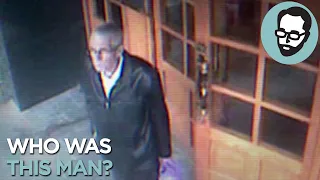
Off it stepped a slim man in his late fifties or early sixties — about 5'10" (178 cm), gray-haired, tan, with pale blue eyes.
He was dressed in a black leather jacket and navy trousers, black size-44 shoes (roughly a US 10.5), and carried a black bag over one shoulder.
He caught a taxi into the city center and checked into the Sligo City Hotel.
At the front desk, he gave his name as Peter Bergmann and paid up front, in cash — leaving no credit-card trail behind.
For an address, he offered "Ainstettersn 15, 4472 Vienna." It would later turn out that no such street existed anywhere in Austria.
His English carried a thick German or Austrian accent, and he came across as neat, composed, almost courtly — the kind of man you'd picture retiring from a career in banking.
Nothing about him raised any flags with the staff. He was quiet, polite, kept to himself.
Nothing, in other words, hinted at what the investigation would later uncover: that he appeared to have come to Sligo with the specific purpose of disappearing.
Investigators would later be struck by just how composed he stayed the entire time.
There was no panic in him, no confusion, nothing that looked like a man unraveling. If anything, he moved like someone quietly working through a checklist.
That calm, more than any single clue, is what convinced police they weren't looking at an impulsive act.
Someone had planned this — carefully, and for a long time.
Erasing Himself, One Bag at a Time
Over the next three days, Sligo's security cameras picked up a strange pattern.
Each morning, Bergmann left the hotel with a full purple plastic bag, walked the town without any obvious destination, and came back with nothing.
Investigators eventually pieced together what he was doing: slowly, deliberately, getting rid of anything that could identify him — clothing, papers, possibly medication — a little at a time, so as not to draw attention.
What actually baffled police wasn't the disposal itself, but how well he pulled it off.
Sligo was thick with CCTV, and yet Bergmann kept finding the cameras' blind spots as he made his rounds. Not one item from those bags was ever recovered.
When investigators later searched the town for even a single scrap that might carry a name, they came up with nothing.
The thoroughness of it struck those on the case as almost eerie.
On Saturday the 13th, at 10:49 a.m. exactly, he walked into the main post office and bought eight 82-cent stamps and airmail stickers — the going international rate at the time.
Who received those letters, or whether anyone ever did, has never been established.
The next day he took a taxi and asked the driver for a quiet beach, somewhere good for a swim.
The driver suggested Rosses Point. Bergmann got out, looked over the water for a few minutes, and went straight back to town.
In hindsight, investigators read that first trip as reconnaissance of the beach — though it was never established that he'd already chosen it as the place he would die.
The Last Day
On Monday the 15th, he asked the hotel for a late checkout, citing some vague errand.
When he finally showed up at the desk past noon, he was carrying a third bag — smaller, the kind you'd take on a short trip, one the staff hadn't seen before.
His original bag was gone; almost certainly it had been broken down and thrown out piece by piece during his earlier walks.
He left on foot toward the bus station, pausing at the Quayside shopping center to stand in a doorway for several minutes, just watching people move past him.
He got to the station at 1:38 p.m., ordered a cappuccino and a toasted ham-and-cheese sandwich, and while he ate, kept taking a few sheets of paper out of his pocket, reading them, folding them back up — until finally he tore them apart.
Somewhere on that walk, his last bag disappeared too. It was never recovered.
He took a bus out to Rosses Point. Late in the day, people out walking noticed him standing barefoot in the shallows, still fully dressed, watching the sun go down over the water.
A couple passing by later said they saw him wade in farther, the water up around his ankles, lit gold in the last of the light.
He looked calm. Almost content. No one saw him alive again.
What the Autopsy Found
The autopsy at Sligo University Hospital ruled out drowning in the conventional sense, and there was no evidence of foul play. His heart had simply stopped — the end point of the severe heart disease that the autopsy would later lay bare.
What caught the pathologist off guard was everything the tidy exterior had been hiding.
Bergmann was in the late stages of prostate cancer that had already spread into his bones, and he'd had at least one previous heart attack. He was also down to one kidney — the other had clearly been removed surgically, years before.
His teeth told their own story: extensive, expensive dental work, including a gold crown, the kind of thing that pointed to a man who'd once had money and taken care of himself.
He was still smoking, despite everything — cameras had caught him outside the hotel with a cigarette more than once.
Oddly, toxicology found no medication in his system at all — not even aspirin — even though aspirin tablets were among the items recovered near where his body was found.
For someone with cancer in his bones, a condition known for grinding, constant pain, that detail stands out.
Some have read it as evidence that he'd deliberately stopped treating himself, tying up loose ends before an end he'd chosen.
But bone pain doesn't hit everyone with equal force, and a negative toxicology report can't, on its own, tell us what he intended.
The items recovered with his body were later logged in detail:
- German-made Finn Comfort shoes, size 44, manufactured in 2002
- A dark jacket and trousers from C&A
- A sleeveless Tommy Hilfiger sweater
- An Italian leather belt stamped "Key West"
None of it was unusual — the kind of clothing sold in chain stores from Germany to Austria.
And that was exactly the problem: it was too ordinary to trace. Thousands of people across Central Europe owned the same pieces.
Theories That Don't Hold Up
Detective Inspector Ray Mulderrig, who worked the case for the Sligo Garda, put it simply years later: nothing about what Bergmann did looked accidental — "everything he did seemed to have had a purpose."
What stuck with Mulderrig wasn't the planning itself, but the choice of setting.
Ireland's west coast, and Scotland just beyond it, offer plenty of scenic, out-of-the-way places to disappear. Something specific drew him to Sligo.
What that was, nobody has ever figured out.
That gap has left plenty of room for speculation.
One theory, popular for years on internet forums, paints Bergmann as a former intelligence operative or a fugitive — the idea being that his skill at dodging cameras looks like professional training.
Irish police, according to later reporting on the case, never found anything connecting him to any intelligence service or organized crime group, anywhere.
A second, much shakier theory occasionally makes the rounds online, tying him to Satoshi Nakamoto, the still-anonymous creator of Bitcoin, who went quiet around the same time Bergmann showed up in Sligo.
The only real evidence for this is the timing — Nakamoto, by most accounts, kept posting online for two more years, well past Bergmann's death in 2009.
The theory has no real backing and is treated mostly as an internet oddity rather than anything worth taking seriously.
In 2013, the case became the subject of a short documentary, The Last Days of Peter Bergmann, directed by Ciaran Cassidy.
It played Sundance and won best short documentary at the 2014 Melbourne International Film Festival — part of why the story still circulates as widely as it does; true-crime podcasts have kept picking it up as recently as this year.
It's often mentioned alongside the "Somerton Man" case out of Australia — another unidentified man found dead on a beach, this one in 1948.
Different decades, different continents, but the same unnerving idea sits underneath both: that someone can simply step out of their own life, and nobody notices.
Could DNA Technology Crack It Now?
Since around 2018, a technique called forensic genetic genealogy has quietly rewritten what's possible in cases like this.
Instead of hunting for an exact match in a police database, genealogists build out a family tree from DNA relatives — sometimes as distant as third or fourth cousins — using consumer platforms like GEDmatch and FamilyTreeDNA, where users have opted in to let investigators search their data.
The results speak for themselves.
It's the method that finally caught the Golden State Killer in 2018, decades after his last known crime.
It's also given names back to people who'd gone unidentified for far longer than Bergmann has — a woman known only as "Buckskin Girl," found dead in Ohio in 1981, was identified through a cousin's DNA after 37 years; and the "Boy in the Box," a four-year-old found dead in Philadelphia in 1957, finally received a name in 2022 — 65 years after his body was discovered.
So why hasn't the same thing happened here?
The honest answer is that the technique is only as good as the database behind it.
Forensic genetic genealogy has been especially successful in countries where large consumer DNA databases hold substantial numbers of users and where investigators can legally access relevant matches.
Whether it could crack this case may depend heavily on where Bergmann's relatives lived — and whether any of them ever uploaded their DNA. Even a flawless sample is useless if nobody who shares it has ever submitted one.
That may not stay true forever.
Genetic testing keeps getting cheaper, and interest in it keeps spreading past the U.S.
It's possible the case isn't missing a clue so much as it's missing time — waiting for the rest of the world's family trees to catch up with America's.
What's Left, and What We May Never Know
The simplest explanation is probably also the truest one.
Bergmann likely knew he was dying, and decided to handle it on his own terms — no hospital bed, no machines, nobody left behind to watch him go.
He planned his death with the same care he used to erase his own name: step by step, bag by bag.
The investigation ran for months. His DNA went out to databases across Europe, his fingerprints were checked against international registries.
Nothing came back.
In September 2009, he was buried in an unmarked grave in a Sligo cemetery, with six people present — mostly the officers who'd worked his case.
The story hasn't faded. In 2021, a renewed appeal republished the exact description of his clothing and belongings.
Two years after that, the missing-persons group Locate International launched its own renewed appeal, releasing new facial reconstructions and CCTV footage from his last days in town.
Small true-crime podcasts have kept picking the story up ever since, most recently in 2026 — proof that people are still turning it over, still hoping someone recognizes something.
Nothing solid has ever come of it.
The one thing Bergmann wanted — to disappear completely, to be forgotten — is the one thing that never happened.
His name is still the best-kept secret in the story. Everything else about him, ironically, got out.
SOURCES
- Sligo Champion (Independent.ie) – 'Mystery man's last surprise' — inquest report, 2010
- BKA (Bundeskriminalamt) – Unbekannter Toter, Ross's Point Beach, Sligo/Irland (primary German police notice)
- The Irish Times – A lonely Sligo death still shrouded in mystery
- The Irish Times – 'Peter Bergmann': Renewed appeal over man found dead on Sligo beach 14 years ago
- Le Monde – 'L'homme qui voulait effacer sa vie' (2015)
- Aeon Video – In 2009, a man arrived in an Irish town with a plan to disappear forever
- Locate International – Renewed Appeal for 'Sligo Man', also known as 'Peter Bergmann'
- IrishCentral – Peter Bergmann: man who went to Ireland to disappear
- DNA Doe Project – Buckskin Girl case
- DNA Doe Project – Investigative Genetic Genealogy education
- BBC News – Golden State Killer pleads guilty to 13 murders
- People – Philadelphia's 'Boy in the Box' identified after 65 years
Aron Corvin
A researcher of the unknown who loves a good story, but doesn't sell sensationalism. I research every topic in detail before I publish it. If you enjoy what I write, your support would mean a lot and help me keep going.