
The Egyptian Book of the Dead: A Guide to the Afterlife, or the Origin of the Ten Commandments?
In the British Museum in London, under the steady glow of a display case, lies a papyrus scroll stretching nearly 80 feet (24 meters).
It was written around 1250 BCE for Ani, a senior scribe and overseer of the temple granaries at Thebes.
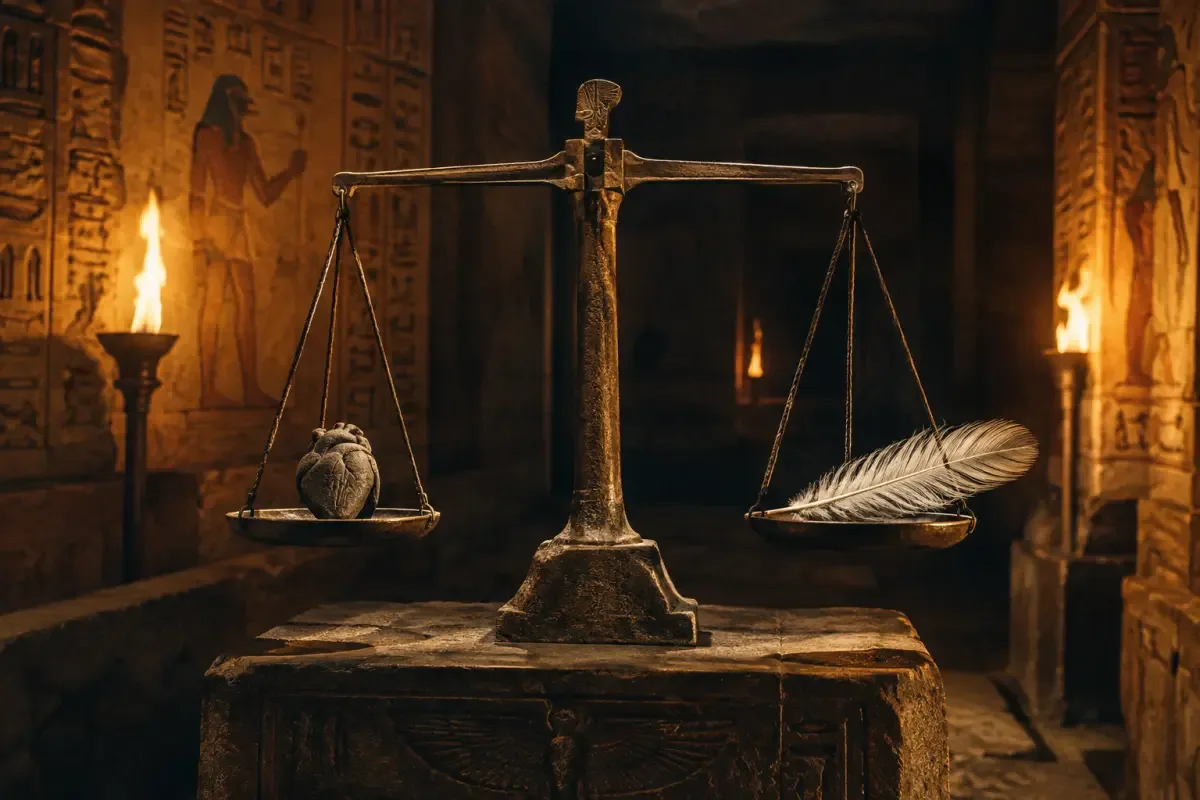
In one painted scene, a scale holds Ani's heart on one side and a single feather on the other. A small baboon perches above it, ready to announce the verdict.
The papyrus was found in Ani's tomb, and the British Museum acquired it in 1888.
The text is written in cursive hieroglyphs, a more formal script, slower to write and reserved for manuscripts like this one rather than everyday use.
Before shipping it to London, Egyptologist E. A. Wallis Budge cut the scroll into 37 sheets of roughly equal size. The decision compromised the integrity of the original, but it's also the reason the papyrus made it to Europe intact at all.
Among the dozens of surviving copies of the Book of the Dead, Ani's stands out as one of the most richly illustrated and complete. His wife Tutu, a priestess of the god Amun, appears alongside him in several of the vignettes.
Today those sheets are kept separately, each behind its own pane of glass.
- 1.What Is the Egyptian Book of the Dead
- 2.From the Pyramid Texts to Papyrus Scrolls
- 3.The Judgment of Osiris and the Negative Confessions
- 4.The Field of Reeds, the Weighing of the Heart, and Ammit
- 5.The Scarab: Amulet, Cheat Sheet, or Preparation?
- 6.Did the Egyptian Book of the Dead Inspire the Ten Commandments?
What Is the Egyptian Book of the Dead
That scene belongs to what we now call the Egyptian Book of the Dead, a collection of nearly 200 magic spells meant to guide the deceased through the afterlife.
No surviving copy contains every spell. Each one was customized for the individual who commissioned it and could afford it.
Ordering a personal copy was as much a matter of status as of faith. Affording a scribe and an illustrator meant a family commanded resources most people simply didn't have.
For the ancient Egyptians, death wasn't an ending. It was a crossing: a long, dangerous journey full of trials you had to know how to pass.
From the Pyramid Texts to Papyrus Scrolls
The roots of these spells reach deep into the past.
The oldest, known as the Pyramid Texts, were carved into the walls of royal tombs during the Old Kingdom and were a privilege reserved for pharaohs alone.
By the start of the second millennium BCE, the spells were also being written on the coffins of wealthier citizens. These became known as the Coffin Texts.
Only in the New Kingdom, starting around 1550 BCE, did they take the form we know today: written on papyrus scrolls, available to anyone who could pay a scribe and an illustrator.
The practice lasted nearly a thousand and a half years, until around 50 BCE, roughly the same span that separates us today from the fall of the Western Roman Empire.
The Judgment of Osiris and the Negative Confessions
The climax of the journey played out in the Hall of Two Truths, before the tribunal of the god Osiris.
According to the World History Encyclopedia, the deceased stood there before 42 deities, each one tied to one of Egypt's 42 provinces at the time.
Before each one, the deceased denied one specific transgression: I have not killed. I have not stolen. I have not made anyone weep. I have not closed my ears to the truth.
Egyptologists call this litany the Negative Confessions, though the name is a bit misleading. It isn't confession and repentance in the sense we'd recognize today, but a formal declaration through which the deceased aligned themselves with Ma'at, the divine principle of truth, justice, and order.
Although people often talk about "the 42 confessions" as a fixed list, the text was in practice tailored to the person it was written for.
A soldier didn't recite the same confession as a merchant or a scribe like Ani himself. Each version featured a slightly different selection of sins, even though the underlying framework stayed recognizable.
Ma'at, though, was more than just a figure in this scene.
For the ancient Egyptians, she represented the very foundation of order: the balance of the cosmos, society, and nature.
Upholding Ma'at against the forces of chaos was described as the basic duty of every pharaoh throughout their reign, not just a standard the soul was measured against after death.
The Field of Reeds, the Weighing of the Heart, and Ammit
Those who passed the test were rewarded with the Field of Reeds, imagined as a perfect version of Egypt: fertile land free of sickness and hunger, where the deceased carried on living the life they'd known and were reunited with the people they'd lost.
But one last, hardest step stood between the deceased and that reward.
The decisive moment was called the Weighing of the Heart.
Unlike the other internal organs, the heart stayed in the body during mummification.
The Egyptians saw it as the seat of reason, memory, and conscience: what we'd today call a person's character.
Anubis, the jackal-headed god, placed the heart on one side of the scale, opposite a single feather belonging to the goddess Ma'at.
Thoth, the scribe of the gods, shown with the head of an ibis, recorded the outcome, while Osiris presided over the tribunal.
To pass the test, the heart couldn't be heavier than the truth, but it couldn't be lighter either. It had to come into perfect balance.
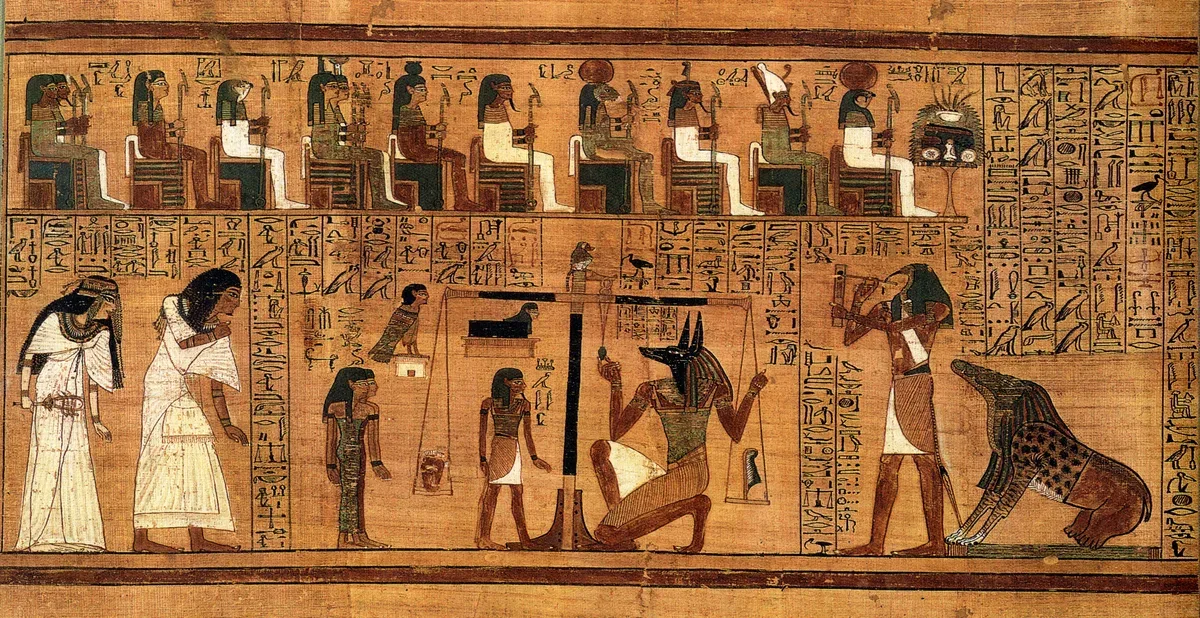
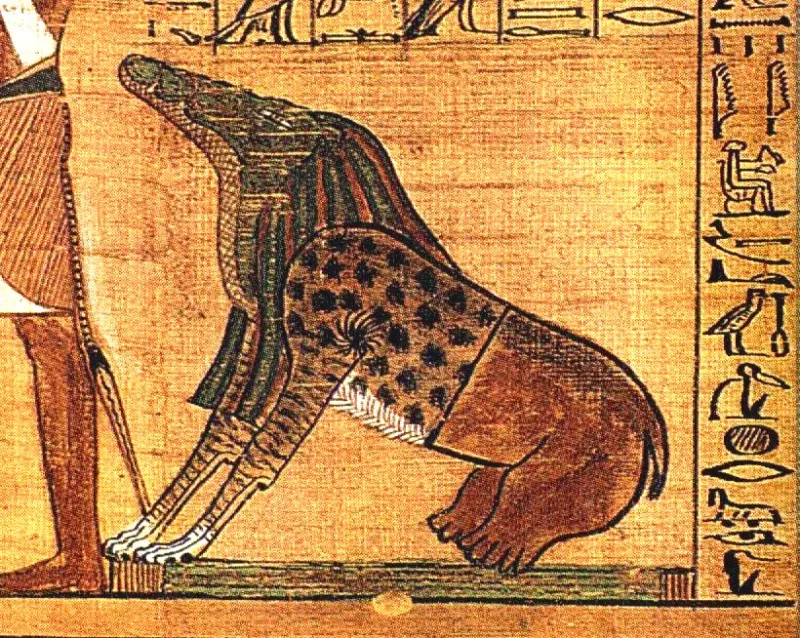
Those whose hearts failed to balance were met by Ammit, a creature assembled from the three animals ancient Egyptians considered most dangerous: the head of a crocodile, the front half of a lion's body, and the hindquarters of a hippopotamus.
Ammit was never an object of worship. She had no temples and no priests, only a single job.
For the Egyptians, what came next wasn't punishment in a hell, the way later traditions would imagine it.
It was something worse: total cessation of existence, erased from every memory and every future. In a culture obsessed with names and remembrance, that was harsher than any torment.
The Scarab: Amulet, Cheat Sheet, or Preparation?
Precisely because no one could be entirely certain of their own conscience, the Egyptians developed one last line of defense.
A stone carved in the shape of a scarab beetle was placed on the body of the deceased, directly over the heart.
According to the Metropolitan Museum of Art in New York, the underside of such an amulet was often carved with a text known as Spell 30B: an incantation addressed to one's own heart, commanding it not to testify against its owner before the scale.
The stone was usually green, jade or green jasper, since green symbolized rebirth and the resurrection of the god Osiris for the Egyptians.
In practice, the heart was ordered to keep quiet, even when the truth was inconvenient.
Some modern commentators describe the amulet as something close to cheating on an exam: a way for the deceased to get around their own conscience.
Egyptologists who study funerary texts offer a different reading: the scarab wasn't a cheat sheet. It was preparation.
To withstand the trial, the deceased had to come before the scale emotionally steady, at peace with their own heart, because it was the heart, according to Egyptian belief, that carried the trace of every good and bad deed.
Both readings remain open. The text itself doesn't settle the question.
The idea that the heart carries the weight of character has outlived the civilization that created it.
Phrases like "lighthearted" and "heavyhearted" survive today, in languages far from the Nile, as a distant echo of the same image.
A direct link can't be proven, but the resemblance is striking.
Egyptologists today largely reject the idea of the Egyptians as a people obsessed with death.
The World History Encyclopedia notes that their preoccupation with the afterlife was, if anything, an expression of their love of life rather than its opposite.
Did the Egyptian Book of the Dead Inspire the Ten Commandments?
There is, however, one question researchers still don't agree on.
Several prohibitions from the Negative Confessions (murder, theft, adultery, lying) show up centuries before the traditional dating of the Ten Commandments, during the period when, according to the biblical narrative, Moses grew up at the Egyptian court.
For some authors, that's reason enough to suspect Egyptian influence on the law of Moses.
Most Egyptologists and comparative religion scholars remain skeptical of that theory.
They point, above all, to the fact that the roots of these spells, as already mentioned, reach deep into the Old Kingdom, long before monotheism appeared in the region at all.
The Negative Confessions are addressed, one by one, to 42 separate deities, while the Ten Commandments open with a demand to worship no god but one.
Not one of the 42 lines on the British Museum's papyrus calls for the worship of a single god.
There's a third argument, and for many it's the hardest one for the theft theory to get around: the two texts simply aren't the same kind of writing.
The Negative Confessions belong to funerary literature. Written in the name of someone already dead, the text was addressed to a divine tribunal a single time, for a single purpose: winning that person passage into the afterlife.
Egyptologist Martin Stadler of the University of Würzburg, writing in the UCLA Encyclopedia of Egyptology, describes the act as a kind of postmortem trial the deceased had to pass in order to be declared "justified."
Some Egyptologists go a step further, arguing that reciting the confession carried magical force in its own right. It wasn't so much stating the truth as trying to create it, which lines up with the heart scarab practice covered earlier, where the heart was literally ordered to stay silent before the tribunal.
The Ten Commandments, by contrast, aren't addressed to the dead, and they weren't spoken on any one person's behalf to secure a personal passage into the next world.
According to the biblical narrative, they were announced publicly to an entire assembled nation as the foundation of a covenant between God and a living community: law by which that community was meant to govern its everyday life, with no ritual formula available to get around the obligation.
In that light, the theft theory quietly turns confessions ("I have not done this") into commandments ("do not do this"). It treats two different literary genres, one for the dead and one for the living, as if they were interchangeable, something the theory itself never really explains.
SOURCES
- World History Encyclopedia: The Forty-Two Judges
- British Museum: Ancient Egyptian gods and goddesses
- The Metropolitan Museum of Art: Heart Scarab of Hatnefer
- E. A. Wallis Budge, The Book of the Dead: The Papyrus of Ani in the British Museum, British Museum, 1895.
- British Museum: Papyrus of Ani (official collection page)
- John H. Taylor (ed.), Journey Through the Afterlife: The Ancient Egyptian Book of the Dead, British Museum Press, 2010.
- UCLA Encyclopedia of Egyptology: Judgment after Death (Negative Confession), Martin A. Stadler, 2008
Aron Corvin
A researcher of the unknown who loves a good story. I won't sell you sensationalism just for a click. If you enjoy what I write, your support would mean a lot and help me keep going.