
The Mystery of Gerry Irwin, the Soldier Who Lost His Memory
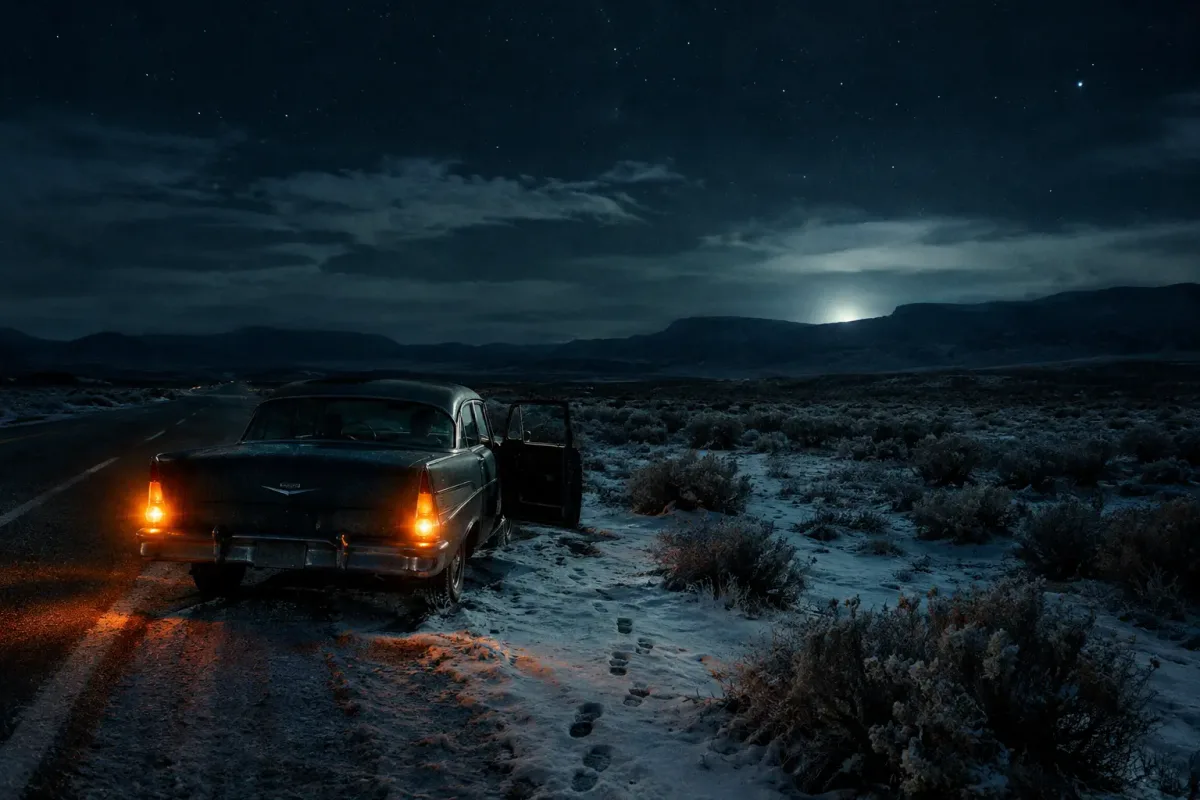
Private First Class Gerry Irwin was driving toward Fort Bliss, Texas, late at night, on his way back from a leave spent with family in Idaho. A Nike missile technician, he already had a long drive across the southern Utah desert behind him.
Somewhere along Route 14, a few miles southeast of Cedar City, he spotted a light dropping down behind a nearby hill.
He thought it was a plane in trouble. He stopped the car, switched on his turn signals, and left a note on the steering wheel asking passersby to notify the police. He was heading out on foot, the note explained, to check on a possible plane crash not far from the road.
He put on his military overcoat, grabbed a flashlight, and walked off into the dark.
The Nike missiles Irwin worked on were part of the air defense system the United States relied on at the time to protect its cities from a possible Soviet bombing attack.
It was a job that demanded considerable reliability and psychological stability from its technicians, something that would matter later, when military doctors came to evaluate Irwin's condition.
That same year, 1959, the U.S. Air Force was already in the sixth year of collecting reports on unidentified flying objects through Project Blue Book, so it's no surprise that Irwin's case caught the attention of military investigators, too.
Sources disagree on the exact date of that evening. The earliest records, based on an investigation the research group APRO conducted right after the event, point to February 28.
More recent accounts, including Jacques Vallée's foreword to a book about Irwin's case, mention February 20 or 21.
A gap of just eight days might seem trivial, but it shows how little about this case has ever been independently verified.
Waking Up in a Cedar City Hospital
About half an hour later, a fish and game inspector came across Irwin's car and the note. He took the note to Otto Pfeif, the sheriff of Cedar City, who organized a search party.
Searchers found Irwin lying unconscious in the snow about a quarter mile from his car. The jacket he'd been wearing under his overcoat was nowhere to be found.
A doctor named Broadbent examined him at the hospital in Cedar City but couldn't find any physical cause for his condition.
Irwin's vital signs were normal, yet no one could wake him for almost a full 24 hours.
While he lay in that state, he muttered something about a jacket on a bush. When he finally came to, the first thing he asked was whether there were any survivors, even though no plane crash was ever confirmed.
Broadbent diagnosed hysteria, meaning a condition with no organic cause. In the medicine of that period, the label often covered what today would be described as a dissociative reaction to acute stress: a state in which the body appears healthy while the mind temporarily shuts off access to a traumatic memory.
Irwin remembered nothing from the moment he stepped out of the car.
He went back to duty at Fort Bliss, but his security clearance was temporarily revoked.
A Second Collapse and a Shot of "Truth Serum"
A few weeks later, Irwin passed out on base, and then again on a street in El Paso.
He was taken to William Beaumont Army Hospital, where, as soon as he woke up, he behaved as though it were still February 28, even though nearly two weeks had gone by. Once again, he asked whether there were any survivors.
This time he was kept on the psychiatric ward for a month. Doctors found nothing unusual, so he was declared healthy and discharged.
On March 27, while he was still under observation, Captain Valentine injected him with sodium amytal, a barbiturate then used as a so-called "truth serum."
According to Valentine's official report, a document released decades later under the Freedom of Information Act, Irwin, under the drug's influence, said that a "special intelligence" had directed him not to remember or reveal what happened in Utah.
He also said that revealing the truth would set off a "big investigation" that would harm many people. He added that it had all begun when he was three years old, but he refused to say more.
A similar theme of blocked memory would surface two years later in the case of Betty and Barney Hill, the New Hampshire couple whose alleged encounter with extraterrestrials in 1961 is now considered the first widely known "abduction" case.
Given that timing, some researchers see Irwin's case as one of the earliest examples of a pattern that later became familiar in the literature on alleged abductions.
The Jacket on the Bush and the Escape
The day after he was declared healthy, Irwin left the base without permission and took a bus back to Cedar City. He seemed like a man in a trance.
He walked for miles across the desert, straight to the spot where he'd lost consciousness about two months earlier, and found his missing jacket hanging on a bush. A pencil was stuck through one of the buttonholes, and a piece of paper was wound around the pencil.
He burned the paper before reading it. According to later accounts, the smell of smoke jolted him out of his trance, and only then did he realize he was AWOL.
He went back to Cedar City and turned himself in to Sheriff Pfeif, who refreshed his memory of everything that had happened to him about two months earlier.
The military punished him for leaving his post without authorization.
According to researcher David Booher, he was soon readmitted for observation, spent three more weeks there, and walked off again without permission the day after his discharge.
At the end of August 1959, he was declared a deserter, and the military never saw him again.
From there, Irwin's trail in the official military records goes cold.
The Man Found Half a Century Later
For decades, the case circulated in UFO literature as the story of a soldier who vanished without a trace, based mostly on the notes of Jim and Coral Lorenzen of APRO and on Jacques Vallée's later retelling.
Booher came across the story in 2013 and decided to try to track down at least someone from Irwin's family.
Instead, he found Irwin himself, alive and willing to talk.
Irwin let Booher see some of his military records and, for the first time since 1959, recounted the events from his own point of view, from the moment he noticed the light all the way to his return to Texas.
According to Booher, even Irwin himself, more than half a century later, couldn't fill in the gap between leaving the car and waking up in the hospital.
The conversations resulted in the book "No Return: The Gerry Irwin Story," published in 2017 with a foreword by Jacques Vallée.
A review in the academic Journal of Scientific Exploration called Booher's research an exemplary case investigation that never pushes preconceived conclusions.
What Remains Unresolved
It's documented that Irwin existed, that he was hospitalized twice, a month apart, and that an official military report of the sodium amytal session exists.
It's also documented that he was found alive decades later and that he himself confirmed the basic outlines of the story.
What has never been established, though, is what Irwin actually saw that night on Route 14, or why his mind blocked the memory of it.
Explanations run the gamut, from a dissociative reaction or dissociative fugue brought on by stress and exhaustion, through speculation about the military mind-control experiments of the era, to a literal encounter with something extraterrestrial.
Researcher Kevin Randle included the case in his survey of government secrets related to the UFO phenomenon, but even he doesn't claim that the "special intelligence" in Valentine's report is proof of alien contact, only a documented but unexplained claim.
Booher's book, likewise, deliberately declines to choose among the possibilities on offer.
What remains is the sentence Captain Valentine wrote down in March 1959, and a question that half a century of investigation has never settled.
SOURCES
- Review of the book "No Return: The Gerry Irwin Story" in the Journal of Scientific Exploration
- David Booher, No Return: The Gerry Irwin Story: UFO Abduction or Covert Operation?, Anomalist Books, 2017 (foreword by Jacques Vallée).
- Nick Redfern, "One of the Strangest Alien Abduction Cases Ever", Mysterious Universe
- St. George News: interview about the book "No Return"
- Kevin D. Randle, The UFO Dossier: 100 Years of Government Secrets, Conspiracies and Cover-Ups, Visible Ink Press, 2015, pp. 134–141.
- Archival overview of the case and the APRO reports
Aron Corvin
A researcher of the unknown who loves a good story, but doesn't sell sensationalism. I research every topic in detail before I publish it. If you enjoy what I write, your support would mean a lot and help me keep going.