
Fermi Paradox: We Are Still Broadcasting
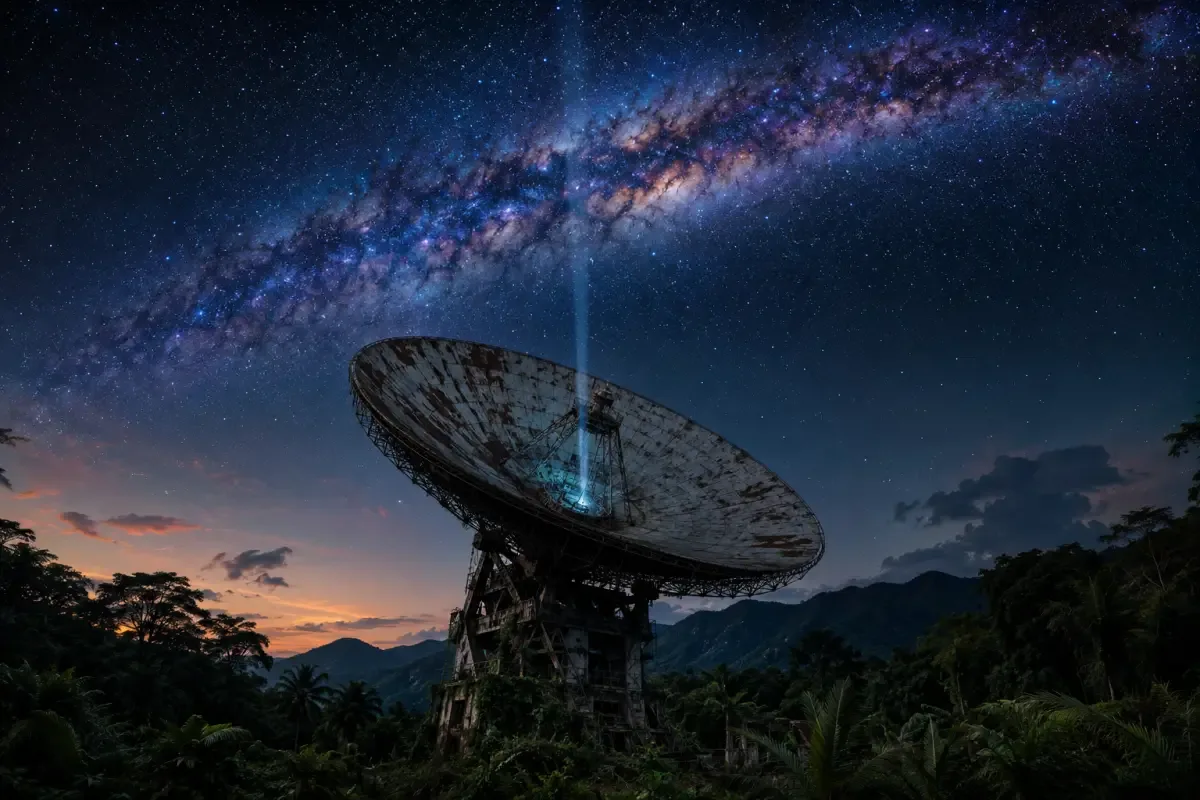
In November 1974, a tightly focused beam of radio energy left the Arecibo Observatory in Puerto Rico and began moving through interstellar space at the speed of light.
Directed toward M13, a dense globular cluster of roughly 300,000 stars in the constellation Hercules, the signal carried a pixelated image: the atomic numbers of hydrogen, carbon, nitrogen, oxygen, and phosphorus; the double helix of DNA; the structure of our solar system; the rough outline of a human body.
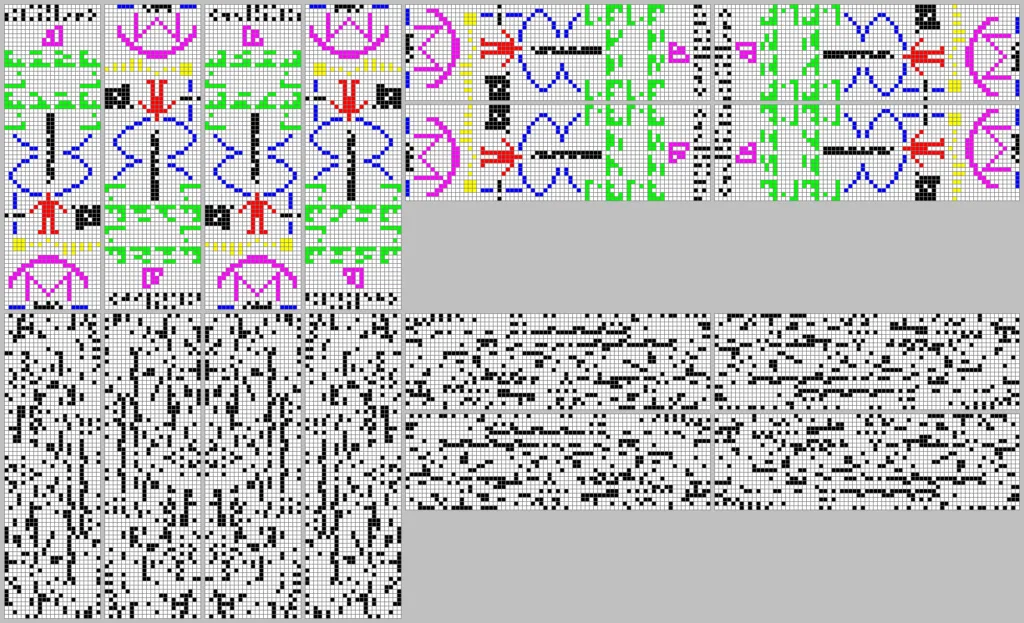
Engineers sent it primarily as a demonstration of the telescope's transmission power.
Taken in a different light, it reads as the most ambitious message in a bottle ever thrown into an ocean with no visible shore.
M13 is roughly 25,000 light-years away. The message will arrive around the year 26,974. If something there receives it and replies immediately, the response reaches Earth around the year 52,000.
This is the arithmetic of our first deliberate attempt at conversation with the cosmos: patient to the point of futility.
No reply has arrived. None was expected this soon. But the silence stretching across those twenty-five thousand light-years has a texture to it, a density, that makes every other kind of silence feel ordinary by comparison. That is the silence at the center of the Fermi Paradox: the mismatch between the overwhelming probability that someone else is out there and the complete absence of any evidence that anyone is.
The Contradiction at the Heart of the Night Sky
Enrico Fermi raised the essential problem in 1950. During lunch at Los Alamos National Laboratory, the physicist who helped split the atom turned to colleagues mid-conversation and asked, flatly: "Where is everybody?"

The question was deceptively simple. Fermi had been running rough mental calculations.
The Milky Way contains between 200 and 400 billion stars. A conservative fraction of those host planetary systems.
Within those systems, many planets fall within the liquid-water zones around their stars: the narrow temperature bands where chemistry complex enough to generate life becomes chemically viable.
Some of those stars formed billions of years before our sun. Any civilizations that emerged around them would have had millions of years, potentially hundreds of millions, to develop interstellar travel, or at minimum, interstellar communication.
The galaxy is 100,000 light-years across. At even modest sub-light travel speeds, a civilization determined to expand could reach every star system in the Milky Way within a few tens of millions of years.
By geological standards, that timescale is brief.
And yet. No visitors. No verifiable signals. No megastructures visible in the night sky.
The absence of evidence is so complete that it earned its own name: the Fermi Paradox, the gap between what probability demands and what observation confirms.
For seventy years, physicists, astronomers, and philosophers have attempted to close that gap.
Three explanations of the Fermi Paradox have survived long enough to be taken seriously. Each one is more disturbing than the last.
The Zoo Hypothesis: We Are the Wildlife
The Zoo Hypothesis, formalized by radio astronomer John Ball in 1973, offers the most structurally optimistic reading of the silence, though optimistic is a relative term here.
Ball's argument begins with a premise that is simple and, on reflection, hard to dismiss: advanced civilizations are watching us and have collectively chosen not to interfere.
The physics of civilizational development makes this plausible, but only once you understand where humanity actually sits on the spectrum of possible societies.
In 1964, Soviet astrophysicist Nikolai Kardashev published a classification system that has since become foundational to every serious discussion of extraterrestrial civilizations. He ranked societies by energy consumption.
A Type I civilization controls all energy available on its home planet: an estimated 1016 watts. Type II harnesses the full output of its star. Type III operates at galactic scale, commanding energies so large the numbers demand scientific notation.
The jump between each level is not arithmetic. It is exponential, tens of billions of times the output of the level below.
Humanity is not Type I. Our total global energy consumption runs at roughly 2 × 10¹³ watts, generated predominantly by burning coal, oil, and natural gas.
The compressed residue of organisms dead for hundreds of millions of years.
We have not figured out how to efficiently harvest the torrent of solar energy striking our planet every hour, let alone command stellar output.
Freeman Dyson, in a 1960 paper in Science, sketched what a Type II civilization's infrastructure would look like from the outside.
A civilization capable of capturing an entire star's output would need to surround it with a vast swarm of energy-collecting platforms, orbiting structures dense enough to intercept virtually every photon the star emits.
Astronomers now call this hypothetical construction a Dyson sphere.
It would register from a distance as an anomalous infrared source: a star radiating too much heat at the wrong frequencies.
Multiple observational programs have searched for such signatures. No conclusive candidates have emerged.
The Zoo Hypothesis places Earth inside a system designed by Type II or Type III civilizations to protect exactly the kind of primitive, isolated biosphere we represent.
On this model, the galaxy is managed space. Certain regions have been designated as wilderness preserves.
The civilizations observing us have agreed — perhaps out of ethical principle, perhaps out of scientific caution — not to contaminate our development with their presence.
Our radio transmissions, leaking into space for over a century, are from their perspective a background hum. Easily detectable. Easily filtered.
A civilization that can engineer Dyson spheres can certainly choose not to respond to a Type 0 civilization's accidental electromagnetic noise.
I keep returning to one implication of the Zoo Hypothesis that rarely receives adequate attention.
The silence is not neglect. It is a policy. Something, or a collective of somethings, has decided that the creatures on this planet should remain ignorant of their observation.
That decision is being actively maintained right now, as you read this.
The Dark Forest Theory: Survival Is the First Law
The Zoo Hypothesis requires something fundamental about advanced civilizations: that they are, on balance, benevolent.
The Dark Forest Theory requires nothing of the sort.
The theory draws its sharpest articulation from two sources. David Brin laid the axiomatic foundation in his 1983 paper "The Great Silence." Chinese science fiction author Liu Cixin elaborated its logic into a complete cosmological framework in his trilogy beginning with The Three-Body Problem, a work that reads less like fiction and more like a theorem.
Greg Bear explored adjacent territory. The conclusions all converge.
Two premises anchor the argument, and both are difficult to reject.
First: every civilization's primary drive is survival. Second: the resources necessary for survival, matter, energy, habitable space, are finite and cannot be infinitely replenished. From these starting points, a cold and unforgiving logic assembles itself.
A civilization that detects another faces a strategic problem it cannot resolve through communication.
The other civilization might be cooperative. It might not be.
The vast distances separating star systems make meaningful negotiation impossible on any useful timescale.
A message takes decades or centuries to arrive. A reply takes as long to return.
In the interim, the detected civilization keeps growing, keeps consuming resources, keeps developing technology.
The uncertainty about its intentions compounds with every passing generation.
The only rational response, across these distances and timescales, is preemptive silence. And when silence fails, preemptive elimination.
This is the Dark Forest: a cosmos in which every civilization that broadcasts its location is effectively issuing an invitation to its own destruction.
The civilizations that survive are the ones that go dark, listen without transmitting, and strike first when they detect others.
Every star system that disappears from the night sky may have been silenced in exactly this way.
The counterargument, raised often, is that we are still here. Our electromagnetic signature has been building for over a century. Nothing has targeted us.
Brin acknowledged this tension explicitly. One resolution is that our signals are still too weak, too diffuse, to register as a threat at meaningful distances.
We became electromagnetically visible only recently. The forest may not yet have noticed us.
The margin between "has not noticed" and "is calculating a response" is not something our instruments can currently measure.
The Berserker Hypothesis: The Machines That Hunt
The Berserker Hypothesis removes biological intelligence from the paradox entirely.
What remains is more unsettling than anything the Dark Forest implies, because it requires no ongoing civilization to sustain it.
John Von Neumann — whose contributions to twentieth-century science encompassed quantum mechanics, game theory, economics, and the architecture of modern computers — developed in the late 1940s the first rigorous theoretical framework for self-replicating machines.
He demonstrated mathematically that a sufficiently complex machine could contain within itself complete instructions for fabricating a functional copy, including the instructions for building those instructions.
Given access to raw materials, such a machine would replicate exponentially.
The math works regardless of the timescale involved.
Applied to interstellar exploration, this concept produces what are now called Von Neumann probes: autonomous spacecraft carrying their own construction blueprints, capable of landing on asteroids or barren moons, mining local materials, fabricating identical copies, and launching those copies toward new star systems.
One probe. Exponential growth. A few million years. A galaxy saturated with machine intelligence.
Fred Saberhagen's science fiction series of the 1960s imagined the darkest version of this scenario.
His Berserker machines were autonomous killing platforms, self-replicating and indefinitely patient, designed to eliminate every instance of biological life they encountered.
The original creators might be long dead. The machines continue operating on their last standing orders, indifferent to the passage of geological time, indifferent to the extinction of every civilization they were originally built to protect.
Modern versions of the Berserker concept incorporate artificial intelligence capable of adapting to novel targets, and nanotechnology capable of restructuring ecosystems at the molecular level. A probe too small to detect could sit dormant near a target solar system for geological epochs, waiting. The same mathematics that describes exponential replication also describes undetectable patience.
Brin's "The Great Silence" raised this possibility with clinical directness: the absence of detectable alien life may not indicate that life is rare. It may indicate that something is systematically eliminating it. The absence of evidence and the evidence of absence, as Brin framed it, are not the same thing.
The worst-case reading, which Brin enumerated without flinching, is that Earth's century of radio transmissions has already been logged somewhere. That we are already on a list. That the list has been in operation since before multicellular life evolved on this planet.
Von Neumann's mathematics remain valid. Nothing in the known laws of physics prohibits this scenario from being operational right now.
Fermi Paradox: Three Answers, None Comforting
Three models. Three answers to the same observation.
The cosmos is empty.
Life's emergence from chemistry is so statistically improbable that it has occurred exactly once, here, on a minor planet orbiting an unremarkable star in the outer spiral arm of one galaxy among four hundred billion. The universe is biologically vacant except for this accident. The silence is not hiding anything. It is the sound of nothing.
The cosmos is inhabited and protected.
Civilizations operating at stellar and galactic energy scales exist, have detected us, and have agreed not to make contact. Earth is a preserve. We are the subject of observation we cannot perceive. Every signal we transmit is received, cataloged, and deliberately left unanswered.
The cosmos is inhabited and dangerous.
A billion-year arms race has produced civilizations whose survival strategy requires eliminating competitors before competitors can eliminate them, possibly through machines operating autonomously long after their creators' extinction.
The Arecibo dish that sent humanity's first deliberate interstellar message collapsed in December 2020.
Its suspension cables failed progressively over several weeks. The platform fell. The structure lies in ruins in Puerto Rico.
The signal it sent in 1974 is still traveling outward at 299,792 kilometers per second, carrying the shape of our DNA, the address of our solar system, and the outline of a human body.
We are still broadcasting.
Aron Corvin
A researcher of the unknown who loves a good story, but doesn't sell sensationalism. I research every topic in detail before I publish it. If you enjoy what I write, your support would mean a lot and help me keep going.