
Dorothy Eady: Omm Sety, Abydos, and a Story of Reincarnation
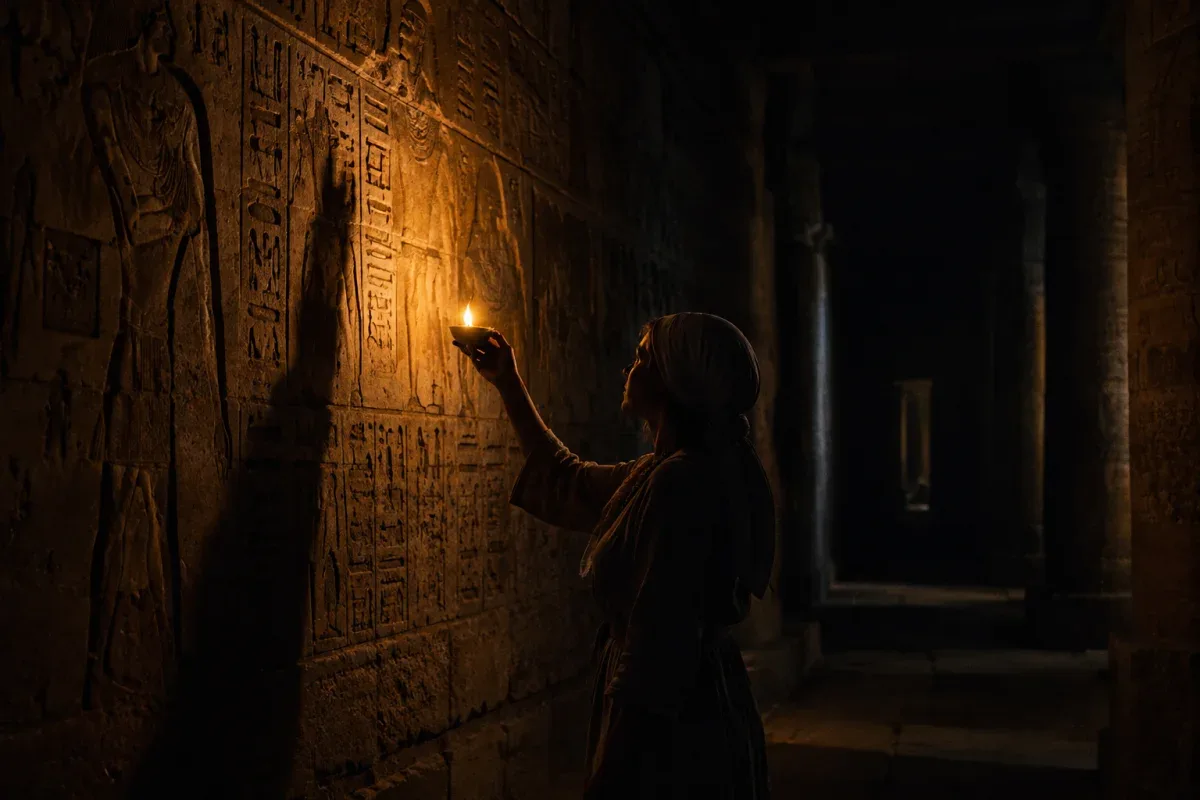
Barefoot, dressed in plain wool, a scarf over her head, and strings of pharaonic-era beads around her neck: that's how the woman who led tourists through the Temple of Seti I at Abydos looked.
She'd point out the painted reliefs calmly and confidently, the way a homeowner shows visitors around her own estate.
She really did consider the temple her home. Harry James, Keeper of Egyptian Antiquities at the British Museum, wrote in her obituary that thousands of visitors came to know her at Abydos over the last twenty-five years of her life.
The editor of Antiquity, who reprinted that obituary, added that James had used it to paint a moving, vivid portrait of a truly unusual and remarkable woman.
Her name was Omm Sety. Born Dorothy Eady in Blackheath, London, she claimed that more than three thousand years earlier, she had been a priestess in that very same temple.
In 2013, Egyptian inspector Ayman Damarany opened a room that had been sealed for decades, in a part of the temple once used as a slaughterhouse.
He'd come to document the wall decorations. What he found instead was thousands of documents: some bundled together, others scattered across the floor.
Among them was a folder of monthly inspection reports Eady had written in 1968 and 1969. The American Research Center in Egypt (ARCE) cites her reports as a good example of what the collection holds, everything from routine bureaucratic paperwork to documents of real historical value.
So Eady's story comes in two parts. One part is recorded in reports and documents. The other exists almost entirely in her own words.
That second part comes down to three claims that nothing in the available record independently confirms: her childhood memories of the temple and its garden, the knowledge of its rooms she demonstrated in the dark in 1952, and her account of a priestess named Bentreshyt, whom she claimed to have been herself.
The Girl Who Was Looking for a Garden
Almost everything we know about her childhood comes from The Search for Omm Sety, the 1987 biography by Jonathan Cott, and Cott mostly heard it from Eady herself.
The Psi Encyclopedia makes the same point explicitly.
According to the story, she fell down a flight of stairs at age three. A doctor pronounced her dead, and an hour later she was found playing on her bed without a scratch on her.
After that, the story goes, the dreams began: a vast building with columns, and a garden full of fruit and flowers.
Her mother would find her in tears. The child said she wanted to go home, even though she was already home.
At the British Museum, so the story goes, she ran from one display case to the next, kissing the feet of the statues.
When she saw a picture of the Temple of Seti I at Abydos, she told her parents that was her home. She asked why it was all in ruins and where the garden had gone.
It's a lovely story, but it has exactly one witness: Eady herself.
The obituary is the one place this story gets any firmer footing. The Egyptian department of the British Museum was her school and her university, and she used to say that E. A. Wallis Budge had taught her a bit of hieroglyphics.
So the museum really did shape her knowledge. Whether that knowledge came from a past life isn't a claim the obituary makes.
A Londoner at the Digs
In 1933 (Barbara Lesko's biographical survey gives 1931), Eady traveled to Egypt to marry Imam Abdel Meguid, whom she'd met while working at a magazine devoted to Egyptian independence. She never went back to England.
She named her son Seti, after the pharaoh, which gave her the name all of Abydos would know her by: Omm Sety, "Mother of Seti." The marriage fell apart by the mid-1930s.
When her husband went abroad for work, she went to work for Professor Selim Hassan, who was excavating at Giza at the time.
For twenty years she assisted him, and later Professor Ahmed Fakhry, on the pyramid fields of the great Memphite necropolis.
She prepared field notes and reports for publication, as her obituary records.
This part of her biography doesn't require taking anything on faith. She did the work, and she did it for a long time.
Barefoot Among the Columns
Her visits to Abydos in 1952 and 1954 convinced her, according to the obituary, that she had once lived in that temple before.
When Fakhry's project at Dahshur was shut down in 1956, he offered her a better-paying job in Cairo or a poorly paid position as a draftswoman at Abydos. She chose Abydos and stayed there for the rest of her life.
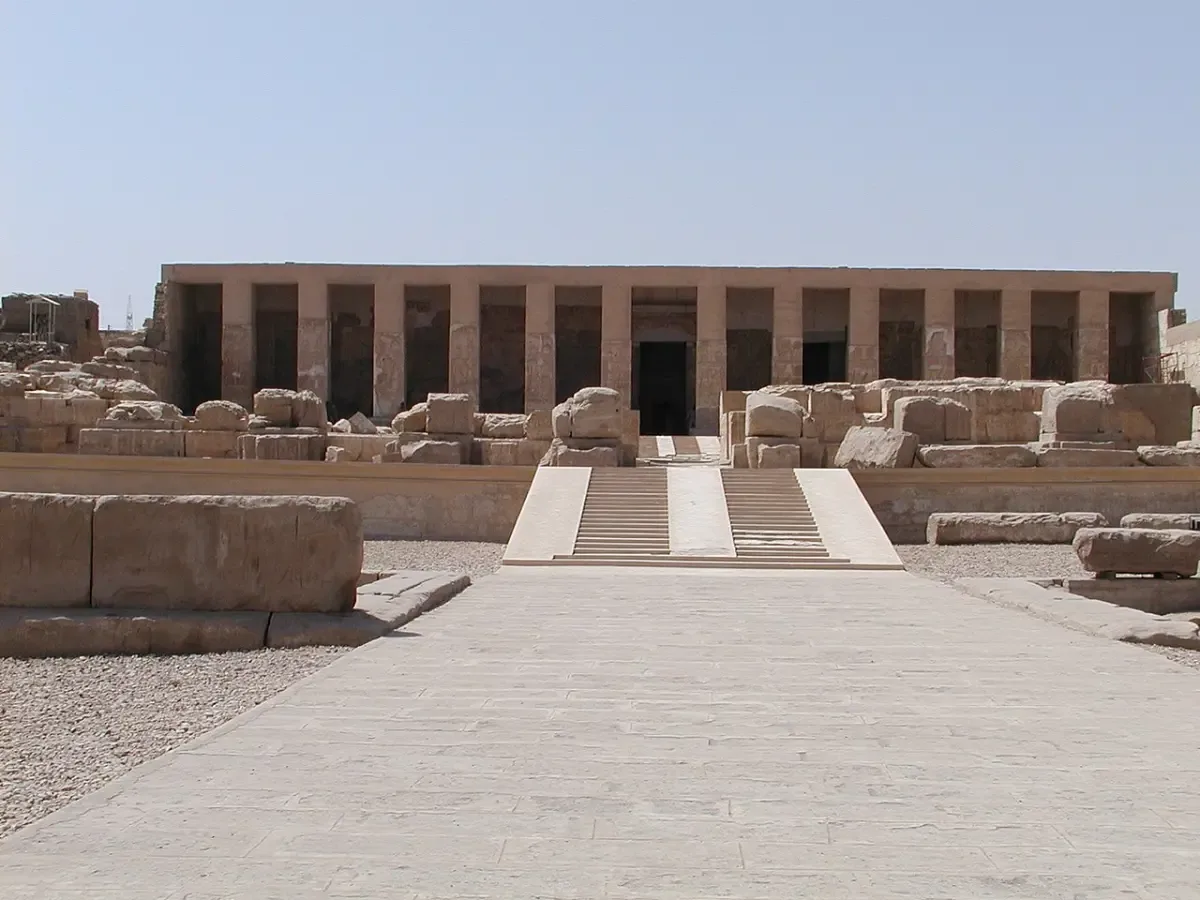
She lived in a simple mud-brick house, surrounded by cats, with a single goose, a donkey, and the occasional snake.
In the temple's sanctuaries, she performed ancient rites as she herself understood them.
And yet, James writes, she was practical and entirely free of occult irrationality.
She planned her tomb and burial well in advance, so that after death she could travel on to the beautiful West, to Osiris, to Seti, and to everyone she felt she belonged with.
In Abydos, she also wrote about life in Egyptian villages. Her notes on customs she believed dated back to pharaonic times weren't published until 2008, when Egyptologist Nicole B. Hansen released them under the title Omm Sety's Living Egypt.
A Test in the Dark and a Garden Found
The most famous episode took place, according to Cott, in 1952, during her first visit to Abydos.
The chief inspector of the Department of Antiquities decided to put her to the test.
In complete darkness, she was supposed to point out where certain scenes appeared on the temple walls, scenes whose locations hadn't been published at the time. She claimed she succeeded.
She also pointed to where, by her own memory, a garden had once stood. Later, according to El Zeini, the remains of old tree stumps turned up in that very spot.
That sounds like proof, but it's worth asking where the story actually comes from. It's told mainly by Hanny El Zeini, an Egyptian who became her friend and co-author of Cott's book.
He claimed to have personally watched an old stump get dug up on that spot, as the Psi Encyclopedia notes.
Even if Eady did correctly point out where the garden was, the question of how she knew remains open. She may have connected it to her belief in a past life.
Just as easily, she might have known it the way anyone learns things over years: through day-to-day work, conversations with archaeologists, and familiarity with earlier research on the site.
A Priestess Who Exists Only in Her Own Writings
According to Cott's biography, Eady would write down messages at night in hieroglyphs, which she told her husband were being dictated to her by a spirit named Hor-Ra. By her own account, the dictation went on for twelve months, and the resulting text ran to about seventy pages of cursive hieroglyphs.
Those writings gave rise to the story of Bentreshyt, a young priestess at the temple in Abydos.
One day, King Seti came to the temple, and the two young people grew close.
When Bentreshyt became pregnant, the high priest interrogated her, and she eventually confessed who the father was. She took her own life to spare the king.
Eady believed that Seti I later appeared to her as a spirit. Egyptologist Jaroslav Černý also saw her hieroglyphic writing and judged it good work for a beginner.
None of this has an independent witness. The Psi Encyclopedia notes that no researcher ever investigated the case, so the story rests almost entirely on her own accounts.
The distinction matters. "Eady claimed this" describes a fact that can be investigated.
"Eady really was Bentreshyt" would be an entirely different claim, one the available record offers no evidence for.
What the Skeptics Say
Cott also asked experts in other fields for their take on her claims, as the Psi Encyclopedia notes. The astronomer Carl Sagan, also known as a skeptic of paranormal claims, considered fantasy the most economical explanation.
His main objection was that nearly all the corroborating stories trace back to Eady herself: her diaries, and the stories she told to Egyptologists, journalists, and friends.
There was, he pointed out, no independent record at all, not even a letter written by her father, confirming so much as her early conviction that ancient Egypt was her "home." Her knowledge of Egypt, he added, required nothing more than a sharp mind devoted to the subject.
One psychiatrist who specialized in adolescent behavior offered a different explanation: that her fall at age three might have left a lasting psychological effect, which she worked through by embracing an obsession.
Psychologist Michael Gruber argued that Eady, who was clearly able to function normally, couldn't be called insane. Her experience, as he put it, "yielded a meaningful life." If being able to live creatively, compassionately, and with discipline is any measure of sanity, he said, then Omm Sety certainly met it. Her belief wasn't purely personal, either. It reached into history as well, and her firm faith in Seti as a guide contributed a great deal to her work in Egyptology.
Some psi researchers, even so, dispute the evidence for reincarnation.
Parapsychologist and remote-viewing researcher Stephan A. Schwartz rejects her certainty that she was reincarnated, arguing that her experiences could be explained by collective consciousness or remote viewing, though he allows that what she believed might still have been true.
Reincarnation researcher James G. Matlock adds that collective consciousness doesn't explain why such experiences latch onto the memories of just one deceased person, and that "psi" explanations require assuming something called "super-psi": an ability to draw together information from multiple sources in a way no one knows to be possible.
What Remains on Paper
The sturdiest part of this story is the part that needs no paranormal explanation at all. The folder containing her 1968 and 1969 reports is part of an archive belonging to the Sohag Inspectorate and the broader Egyptian Antiquities Service, a collection of correspondence, excavation reports, maps, and other documents, some dating back as far as the 1820s.
ARCE describes the collection as unique, the first one to let the early history of Egyptology be seen through Egyptian eyes rather than those of foreign missions.
Among the other files is one containing the papers of Labib Habachi, one of the first Egyptologists to graduate from Cairo University, who spent more than thirty years working for the Antiquities Service.
So Eady wasn't just a character out of later stories about the paranormal. She was a real employee, real enough that her reports survive in the Sohag Inspectorate's own archival collection.
According to Cott's biography, her work on the texts also fed into Edouard Ghazzouli's monograph on the palace and magazines of the Temple of Seti I, where the author specifically thanks her.
According to Cott, a number of respected Egyptologists have publicly said that some works published under other people's names were, in large part, edited or written by her.
Dorothy Eady died on April 21, 1981, in Abydos, at the age of 77, and was buried in the desert outside the Coptic cemetery, in an unmarked grave facing west.
She believed her life would go on. The paperwork speaks only to this one.
It doesn't say who she was before 1904. It says what she was doing near the end of her life, in a place she'd called home for decades.
SOURCES
- American Research Center in Egypt, "Abydos Temple Paper Archive". Describes the 2013 discovery of the archive and cites the folder of Dorothy Eady's 1968–69 monthly reports (primary archival source for that section).
- "Editorial", Antiquity, Vol. 55, No. 215, November 1981, pp. 165–171. Reprints Harry James's obituary from the London Times of April 29, 1981, with an introduction and closing note from the editor of Antiquity.
- Harry James, obituary of Dorothy Eady, The Times, April 29, 1981. Source for details of her career, her life in Abydos, and her final years.
- K. M. Wehrstein, "Dorothy Eady/Omm Sety (reincarnation case)", Psi Encyclopedia, Society for Psychical Research. An overview of the case with a full bibliography; source for the responses from Sagan, Gruber, Schwartz, and Matlock, and for the psychiatrist's alternative explanation (Cott, p. 219).
- Cott, Jonathan, with Hanny El Zeini, The Search for Omm Sety: A Story of Eternal Love, Doubleday, 1987 (Internet Archive). The core biography: Sagan p. 205, Gruber pp. 228 and 230, Schwartz pp. 208–210, Egyptologists and attributed works p. 57, burial p. 174, Ghazzouli's monograph p. 84.
- Omm Sety, with Hanny El Zeini, Abydos: Holy City of Ancient Egypt, L L Company, 1981 (Internet Archive). Her own book on Abydos (primary source).
- El Zeini, Hanny, & Dees, Catherine, Omm Sety's Egypt, St Lynn's Press, 2007. An account from the co-author of Cott's book.
- Omm Sety, Omm Sety's Living Egypt: Surviving Folkways from Pharaonic Times, ed. Nicole B. Hansen, Glyphdoctors, 2008.
- Lesko, Barbara, "Omm Sety, 1904–1981", in: Joukowsky, Martha Sharp & Lesko, Barbara (eds.), Breaking Ground: Women in Old World Archaeology. An academic biographical overview.
- Haraldsson, Erlendur, & Matlock, James G., I Saw a Light and Came Here: Children's Experiences of Reincarnation, White Crow Books, 2016, p. 262.
- Matlock, James G., Signs of Reincarnation: Exploring Beliefs, Cases, and Theory, Rowman & Littlefield, 2019, pp. 116–117.
Aron Corvin
A researcher of the unknown who loves a good story, but doesn't sell sensationalism. I research every topic in detail before I publish it. If you enjoy what I write, your support would mean a lot and help me keep going.