
The Malmstrom Missile Shutdown: A UFO, a Secret Pentagon Test, or Something Else Entirely?
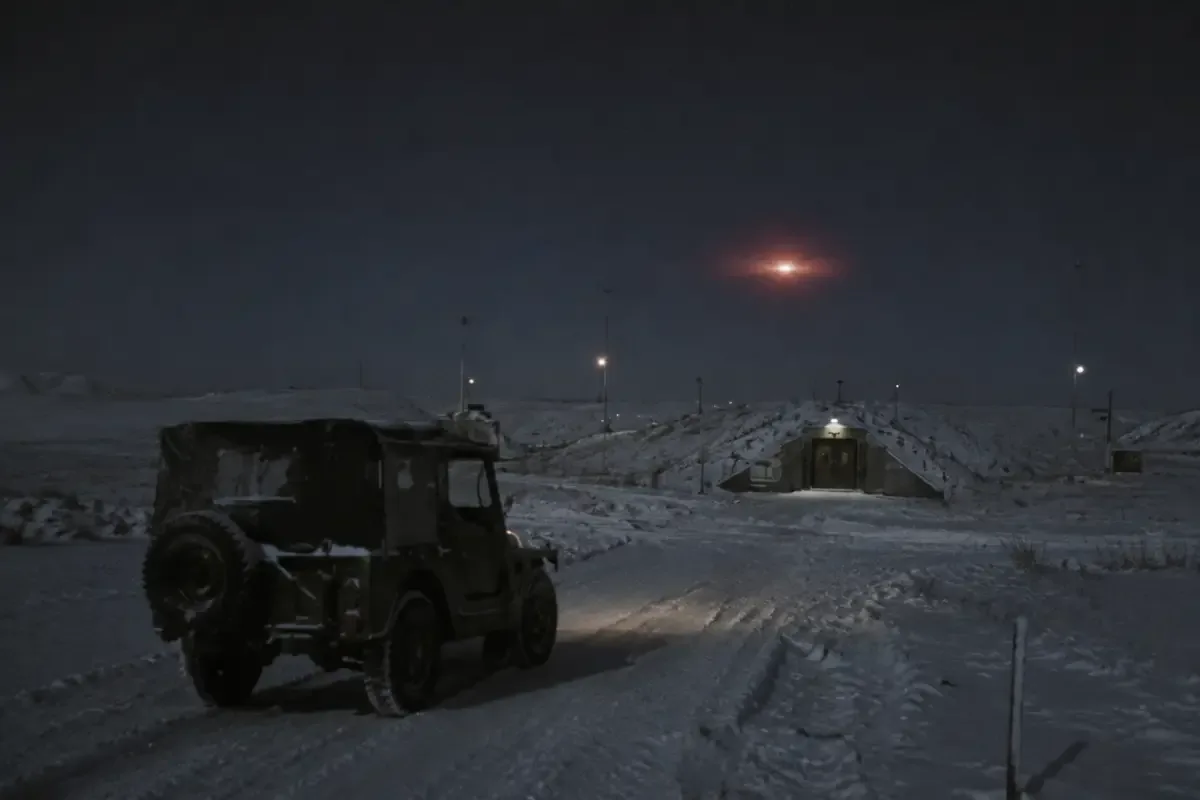
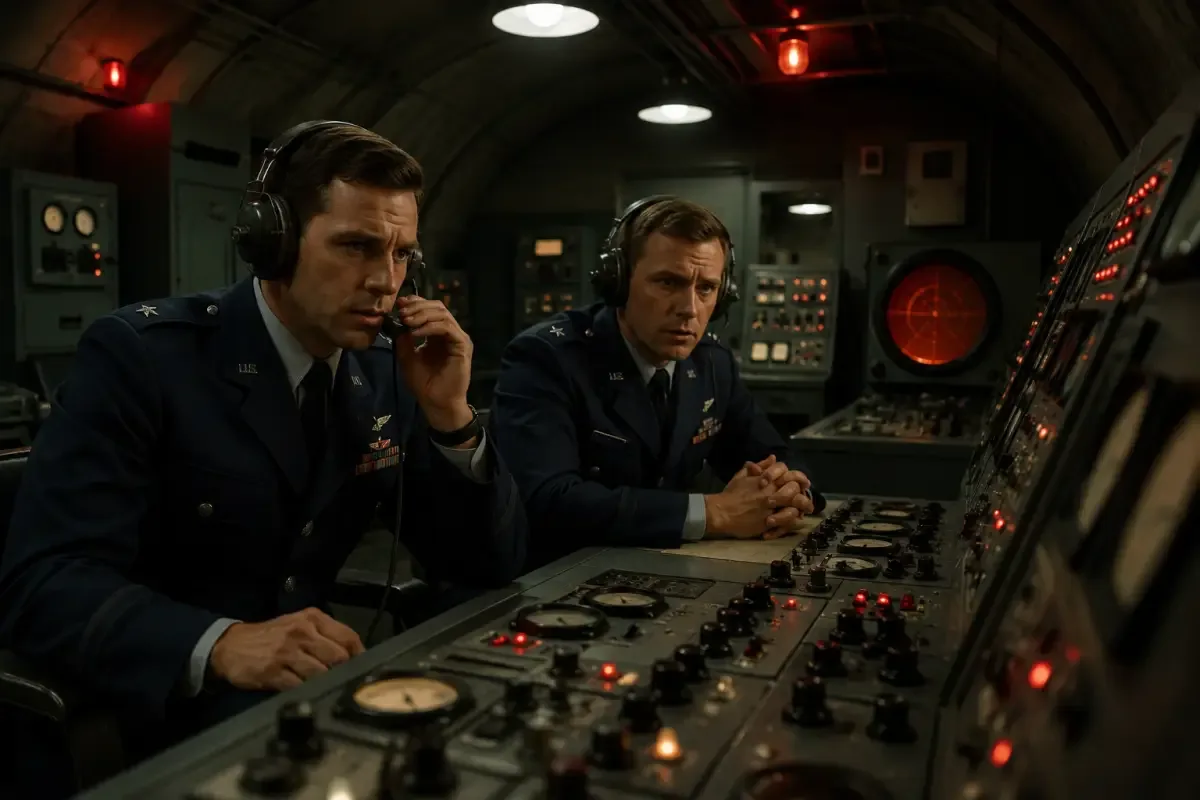
Captain Eric Carlson sat thirty feet beneath the Montana prairie on Thursday morning, March 16, 1967, monitoring routine status reports inside the underground command capsule of Echo Flight.
First Lieutenant Walter Figel was reading him the flight's indicators when an alarm horn cut through the capsule.
One of the ten Minuteman intercontinental ballistic missiles under their control had dropped out of launch-ready status, with no maintenance scheduled and no fault indicator to explain it.
Thirty seconds later, a second missile failed. Then a third, a fourth, a fifth, in rapid succession, until the entire ten-missile fleet had fallen into "No-Go" condition.
A then-classified Strategic Air Command message on the incident, later released along with the 341st Strategic Missile Wing's unit history, described the loss of all ten missiles as occurring within ten seconds of each other for no apparent reason, and called it a cause for grave concern.
Hours earlier, security patrols and maintenance crews camped at two of the flight's launch sites had already radioed in reports of a silent object hovering near the facilities.
Figel brushed off the first call. Once the entire missile fleet went dark within a minute, the report stopped sounding like a joke.
Malmstrom Air Force Base that year anchored a piece of the American nuclear deterrent, one node in a network of Minuteman missile fields scattered across the plains of central Montana.
The Cold War arms race was near its peak, and any unexplained fault in a strategic weapons system drew scrutiny from the highest levels of the Air Force.
A Deterrent on Hair-Trigger Alert
By the mid-1960s, the Minuteman program had turned Montana's grasslands into one of the most heavily defended stretches of territory in the country, its missiles buried in scattered underground silos and linked to command capsules staffed around the clock.
The system depended on near-absolute reliability, since the entire strategy of nuclear deterrence rested on the assumption that the missiles would fire the moment an order came through.
Ten missiles losing power within seconds of one another, with no external trigger and no loss of electricity to the sites, had no precedent in the wing's history. The guidance and control system inside each individual launch facility had failed almost simultaneously, an outcome that should have been statistically close to impossible under ordinary conditions.
That anomaly, not any claim about lights in the sky, is what set off a monthslong investigation involving multiple engineering teams and military units.
The Investigation That Found Nothing
Boeing, which built and maintained the missiles' guidance systems, opened a full investigation within days, running tests both in the field and at its engineering plant in Seattle.
Robert Kaminski, the Boeing engineer who led the effort, later concluded that his team found no technical explanation that could account for the event, a finding later confirmed by declassified documents from the Strategic Missile Wing.
The closest engineers came to reproducing the failure was by deliberately injecting a ten-volt electrical pulse directly into a missile's logic coupler.
Robert Rigert, another Boeing engineer on the team, devised that test, which reproduced the shutdown effect in roughly eight of ten attempts, but only when injected at that specific point in the circuit.
No one on the investigation could identify where a pulse of that kind would have come from under real field conditions, since the missile equipment was specifically shielded against exactly that sort of outside electrical interference.
Other engineers ruled out more mundane culprits, including lightning strikes and interference from the commercial power grid.
William Dutton, another Boeing engineer, checked specifically for commercial power interruptions and transients and reported finding no anomalies in that area.
Several other military units and outside engineering firms joined the review over the following months, and none of them offered an alternative explanation for how ten independent guidance systems failed within seconds of each other.
Investigators eventually concluded that the only way such a pulse could have reached the shielded system from outside was through an electromagnetic pulse, the kind of disturbance a nuclear detonation can produce.
Generating an EMP strong enough to penetrate the missiles' shielding, however, required bulky, heavy equipment that, as far as investigators could determine, was nowhere near Echo Flight that night.
The source of the actual pulse that disabled the missiles remained, in the investigators' own words, a mystery to this day.
The Story from Oscar Flight
Roughly twenty miles southeast, in the command capsule at Oscar Flight near the town of Roy, Lieutenant Robert Salas was on duty as deputy commander during that same period.
Salas has said publicly since the late 1990s that his flight's incident happened the same morning as the Echo Flight shutdown, though later cross-checks of newspaper archives and Air Force records place his experience eight days later, on March 24 — a discrepancy that remains unresolved even within the story itself.
By Salas's account, a security airman above ground first noticed a light zig-zagging across the sky, then a second, larger light closer to the facility.
The airman called it in to Salas below ground, and Salas, skeptical at first, told him to keep watching.
Minutes later the same man called back, this time frightened, describing an object hovering directly outside the front gate and glowing red.
Salas ordered the site secured and began to call the command post. Before he finished, alarm lights started firing across his capsule's panel — one missile, then another, then several more in rapid succession, until between six and eight of the flight's ten missiles had dropped into "No-Go" status within seconds.
A security patrol sent to check the remaining launch facilities reported spotting a second object and then lost radio contact with the base, according to the account Salas and researcher Jim Klotz later published together.
By the time Salas's crew was relieved the next morning, maintenance teams still had not restored the missiles to full operational status.
A Recurring Claim in UFO Lore
Salas has continued to develop his account across three books published between 2005 and 2023, shifting over time from simply requesting an explanation to arguing that the incident reflects a deliberate, non-hostile warning about nuclear weapons from a non-human source.
Author Robert Hastings folded the Malmstrom case into a wider catalog of similar claims in his 2008 book on UFOs at nuclear weapons sites, drawing on interviews with dozens of former military personnel who described comparable sightings near missile silos and bomber bases elsewhere in the country.
In 2010, Salas joined several other former officers at Washington's National Press Club to press for a formal investigation, and in 2023 he testified before a congressional task force on unidentified phenomena, more than half a century after the original incident.
The claim that unidentified objects have targeted nuclear weapons sites has since become one of the most persistent threads in American UFO culture, repeated across books, documentaries, and congressional hearings long after the 1967 shutdown itself faded from public memory.
It gives the Malmstrom case a symbolic weight that a routine guidance-system failure would never have carried on its own.
Lights Before and After
Reports of unusual objects around the missile fields did not begin or end with the March shutdowns.
Weeks earlier, on February 8, 1967, the Great Falls Tribune reported that a local resident named Louis DeLeon saw two glowing orange-red objects while driving east of the town of Chester, neither resembling an aircraft.
A short time later, another resident, Jake Walkman, watched a saucer-shaped object from his backyard several miles away, and the following evening a railroad foreman named George Kawanishi saw a bright ball of light hovering above the town's train depot.
Similar sightings continued after the missile incidents.
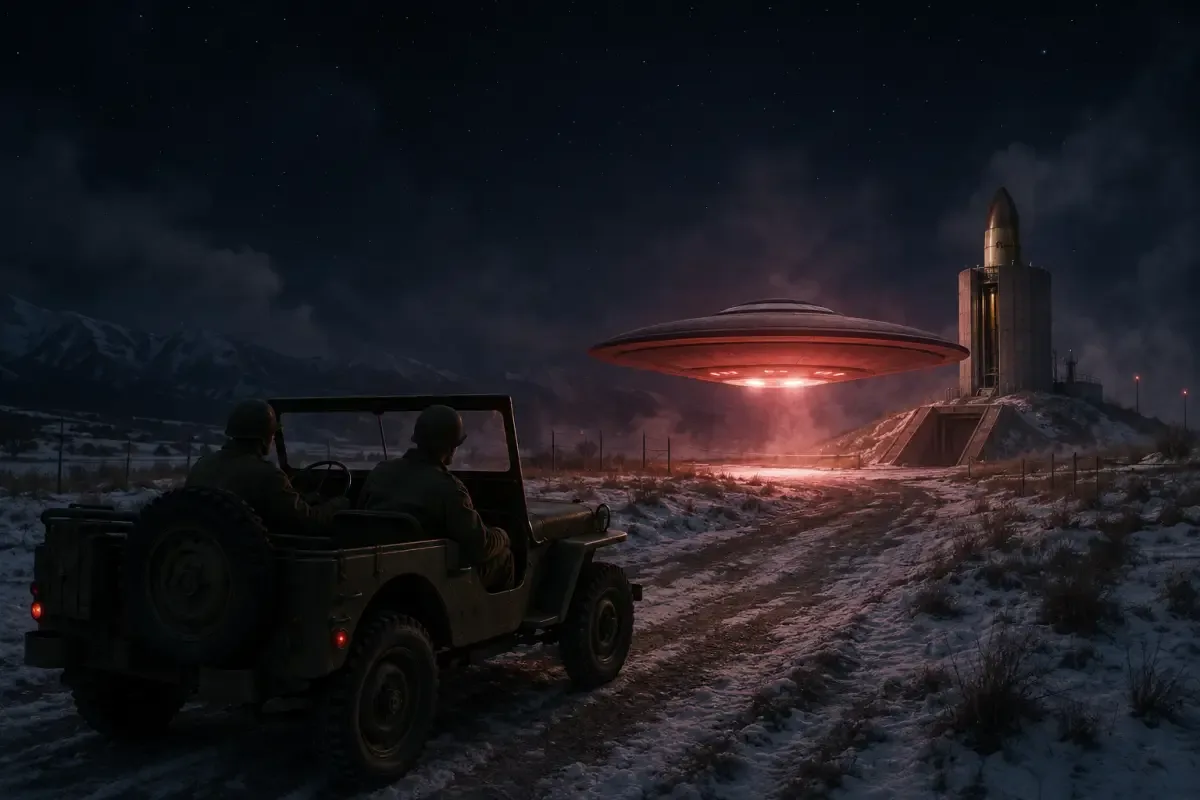
According to retired Colonel Don Crawford, a two-man security team performing a routine check north of Lewistown one night stopped their vehicle abruptly when a large glowing object appeared a few hundred feet ahead, hovering silently over one of the launch facilities.
The airman radioed Crawford, then the officer on duty, describing the sight in a voice shaking with fear.
When Crawford reported the incident to the command post, the duty officer refused to log it, telling him such reports were no longer being recorded.
Crawford gave the guard permission to fire on the object if it showed signs of aggression; the airman replied that he doubted it would do any good. Seconds later, the object moved off without a sound.
Two Timelines, Two Camps
The Air Force's official position for decades held that no reported UFO incident had ever threatened national security, and the declassified history of the 341st Wing appears to support that stance in a single line, stating that rumors of UFOs around Echo Flight had been disproven.
Advocates of the UFO explanation point out that the check described in that history was carried out at a nearby site called November Flight, not at the Echo Flight facilities where witnesses actually reported sightings, a distinction documented in the case's public record and one that proponents consider a critical gap in the official account.
Skeptics dispute Salas's timeline just as firmly.
According to researcher Brian Dunning, wing records show no unusual activity on the night Salas describes, and a UFO report from a town roughly fifty kilometers away only reached local newspapers eight days after the Echo Flight failure, a gap he argues leaves no rational basis for linking the two events.
Writer Robert Sheaffer has gone further, arguing that the object seen that night was most likely the planet Mars.
Even skeptics have stopped short of accusing Salas of dishonesty. Asked on CNN in 2008 whether he believed Salas was lying, psychologist Michael Shermer said no, explaining that people are "not always reliable observers" and that misperceiving an event is not the same as intentionally misrepresenting it.
The Pentagon's New Explanation
In February 2024, the Pentagon's All-domain Anomaly Resolution Office, the same agency later cited in David Grusch's congressional testimony on unidentified phenomena, released the first volume of its historical review of government involvement with the subject, listing the Malmstrom case among unresolved nuclear-adjacent incidents still under examination.
At a briefing on the report, acting Director Tim Phillips said the office had found no verifiable evidence that any UAP sighting represented extraterrestrial activity.
In June 2025, The Wall Street Journal reported that, according to unpublished AARO research and statements from the office's former director, Sean Kirkpatrick, the actual cause of the Echo Flight shutdown was a classified test of the launch facilities' vulnerability to an electromagnetic pulse, an exercise whose existence had stayed hidden from the public for decades.
That account has drawn sharp criticism, and not only from UFO proponents.
Critics argue that an EMP strong enough to disable ten hardened missile systems at once would normally be expected to produce more severe or lasting effects than were observed, and that Echo Flight's missiles being back in operation within a day sits uneasily with that expectation.
Malmstrom is not an isolated case in AARO's review. The office interviewed five former Air Force personnel who served at missile installations in Montana, South Dakota, California, and North Dakota between 1966 and 1977, several of whom independently described similar reports of unidentified objects coinciding with missile outages, a pattern AARO characterized as part of a broader, still-unresolved set of claims rather than a single incident tied to Echo and Oscar Flight alone.
A second volume of the AARO report, expected to contain a more detailed analysis of these cases, had not been publicly released as of this writing.
What's Certain, What Isn't
Carlson, Figel, Salas, and their fellow officers signed nondisclosure agreements shortly after the incidents and stayed silent about them for nearly three decades.
When they finally spoke publicly in the mid-1990s, their goal was less about sensationalism and more about finding an explanation that matched what they had seen firsthand on their control panels and above the silos.
Nearly sixty years later, that explanation still arrives in pieces, and the pieces still contradict each other.
What is not in dispute: ten nuclear missiles in Montana genuinely went dark that March night, a fact confirmed by declassified military records, and months of investigation never turned up a technical fault that fully explained it.
It is also well documented that multiple military and civilian witnesses, independently of one another, reported seeing unidentified glowing objects near the launch facilities that same week.
What stays open is everything else: whether the sightings and the shutdown were connected at all, whether Salas recalled the date correctly, and whether the Pentagon's account of a secret EMP test holds up any better than the string of earlier explanations that failed to account for how quickly the missiles came back online.
Ten missiles in Montana stopped working in 1967. Why remains a matter of who is asked.

SOURCES
- Report on the Historical Record of U.S. Government Involvement with Unidentified Anomalous Phenomena, Volume I — All-domain Anomaly Resolution Office (AARO), U.S. Department of Defense, February 2024.
- Malmstrom AFB Missile/UFO Incident, March 1967 — Robert Salas and Jim Klotz, CUFON.
- Malmstrom UFO incident — Wikipedia (overview of sources and accounts related to the incident).
- Joel Schectman and Aruna Viswanatha, "The Pentagon Disinformation That Fueled America's UFO Mythology," The Wall Street Journal, June 6, 2025 (subscription required; title listed for independent search).
- Great Falls Tribune archives, February 1967 and August 1996 reporting on regional sightings and the Salas account.
Aron Corvin
A researcher of the unknown who loves a good story, but doesn't sell sensationalism. I research every topic in detail before I publish it. If you enjoy what I write, your support would mean a lot and help me keep going.