
Computer or Cemetery? What Stonehenge Really Was
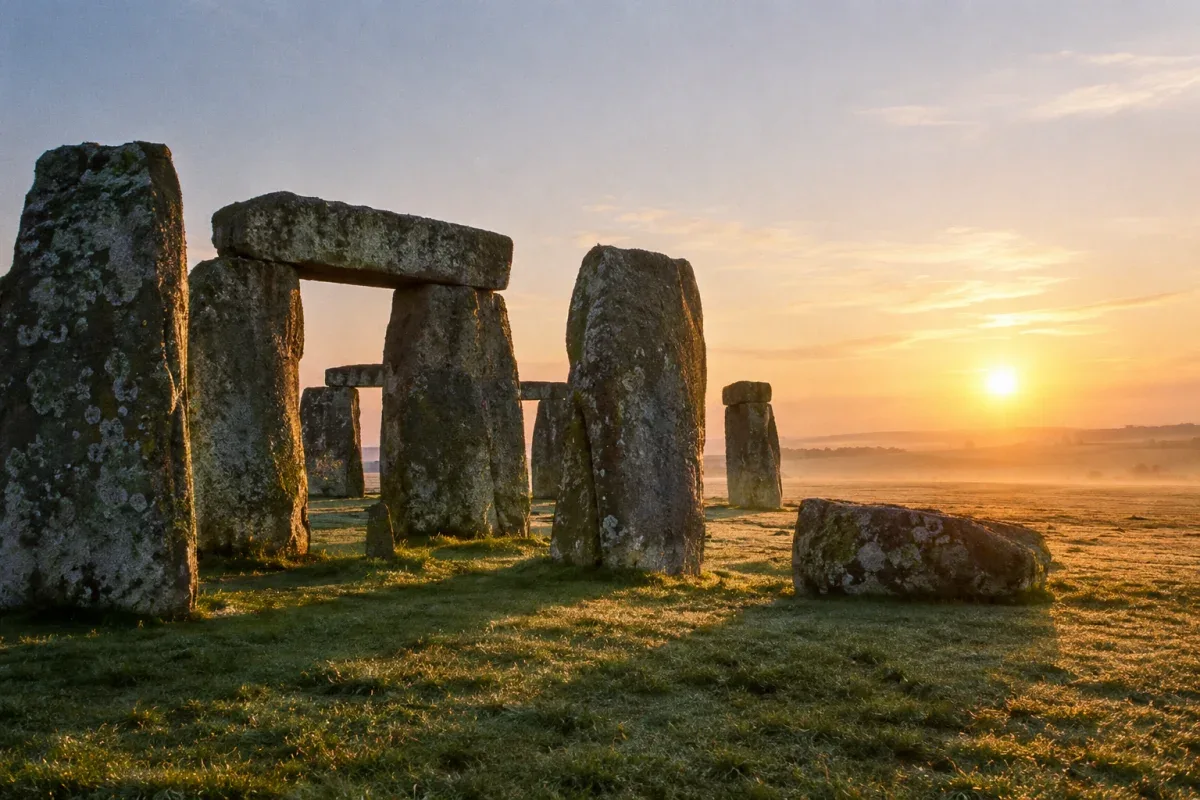
In October 1963, the British science journal Nature published a three-page paper with an unusual title: "Stonehenge Decoded."
Its author was Gerald S. Hawkins, an astronomer at Boston University and a research associate at the Harvard-Smithsonian Observatory in Cambridge, Massachusetts.
For decades, scholars had filed Stonehenge under ritual: a shrine to a sun god, a sacrificial altar, a monumental tomb for the elite dead. Hawkins ignored that consensus.
With the help of an IBM computer, he claimed to have found something altogether different: the site's features lined up with the positions of the sun and moon with mathematical precision, and he believed the key to predicting eclipses was hidden in the number fifty-six.
To Hawkins, Stonehenge wasn't just a sacred site. It was an instrument.
A Computer Reads Prehistoric Stone
Hawkins first visited Stonehenge in 1961 and came away with precise survey maps: the positions of every stone, every excavated pit, every earthwork.
At the Harvard-Smithsonian Observatory, he had access to an IBM 7090 (then the most powerful computer available to the observatory) and used it, together with his team, to calculate the celestial positions for the period when Stonehenge was built.
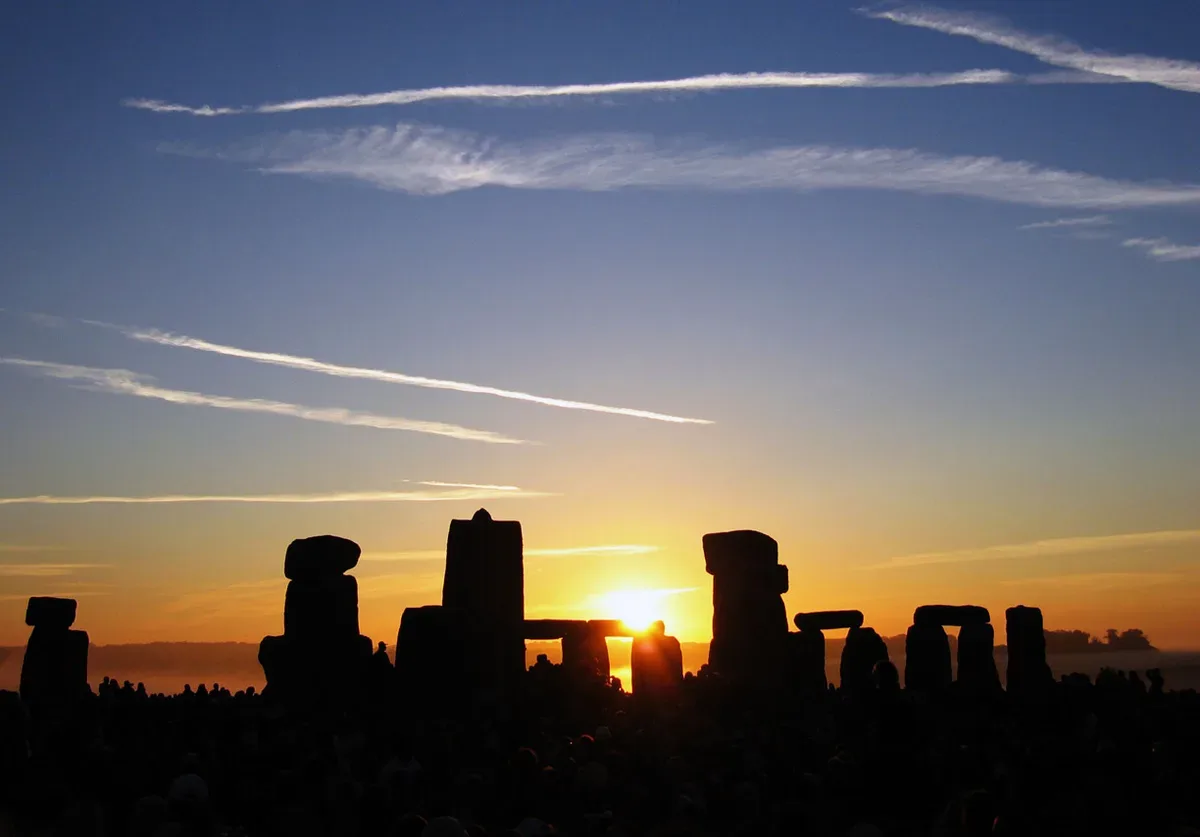
The computer analyzed 120 pairings among 165 identified points at the site and returned a result that surprised even Hawkins: dozens of alignments matched the positions of the summer solstice sunrise, the winter solstice sunset, and key points in the moon's cycle.
His central argument centered on 56 evenly spaced pits around Stonehenge's outer edge, now known as the Aubrey Holes after the antiquarian John Aubrey, who first described them in the 17th century.
They were dug around 3100 BCE, during the first phase of construction, and their purpose was unknown.
Hawkins noticed that the cycle of lunar eclipses repeats every 18.67 years. Three such cycles add up to almost exactly 56.
The conclusion seemed elegant: by moving a marker three positions each year, prehistoric observers on Salisbury Plain would have had a reliable eclipse calendar at their disposal.
"Stonehenge was locked to the Sun and Moon as tightly as the tides," Hawkins told the BBC in the summer of 1966. "It was an astronomical observatory. And a good one, too."
A Bestseller for Readers, "Moonshine on Stonehenge" for Colleagues
The book "Stonehenge Decoded," published in 1965 and co-written with John B. White, became a bestseller on both sides of the Atlantic. The combination of the Neolithic and an IBM computer drew attention far beyond academic circles.
Part of the theory's appeal came from its apparent scientific legitimacy: the original paper had run in the respected pages of Nature, and its conclusion was tidy and persuasive.
Hawkins argued that there was no real question of whether Stonehenge had been a temple or an observatory, since to his mind it had been both, because in that era the sun and moon were gods in their own right.
The scholarly response was fierce. British archaeologist R. J. C. Atkinson, who had led excavations at Stonehenge between 1950 and 1964 and was then regarded as the site's leading expert, published a rebuttal that same year in Antiquity titled "Moonshine on Stonehenge."
Atkinson showed that some of the points Hawkins had used for his sightlines were natural depressions, not deliberately dug features.
A margin of error of up to two degrees, which Hawkins accepted as acceptable, was, in Atkinson's view, wide enough that almost any geometric alignment on flat terrain could be called "precise."
Atkinson calculated that the probability of seeing that many alignments among 165 points was close to 0.5, or roughly 50:50, not the "one in a million" that Hawkins had claimed.
Hawkins defended his work, but he didn't win over the field. The Neolithic-computer theory lived on in popular culture. Among scholars, it steadily lost ground.
1,500 Years of Building, and a Cemetery in the Pits
The definitive answer came decades later, from the ground itself.
The Stonehenge Riverside Project ran from 2003 to 2009, led jointly by researchers from the universities of Sheffield, Manchester, Bournemouth, Southampton, and UCL. Among them was the archaeologist Michael Parker Pearson.
Parker Pearson's team analyzed the cremated remains buried at the site, applied radiocarbon dating, and reconstructed the building phases.
What they found ran directly against the basic premise of Hawkins's theory.
Hawkins had treated Stonehenge as a coherent whole, built for a single purpose.
Radiocarbon dating showed that the complex was actually built over more than 1,500 years, from roughly 3100 to about 1600 BCE, in distinct phases that reflect distinct communities with distinct needs.
The first building phase, the one that produced the Aubrey Holes, was tied to a burial ground: cremated human remains have been found in the holes themselves and in the ground immediately around them, showing that Stonehenge served a funerary purpose from its earliest stage.
Parker Pearson has explained to the BBC that Stonehenge was actually built in a completely different, multi-phase sequence spanning more than 1,500 years.
As he put it, the solstice alignments with the moon were never precise, accurate only to within a degree or two, so the monument was never a timekeeping instrument.
It was a monument that celebrated certain movements of the sun and moon.
Nobody denies that the astronomical connection is real: Stonehenge's solstice alignment is well documented and spatially confirmed. But there's a gap between a solstice orientation and a precise eclipse-prediction mechanism, and nothing in Stonehenge's architecture bridges it.
One comparison illustrates this well.
According to Parker Pearson, there's evidence that people in Britain were tracking and predicting lunar eclipses by around 1000 BCE.
That's somewhere between 1,500 and 2,000 years after Stonehenge, as an active site, had already lost its primary role.
Hawkins was right that Stonehenge had something to do with the sky. Where he went wrong was projecting the defining metaphor of his own era, the computer, back onto the Neolithic.
SOURCES
- Willis, C., Marshall, P., McKinley, J., Pitts, M., Pollard, J., Richards, C., Richards, J., Thomas, J., Waldron, T., Welham, K., and Parker Pearson, M., "The dead of Stonehenge," Antiquity 90, no. 350 (April 2016), pp. 337–356. https://doi.org/10.15184/aqy.2016.26
- Hawkins, G. S., "Stonehenge Decoded," Nature 200, pp. 306–308 (1963). https://doi.org/10.1038/200306a0
- Atkinson, R. J. C., "Moonshine on Stonehenge," Antiquity 40, no. 159 (September 1966), pp. 212–216. https://doi.org/10.1017/S0003598X0003252X
- Hawkins, G. S. and White, J. B., Stonehenge Decoded, Doubleday, Garden City, New York, 1965.
- UCL News, "Rewriting the Story of Stonehenge," March 2013. https://www.ucl.ac.uk/news/2013/mar/rewriting-story-stonehenge
- "Astronomer Who Wrote On Stonehenge Dies," The Harvard Crimson, August 1, 2003. https://www.thecrimson.com/article/2003/8/1/astronomer-who-wrote-on-stonehenge-dies/
Aron Corvin
A researcher of the unknown who loves a good story, but doesn't sell sensationalism. I research every topic in detail before I publish it. If you enjoy what I write, your support would mean a lot and help me keep going.