
The Sea Peoples Fought Three Pharaohs: None Ever Learned Where They Came From
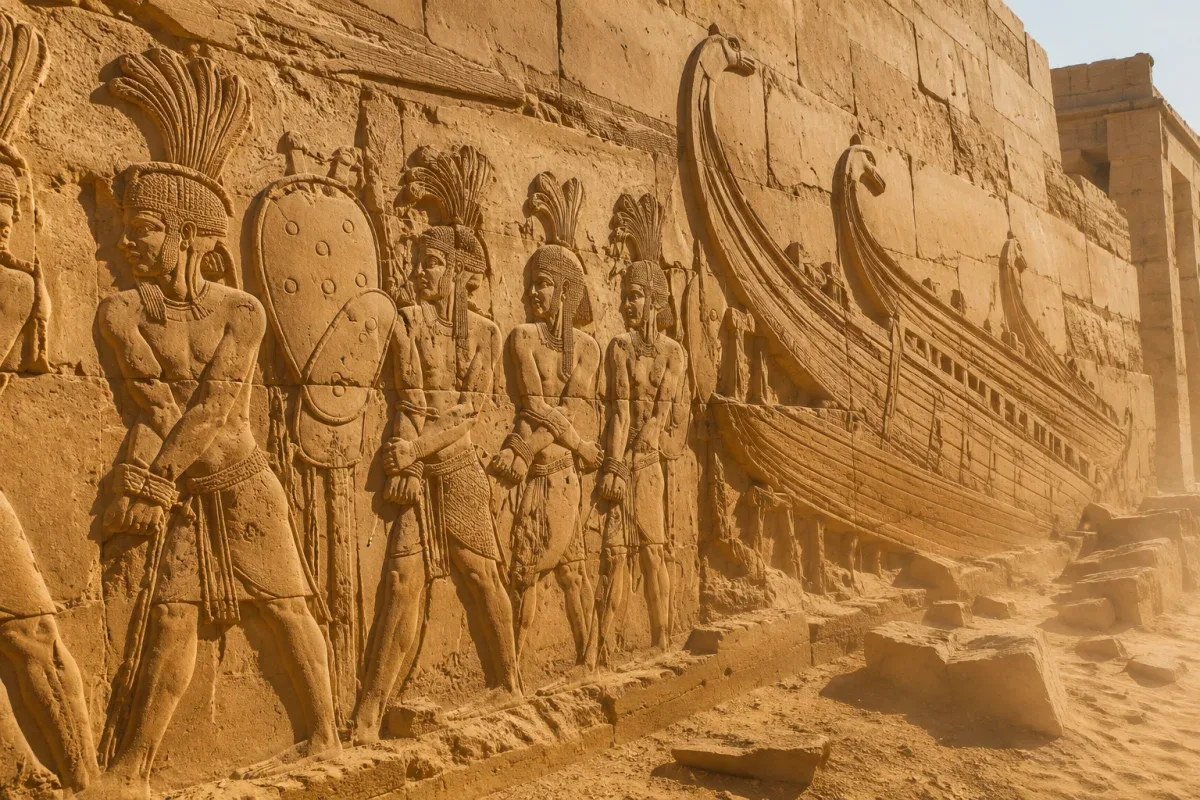
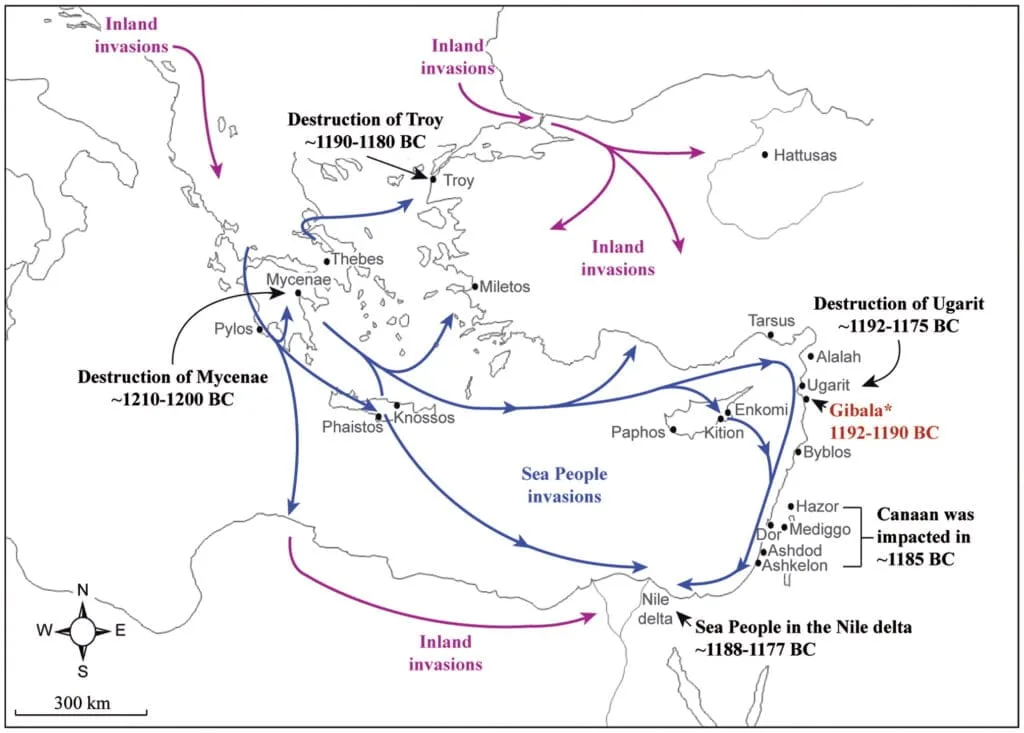
Seven ships did the damage. That's the number Ammurapi, the last king of Ugarit, gave when he begged a neighboring ruler for help, sometime around 1185 BCE.
His port city on the coast of northern Syria was already burning, he wrote, and his own army and fleet were stationed far away in the land of Hatti.
The message never reached its destination. Raiders leveled Ugarit soon after, and no one ever rebuilt it.
That single surviving letter is one of the clearest firsthand accounts of a crisis historians still can't fully explain: a wave of attacks that helped end the Bronze Age in the eastern Mediterranean and left behind a cast of raiders whose own name for themselves has never turned up in any archive.
A Name No One Ever Claimed
Egyptian scribes described the enemy only as people who came "from the sea" or "from the islands," without offering a country, a capital, or a king.
No tablet, seal, or inscription produced by the raiders themselves has ever surfaced to correct the record. Everything known about them comes filtered through the accounts of the people they attacked.
Even the label used today is a modern invention. French Egyptologist Emmanuel de Rougé coined the French phrase for it, peuples de la mer, in 1855 while studying reliefs at the temple of Medinet Habu, and his successor at the Collège de France, Gaston Maspero, popularized the term further around 1881.
For more than three thousand years before that, this group existed in history without any name a modern reader would recognize.
Three Pharaohs, One Recurring Enemy
The earliest firm trace runs through Ramesses II, who ruled Egypt from 1279 to 1213 BCE.
In his second year on the throne, Sherden pirates were raiding cargo ships along Egypt's coast, and Ramesses ambushed and defeated them near the mouth of the Nile.
Rather than execute the survivors, he folded many of them into his own royal bodyguard — men who had plundered Egyptian shores one year and stood watch over the pharaoh's person soon after.
A few years later, at the Battle of Kadesh in 1274 BCE, that same confederation of raiders turned up on both sides of the field. Ramesses' own inscriptions record Sherden mercenaries fighting under the Egyptian banner, while listing Lukka warriors among the Hittite king's allies.
Whatever loyalty these groups held, it clearly wasn't to a single throne.
His son Merneptah inherited the same problem.
In 1209 BCE, a Libyan chief named Meryey allied with groups the Egyptians called Ekwesh, Teresh, Lukka, Sherden, and Shekelesh, and together they invaded the Nile Delta.
The Great Karnak Inscription describes the invaders only as northerners arriving from the sea, with no further detail about their actual homeland.
Egyptian scribes tallied the enemy dead two different ways, by severed hands and by severed genitals, and the resulting count let later historians establish that the Ekwesh were circumcised — a detail that undercut the once-popular theory that they had come straight from Greece.
The third and final showdown fell to Ramesses III.
By his account, the raiders had already helped bring down the Hittite Empire around 1200 BCE before destroying an Egyptian trading post at Kadesh a couple of decades later.
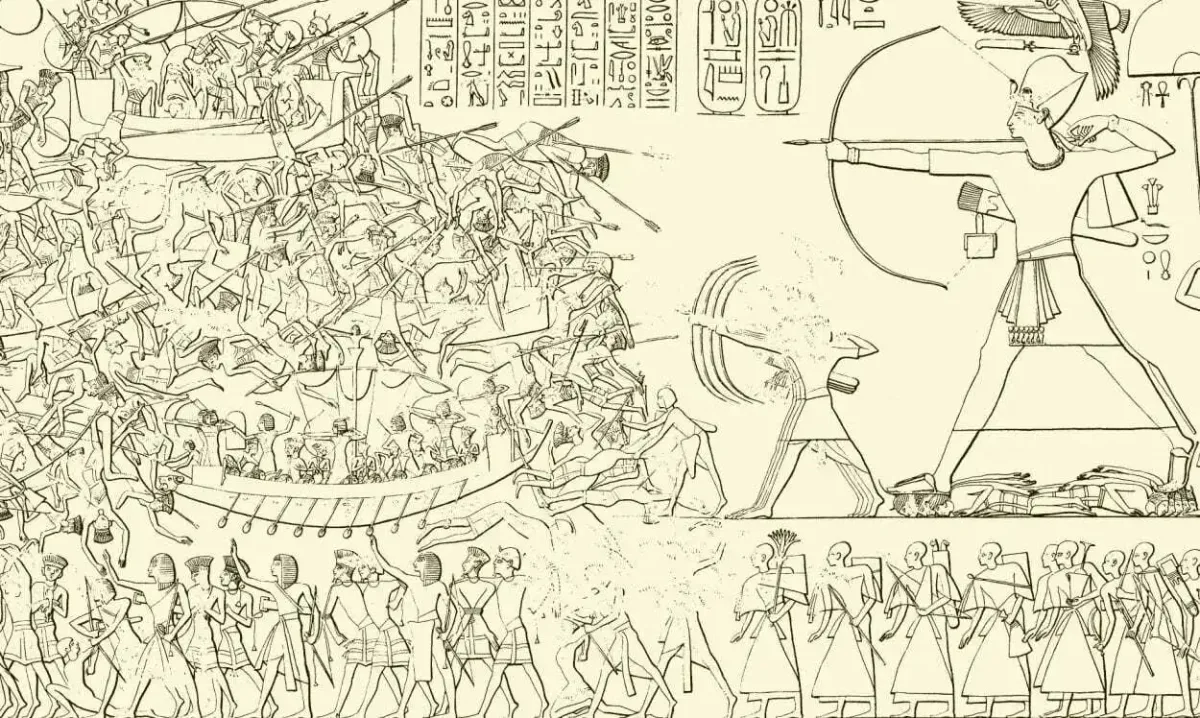
Ramesses met them in two decisive engagements, one on land near Djahy and one at sea by the Nile's mouth, claiming final victory around 1175 BCE.
The reliefs at Medinet Habu show him directing ranks of archers who fired into enemy ships pinned against the shore.
Those same reliefs include a detail rarely seen in Egyptian war art: ox-carts loaded with women, children, and household goods, traveling behind the invading force.
Scholars have pointed to this as evidence that Ramesses III wasn't only facing an army, but a population looking for somewhere new to settle.
The win came at a cost the pharaoh's own monuments preferred not to advertise.
The war left Egypt's treasury thin enough that, within a couple of decades, the tomb-builders of Deir el-Medina went unpaid their grain rations.
Their protest, recorded on papyrus, is now recognized as the earliest documented labor strike in written history.
Names Scholars Still Can't Place
Across the reigns of all three pharaohs, Egyptian records name at least nine distinct groups: Sherden, Shekelesh, Lukka, Teresh, Ekwesh, Peleset, Tjeker, Denyen, and Weshesh.
Sherden appear under all three kings, Lukka and Teresh under two of them, and a handful of names surface exactly once and never again.
What survives is a catalogue of names written down by scribes who never once explained where any of them actually came from.
Guesses about their origins are about as plentiful as the scholars making them.
Shekelesh sounds close to the Sicels of Sicily, Sherden echoes Sardinia, and Lukka is generally tied to the later region of Lycia in Anatolia.
Peleset are widely accepted as the ancestors of the Philistines, whose name eventually gave the surrounding region its own.
Scholars have floated Mycenaeans, Minoans, and Etruscans as candidates for the remaining names, though no archaeological find has settled the question.
Archaeologist Eric Cline, who has spent much of his career on this period, discussed the puzzle at length in a 2019 interview, arguing against pinning the wider collapse on the raiders alone.
He points to drought, earthquakes, broken trade routes, and internal revolts happening at roughly the same time — and notes that inland kingdoms such as Assyria and Elam, which the Sea Peoples never touched, declined during those very same decades.
What the Bones Remember
The most concrete lead in recent years hasn't come from stone, but from bone.
In 2019, geneticists working with the Max Planck Institute for the Science of Human History sequenced DNA from ten skeletons recovered at Ashkelon, a Philistine stronghold on Israel's coast.
Adults buried there during the Bronze Age were genetically indistinguishable from the surrounding Levantine population.
Four infants, buried under house floors just a few generations later at the start of the Iron Age, told a different story.
They carried between roughly a quarter and most of their DNA from southern European ancestors, with the closest genetic ties running to the Aegean, Sardinia, and the Iberian peninsula.
By the tenth and ninth centuries BCE, when the Philistine cemetery at Ashkelon was in use, that signal had already faded past detection, even as the region's distinctive pottery and architecture stayed recognizably Philistine for generations longer.
The Ashkelon result speaks only to the Peleset, one group among as many as nine that Egyptian scribes lumped together.
Whether Sherden, Shekelesh, or Lukka settlements would show a similar genetic pattern is still unknown, since comparable studies of their presumed territories haven't been published yet.
I've gone back to that list of names a few times now — Sherden, Shekelesh, Lukka, Teresh, Peleset — and it reads the same way every time: an alarm raised against an enemy whose geography, it seems, even the Egyptians who fought them three separate times never worked out.
Only one of those names survived its own extinction notice.
Papyrus Harris I, composed in the name of Ramesses III, delivered its verdict on the invaders in fourteen words: "their seed is not, their heart and their soul are finished forever and ever."
For the Peleset, that verdict was wrong — they lived on as the Philistines long enough to outlast the pharaoh who claimed to have erased them.
For Sherden, Shekelesh, Lukka, and Teresh, that same line turned out to be the last thing anyone ever wrote about them.
No source anywhere in the eastern Mediterranean mentions any of the four again, not by name, not by tribe, not in a single battle.
SOURCES
- World History Encyclopedia – "Sea Peoples"
- World History Encyclopedia – "Interview: The Mysterious Bronze Age Collapse with Eric Cline"
- Max Planck Society – "Ancient DNA Sheds Light on the Origins of the Biblical Philistines"
- Michal Feldman et al., "Ancient DNA Sheds Light on the Genetic Origins of Early Iron Age Philistines," Science Advances, 2019.
- Archaeology Magazine – "The Ugarit Archives"
- World History Encyclopedia – "The First Labor Strike in History"
- Colleen Manassa, The Great Karnak Inscription of Merneptah: Grand Strategy in the 13th Century BC, Yale Egyptological Seminar, 2003.
- Jean Nougayrol et al., Ugaritica V (Letter RS 18.147), Mission de Ras Shamra, Paris, 1968.
- Papyrus Harris I, British Museum, London (P. BM EA 9999), c. 1155 BCE.
Aron Corvin
A researcher of the unknown who loves a good story. I won't sell you sensationalism just for a click. If you enjoy what I write, your support would mean a lot and help me keep going.