
The Interdimensional Hypothesis: UFOs From Other Dimensions
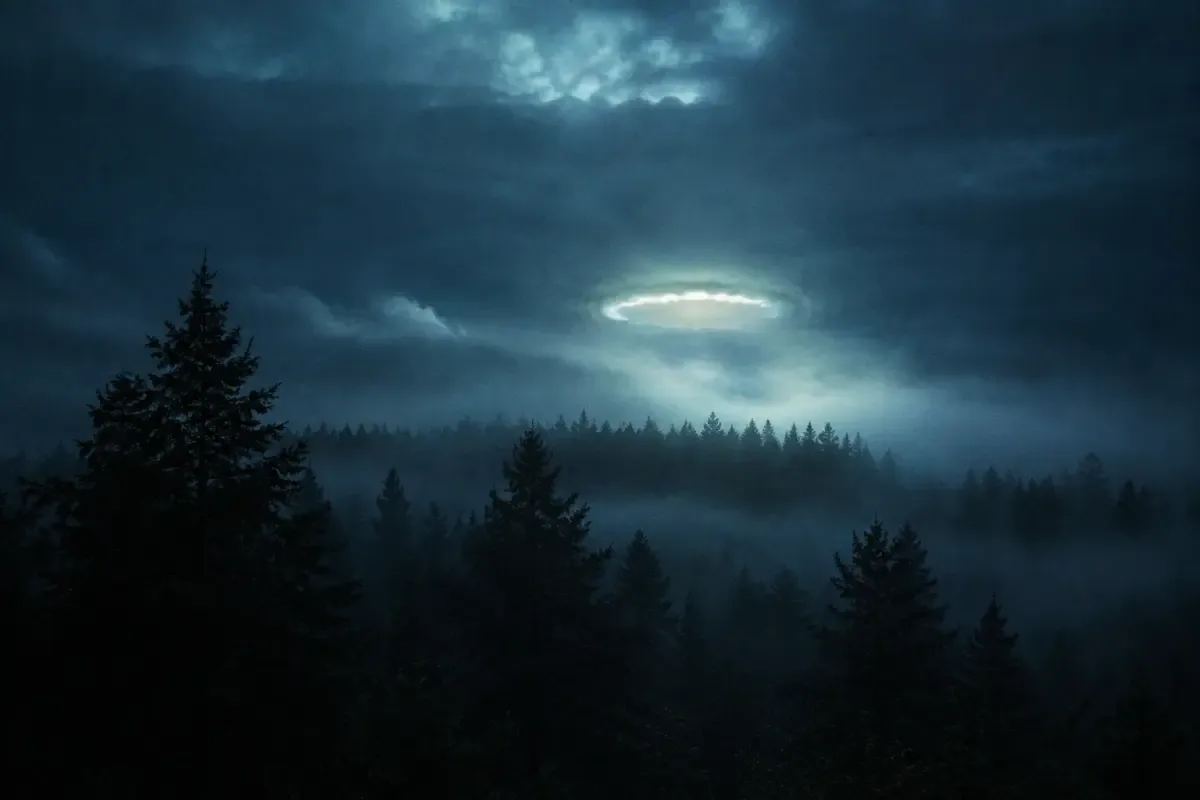
In the summer of 1947, as news spread across America about a man who'd spotted nine bright objects above Mount Rainier, occultist Meade Layne offered his own explanation.
Flying saucers, he insisted, weren't metal spacecraft from outer space at all: they were "etheric" objects arriving from another layer of reality.
Layne claimed to receive messages through a medium from what he called "people in the saucers," and he wrote that such objects "can pass from an etheric to a dense level of matter" before reversing course and returning to an etheric state.
Layne founded and ran an organization called Borderland Sciences, and religious historian Gregory L. Reece, in his academic study of UFO cult culture, points to Layne's etheric take on flying saucers as the earliest form of what would later be called the interdimensional hypothesis, the idea that UFOs don't come from other planets at all but from dimensions that exist alongside our own, invisible until they break through into our space.
Almost eighty years later, that same idea is back, this time dressed in the language of quantum physics rather than spiritualism.
The core claim is nearly identical to the one from 1947: somewhere alongside us are layers of reality the human eye can't register, and UFOs supposedly cross between them at will.
The Physics the Interdimensional Hypothesis Borrows
The interdimensional hypothesis leans on one genuine observation from physics and one piece of speculation that doesn't actually follow from it.
The observation is real: the human brain only processes three spatial dimensions (length, width, and height), and we have no sensory apparatus that could let us directly "see" an extra dimension even if one existed.
The speculation is that these extra dimensions aren't just a mathematical tool but inhabited spaces, stacked on top of each other like sheets of transparent film, and that certain UFOs can cross from one to another, which would explain why some witnesses describe objects that vanish abruptly and reappear somewhere else.
To account for that kind of crossing, the modern version of the theory points to quantum entanglement, the phenomenon in which two particles stay linked so that measuring one instantly affects the state of the other, no matter the distance between them.
Entanglement itself is experimentally confirmed and well documented; what isn't documented is any connection between that phenomenon and the possibility that a macroscopic object, like a spacecraft, could shift between dimensions.
What has actually been proven points the other way: entanglement can't be used to transmit a message.
However instantaneous the correlation between particles may be, no signal travels through it, so it can't explain either a craft's navigation or its disappearance.
On top of that, entanglement is extremely fragile, and macroscopic objects lose it the moment they interact with their surroundings, so a craft can't be treated as an entangled quantum object.
The Hologram That Doesn't Give UFOs Wings
The other scientific idea the theory borrows is the holographic principle.
Physicist Gerard 't Hooft proposed it in 1993, and Leonard Susskind developed it further, starting from a puzzle about black holes: it turned out that the amount of information a black hole contains isn't measured by its volume but by the surface area of its event horizon, as if all the information about a three-dimensional object were actually written onto a two-dimensional boundary.
In 1997, physicist Juan Maldacena turned that idea into a concrete mathematical model, the so-called AdS/CFT correspondence: a certain type of universe with gravity inside it corresponds to a mathematically equivalent description with no gravity on its boundary.
That duality remains one of the most influential ideas in theoretical physics today, but it's still an assumption, not proof.
Here's the important caveat: Maldacena's model describes what's called anti-de Sitter space, a mathematical construct that behaves differently from our actual universe, because our universe is expanding at an accelerating rate, while anti-de Sitter space does not.
Physicists working on the holographic principle openly admit that applying it directly to our actual cosmos remains an unsolved problem, not a proven fact.
The interdimensional hypothesis skips past that caveat and treats the universe-as-hologram idea as a settled conclusion, then goes on to claim that UFOs can "rewrite" the information around them to change the physics of their own flight.
The Interdimensional Hypothesis Predates the Flying Saucer
After Layne, the interdimensional hypothesis was developed further by researchers who approached it with far more rigor than its founder had.
Journalist and researcher John Keel, in his 1970 book "UFOs: Operation Trojan Horse," argued that the UFO phenomenon was the work of something he called ultraterrestrials, an intelligence that supposedly exists "in a wavelength of energy which we cannot detect" and that has taken various forms throughout history, from ghosts to elves.
Astronomer J. Allen Hynek, who spent years as the US Air Force's scientific consultant on UFO investigations, and his colleague Jacques Vallée went a step further in a conversation published in the 1975 book "The Edge of Reality."
Hynek said at the time that our space-time "could be a cross-section through a universe with many more dimensions," reaching for an analogy with TV signals that pass through a room without our seeing them until we turn on a receiver.
In 1990, writing in the Journal of Scientific Exploration, Vallée laid out five arguments against an extraterrestrial origin for UFOs, among them the observation that the number of reported encounters would be disproportionately large for any kind of systematic physical reconnaissance of the planet, and that the humanoid body shape of alleged visitors isn't what you'd expect from a being adapted for space travel.
Neither Keel nor Hynek nor Vallée ever claimed to have proof; they made the opposite point, that the existing data fit a model of "neighboring worlds" better than a model of physical visitors from another planet, though neither model has been confirmed.
More Reports Doesn't Mean More Visits
One question keeps coming back in stories about hidden dimensions: why there have been so many more UFO reports lately.
Data from the All-domain Anomaly Resolution Office (AARO), the Pentagon agency in charge of these cases, points to a far more down-to-earth explanation than an increase in visitors.
AARO's director told the Associated Press that the number of reports has grown significantly since the office was established, but not because there are more UFOs: public-information programs have reduced the stigma of reporting, while the military branches have started applying established reporting procedures more consistently.
AARO's 2022 annual report shows just how easily "unexplained" becomes "explained" once you look closer: of the 366 newly reported cases that year, 163 were balloons, 26 were drones, and six were ordinary debris like birds or plastic bags carried by the wind.
Just 171 cases remained in the unresolved category.
By May 30, 2025, the office had 1,870 reports in its database, according to the annual report published in July 2026, and it continues to expand the sensor network covering its military ranges.
The growth of the database, in other words, tracks the growth in the number of cameras, radars, and sensors capable of registering an anomaly at all, not necessarily a growth in the number of objects in the sky.
Science Stays Cautious, the Fringe Doesn't
Interest in "invisible" or hidden forms of intelligent life hasn't stayed confined to fringe circles, but the difference lies in how far each side is willing to stray from the evidence.
Researchers tied to Harvard's Human Flourishing Program published a 2024 paper examining the so-called cryptoterrestrial hypothesis, the idea that a technologically advanced, unknown population might be living hidden on Earth, underground, underwater, or even disguised among humans.
The paper wasn't peer-reviewed, and its own authors stated up front that they consider the hypothesis "in all likelihood false," though they believe it still merits scientific consideration as one alternative alongside the more familiar theories about the UFO phenomenon's earthly or extraterrestrial origins.
That caveat, an explicit acknowledgment that this is speculation still waiting to withstand scrutiny, is exactly what separates serious engagement with an idea from plain guesswork dressed up as a conclusion.
A similar caution shows up in the physics of entanglement itself.
A study published in early 2026 in the journal Nature Communications, led by scientists from the University of the Witwatersrand in South Africa and Huzhou University in China, showed that the standard method of producing entangled photons in quantum labs contains topological structures that are mathematically described in as many as 48 dimensions.
Those dimensions aren't spatial; they describe the state of light through its orbital angular momentum, a form of encoding information, not a space through which anything could travel or hide.
In the same study, the researchers counted more than 17,000 distinct topological signatures; the study's authors talk about a new "alphabet" for encoding quantum information, not new places where a flying object could take shelter.
Unsolved Cases Aren't Proof of Extra Dimensions
Once you set aside the pieces of the puzzle that are genuinely proven (quantum entanglement, the holographic principle, the documented rise in reported UFO cases), one layer remains that science has so far neither confirmed nor definitively ruled out: the small number of cases AARO still classifies as unexplained, like the 171 from the 2022 report. Those are objects described as having "demonstrated unusual flight characteristics or performance capabilities" with no identified cause, not a balloon, drone, or known technology.
No official source claims that these remaining cases are proof of an interdimensional origin.
They simply stay open, in the same category of uncertainty as the cases Hynek dealt with back in 1975, just recorded now with far more precise sensors than existed half a century ago.
SOURCES
- Meade Layne, Borderland Sciences
- Gregory L. Reece, UFO Religion: Inside Flying Saucer Cults and Culture, I.B. Tauris, 2007.
- Jacques Vallée, Five Arguments Against the Extraterrestrial Origin of Unidentified Flying Objects, Journal of Scientific Exploration, 1990
- Nobel Prize in Physics 2022, popular information
- Michael A. Nielsen, Isaac L. Chuang, Quantum Computation and Quantum Information, Cambridge University Press, 2000 (no-communication theorem for entanglement).
- Holographic principle, plus.maths.org
- What if the universe is a hologram?, ISPR
- Scientists just found a hidden 48-dimensional world in quantum light, ScienceDaily
- Several hundred UFO sightings in 2022, says Pentagon, Interesting Engineering
- Pentagon's new UFO report: 247 new UAPs, Vice
- Pentagon investigating mysterious UAP event reported by the Navy near Virginia's coast, DefenseScoop
- Aliens may be living among us disguised as humans, Harvard researchers claim, FOX
Aron Corvin
A researcher of the unknown who loves a good story. I won't sell you sensationalism just for a click. If you enjoy what I write, your support would mean a lot and help me keep going.