
Alien Interview: Anatomy of a Roswell Myth
The letter arrived without warning. Lawrence Spencer, a writer from Montana who had spent years covering unexplained phenomena, opened the envelope in the spring of 2007 and found something he'd neither ordered nor expected: a stack of military documents from the 1940s.
Duty rosters. Internal memos. Stamps reading "Top Secret." And at the very bottom: transcripts.
Page after page of conversation with someone, or something, for whom no translator existed in any known language.
The envelope had come from an eighty-three-year-old woman with only a few weeks left to live.
Her name was Matilda O'Donnell MacElroy, and for sixty years she had carried a story she was convinced would cost her her life if she ever told it. In the end, she decided silence had cost her more.
What Spencer read that year, and published in 2008 under the title Alien Interview , became one of the most discussed, most puzzling, and most controversial texts in the history of UFO research.
The book didn't just claim to explore what happened at Roswell in 1947. It asked a far bigger, far more unsettling question: what are human beings, and why are we here?
Morning at the Base, July 1947
Matilda MacElroy was a nurse with the Women's Army Air Forces, assigned to the 509th Bomb Group at the Roswell airfield in New Mexico.
July 8, 1947, was no ordinary day. Even though she knew almost nothing yet about what had crashed in the Chaves County desert that night, she sensed something was wrong the moment she set foot on base.
Guards stood in places she'd never seen them stand before. Unfamiliar faces in uniforms and suits moved with an air of urgency and unease.
Two military police officers approached her as she hurried toward the hospital and asked, politely but leaving no room for refusal, that she come with them.
The colonel waiting outside the hangar didn't waste words. They'd found a craft in the desert. And they'd found a survivor.
But the survivor hadn't responded to any attempt at communication: not English, not any other language, not gestures, not pictures, nothing. MacElroy's job was to determine whether it was injured.
She noticed right away that the colonel kept calling the survivor "it," never "he" or "she."
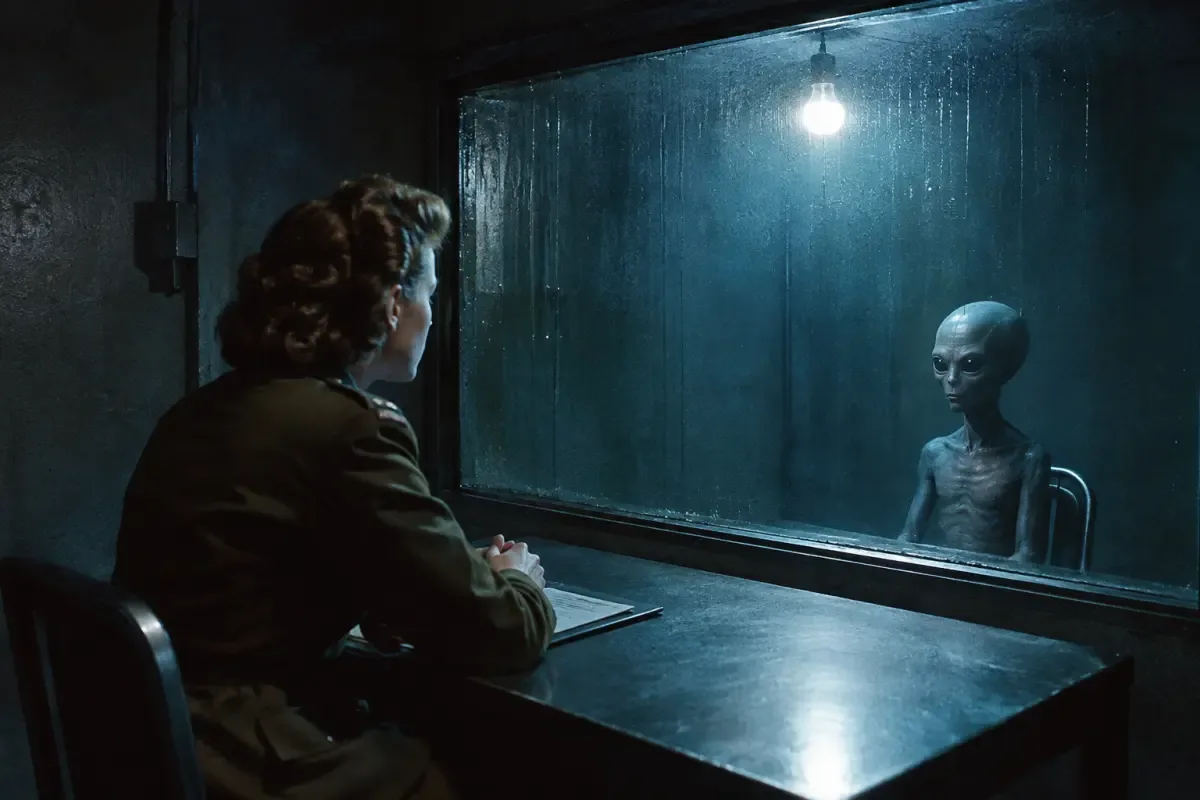
When they stepped into a dimly lit room at the back of the hangar, MacElroy understood why.
The being stood about three feet tall (90 centimeters), with gray skin, an oversized head, and three fingers on each hand.
No mouth. No ears. No visible bodily openings of any kind.
The body looked almost synthetic, with no organs and no reproductive system, more like a shell than a living creature.
It sat quietly on a small chair in the corner, unresponsive to the soldiers surrounding it or the voices swirling around it.
MacElroy walked over. She sat down. She said nothing.
And then a thought echoed in her mind that wasn't her own.
I am not injured. The body I inhabit is not a body like yours. I don't need food or air, but I do need water.
Six Weeks with Airl
The being MacElroy learned to call Airl didn't have an ordinary biography, not the kind you could fit on a military ID card.
Airl was an officer of a civilization known as the Domain, an organization that, by her own account, controlled roughly a quarter of the known physical universe. Not the galaxy, but the universe.
This civilization had existed for trillions of years, and progress was its only goal.
The Domain wasn't alone.
An older power, called the Old Empire, had once ruled this part of space through nuclear weapons, electronic warfare and, in what MacElroy found most extreme, planet-wide mind control.
A war between the two civilizations raged for millennia. The Domain eventually won. But the victory wasn't complete.
The Old Empire had scattered automated systems across thousands of worlds, systems that kept running even without central command, like machines with instructions buried so deep that not even the fall of a government could shut them down.
One of those systems was here. In our own solar system.
Airl had been sent to investigate. Her craft was struck by an electromagnetic discharge, its navigation failed, and it went down in the New Mexico desert.
For six weeks, MacElroy sat with Airl every day. The military recorded everything the nurse said aloud, but the telepathic layer of the conversation, the original direct exchange, stayed invisible to every recording device.
MacElroy shared only what she chose to share. The rest stayed between her consciousness and Airl's.
What she did transcribe filled hundreds of pages.
Prisoners Without Memory
At the core of Airl's account was a claim that upends everything we think we know about ourselves.
Every conscious being in the universe, Airl said, is an IS-BE, an immortal spiritual entity.
An IS-BE exists as pure consciousness. It can move, perceive, and create at any distance, without a physical body.
The body is just a tool, a vehicle taken on for a task and set aside once the mission is done.
Airl herself was proof of this: the being in the gray Roswell shell was only a means of transport for a far older and more complex consciousness.
Human beings, Airl claimed, are IS-BE entities who have traveled the universe for millennia, carrying memories of countless lifetimes. And we'd be free, if we still had those memories. But we don't, because Earth isn't a planet. Earth is a prison.
The Old Empire built a prison system around Earth roughly 8,000 years BCE. Into it went anyone the regime considered dangerous: political dissidents, free thinkers, artists, the disobedient.
They called them the untouchables. Millions were cast off to the edge of the galaxy and forced into fragile, mortal bodies that age, suffer, and die.
But death doesn't set you free. An invisible shield surrounds the solar system, and when an IS-BE leaves its body, the shield detects it.
The spirit is captured and taken to a processing station, where its memories are wiped, not just from its most recent life but from every life before that. Millennia of experience, everything it ever learned, every trace of identity: erased.
Then comes a second program.
The system projects straight into the spirit's consciousness: a tunnel of light, deceased loved ones waiting on the other side, guides and angels.
That's exactly why, Airl says, near-death experiences look the same across every culture and every era.
They aren't real. They're programmed: props inserted so the spirit walks willingly back into recycling.
Finally, new memories are implanted: creation myths, moral codes built to produce guilt and obedience.
And the spirit returns, into the body of a newborn. No memories. No identity. No knowledge of who it really is.
Die. Forget. Return. A million times over.
The Men from the Himalayas
MacElroy listened to all of this with a strange mix of shock and something she almost recognized as memory. Airl noticed.
Eight thousand years ago, once the Domain had defeated the Old Empire, it sent a specialized battalion of 3,000 officers and engineers to Earth with a single mission: shut down the prison system.
They set up a base high in the Himalayas, out of reach and out of sight. They mapped the solar system, located the processing stations, and identified every surviving piece of Old Empire technology.
They had a plan. Then they were detected.
The automated defenses didn't recognize the Domain officers as allies; they read them as escaped prisoners.
All 3,000 were captured, processed, and put back into circulation: placed in human bodies within the general population and scattered across history.
The Domain called them the Lost Battalion.
Airl told MacElroy something that shook her to the core: she herself had been one of those officers.
Her talent for telepathy hadn't been some random gift; it was a trained skill breaking through the amnesia.
Her instinct to approach Airl with compassion, her sense of recognizing something familiar in the gray being in the hangar: all of it, Airl said, was an echo of a previous life MacElroy could now barely remember.
On August 12, 1947, the military cut off the interviews. They wanted Airl without MacElroy, without telepathy, on their own terms. Airl refused to cooperate.
The military turned to electroshock. They attached electrodes to her head and started with a low current, then increased it.
Electroshock, the same tool the Old Empire had used to erase memory.
Airl didn't fight it. She didn't even react. She looked at MacElroy through the glass partition one last time, and then she was gone.
Not her body: just her. What was left sitting on the table was nothing but an empty plastic shell.
MacElroy was forced to sign a document swearing absolute silence, under threat of execution for treason. And she kept silent. For sixty years.
Cracks in the Story
Alien Interview came out in 2008 and quickly spread through a community that embraced it with an intensity far beyond how most people read a typical UFO book.
Reviews said the book wasn't simply read; it was remembered. Readers said it stirred something deep inside them.
Some even called it "the most important book ever written."
But researchers started digging. And they quickly hit the first cracks.
The transcripts, dated to 1947, used words like computer and database, terms that weren't in common military or civilian use until the 1960s.
The dates in the documents followed the European format (day/month/year), while the U.S. military strictly uses the reverse order.
Trivial mistakes, maybe. Spencer himself noted he'd edited the material for clarity.
But then a reader found something far more concrete in chapter eleven.
In an interview dated July 9, 1947, Airl cites Jonas Salk as an example of human genius.
The problem: in 1947, Salk was a relatively unknown medical researcher. He didn't become famous until 1955, when he developed the polio vaccine.
The man simply wasn't well known at the moment Airl was supposedly talking about him.
These anomalies led Bill Ryan, a researcher and co-founder of Project Avalon, to give the text a longer, more systematic read.
The more he read, the more familiar the mythology became, but not from the context of alien-contact accounts. From something else entirely.
Beings of pure consciousness who use physical bodies as vehicles. Implant stations between lives. A galactic war between rival civilizations. A prison planet. Religion as a tool of alien control. Amnesia imposed on souls in an endless recycling process. A "space opera" cosmic framework for making sense of human suffering.
This wasn't the mythology of Roswell. It was the mythology of Scientology.
Thirty-One Years in the Making
L. Ron Hubbard, the founder of Scientology, was a science-fiction writer who published Dianetics in 1950 and went on to build a sprawling religious-philosophical system that culminated in what his followers call the "Operating Thetan" materials, secret doctrines available only to the most advanced tier of believers.
In those materials, Hubbard laid out a mythology of cosmic conflict: souls (thetans) trapped in physical bodies, galactic tyrants who, millions of years ago, carried out mass deportations of souls and mass memory-wiping.
Bodies are tools, not homes. Physical life is a trap. Memory is the key to freedom.
Same system. Same mechanisms. Same categories.
When researchers found an email Spencer sent to writer Graham Hancock in 2000, the circle closed.
In it, Spencer stated plainly that he'd been a Scientologist for three decades, thirty-one years, and that his first book, The Oz Factors, had applied Hubbard's principles through the lens of the Wizard of Oz.
The very book that started it all. The same book that, according to the story, Matilda MacElroy had read, and the reason she supposedly chose Spencer as the one man she could trust.
When researchers stepped back and looked at the whole picture, it became clear: Spencer had built the entire mythology of Alien Interview by drawing directly on Hubbard's body of work, in some places almost word for word, in others transformed just enough to pass as original.
Then he wrapped that mythology in the trappings of Roswell: one of the most thoroughly documented and investigated incidents in UFO history, complete with real witnesses, real military personnel, and real contradictions between official accounts.
Spencer then destroyed all the original documents he claimed to have received from MacElroy. The witness was dead. The physical evidence was gone.
"I have burned all of the original documents," Spencer wrote, adding that he had no wish to spend the rest of his life hounded by UFO researchers and government agents.
That, skeptics concluded, is a classic strategy: construct a legend that can't be verified or disproven, because the only evidence has been destroyed.
Why We Want to Be Prisoners
The story behind Alien Interview is, as far as the evidence shows, a literary fabrication.
There's no military record of Matilda MacElroy; the military has no file on her. The book is riddled with anachronisms and direct borrowings from Hubbard's cosmology. Spencer spent thirty-one years living inside a philosophy that shaped his entire view of the universe, then dressed that philosophy up as documentary testimony.
But that's not where the story ends. That's where it really opens up.
Because the millions of people who read this book aren't stupid. They're not gullible people incapable of critical thought.
Many of them knew about the inconsistencies in the text and kept reading anyway.
And many of them described the experience the same way: it didn't feel like discovering something new; it felt like remembering something they already knew.
There's something about the prison-planet story that resonates on a frequency few abstract ideas can match. The idea that your suffering has a cause. That your limitations aren't your fault. That you're more than a random biological accident clinging to an insignificant rock at the edge of the galaxy. That your struggles (illness, loss, the feeling of not belonging anywhere, the sheer exhaustion of simply being alive) were imposed on you from the outside. That someone did this to you. And that there's a way out.
A man who lost his wife to cancer reads this book and thinks: maybe she isn't really gone. Maybe she's trapped somewhere in the recycling system, waiting to wake up.
A teenager who has never once felt like they belonged sees in the Lost Battalion theory a kind of confirmation: that they're different for a reason, that they're stranded here, that somewhere out there is the place they actually belong.
That isn't naivety. That's hope, dressed in a cosmic narrative.
Spencer, whether he meant to or not, tapped into something religion, philosophy, and therapy have all tried to do for centuries: offer a framework in which suffering makes sense. Where the exhausting paradoxes of existence (why the innocent suffer, why the capable fail, why effort and good intentions guarantee nothing) get an answer that isn't just "it is what it is." Where the answer instead is: you weren't made for this. This was done to you. And you can be free of it.
A myth is powerful not because it's true. It's powerful because it gives us language for what we already feel.
A Final Word
Roswell in 1947 was a real incident. Something crashed, and the military changed its story more than once. Witnesses, military officers, supply officers, morticians, and medical technicians, gave accounts late in life with a consistency that goes beyond coincidence.
(One declassified telegram from July 8, 1947 is available in the FBI's files.)
Neither Spencer nor Hubbard invented those contradictions or those testimonies, and it's only today that senior U.S. officials are starting to speak openly about decades of cover-up.
What Spencer did was take that reality and weave something else entirely around it.
He used a genuine mystery as the foundation for his own fiction, and in the process blurred the line between the two.
That, in the end, is what remains. Not whether Matilda MacElroy was a real person. Not whether Airl really sat in some hangar in New Mexico.
But this: how easily, and how eagerly, we embrace stories that tell us our pain isn't random.
That our sense of alienation is justified. That we're trapped, but that there's a key.
What this story actually tells us has nothing to do with aliens. It tells us about ourselves.
SOURCES
-
Spencer, Lawrence R. Alien Interview. Createspace Independent Publishing Platform, 2008. ISBN: 978-1-4421-1011-0. — Free to read on the Internet Archive.
-
Randle, Kevin D. & Schmitt, Donald R. UFO Crash at Roswell. Avon Books, 1991. — A foundational study of the Roswell incident, drawing on firsthand military and civilian testimony.
-
Ruppelt, Edward J. The Report on Unidentified Flying Objects. Doubleday, 1956. — A report by the former head of Project Blue Book, documenting early military analysis of UFO incidents.
-
Hubbard, L. Ron. Dianetics: The Modern Science of Mental Health. Bridge Publications, 1950. — The foundational text of Scientology; essential background for understanding the parallel doctrinal structures in Alien Interview. — Britannica: L. Ron Hubbard.
-
Miller, Russell. Bare-Faced Messiah: The True Story of L. Ron Hubbard. Henry Holt & Co., 1987. — A Hubbard biography that covers the development of Scientology and its cosmological doctrines in detail.
-
Ryan, Bill. "Alien Interview Analysis." Project Avalon (projectavalon.net), 2008–2009. — An independent line-by-line analysis of the text, the first to document its parallels with Hubbard's material in detail.
-
U.S. Air Force. The Roswell Report: Fact vs. Fiction in the New Mexico Desert. U.S. Government Printing Office, 1994. — The official government study of the Roswell incident.
-
U.S. Air Force. The Roswell Report: Case Closed. U.S. Government Printing Office, 1997. — A follow-up study introducing the "crash test dummies" theory.
-
Pflock, Karl T. Roswell: Inconvenient Facts and the Will to Believe. Prometheus Books, 2001. — A critical analysis of Roswell mythology, distinguishing documented testimony from later embellishments.
-
FBI Vault. Roswell UFO — A collection of declassified documents, including a telegram from July 8, 1947.
Aron Corvin
A researcher of the unknown who loves a good story, but doesn't sell sensationalism. I research every topic in detail before I publish it. If you enjoy what I write, your support would mean a lot and help me keep going.