
If the Universe Is Infinite, Physics Allows for Something Unsettling: Your Doppelganger
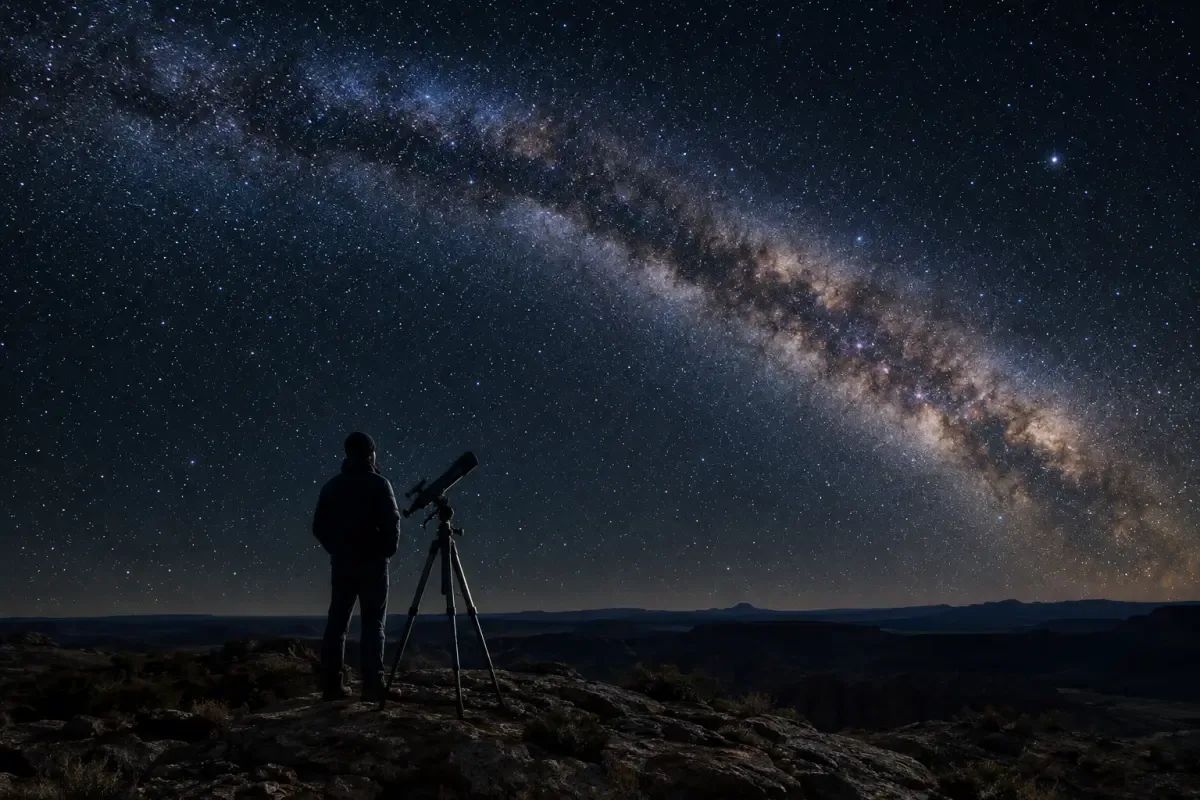
Somewhere out there, if space really is infinite, an identical copy of you exists.
It's a possibility that mathematics allows, and the whole story traces back to the Planck satellite's 2018 results, when a curious pattern turned up in part of the data: space might not be perfectly flat after all.
Specifically, measurements of temperature fluctuations that excluded gravitational lensing showed a slight but persistent curvature, as if space were curving back in on itself.
Planck's official headline conclusion that same year still favored a flat universe, but this particular signal was persistent enough to become a debate all its own.
Combine the Planck data with independent measurements of baryon acoustic oscillations (BAO), which break the geometric degeneracy built into the cosmic microwave background (CMB) signal itself, and the preference for a closed geometry disappears, leaving a result consistent with a flat universe.
That discrepancy isn't a math error.
It's a symptom of something deeper: a dispute that's still going strong eight years later, one that has only grown stranger since 2018.
A Dispute That Refuses to Settle
In 2019, Eleonora Di Valentino, Alessandro Melchiorri, and Joseph Silk showed in the journal Nature Astronomy that the curvature measured from Planck data alone naturally explains another long-known anomaly in the same dataset: an excess of gravitational lensing in the radiation spectrum.
Their conclusion wasn't that the universe is definitely closed, but that the standard flat-universe assumption might be masking a more serious inconsistency in the cosmological model as a whole.
Part of that story has since cooled off, though.
In 2024, Matthieu Tristram and his collaborators published a completely reworked analysis of the same Planck measurements, based on the latest generation of maps (PR4) and an improved model of radiation from our own galaxy.
The result, ΩK = -0.012 ± 0.010, deviates from a perfectly flat universe by just 1.2 standard deviations, a value the authors themselves describe as consistent with flatness.
A direct comparison with the original 2018 Plik analysis isn't straightforward, since it involves a different approach to processing the same underlying measurements.
But the difference suggests that at least part of Planck's 2018 "closed universe" signal may have come from the specific data-processing method, rather than being an inherent property of space itself.
But just as the dispute seemed to be dying down, independent measurements entered the picture and reignited it, this time from the opposite direction.
The DESI collaboration, which measures baryon acoustic oscillations in the distribution of galaxies, reported in 2024 that combining its data with CMB measurements gives ΩK = +0.0024 ± 0.0016, technically nonzero but within the range treated as flat in practice.
A second round of DESI data (DR2), released in 2025, sharpened the tension between the DESI and CMB measurements even further, though the result still depends on which combination of data and cosmological model you use.
Under the standard convention, where a positive value corresponds to an open geometry and a negative one to a closed geometry, some of these combinations now lean slightly toward an open universe rather than a closed one.
Still, the statistical and model uncertainty is too large to call this a discovery of a curved universe.
In 2025, Deng Wang and collaborators showed in a paper posted on arXiv that this same lean toward an open universe exceeds three standard deviations when DESI data is combined with measurements of distant supernovae, and reaches as high as five in some data combinations.
Their conclusion isn't that the universe is definitely open, but that there's added tension between what early-universe measurements show and what independent low-redshift measurements show, tension that, if confirmed, would call the standard models of cosmic inflation into question.
In other words, physicists still don't agree in 2026; they've simply ended up on the opposite side of the argument from where they stood in 2018.
Three Possible Shapes, If the Dispute Is Ever Settled
If curvature turns out to be real, in either direction, the universe would be closed but edgeless, something like a three-dimensional version of a ball's surface.
An ant walking along the peel of an orange only sees a small patch of that peel, but if it kept walking in a straight line, it would eventually return to its starting point without ever hitting an edge.
There's also an asymmetric version of the same idea: a donut-like shape, where space isn't the same in every direction.
Light from distant galaxies would then reach us along paths of different lengths, and in theory we could see the very same star being born on one side of the sky and dying on the other.
If, on the other hand, space is flat and infinite (as most, though not all, current measurements suggest), there's nothing "outside" it, because beyond everything, by definition, there's nothing at all.
How Would We Even Know?
For any of the closed geometries to be possible, it would have to leave no trace we haven't already noticed.
In 2004, Neil Cornish and his collaborators launched a search called the "circles-in-the-sky" method: they looked for matching pairs of equal-temperature circles in the cosmic microwave background, the kind of trace that would appear if light from the same source, after looping all the way around a closed universe, met itself again.
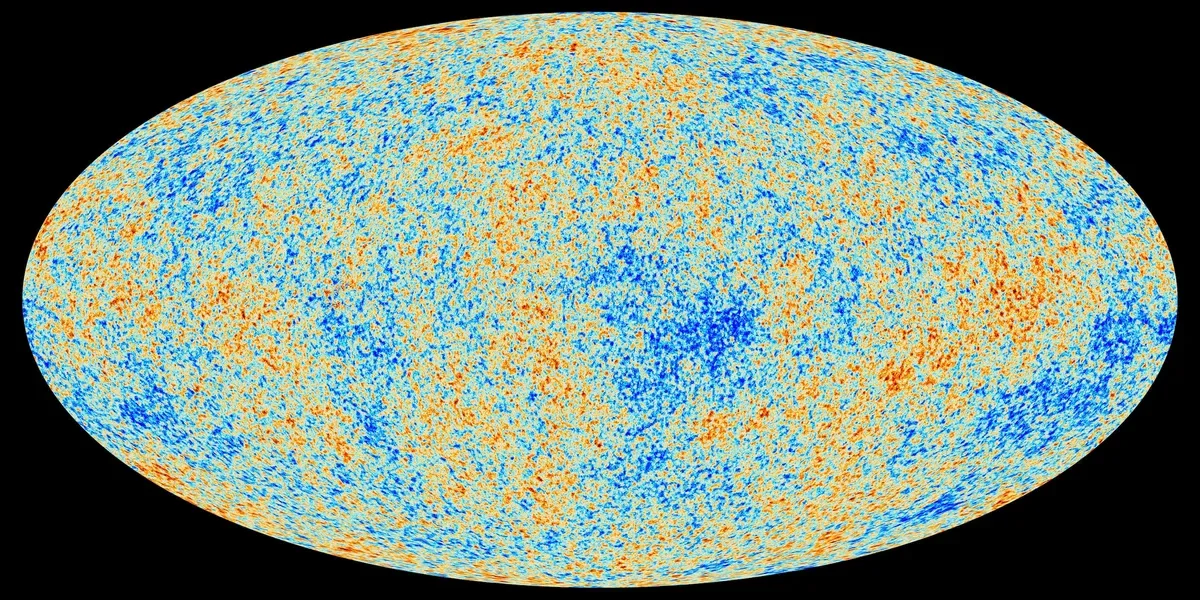
Neither that search nor later ones ever found such circles.
The absence of a signal doesn't prove the universe is infinite, but it does set a lower limit on the size of any closed geometry: if the universe is closed, it has to be larger than roughly 24 gigaparsecs (about 78 billion light-years), nearly twice the size of the entire observable universe.
Even what we can see hasn't been fully counted.
In 2016, Christopher Conselice and colleagues at the University of Nottingham used deep Hubble Space Telescope images and mathematical models of galaxy mass distribution to estimate that the observable universe contains about two trillion galaxies, ten times more than earlier estimates.
Five years later, Tod Lauer and colleagues used measurements from the New Horizons probe (by then far beyond Pluto and clear of the zodiacal light that blurs observations from Earth) to measure the total amount of light in the darkest patches of the sky.
The light they measured was roughly twice the integrated light from galaxies in existing catalogs.
That alone doesn't confirm the two-trillion-galaxy figure, or rule it out either: the result just shows that part of the optical background still isn't fully explained by the galaxies we already know about.
An Infinity That Still Has a Beginning
If a flat, infinite universe turns out to be correct, it raises what looks like a logical problem: how can something that's always been infinite have a beginning at all, and how can space that's already everywhere expand and become bigger?
The Big Bang wasn't an explosion from a single point into space that already existed.
It was a moment when all of space, including the infinite part we can't see, was immeasurably denser than it is today.
Expansion doesn't mean new space is appearing at some outer edge.
It means the distance between any two points in that space, whether finite or infinite, grows over time.
Infinite space, then, can have a starting point in time and can keep expanding, all while never having been any less infinite than it is today.
What Infinity Would Mean for You, Personally
If space really is infinite and the laws of physics are the same everywhere, one more consequence follows, though it is far more speculative: not a proven fact but a mathematical implication of a few specific assumptions.
In 2003, physicist Max Tegmark pointed out, in a paper published in a volume honoring John Wheeler, that quantum physics allows only a finite number of possible particle arrangements within any region of space the size of the observable universe, even assuming that region is as hot as physically possible.
Accept both assumptions: that space is literally infinite and that the number of possible combinations really is finite, and by his calculation, any given particle arrangement would statistically have to repeat itself somewhere else out in space.
Not because some pattern recurs at regular intervals, but simply because the odds that no combination ever repeats, given infinite tries, fall to zero.
Tegmark's estimate, derived purely from counting possible quantum states rather than from any actual observation, holds that under these assumptions, the nearest identical copy of Earth, including an identical copy of every single reader of this article, should be roughly 101029 meters away: a number written as a 1 followed by a hundred octillion zeros.
That doesn't mean such a copy actually exists.
It means that, if the underlying assumptions are correct, its non-existence would be statistically stranger than its existence.
Until Then, the Dispute Stays Open
The scale of that distance is so absurd that the entire observable universe, with every one of its galaxies, could repeat an unimaginable number of times before you'd reach such a copy.
But all of it hinges on one unresolved question.
The next generation of instruments for measuring the cosmic microwave background, among them LiteBIRD and the Simons Observatory, should, over the coming decade, narrow the curvature measurement enough to finally settle the dispute Planck started, one that DESI and the latest supernova measurements have redirected rather than resolved.
Until then, the equations remain conditional. They still allow for a doppelganger of you, somewhere past a number too large to imagine, in a space we don't even know has an end.
SOURCES
- Di Valentino, E., Melchiorri, A., and Silk, J. (2020). "Planck evidence for a closed Universe and a possible crisis for cosmology." Nature Astronomy, 4, 196-203.
- Tristram, M., et al. (2024). "Cosmological parameters derived from the final (PR4) Planck data release." Astronomy & Astrophysics, 682, A37.
- DESI Collaboration (2024). "DESI 2024 VI: Cosmological Constraints from the Measurements of Baryon Acoustic Oscillations."
- DESI Collaboration, Abdul-Karim, M., et al. (2025). "DESI DR2 Results II: Measurements of Baryon Acoustic Oscillations and Cosmological Constraints."
- Wang, D., Mena, O., Capozziello, S., and Mota, D. (2025). "Do low-redshift observations open the doors to an open universe?"
- Cornish, N. J., Spergel, D. N., Starkman, G. D., and Komatsu, E. (2004). "Constraining the Topology of the Universe." Physical Review Letters, 92, 201302.
- Tegmark, M. (2003). "Parallel Universes." Scientific American / Science and Ultimate Reality, Cambridge University Press.
- Conselice, C. J., Wilkinson, A., Duncan, K., and Mortlock, A. (2016). "The Evolution of Galaxy Number Density at z < 8 and its Implications." The Astrophysical Journal, 830(2), 83.
- Lauer, T. R., et al. (2021). "New Horizons Observations of the Cosmic Optical Background." The Astrophysical Journal, 906(2), 77.
Aron Corvin
A researcher of the unknown who loves a good story, but doesn't sell sensationalism. I research every topic in detail before I publish it. If you enjoy what I write, your support would mean a lot and help me keep going.