
Quantum Immortality: The Theory That Promises Eternal Life
Hugh Everett III died in his sleep of a heart attack at his home in McLean, Virginia, on July 19, 1982. He was 51.
His son Mark, then a nineteen-year-old musician who would later front the band Eels, found his body that morning.
Twenty-five years earlier, as a graduate student at Princeton, Everett had proposed an interpretation of quantum mechanics that, according to people who knew him, he privately believed meant he would never truly cease to exist.
With reality branching at every moment, his consciousness would simply continue along whichever path did not lead to death.
That belief is known today as quantum immortality, and it grew out of one of the most contested ideas in twentieth-century physics.
Quantum Mechanics: A Theory That Defies Common Sense
Quantum mechanics, the theory that describes how particles behave at the smallest scales, has long been well known for defying common sense.
Fire an electron through two closely spaced slits, and it doesn't pass through one or the other.
It goes through both at once, leaving behind a pattern on the screen characteristic of waves reinforcing and canceling each other out.
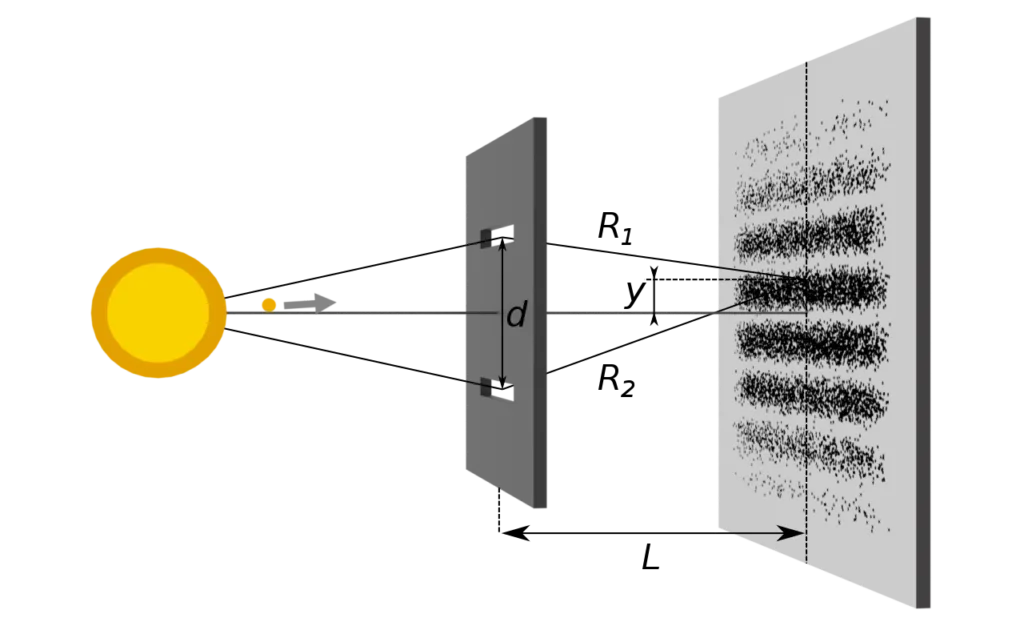
Physicists call this condition superposition, and its mathematical description is given by the so-called wave function, first written down a century ago by Erwin Schrödinger.
The trouble starts at the moment of measurement.
As long as no one is observing it, a particle remains in superposition, holding all of its possible states at once.
In the traditional textbook account associated with the Copenhagen interpretation, a measurement is described as instantly producing a single outcome from among the available possibilities, with odds set by what's known as the Born rule.
That probability has been confirmed experimentally to an extremely high degree of precision, even though no one has ever managed to explain the mechanism behind the collapse itself.
Most physicists today agree that this measurement doesn't require a conscious observer; interaction with the surrounding environment, even a single stray photon, is enough.
But that only pushes the problem back a step, because, strictly speaking, that photon should enter the same superposition too.
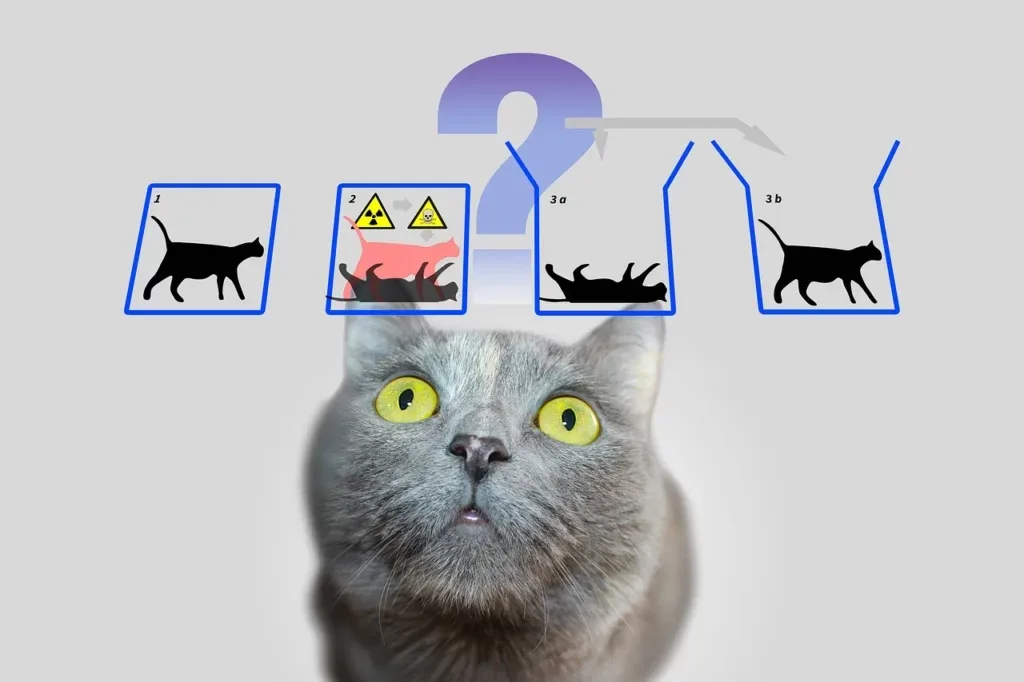
The famous thought experiment involving Schrödinger's cat, sealed in a box with a device that may or may not kill it depending on the outcome of a quantum measurement, captures exactly that tension: before the box is opened, the cat is, strictly speaking, both alive and dead at once.
A World That Never Stops
Everett proposed a fundamentally different solution: in his view, the wave function never collapses at all.
Instead, every possible outcome of a measurement actually happens, each in its own branch of reality that from that moment on has no further effect on any of the others.
The box, the cat, the observer, and the rest of the universe are all part of one single, vast wave function.
What we experience as nature "choosing" an outcome is really just branching, with each version of the observer ending up in a branch of their own, convinced that theirs is the only real one.
Physicist Bryce DeWitt, who edited the journal that published Everett's dissertation, initially objected that the world obviously doesn't branch, since no one had ever experienced anything of the kind.
According to an essay published in Aeon, Everett answered with a question of his own: "I can't resist asking, do you feel the Earth moving?"
DeWitt admitted the argument hit home.
Over the following decade he became one of the theory's most outspoken champions, and he's also the one who gave it the name it still carries today: the many-worlds interpretation.
For decades, the idea remained on the margins of physics.
Discouraged by the cold reception, Everett left academia immediately after earning his doctorate and took a job as a military analyst, working on classified Cold War projects.
Only in the last two decades or so has the many-worlds interpretation gained serious traction among physicists such as Sean Carroll, David Deutsch, and Max Tegmark, largely thanks to the concept of decoherence: the explanation for how complex interactions with the environment quickly separate branches from one another, until no measurable interference remains between them.
How much traction is hard to pin down precisely, but two informal head counts give a sense of the shift.
In 1997, physicist Max Tegmark asked 48 physicists, philosophers, and mathematicians at a quantum-foundations workshop at the University of Maryland, Baltimore County, to name their preferred interpretation; Copenhagen came out on top with 13 votes, but many-worlds placed a clear second with 8, comfortably ahead of rivals like Bohmian mechanics.
A follow-up survey run by physicists Maximilian Schlosshauer, Johannes Kofler, and Anton Zeilinger at a 2011 conference in Austria found a similar split among 33 physicists, philosophers, and mathematicians: 42 percent still favored Copenhagen, and 18 percent chose many-worlds, almost exactly matching Tegmark's numbers from fourteen years earlier.
Both research teams were upfront that their polls were informal and not representative of the field as a whole.
But taken together, they point to something most working physicists rarely say out loud: on the deepest question quantum mechanics raises, what's actually happening when a measurement is made, there's still no consensus at all.
Quantum Russian Roulette
The same mathematical framework gave rise to an idea that leads to the strangest possible reading of many-worlds.
Physicist Max Tegmark popularized a thought experiment known as quantum Russian roulette in his 2014 book Our Mathematical Universe: picture a device that measures the spin of a particle once every second and, depending on the result, either kills you instantly or produces nothing more than a click.
Under the Copenhagen interpretation, the odds of surviving forty consecutive clicks are roughly one in a trillion.
Under many-worlds, though, there's a branch every second in which you're still alive.
The argument then adds a further premise: that consciousness, by definition, can never experience its own nonexistence.
Taken together, the prediction is that you would hear nothing but an unbroken string of clicks, with complete certainty, no matter how long the experiment ran.
According to a biographical sketch compiled by Russian physicist Eugene Shikhovtsev, Everett firmly believed his theory guaranteed exactly that.
Tegmark doesn't recommend anyone actually try the experiment, and over time he has softened the claim himself.
His argument hinges on death occurring faster than a person could possibly perceive it.
Most real causes of death, he notes, don't work that way.
They arrive as a gradual loss of consciousness rather than an instant switch, which makes quantum immortality hard to apply outside a laboratory thought experiment.
Peter Byrne, author of another Everett biography, goes a step further, doubting the physicist truly believed the literal version of the idea, since it guarantees only that most of his copies will die — hardly a rational goal to pursue, as Byrne puts it.
Some multiverse researchers sum up the view held by many of their colleagues with a warning: it would be deeply unreasonable, even selfish, to let a possibility like this guide any real decision about life and death.
A Crack in the Argument
Some philosophers of physics argue that Tegmark's condition doesn't solve the problem so much as move it.
The universe branches, they point out, the moment a quantum measurement occurs, which is to say before a bullet ever physically reaches the body. No physical process, they argue, can be truly instantaneous.
If even a fraction of a second separates the branching from the moment of death, they contend, ordinary probability still applies, no matter how brief that fraction is.
A second layer of the dispute concerns probability itself.
If, under many-worlds, every outcome happens with complete certainty, the theory seems to lose its power to predict anything at all.
Philosopher David Lewis, in a lecture delivered shortly before his death in 2001 and published posthumously in 2004 in the Australasian Journal of Philosophy, proposed a fix he called the modified intensity rule: branches in which a person dies simply get excluded from the calculation, because death, as he put it, is the complete absence of experience.
A number of philosophers and physicists disagreed, each for their own reasons.
Some wrote that there's no clear reason why supporters of many-worlds should change the probability rule specifically for questions of life and death and nowhere else.
Others warned that the assumption of disregarding branches in which the observer no longer exists is an extra claim, one that doesn't follow directly from quantum theory itself, and, in their view, probably a mistaken one.
Lewis also identified a third angle on the problem, perhaps the most uncomfortable one.
If quantum immortality is real, a person should expect to spend far more time old, sick, and on the brink of death than young and healthy, since it's precisely those fragile, dying branches that hold out longest against the final end.
Proponents respond with what's called the mediocrity principle: a person's current youth and health aren't unusual at all if they belong to a narrow reference class of people currently at a "normal" stage of life. Even they don't claim this fully resolves the discomfort.
Who, Exactly, Is "Me"?
In the end, the debate opens up a question physics alone can't settle: what the word "me" actually means.
Columbia University physicist Brian Greene holds that every branch remains part of the same identity.
The real "you," in his view, is the sum of all those versions together; it's just that the consciousness within any single branch is too limited in its awareness of the whole to notice.
Israeli physicist Lev Vaidman takes a more pragmatic position: many different versions of each person exist across different branches, but it makes no sense to talk about "another me," since each version's continuity of consciousness runs only within its own branch.
Philosopher David Wallace goes further than either of them, arguing that the very notion of personal identity stops making sense if consciousness can't be confined to a single branch.
And since that confinement is, by his argument, neither logically nor physically possible, many-worlds may not multiply the self so much as dissolve it altogether.
Branches Without Us
Supporters of the theory sometimes point out that the whole of human history, not just any single life, rests on a series of similar branch points.
On October 27, 1962, at the height of the Cuban Missile Crisis, American destroyers located the Soviet submarine B-59 off the coast of Cuba and began dropping practice depth charges to force it to the surface.
Cut off from Moscow and enduring days of extreme heat inside the submarine, the crew came to believe that war had already broken out.
Captain Valentin Savitsky ordered a nuclear-tipped torpedo readied, and the political officer aboard agreed.
Under the rules in force at the time, launching it required the consent of all three senior officers on board.
The third, flotilla chief of staff Vasily Arkhipov, refused to give his consent and ultimately talked Savitsky into surfacing the submarine instead of attacking.
According to archival documents from George Washington University, the incident remained almost unknown to the public for the next four decades.
In a popular reading of the many-worlds interpretation, there are branches in which the standoff ended differently, including ones in which it ended in nuclear war and no one was left to read about it today. By that reading, our own branch of reality sits at the end of a long chain of similar, statistically near-impossible survivals.
Hugh Everett never lived to see his idea earn the standing it holds today.
His daughter Elizabeth, after a long struggle with depression, took her own life in 1996, fourteen years after her father's death.
In the note she left behind, according to an account biographer Peter Byrne published in Scientific American, she wrote that she wanted her ashes thrown out with the trash, just like her father's had been, in the hope that doing so would land her in the right parallel universe and reunite her with him.
SOURCES
- Peter Byrne, The Many Worlds of Hugh Everett, Scientific American, 2008.
- National Security Archive, The Underwater Cuban Missile Crisis at 60, George Washington University, 2022.
- Aeon Essays, Splitting the Universe.
- Eugene B. Shikhovtsev and Kenneth W. Ford, Biographical Sketch of Hugh Everett, III.
- Peter Byrne, The Many Worlds of Hugh Everett III: Multiple Universes, Mutual Assured Destruction, and the Meltdown of a Nuclear Family, Oxford University Press, 2010.
- David Lewis, "How Many Lives Has Schrödinger's Cat?", Australasian Journal of Philosophy, 82(1), 2004.
- Max Tegmark, Our Mathematical Universe: My Quest for the Ultimate Nature of Reality, Vintage Books, 2014.
- Max Tegmark, The Interpretation of Quantum Mechanics: Many Worlds or Many Words?, Fortschritte der Physik, 46(6-8), 1998.
- Maximilian Schlosshauer, Johannes Kofler, and Anton Zeilinger, A Snapshot of Foundational Attitudes Toward Quantum Mechanics, 2013.
- Lev Vaidman, Many-Worlds Interpretation of Quantum Mechanics, Stanford Encyclopedia of Philosophy.
- Brian Greene, The Hidden Reality: Parallel Universes and the Deep Laws of the Cosmos, Vintage Books, 2011.
- David Wallace, The Emergent Multiverse: Quantum Theory According to the Everett Interpretation, Oxford University Press, 2012.
Aron Corvin
A researcher of the unknown who loves a good story, but doesn't sell sensationalism. I research every topic in detail before I publish it. If you enjoy what I write, your support would mean a lot and help me keep going.