
The Universe as a Giant Brain: A Real Pattern, an Ancient Idea, or an Untestable Theory?
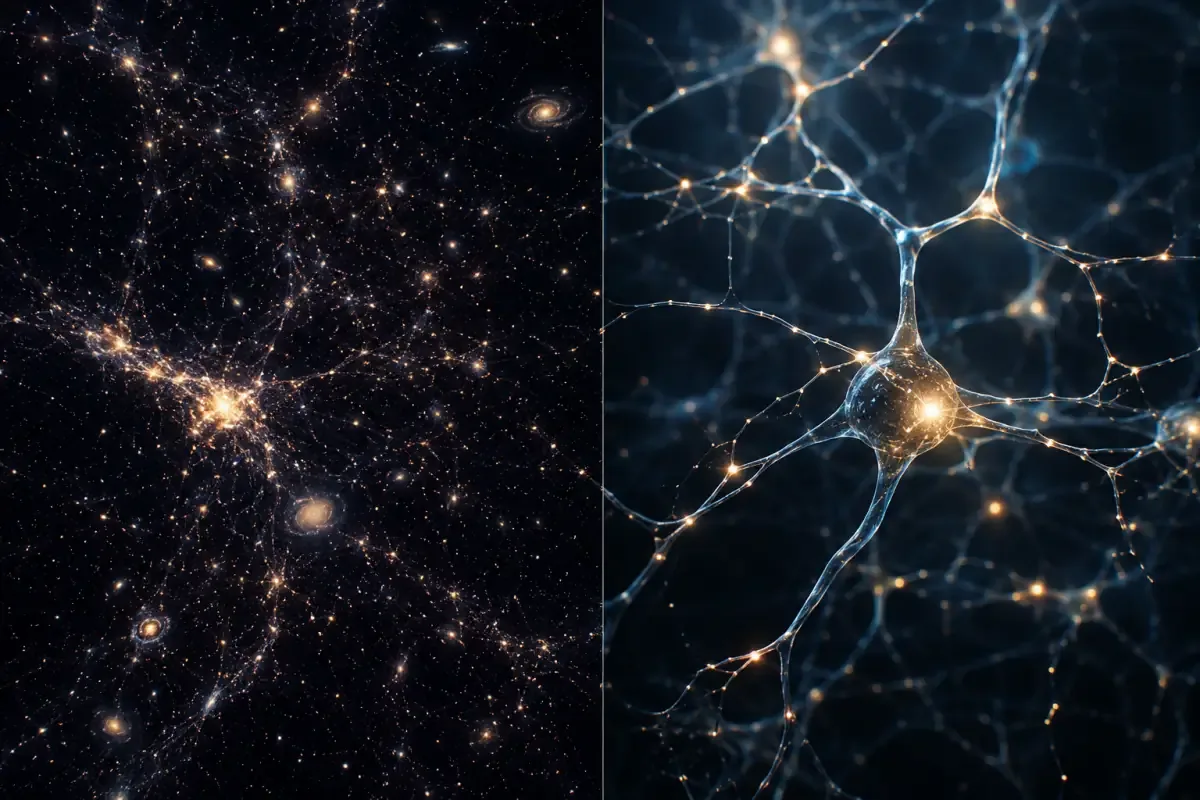
Franco Vazza studies the largest structures that exist: filaments of galaxies stretching across billions of light-years.
In 2020, he decided to compare them to something far smaller — the wiring inside a human skull.
Working with Alberto Feletti, a neurosurgeon at the University of Verona, Vazza set the architecture of the cosmic web against the architecture of the brain.
The cosmic web is the structure formed by galaxies, threaded together by filaments of dark matter and hydrogen gas into a pattern stretching across the observable universe.
Their paper, published in Frontiers in Physics, didn't lean on metaphor. It ran the numbers.
Two Networks, One Method
The scale gap between the systems is hard to hold in mind. The observable universe may contain up to two trillion galaxies, an estimate built from Hubble Space Telescope surveys and published in 2016.
The human brain holds around 86 billion neurons, a figure established in 2009 by Brazilian neuroscientist Suzana Herculano-Houzel, replacing a long-repeated textbook number that no one had ever actually measured.
Despite a size difference of more than 27 orders of magnitude, Vazza and Feletti found that both networks organize themselves the same way statistically: a small number of densely connected hub nodes, surrounded by a much larger population of sparsely connected ones.
"Structural parameters have identified unexpected agreement levels," Feletti said, describing how closely the two systems matched once translated into the same mathematical language.
The parallels went beyond node counting. As the researchers described it, roughly 30 percent of the mass in each system belongs to the structures being compared — galaxies, or neurons — while the rest plays a more passive role in their model: water in brain tissue, dark energy in the cosmos.
Neither researcher claimed the brain and the cosmos share more than that pattern.
Their paper states plainly that the model approximates neural connections by spatial proximity, not by actual signaling — a simplification, not a measurement of thought. What they measured is a shared statistical signature, not shared machinery.
An Old Instinct, Dressed in New Data
This kind of overlap isn't unique to brains and galaxies.
Airline routes, social networks, and the internet all tend to organize around a small number of high-traffic hubs, because similar mathematical rules govern how connections accumulate as any large system grows.
Stephen Hawking once made a related point, comparing the internet to a network of neurons inside one enormous brain — a remark about human communication, not cosmic architecture, though the two ideas often blur together in retelling.
The impulse to see intelligence behind the universe's structure predates any of this by roughly 2,500 years.
In the fifth century BCE, the Greek philosopher Anaxagoras proposed nous — a cosmic mind that ordered matter out of primordial chaos.
Aristotle later praised the idea as a rare sober voice among the early natural philosophers, though he thought Anaxagoras never fully worked out how nous actually functioned.
Where the Data Stops
Some physicists have pushed the brain-cosmos comparison much further than Vazza and Feletti ever did.
In 1992, Lee Smolin proposed that black holes might spawn new universes with slightly altered physical constants, and that universes best tuned toward producing black holes would come to dominate over time — an idea he called cosmological natural selection.
Leonard Susskind later said the theory deserved more attention than it got, then rejected its mechanics, arguing that black hole physics doesn't allow information to pass from a parent universe into a new one the way Smolin's theory requires.
Max Tegmark has proposed something more radical still: a "Level IV multiverse," in which every mathematically possible structure exists physically, somewhere.
Both ideas remain outside mainstream cosmology and untestable with any instrument that currently exists, even though they come from physicists with serious credentials in other corners of their field.
What Actually Holds Up
Strip away the speculation, and one measured result remains standing: two networks, built by entirely different physical forces, arrange their connections in statistically similar ways.
That much is published, peer-reviewed, and real. Everything past that point — a thinking universe, reproducing cosmoses, a mathematical mind behind it all — is inference stacked onto a data set that never claimed to support it.
Vazza and Feletti drew that line themselves, carefully, inside their own paper.
The bigger claim came later, from headlines that preferred "the universe is a brain" to "two network diagrams matched."
The pattern is real. What it means, if anything, is still an open question, and neither author has pretended otherwise.
SOURCES
- The Quantitative Comparison Between the Neuronal Network and the Cosmic Web — Vazza, F. & Feletti, A., Frontiers in Physics, 2020.
- Does the Human Brain Resemble the Universe? — University of Bologna, press release, 2020.
- The Human Brain in Numbers: A Linearly Scaled-Up Primate Brain — Herculano-Houzel, S., Frontiers in Human Neuroscience, 2009.
- Hubble Reveals Observable Universe Contains 10 Times More Galaxies Than Previously Thought — NASA Science, 2016.
- Smolin vs. Susskind: The Anthropic Principle — Edge.org.
- Lee Smolin, The Life of the Cosmos, Oxford University Press, 1997.
- Max Tegmark, Our Mathematical Universe: My Quest for the Ultimate Nature of Reality, Knopf, 2014.
Aron Corvin
A researcher of the unknown who loves a good story, but doesn't sell sensationalism. I research every topic in detail before I publish it. If you enjoy what I write, your support would mean a lot and help me keep going.