
Something is in the Water: Underwater Alien Bases Around the Planet
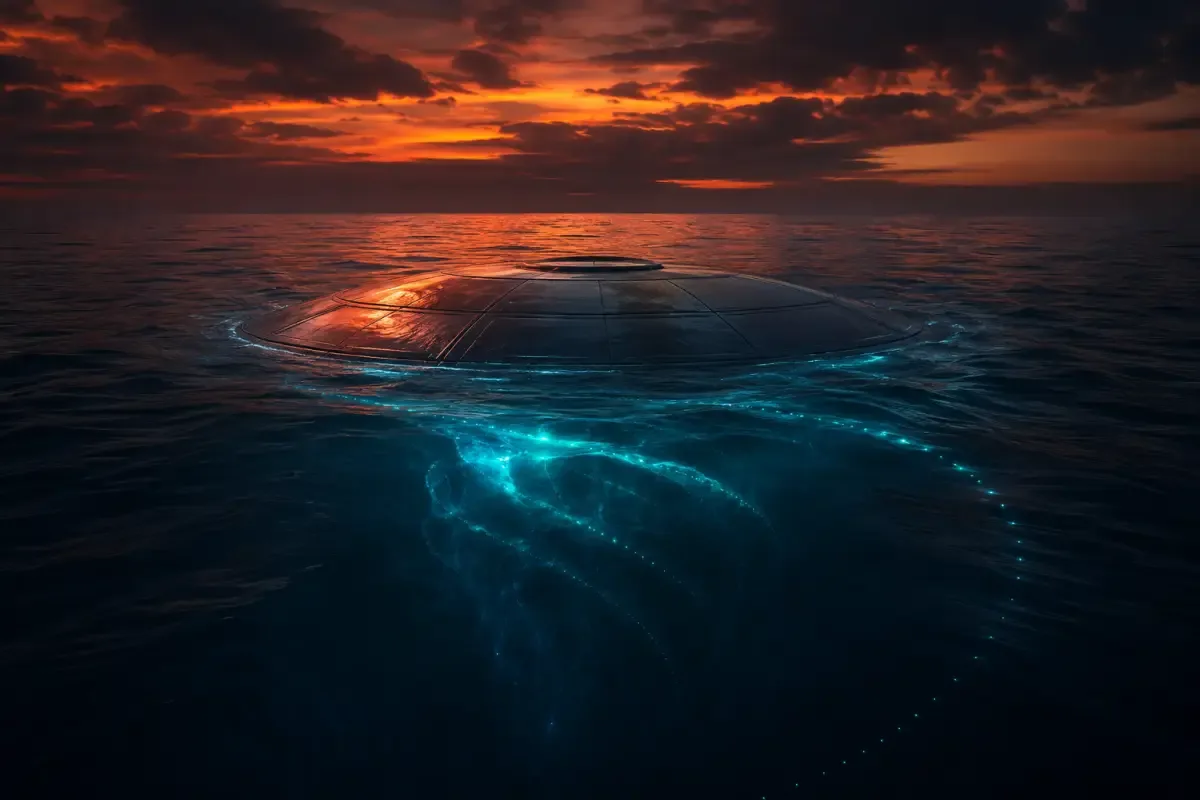
For seventy years the UFO conversation has pointed up. Saucers over Roswell. Lights over Phoenix. Triangles over Belgium.
The sky got all the attention, and somewhere along the way almost nobody noticed that the ocean was quietly accumulating a file of its own.
It is a thick file. Pilots, fishermen, naval officers, Coast Guard radiomen: they keep reporting the same thing, decade after decade, in different languages and different hemispheres: objects that fly, then dive straight into the water without slowing down, without a splash that makes sense, without ever coming back up where anyone could find them.
Ivan T. Sanderson, the British naval-intelligence-officer-turned-zoologist who all but invented the modern study of these cases in his 1970 book Invisible Residents, put a number on it that UFO researchers still argue about.
He claimed that more than half of all reliable sightings happen over, near, or in connection with water.
Whether or not that statistic survives close scrutiny, the geography behind it does not lie.
Seventy percent of this planet is ocean.
Something like ninety percent of that ocean has never been mapped in any detail finer than a coarse sonar sweep from a satellite or a survey ship passing overhead once a decade.
Think about what that means in practical terms.
We have crisper photographs of the far side of the Moon than we have of most of the Mariana Trench.
An object the size of a city block could sit on a seafloor shelf in the South Pacific for a thousand years and nobody would know, because nobody has looked, because there is no economic reason to look, because the pressure down there is measured in tons per square inch and human bodies do not belong below a certain line no matter how much steel you wrap around them.
So when witnesses describe something rising out of a lake, or a fleet of lights submerging off a coastline and never resurfacing, the honest response isn't laughter. It's a kind of vertigo.
The hiding place is right there, ninety percent unexplored, ready-made.
What follows is not a single story.
It's six of them, scattered across four continents and sixty years, that keep circling back to the same unsettling proposition: that whatever has been visiting us, or has always been here, might prefer to live below the waterline rather than above it.
The Baltic Sea Anomaly (2011)
What the Sonar Showed
In June 2011, a Swedish outfit called the Ocean X Team was doing what treasure hunters do: dragging side-scan sonar across the floor of the Gulf of Bothnia, the cold northern arm of the Baltic Sea wedged between Sweden and Finland.
I don't know what's at the bottom of the Gulf of Bothnia. But the fact that nobody has gone back to check — not with proper funding, not with proper equipment — bothers me more than any of the explanations.
They were hunting old shipwrecks. Liquor, mostly. Vintage champagne bottles from sunken cargo holds sell for absurd money to collectors, and that was the actual business plan.
Then the sonar returned something that made team leader Peter Lindberg stop the boat.
A disc roughly sixty meters across. Resting at a depth of about ninety meters.
Lying on the seabed with edges too straight to be comfortable, with what looked like a stairway of one-meter steps climbing one side, and a long, scraped channel — almost three hundred meters of it — trailing away from the object like drag marks.
Lindberg and his partner Dennis Åsberg went public, and within days the tabloids had their headline: a flying saucer, sunk in the Baltic, finally found.
When the Instruments Died
The part of the story that wouldn't go away wasn't the shape. It was what the team claimed happened every time they parked their boat directly above it.
Satellite phones stopped transmitting. Cameras drained their batteries in minutes.
The boat's own electrical system, according to multiple crew accounts, behaved erratically: flickering, cutting out, recovering the second they motored away from the site.
None of this was measured with calibrated instruments.
None of it was independently verified by a scientist standing on that deck with no financial stake in the outcome.
A Swedish naval vessel, unannounced, showed up while they worked in international waters. Lindberg has said he still doesn't know why.
"It's not obviously an alien spacecraft. It's not made of metal." — Peter Lindberg, Ocean X Team
That quote, given to reporters after a follow-up dive, gets left out of most retellings, because it doesn't fit the story people want.
Lindberg never actually claimed extraterrestrial origin. He claimed something stranger and more boring: that nobody could explain it.
Marine geologists were less generous. Dan Fornari of the Woods Hole Oceanographic Institution looked at the published sonar data and was unimpressed.
"I'm saying the data are lacking in resolution, detail and quantification." — Dan Fornari, marine geologist, Woods Hole
The mainstream verdict, for what it's worth, settled on a glacial deposit: a chunk of debris dragged south and dropped by retreating ice ten thousand years ago, its "staircase" an accident of fracture lines, its right angles a trick of low-resolution sonar rendering.
Ocean X disputes that to this day.
Returning in 2012, divers reported corridor-like structures and two circular openings bored into the object's surface, one of them ringed with a square collar that looked, in their words, deliberately built.
Nobody has dived to the bottom of the Gulf of Bothnia since with the funding to settle it either way.
The Shag Harbour Incident (1967) — Canada's Roswell
Shag Harbour is a fishing village at the southern tip of Nova Scotia, the kind of place with one general store and more lobster traps than people. On the night of October 4, 1967, at roughly 11:20 p.m., that changed for good.
Multiple witnesses — among them RCMP Corporal Werbicki, who happened to be driving through nearby Barrington Passage — watched a string of four orange-yellow lights drop out of the sky over the water.
The object tilted to a steep angle. It descended fast.
Then it struck the surface, and there was a flash, and a sound like a detonation, and a wide patch of yellowish foam spreading across the harbor where nothing had been a minute before.
The RCMP file, later pulled from the Department of National Defence archive, records the impression with almost bureaucratic flatness: a large flying object that, in the span of about five minutes, came down to the water, floated, and sank.
A Search That Came Up Empty
Believing a small plane had gone down, the RCMP scrambled fishermen and Coast Guard boats within the hour.
They found the foam — by most estimates a patch some eighty feet wide — and nothing else. No bodies. No fuel slick. No wreckage of any kind.
By morning, the Royal Canadian Navy had a more serious answer ready: divers. Two days of underwater search followed, with naval vessels combing the harbor floor and the channel beyond it.
They turned up nothing either, and the file was never quietly closed the way most "weather balloon" cases were.
The Rescue Coordination Centre in Halifax and the RCAF formally classified it, in writing, as an Unidentified Flying Object: one of the only times in Canadian history that a government office used that exact phrase in an official report rather than reaching for it.
The U.S. Condon Committee, the federally funded UFO study that spent the late 1960s trying to debunk cases like this one, examined Shag Harbour too. It went into the file unresolved.
Among the witnesses was a thirteen-year-old boy named Peter Goreham, who watched a white light tear through the treetops outside his bedroom window, followed by a whistling, tumbling sound he never forgot.
He told his parents. He told the RCMP. He told almost nobody else for forty years.
"When you mention extraterrestrial, people don't go for that." — Peter Goreham, witness
There's a coda to the story that gets repeated in nearly every retelling, and it's worth repeating again.
Two days after the splashdown, fishermen working a few miles out in the Gulf of Maine reported a second sighting: something rising from the water, lights blinking, before climbing away into low cloud and vanishing.
If the same object surfaced once it sank, nobody was ever able to prove it. Nobody could disprove it either.
Ancient Waters: Lake Ontario & Lake Titicaca
The Vortex Nobody Wants to Name a Triangle
Draw three points on a map of eastern Lake Ontario. Wolfe Island near Kingston.
Point Petre, on the tip of Prince Edward County. Mexico Bay, on the New York shore near Oswego.
Connect them, and you've outlined what local divers call the Marysburgh Vortex: a patch of cold freshwater with a body count that, ship for ship, beats the Bermuda Triangle.
Somewhere between 270 and 500 wrecks rest on that stretch of lakebed. At least 40 aircraft have gone down there too, a concentration that has no easy explanation in a body of water this size.
The 1889 disappearance of the schooner Bavaria still gets told around Kingston harbor pubs.
She was under tow in a convoy of three vessels, hauling timber, when a storm rolled in off the lake.
When it cleared, the Bavaria was gone: no wreckage, no survivors, nothing but open water where a ship had been minutes before.
Eleven years later it happened again, to the schooner Picton, in full view of two other ships sailing alongside her.
Witnesses described her vanishing as though the lake had simply opened beneath her hull.
A message in a bottle washed up weeks later, signed by her captain, describing a vessel taking on water and a crew bracing to die together.
The bottle is real. The bodies were never recovered.
Pilots have logged stranger things still.
In 1952, Royal Canadian Air Force Flight Lieutenant Barry Allen Newman went down in his P-51 from 20,000 feet almost directly over the vortex's center, and was never found.
Other pilots flying the same corridor have described a wing simply refusing to respond to the controls — "as if an invisible giant took hold of it," in the words of one — before righting itself with no explanation a few seconds later.
Geologists point to Charity Shoal, a near-perfect circular depression on the lakebed believed to be the scar of a 460-million-year-old meteorite strike, and its associated magnetic field, which is known to throw compasses off by several degrees in the immediate area.
That accounts for some of it. It does not obviously account for ships disappearing in full view of witnesses on a calm afternoon.
A Lake the Gods Climbed Out Of
Six thousand miles south, fourteen thousand feet up in the Andes, Lake Titicaca tells a version of the same story in a completely different register.
In Inca cosmology, the lake isn't just old. It's the origin point.
Viracocha, the creator deity, is said to have risen directly out of Titicaca's black water in total darkness, before there was a sun, and made the sky and the first humans on its shores.
Spanish chroniclers recorded variants of the myth within a few decades of the conquest, and the lake has carried that weight in regional folklore ever since: a body of water treated less like a lake and more like a door.
Modern witnesses describe something that sounds, uncomfortably, like an echo of the old story rather than a contradiction of it: solid, matte-black objects breaking the surface at night with no running lights, no wake, and no sound, before submerging again as if the water had simply swallowed them.
Bolivian and Peruvian fishing communities on opposite shores have independently reported the same shape for decades, without, as far as anyone has documented, ever comparing notes.
Subterranean and Submarine Networks of Puerto Rico
Jorge Martín has spent his career chasing a sound nobody else could find the source of.
Born in New York in 1952 to Puerto Rican parents who moved the family home when he was five, Martín became an active UFO investigator in 1975 and has stayed one for fifty years, building a reputation as the island's most dogged chronicler of its aerial weirdness: most famously the wave of sightings reported around El Yunque rainforest through the 1990s.
But the case that pulled him in originally happened underground, in the city of Ponce, on the island's southern coast, sometime in the late 1980s.
Residents started reporting a vibration through the ground at night. Not an earthquake. Earthquakes don't last for hours.
This felt mechanical. A grinding, droning hum, as if something with serious horsepower was boring through bedrock somewhere beneath the streets.
It went on for several nights running.
People organized vigils. Local press picked the story up, then dropped it within a week or two once the noise simply stopped, as abruptly as it had started, with no source ever located and no follow-up ever published.
Martín filed it away and moved on to other cases for over two decades.
Then, in 2012, working through NOAA satellite seabed imagery of the waters south and east of Puerto Rico, he found something that sent him straight back to his old Ponce notes.
A long, rigid, geometrically precise structure on the continental shelf southeast of the island, with what looked like an entrance carved into one end.
Running out from that structure, in the imagery he published, what appeared to be a corridor or roadway extending northwest: toward the mainland, and toward Ponce specifically.
His question, stated plainly in his own published research, was whether the drilling sounds the city heard in the 1980s had been the construction of an access route connecting that undersea structure to a facility on land.
He has never claimed proof of that connection. He has also never let go of the coincidence.
No government agency — Puerto Rican, American, or otherwise — has ever issued a formal study confirming or denying the existence of the structures Martín photographed.
The Hostile Encounter at Lake Baikal (1982)
This is the story that, if even a fraction of it is real, changes the stakes of everything else on this list.
Lake Baikal, in southern Siberia, is the deepest lake on the planet: over a mile down at its lowest point, holding roughly a fifth of all the unfrozen fresh water on Earth.
It is also, by Soviet-era military necessity, a body of water the Russian navy trained combat divers in for decades, far from any coastline an enemy submarine could threaten.
The story traces back to a single source: Vladimir Azhazha, a former Soviet submarine officer who spent his later career as a UFOlogist, and whose published claims have been challenged on more than one occasion for accuracy.
No Soviet or Russian military archive has ever surfaced to independently confirm what he wrote. With that caveat sitting over the entire account like a flag that should not be ignored, here is the story as it has been told and retold for forty years.
In the summer of 1982, a detachment of Soviet Navy divers was running standard training drills at a depth of roughly fifty meters.
According to Azhazha's account, and to later interviews with the historian Alexey Tivanenko, the divers became aware they were no longer alone in the water.
Several silver-suited figures, close to three meters tall, were holding position a short distance away, watching them.
No tanks. No regulators. No visible breathing apparatus of any kind, in water cold enough that an unprotected human body has minutes, not hours, before hypothermia takes over.
"Swimmers about three meters high, dressed in tight-fitting silver suits." — Alexey Tivanenko, historian, on the divers' reported account
The figures wore helmets — some descriptions say fully transparent, others compare them to an open umbrella held above the head — and made no aggressive move.
For a few seconds, by every version of the story, both groups simply held still in the water and looked at each other.
Then, according to the account, a command came down from the surface: capture one of them.
What happened next is the part that gets repeated in the darkest tone. The divers closed the distance.
The figures didn't flee in any conventional sense: they reacted, and the divers found themselves rocketing toward the surface at a speed no human propulsion system in that water could explain, the kind of forced, violent ascent that gives no time for a body to decompress.
Three of the divers reportedly died from the bends before they reached the boat. The survivors required serious medical treatment.
There is no surviving primary document anyone has produced — no logbook, no medical record, no court-martial file — that independently corroborates a single detail of this.
It may be exactly what Soviet military culture occasionally produced on its own without any alien involvement: a training accident, divers ascending too fast in a panic, and a story that grew teeth in the retelling as it passed through Cold War secrecy and then through twenty years of post-Soviet UFOlogy.
Or it may be the only documented instance of a hostile underwater encounter between trained military personnel and something nobody can identify.
Satellite mapping of Baikal's floor in more recent years has reportedly turned up two anomalies that don't match the surrounding sediment pattern: features described by researchers who've examined the imagery as having an unnervingly artificial regularity to their edges.
Nobody has sent divers down to either one.
Even if the Baikal story is just a Cold War legend — and it probably is — it's a reminder that the most interesting stories live in the gap between what can be proven and what can be dismissed.

The Abyssal Horizon
Six stories. Four continents. Sixty years.
A glacial boulder that might not be a boulder.
A government file that uses the word UFO without irony.
A lake the Inca said a god was born from.
A noise under a city that nobody traced.
A legend out of Siberia with no paper trail and three dead men attached to it anyway.
None of it proves a base exists under any ocean on this planet. None of it can be dismissed cleanly either, and that's the uncomfortable middle ground this subject has occupied for half a century: too persistent to laugh off, too unverifiable to file as fact.
What's certain is the math nobody disputes. Most of the water on this planet has never had a flashlight pointed at it.
Whatever has been seen rising from it, or sinking into it, or watching from just below the surface where the light runs out, it has had the whole dark, cold, crushing majority of the hydrosphere to retreat into every single time.
The lights keep going down. They just haven't, so far, come back up where anyone was watching.
SOURCES
- Ivan T. Sanderson, Invisible Residents: The Reality of Underwater UFOs (World Publishing Co., 1970; reissued by Adventures Unlimited Press) — the foundational text on USOs and the "OINTS" theory.
- Department of National Defence (Canada) files on the Shag Harbour incident, held at Library and Archives Canada, Ottawa.
- Condon Report (Scientific Study of Unidentified Flying Objects, University of Colorado, 1968) — includes case review material touching on Shag Harbour.
- Hugh F. Cochrane, Gateway to Oblivion: The Great Lakes' Bermuda Triangle (Prentice-Hall, 1980) — the original popularizer of the Marysburgh Vortex.
- Erich von Däniken, Chariots of the Gods? (1968) — early popular treatment of Andean creation mythology in a UFO context, including Titicaca lore.
- Jorge Martín's research archive, published in Spanish and English at Enigmas del Milenio and in back issues of his magazine Evidencia OVNI.
- Vladimir Azhazha's published accounts of Soviet-era USO and underwater-encounter cases, including the Lake Baikal incident — treat as a single-source claim pending independent corroboration.
- NOAA seafloor and bathymetric satellite imagery archives (public domain), the type of dataset cited in both the Puerto Rico and Lake Baikal anomaly claims.
- Richard Dolan, UFOs and the National Security State (2002) — for general context on military classification practices around unexplained aerial and underwater incidents during the Cold War.
Aron Corvin
A researcher of the unknown who loves a good story. I won't sell you sensationalism just for a click. If you enjoy what I write, your support would mean a lot and help me keep going.