
The Galactic Network: Bill Herrmann's Metal Bar From the Sky
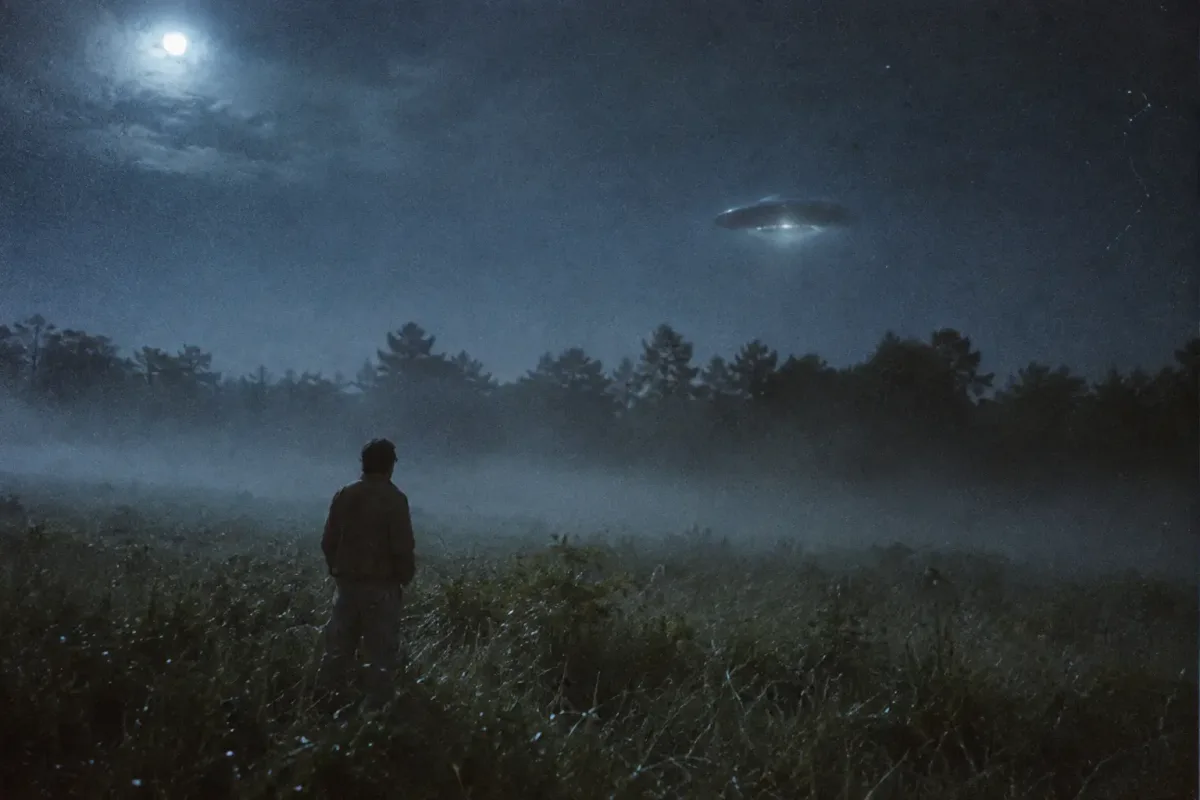
Officer Pike Limehouse of the Dorchester County Sheriff's Office took the call just after one in the morning: a man was standing alone in a remote field near Summerville, South Carolina, and seemed on the verge of a breakdown.
When he arrived, he found a young diesel mechanic, William "Bill" Herrmann, so shaken that the officer later admitted, on camera for a film crew, that he could recall few people he had seen in such a state.
Herrmann claimed that just moments earlier he'd been standing in his yard in North Charleston, and then, with no memory of the trip at all, suddenly found himself in a field about fifteen miles from his home.
That episode of missing time, from the night of March 18, 1978, became the opening chapter of one of the longest-documented contact cases in American ufology, and one of the hardest to untangle.
Since then, Herrmann's name has turned up regularly in newspaper articles, ufology catalogs, and books, always in the same context: the man who supposedly photographed a glowing disk over Charleston and received a message from an organization of alien civilizations he called "the Network."
The Mechanic Who Watched the Sky
In the second half of the 1970s, Herrmann lived in a mobile home in North Charleston, worked as a diesel mechanic, and was an active member of a Baptist church.
The first sightings of a strange light above his car began in November 1977, and repeated nighttime observations of pulsing objects over the wooded, marshy land near his house soon followed.
On January 22, 1978, he managed to snap nine photographs of a glowing disk. The pictures later made the rounds in newspapers, magazines, and even Japanese television.
His wife and several neighbors said they had noticed similar lights that same season, giving researchers additional testimony, but not confirmation of his claims.
Researchers from the Mutual UFO Network later analyzed the photographs and found no signs of tampering on the negatives, a finding that in itself proves nothing about the object's origin; it only rules out obvious fakery.
"I'd never been interested in science fiction. I thought that was all hogwash. Garbage," Herrmann told a reporter, adding that by then he'd had two contact experiences and fifteen UFO sightings.
The story took a real toll on his daily life.
On November 10, 1981, the church where he taught children removed him from that role after part of the congregation linked his televised confession about UFOs to satanic influence.
That same day, according to Stevens's records, he wrote an essay titled "Inevitable Destruction," warning that an unending firestorm would soon engulf the planet because of the geopolitical events of the time.
A year earlier, in an interview with the Index-Journal of Greenwood, he said his wife had put up with more than most people could: nights spent waiting for a husband who sat for hours in the car with binoculars, watching the sky.
An Object That Could Be Tested
Of everything Herrmann described, one detail stands apart because it could actually be verified: the metal bar.
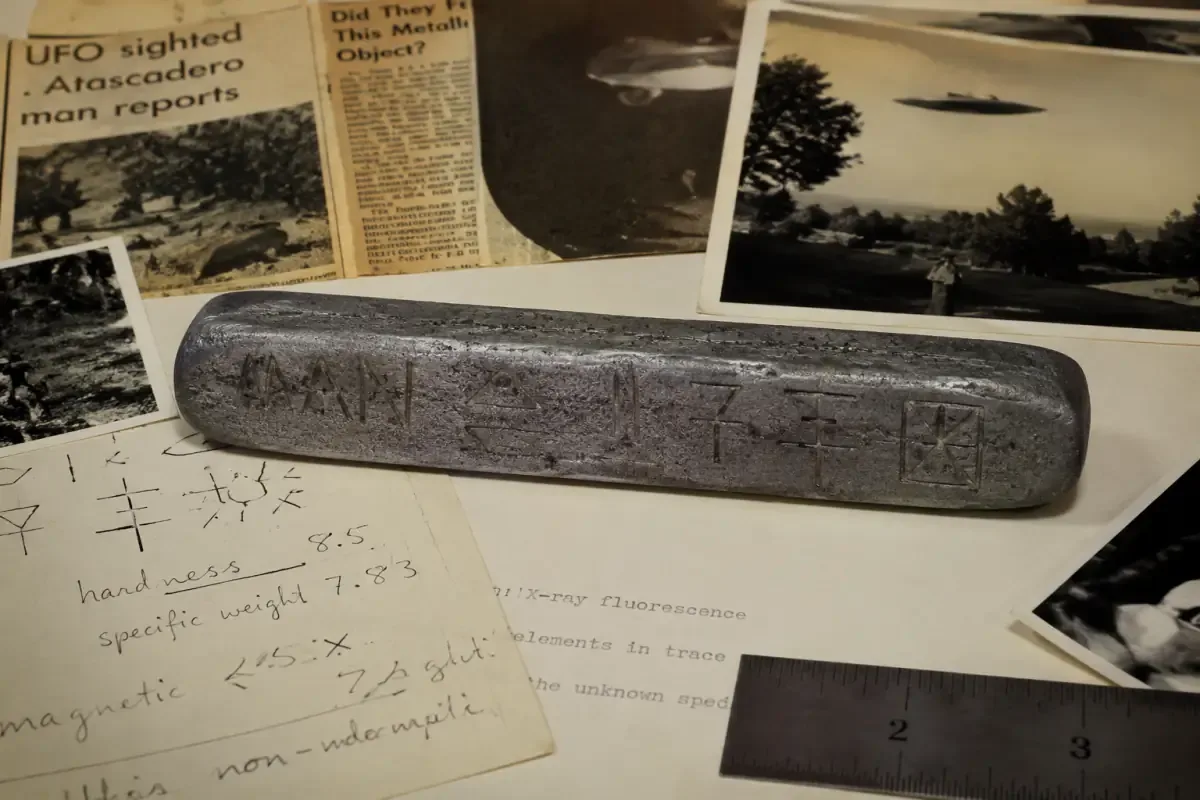
According to his account, on April 21, 1979, a bar engraved with the letters "MAN" and a series of unknown symbols materialized in his bedroom inside a bluish-green sphere of light.
A month later, on May 16, he deliberately went back to the site of his earlier encounters, where, in his own words, he was told the bar was a gift.
According to a Charleston News and Courier report of November 18, 1979, Omni magazine sent a small sample from the bar to the Massachusetts Institute of Technology (MIT) for analysis.
It's a rare moment in the story with an actual lab result behind it, and that result showed an ordinary cast lead alloy with six percent antimony, a composition close to what you'd find in lead pipe or car battery grids.
According to the laboratory report by Dr. Walter W. Walker reproduced in Stevens's book, the small symbols on top of the bar were cast with it, while the letters "MAN" were pressed in with a blade later, and the alloy itself was described as "indistinguishable from terrestrial hard lead."
That scientific finding doesn't support the claim of a material with unknown origins. If anything, it points the other way.
The bar itself disappeared in the early 1980s. Herrmann claimed intelligence agencies had confiscated it, a claim that, unlike the lab analysis, was never backed up by a single document or independent witness.
Tests That Couldn't Prove the Encounter
Herrmann's story went through a series of formal tests that are rare for cases like his.
In February 1978, he took a polygraph test administered by Thomas M. Olsen, then president of the UFO Information Retrieval Center in Maryland.
He later took a PSE test (psychological stress evaluation) administered by an examiner named McWinston, who said he personally screened hundreds of people every year who claimed to have seen a UFO or made contact with aliens.
McWinston found no signs of deliberate deception, but stressed that such a test can't establish whether an encounter actually happened, only whether the person believes what they're saying.
The distinction is subtle but crucial: none of the tests given to Herrmann confirmed that the encounter happened, only that he sincerely believed it did.
He also underwent hypnosis led by James Harder, a researcher affiliated with APRO, in an attempt to reconstruct the missing stretches of memory.
Stevens claimed the symbols engraved on the bar represented a star map of the constellation Reticulum, visible only from the Southern Hemisphere, in a configuration he said matched a rare Hungarian star chart.
No one else independently confirmed that claim. Stevens also sent Herrmann's photographs to the Jet Propulsion Laboratory in Pasadena for digital enhancement, but the results were never found or published, one more thread that disappears into the paperwork of this case.
A Crew Without Switches
According to Herrmann's account, he was brought inside the craft after a noninvasive medical exam.
The interior, he said, looked as though it had been cast in a single piece, with no visible seams, and the air smelled fresh, like ozone after a summer thunderstorm.
He said he never saw a single switch, handle, or control panel anywhere. By his account, the craft's systems responded to touch, or directly to the crew's thoughts.
The only being who communicated with him, called "the Leader," sent messages telepathically, while the rest of the crew wore dark red uniforms bearing the emblem of a winged serpent.
That description is a sharp departure from the popular stereotype of the Grays: short beings with large black eyes, most often associated with abductions from the second half of the twentieth century.
Herrmann's beings were, in his telling, taller and more open to communication, a difference that, like everything else in the story, comes down to one man's testimony with no independent confirmation.
An Archivist With a Past of His Own
The key figure in documenting the story was Wendelle C. Stevens, a retired U.S. Air Force colonel who became a researcher for the Aerial Phenomena Research Organization (APRO) after his military career.
In 1981, he self-published a book devoted entirely to Herrmann's case: several hundred pages of illustrations, diagrams, and examples of the supposed alien script.
His reputation within ufology circles was a mixed one. He was regarded as one of the field's most dedicated archivists, a man who collected thousands of testimonies over the course of his career.
At the same time, critics point out that he backed nearly every contactee whose story he investigated, including some whose claims were later publicly debunked, which undercuts the value of his conclusions as independent confirmation.
The best-known example is Swiss farmer Eduard "Billy" Meier, whose story of contact with Pleiadian beings Stevens spent years wholeheartedly defending as credible.
Today, much of the ufology community considers that case one of the most elaborate known hoaxes in the field's history, with some alleging that certain photographs were taken using model spacecraft hung from string.
That willingness to defend such a discredited story without reservation further undercuts the weight of his support for Herrmann.
Stevens himself, apart from his work in ufology, later faced serious legal trouble.
According to Legs McNeil's "Loving the Aliens" in SPIN (July 1987), Stevens had pleaded guilty to 3 of 10 counts of child molestation, four counts of furnishing obscene or harmful material to minors, and two counts on the film and pictures charges. He was sentenced to seven years.
The Network, Zeta Reticuli, and a Family of Similar Stories
According to Herrmann, the beings who contacted him identified themselves as members of a species from Zeta Reticuli, a binary star system in the constellation Reticulum, and claimed to come from a distance of about 32 light years.
Modern parallax measurements place that system at roughly 39 light years from Earth, a discrepancy any fact check has to note, even though it doesn't by itself prove anything about the rest of the story.
Herrmann claimed the beings described an organization of dozens of species from that part of the galaxy, what he called "the Network," tasked with monitoring civilizations that had mastered nuclear energy and placing them under a kind of quarantine.
This kind of narrative, a network or federation of civilizations, isn't unique to Herrmann's case. Similar language and cosmology show up across many contactee accounts going back to the 1950s.
The Zeta Reticuli system became known in ufology mainly through the 1961 case of Betty and Barney Hill in New Hampshire, one of the first widely publicized abduction stories in the United States.
In the late 1960s, amateur researcher Marjorie Fish proposed that the star map Betty Hill drew under hypnosis resembled the layout of stars seen from that system's vicinity, an interpretation that made its way into popular ufology lore even though astronomy never accepted it as evidence.
Herrmann's case ties these two narratives even closer together, describing beings similar to the ones the Hills reported, with some differences in height and eye appearance.
In ufology literature, the case is often ranked alongside other frequently cited events, like the Rendlesham Forest incident in England (1980) or the Ariel School encounter in Zimbabwe (1994).
That kind of ranking says more about how ufology builds its own canon of "greatest hits" than it does about how well-proven any of these claims actually are.
What Verification Can't Reach
Most of Herrmann's story can't be confirmed by any independent source.
The claims of a planetary quarantine supposedly dating back to World War II, of 1940s and '50s radar systems that destabilized the gravitational fields of spacecraft and caused crashes like the one at Roswell, of a species that genetically shaped humanity, and of warnings tied to the years after 2027, all of it exists solely within Herrmann's testimony and Stevens's records.
No document, scientific paper, or independent institution confirms any of it.
That doesn't necessarily mean deliberate deception. The difference between unverifiable and false isn't a small one, and most researchers who've studied the case have concluded that the lack of corroboration makes it unproven rather than disproven.
Over time, Herrmann's case faded into the background of the ufology community: occasionally mentioned as a curiosity, rarely treated as a serious reference point.
What happened to him in the decades that followed is hard to say with any certainty.
One unsigned comment on an old ufology forum claims that Herrmann later rejected the alien story entirely, attributing the whole experience to demonic influence after joining a fundamentalist evangelical congregation.
The source's anonymity means this claim can't be treated as an established fact, but it does illustrate just how little is reliably known about his later life.
What's Proven, and What Isn't
A handful of elements remain solidly documented: the 1978 police call, photographs that were analyzed without any evidence of tampering, polygraph and PSE tests that found no deliberate deception, the MIT lab finding on the metal bar's composition, and Stevens's extensive, if biased, investigation.
Everything else, including the Galactic Network itself, its mission, and its rules for humanity, exists solely as Herrmann's testimony, filtered through a researcher who never questioned a single part of the story he was documenting.
For the reader, the dividing line is clear. The documents show that Bill Herrmann ended up in the middle of a remote field that night. What they don't show is that a Galactic Network is how he got there.
SOURCES
- URECAT catalog: William Herrmann, Summerville, March 18, 1978
- Charleston City Paper – Shining a light on UFO sightings (Dustin Waters, 2016)
- BBC Sky at Night Magazine – Zeta Reticuli star system
- Encyclopedia of Occultism and Parapsychology – Hermann, William J.
- Legs McNeil, "Loving the Aliens," SPIN, July 1987, p. 54 (archive.org)
- Wendelle C. Stevens and William Herrmann, UFO Contact from Reticulum, self-published, 1981
- News and Courier (Charleston), November 18, 1979 (via the URECAT catalog)
Aron Corvin
A researcher of the unknown who loves a good story. I won't sell you sensationalism just for a click. If you enjoy what I write, your support would mean a lot and help me keep going.