
The Two Hours That Vanished: The Betty and Barney Hill Abduction
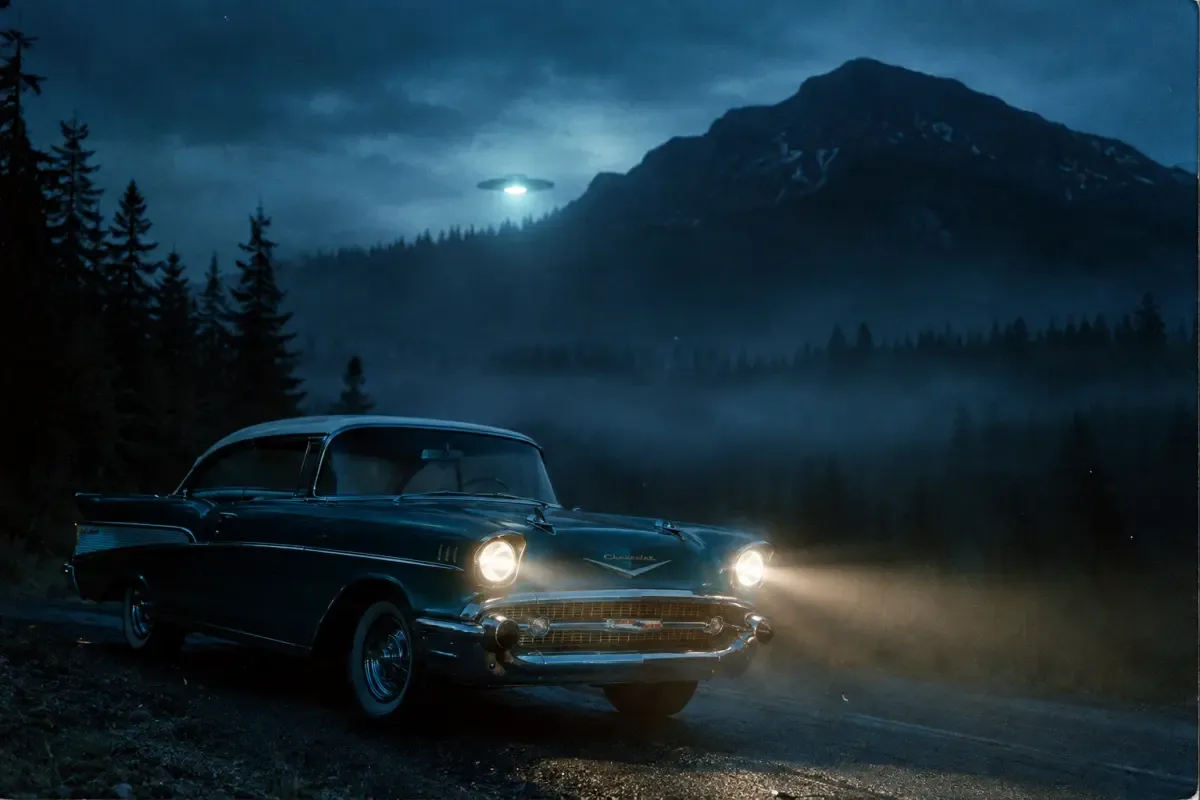
Betty Hill was the first to notice it: a shimmering point of light in the sky, somewhere above Lancaster.
It was the evening of September 19, 1961, and the married couple from Portsmouth, New Hampshire, were driving home from a trip to Niagara Falls and Montreal, heading south through the White Mountains on Route 3.
Their dog, Delsey, slept in the back seat of their 1957 Chevrolet Bel Air.
The light, the couple would later say, behaved strangely — changing direction and gradually closing the distance as they drove through Franconia Notch.
Betty talked Barney into pulling over at a picnic area south of Twin Mountain.
Through binoculars, she described the object in words she'd soon relay to a civilian UFO research organization: it "appeared to be pancake in shape," with flickering lights along its rim.
Near Cannon Mountain and the rock formation known as Indian Head, the object, as they later described it, descended and hovered just above the car.
Barney says that through his own binoculars, he saw humanoid figures in the craft's windows.
What happened next, neither of them could ever consciously recall: somewhere on the stretch of Route 3 between Lincoln and Ashland, roughly two hours of driving time went missing — a phenomenon that later abduction literature would come to call "missing time."
The Couple from Portsmouth
Barney Hill Jr. was born July 20, 1922, in Newport News, Virginia. He worked as a postal employee and was a World War II veteran.
His wife, Eunice Elizabeth "Betty" Barrett, born June 28, 1919, in Newton, New Hampshire, worked as a social worker.
Their marriage — at a time when laws against interracial marriage were still on the books in parts of the United States — was a rare one for rural New Hampshire in that era.
Both were active in Portsmouth's Unitarian congregation and in the NAACP, and Barney also served on the local board of the U.S. Commission on Civil Rights.
Yale University Press includes that civil rights work as part of the biography of a couple whose case would later become known as the "Zeta Reticuli Incident."
The next day, Betty called Pease Air Force Base to report the encounter.
On September 22, Major Paul W. Henderson filed an official report for Project Blue Book, the U.S. Air Force program that investigated thousands of UFO reports between 1952 and 1969 before closing without finding evidence of a threat to national security.
As a possible explanation, the report pointed to a misidentification of the planet Jupiter.
That didn't satisfy Betty. On September 26, she wrote to Donald Keyhoe, director of the National Investigations Committee on Aerial Phenomena (NICAP), then one of the country's most influential civilian UFO research organizations.
Her letter was forwarded to Walter N. Webb, an astronomer at the Hayden Planetarium and a NICAP associate.
On October 21, Webb spent six hours talking with the couple in their home and came away convinced that Betty and Barney were describing the event credibly and sincerely, allowing for the usual uncertainties of human perception — exact timing, distance, and the size of the object.
A month later, on November 25, the couple spoke with two more NICAP associates.
Separate Rooms, the Same Story
Neither Blue Book nor NICAP ever resolved the two missing hours.
A resolution — or at least an attempt at one — arrived by chance in November 1962, when the couple met Air Force Captain Ben H. Swett, who practiced hypnosis, at a church lecture.
Swett referred them to a colleague, Boston psychiatrist Dr. Benjamin Simon.
At the time, hypnosis was regarded in clinical circles as a promising way to access repressed memories — it would take later research to call into question just how reliable those recovered memories really are.
Betty and Barney's first session with Simon was on December 14, 1963.
The formal hypnosis sessions ran from January 4 to June 6, 1964, conducted separately for Barney and Betty so that one's memory couldn't shape the other's.
Under hypnosis, each independently described largely matching, though not identical, versions of events: being stopped at a roadblock, boarding a craft, undergoing a medical exam, and communicating telepathically with the beings they described.
None of these details existed in either of their conscious memories in the period right after September 1961 — they surfaced only during sessions held two and a half years later.
According to later psychological research, a hypnotically recovered memory isn't a recording of what happened but a reconstruction, one shaped by a therapist's suggestions and by information absorbed after the event itself.
Simon himself, however, never accepted a literal extraterrestrial explanation.
His conclusion, published in the journal Psychiatric Opinion in 1967, described the case as a "singular psychological aberration," which he attributed to Betty's dreams bleeding into Barney's mind, against the backdrop of the strain their interracial marriage faced in the social climate of the time.
Betty, though, held to her version of events for the rest of her life. In a 1986 Associated Press interview, she described that part of the story this way: "They dragged me, kicking and screaming."
The story didn't reach the public right away — but when it did, it became what's now considered the first widely reported alleged alien abduction in the United States.
It didn't leak out until 1965, when, starting October 25, the Boston Traveler ran a five-part series by reporter John H. Luttrell titled "A UFO Chiller: Did THEY Seize the Couple?"
A year later came John G. Fuller's book The Interrupted Journey, which was the first place Betty's hypnosis-drawn sketch of the star map ever appeared in print.
In 1975, NBC turned the book into a TV movie, The UFO Incident, starring James Earl Jones and Estelle Parsons.
A Star Map, 39 Light-Years Away
That sketch would become the foundation of a decade-long debate.
Marjorie Fish, an elementary school teacher and amateur astronomer from Ohio, spent from August 1968 to February 1973 building a series of three-dimensional models of nearby stars — beads strung on thread and positioned according to their actual distances from Earth.
The pattern stars form in the sky shifts depending on where in space you're viewing them from, so a physical model like this was the only way to check whether there was some vantage point from which Betty's sketch would match the real arrangement of stars.
Fish worked from the 1969 Gliese Catalogue of Nearby Stars. By late 1968, she'd arrived at a configuration she believed best matched the double star system Zeta Reticuli, roughly 39 light-years away.
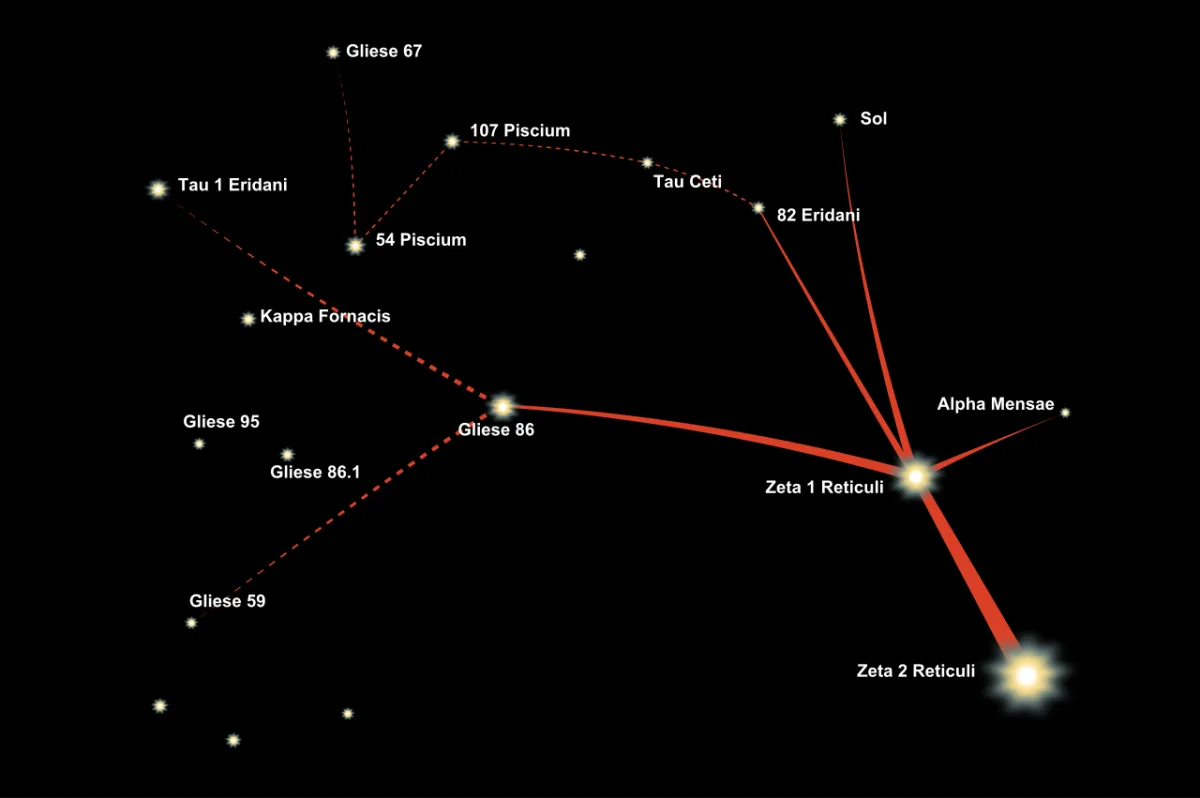
She sent her analysis to Webb, who agreed with her conclusion and passed it along to Terence Dickinson, editor of Astronomy magazine.
In December 1974, the magazine published Dickinson's article "The Zeta Reticuli Incident" — the first time a respected astronomy publication had opened its pages to debate over a UFO report. The debate in its pages would continue for the next year.
Connecting the Dots
In that same issue, Carl Sagan and Steven Soter — at the time a young researcher under Sagan's mentorship at Cornell University — argued that the map, stripped of the connecting lines Fish herself had drawn, showed no meaningful resemblance to the real layout of the stars.
What Fish had done, in their view, was connect the dots arbitrarily: given enough stars and the freedom to choose your own connecting lines, they argued, you could find a similar pattern almost anywhere in the sky.
David Saunders, a statistician who had previously worked on the Condon Report — the U.S. government's official study of UFO phenomena — pushed back on that assessment, arguing the match was statistically too precise to be coincidence.
The final blow to the map came from data collected by the European Hipparcos satellite, published in the early 1990s.
Precise parallax measurements of more than 100,000 stars showed that the distances to several stars in Fish's interpretation had been significantly miscalculated relative to the 1969 catalog she'd used.
Later research also found that some of the stars she'd included as "suitable for life" wouldn't have qualified even by her own criteria. The Armagh Observatory notes that Fish herself publicly acknowledged her identification no longer held up.
Still, the debate over the map only touches one part of the story. What did or didn't happen on the road by Cannon Mountain, and the two hours missing from it, is a question the star map was never going to settle on its own.
The Beacon, the Sleep, and the Twelve-Day Coincidence
Not everyone bought the alien explanation — not even everyone who took the case seriously.
Jim Macdonald, who lived in the area where the encounter supposedly happened, reconstructed the couple's nighttime drive and concluded that Betty and Barney had likely mistaken a blinking aircraft beacon atop Cannon Mountain — a signal that warns pilots of obstacles in hilly terrain — for a UFO.
This Macdonald shouldn't be confused with physicist James E. McDonald, a well-known UFO research advocate.
By his analysis, the beacon appears and disappears at exactly the moments the couple describe.
After that reconstruction, skeptic Robert Sheaffer attributed the rest of the experience to stress, sleep deprivation, and false memories "recovered" under hypnosis.
He called the Hills the "poster children" for driving without enough rest.
One detail from the hypnosis sessions has particularly fascinated pop-culture researchers.
An episode of The Outer Limits called "The Bellero Shield" aired on February 10, 1964, and featured an alien with unusual, "wraparound" eyes.
Barney first described and sketched those same eyes during a hypnosis session held on February 22, 1964 — just twelve days later.
In 1990, researcher Martin Kottmeyer argued in his piece "The Eyes that Spoke" that Barney's memory might have been unconsciously shaped by that episode — an example of what psychologists call cryptomnesia, remembering something you've seen or heard without realizing where it came from — since, as he wrote, "wraparound eyes are an extreme rarity in science fiction films." Betty, for her part, insisted to the end that she'd never seen the episode.
Two Hundred Slides
Barney Hill died on February 25, 1969, of a cerebral hemorrhage. He was 46.
Betty spent the next several decades continuing to speak publicly about UFOs, at conferences and in media devoted to the subject.
In 1980, at the National UFO Conference in New York, she presented more than two hundred slides of indistinct lights as evidence of UFO encounters.
According to Robert Sheaffer's account, the audience openly mocked her by the end, since her talk ran far past its allotted time.
In 1995, Betty self-published the book A Common Sense Approach to UFOs, which described sightings of everything from entire squadrons of UFOs to a truck levitating above a highway — episodes that even sympathizers of the case consider damaging to her later credibility.
She died of lung cancer at 85, in October 2004 — sources disagree on the exact date.
In 2011, New Hampshire installed historical marker No. 224 on Route 3 in Lincoln, at the spot where, according to the story reconstructed under hypnosis nearly three years after that night, it all supposedly began.
SOURCES
- The Abduction of Betty and Barney Hill — Boston Public Library
- The Alien Abduction Story of Two Civil Rights Activists — Yale University Press
- The Eyes that Spoke (Martin Kottmeyer) — Skeptical Inquirer
- Captured! The Betty and Barney Hill UFO Experience (review) — Skeptical Inquirer
- Pattern Recognition and Zeta Reticuli — Carl Sagan and Steven Soter, Astronomy, December 1974 (archived text)
- The Truth about Betty Hill's UFO Star Map — Armagh Observatory and Planetarium (Astronotes)
- An Alien Abduction? Hardly a Convincing One — McGill University, Office for Science and Society
- Betty and Barney Hill Incident — Historical Marker Database
- Betty & Barney Hill Abduction – 1961 — MUFON
- Famous UFO 'abductee' dies — CBC News
- Betty and Barney Hill Abducted By Aliens in New Hampshire — New England Historical Society
- 50th Anniversary of First UFO Abduction Story — Associated Press / Fox News
- Fuller, John G. The Interrupted Journey: Two Lost Hours Aboard a Flying Saucer. New York: Dial Press, 1966.
Aron Corvin
A researcher of the unknown who loves a good story, but doesn't sell sensationalism. I research every topic in detail before I publish it. If you enjoy what I write, your support would mean a lot and help me keep going.