
The Living Universe Theory: Is the Cosmos Alive?
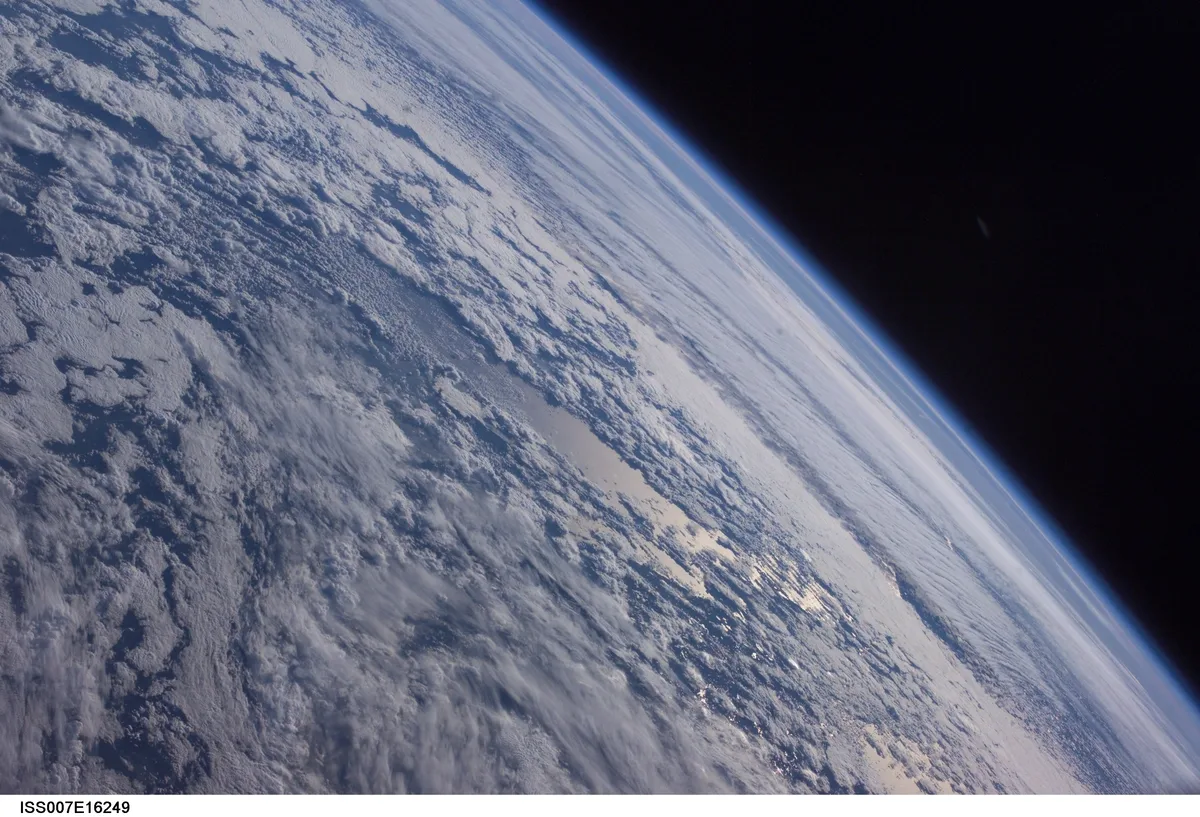
There's a question that rarely gets asked out loud, because it sounds too big for serious conversation: did life happen to Earth by chance, a rare exception in a cold and indifferent universe, or is it, in some sense, built into the very nature of what happens when matter organizes and reorganizes itself for long enough?
Nobody knows the answer for certain, but the path toward one runs straight through one of the strangest ideas of the twentieth century: the hypothesis that Earth itself behaves something like an organism.
The idea wasn't born in a philosophical debate. It came out of the lab of an engineer who was trying to figure out how to detect life on Mars, and ended up discovering something unexpected about life on his own planet.
- 1.James Lovelock and the Idea That Changed How We See Earth
- 2.Earth as Something More Than a Collection of Living Organisms
- 3.Daisyworld: An Imaginary Planet That Regulates Its Own Temperature
- 4.From Earth to the Universe: Could the Cosmos Be a Single System?
- 5.What Does It Actually Mean for Something to Be Alive?
- 6.The Limits of the Gaia Hypothesis and Its Scientific Critics
- 7.Humans Inside the Bigger System
- 8.Conclusion: A Living Universe, or a Universe That Creates Life?
James Lovelock and the Idea That Changed How We See Earth
In the early 1960s, James Lovelock was a British scientist and inventor known for building the electron capture detector (ECD), an instrument so sensitive that it later helped reveal traces of pesticides in the environment worldwide.
That reputation brought him to NASA in 1961, which was just setting up its Exobiology program and looking for experts who could design instruments to search for life on other planets. That same year, he became a professor of chemistry at Baylor University College of Medicine in Houston, where he stayed until 1964.
During his time in Texas, he worked as an outside consultant with colleagues at the Jet Propulsion Laboratory in Pasadena, which was then developing what would later become known as the Viking mission.
During those visits, in 1965, he found himself at JPL among people grappling with a question that had no clear answer at the time: how do you even recognize life on a planet you'll never physically visit?
Among them were Carl Sagan, then a young astronomer and visiting scientist at JPL, and Dian Hitchcock, a philosopher and systems analyst NASA had brought in to oversee the logic behind the life-detection experiments.
Lovelock quickly grew unhappy with the planned experiments, which largely assumed that Martian microorganisms would respond to nutrient solutions the same way Earth bacteria did.
In 1965, working on his own, he published a short paper in Nature titled A Physical Basis for Life Detection Experiments, proposing an entirely different approach: instead of hunting for specific organisms, it made more sense to examine a planet's atmospheric chemistry.
Two years later, in 1967, he developed the idea further with Hitchcock in a more extensive paper, Life Detection by Atmospheric Analysis, published in Icarus. The idea was simple but profound: a living planet has to constantly spend energy to keep its atmosphere far from chemical equilibrium.
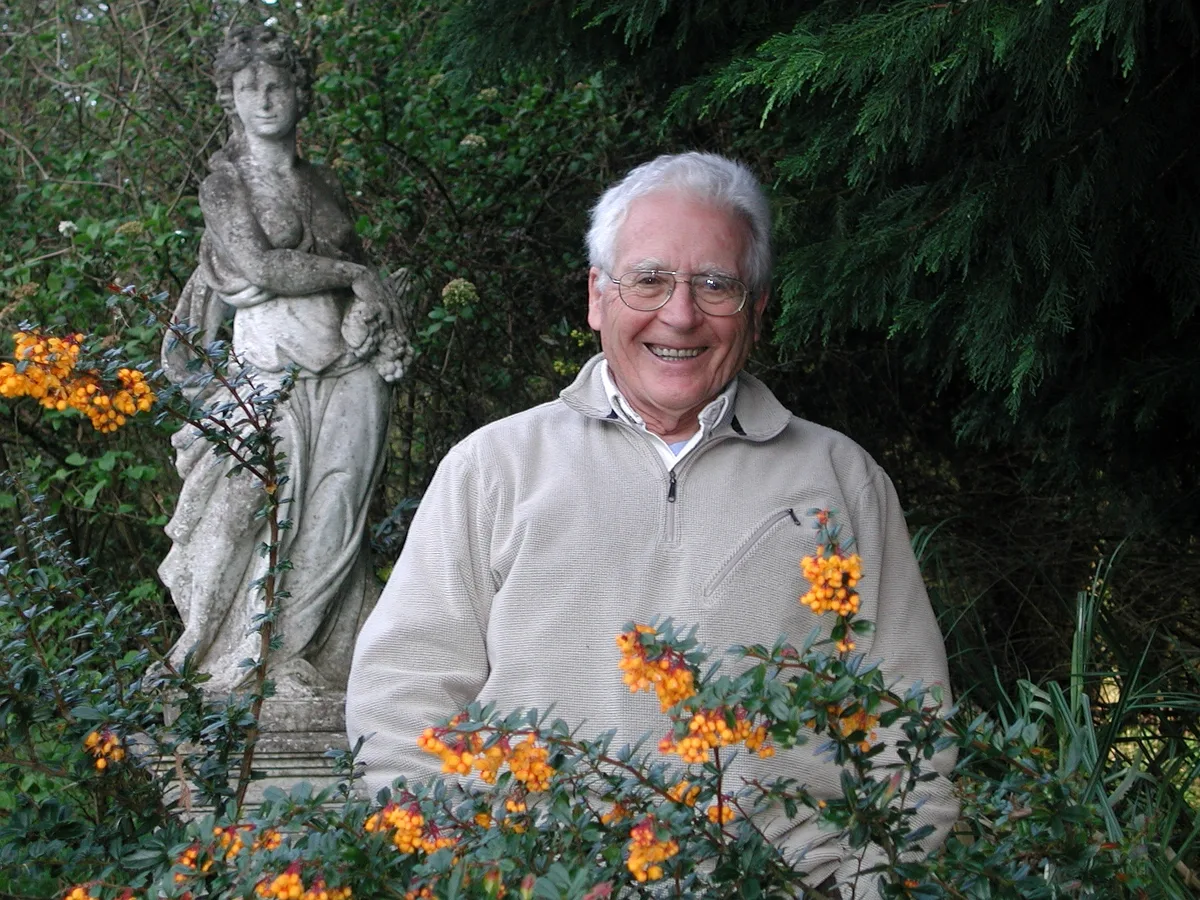
Earth's atmosphere, it turns out, is a strange mixture. It contains oxygen and methane in quantities that, by the laws of ordinary chemistry, should cancel each other out on a geologically short timescale. Instead, that imbalance has persisted for millions of years, constantly replenished.
On Mars and Venus, by contrast, the atmospheres are dominated by carbon dioxide and sit much closer to chemical equilibrium. Neither shows anything close to the same persistent, biologically maintained imbalance found in Earth's atmosphere. That pointed to a simple conclusion: what keeps Earth's atmosphere in that strange, unstable state is life itself.
After returning to England, Lovelock kept developing the idea. The decisive push came when he met Lynn Margulis, an American microbiologist who was then developing the theory of endosymbiosis, the explanation for how complex cells arose through the merging of simpler bacteria.
Margulis knew the microbial world and its role in shaping the environment inside and out, and working with her gave Lovelock's idea a much firmer scientific footing. That collaboration produced a paper published in 1974 in the journal Tellus, titled Atmospheric Homeostasis by and for the Biosphere: The Gaia Hypothesis.
In it, the authors argued that all living organisms on Earth act together as a kind of active system that regulates the atmosphere's chemical makeup, surface acidity, and even climate, maintaining conditions suited to their own survival.
It wasn't Lovelock's first paper with the word Gaia in the title. He'd presented the idea at the 1970 Gordon Conference on atmospheric sciences, and in 1972 published a shorter piece, Gaia as Seen Through the Atmosphere, in Atmospheric Environment.
The hypothesis got its name from Lovelock's neighbor in the village of Bowerchalke, the novelist William Golding, author of Lord of the Flies. That happened in 1969, five years before the joint paper with Margulis.
He suggested the name of the Greek earth goddess, Gaia. The name was poetic, maybe too poetic for the taste of part of the scientific community, but it stuck precisely because it was so unusual. Seven years later, in 1979, Lovelock expanded the idea into a full book, Gaia: A New Look at Life on Earth, introducing the hypothesis to a wider audience and kicking off a debate that would run for decades.
Earth as Something More Than a Collection of Living Organisms
Lovelock and Margulis weren't just interested in describing existing biological processes, but in how those processes interact. Traditionally, the atmosphere, oceans, soil, and rocks are treated as a stage on which life plays out: a natural backdrop that exists independently of living organisms, which simply adapt to it.
The Gaia hypothesis offered a different view: the atmosphere isn't just the stage life plays out on, but an integral part of a system that living organisms have been shaping and maintaining through their own activity for billions of years.
Examples weren't hard to find. The oxygen in Earth's atmosphere comes almost entirely from the photosynthesis of cyanobacteria and plants. Without constant biological production, oxygen would gradually get consumed in reactions with volcanic gases and rock, and its concentration would steadily drop.
Lovelock and Margulis also co-wrote the paper Biological Modulation of the Earth's Atmosphere, published in 1974 in Icarus. In it, they examined in more detail how microorganisms influence the cycling of sulfur, nitrogen, and other elements.
The oceans, for example, contain salts whose concentration stays relatively stable despite a constant inflow of minerals from rivers. Researchers like Alfred Redfield had previously explained that stability mainly through geochemical processes, while Lovelock and Margulis pointed to a possible role for living things.
Even Earth's average temperature has stayed within a range suited to liquid water, even though the Sun has grown about 30 percent brighter over the planet's history. Lovelock saw this as one of the biggest puzzles the Gaia hypothesis needed to explain.
The claim wasn't that organisms consciously planned this kind of regulation. It was a network of feedback loops: changes in the environment affect organisms, organisms alter that environment through their own activity, and those changes then loop back and affect them again.
The question that remained open, and later became the main target for critics, was whether such a network of feedback loops necessarily leads to stability, or whether stability only shows up in particular cases, with no inherent tendency of the system to maintain it.
Daisyworld: An Imaginary Planet That Regulates Its Own Temperature
To answer the question of whether planetary self-regulation could arise without any conscious intention, Lovelock and oceanographer Andrew Watson published a paper in Tellus in 1983 titled Biological Homeostasis of the Global Environment: The Parable of Daisyworld. The model was deliberately simplified to the extreme, almost like a children's game, but that simplicity is exactly what let them demonstrate mathematically something that was hard to explain in words.
The imaginary planet, called Daisyworld, orbits a star whose light gradually brightens, much like the Sun's luminosity has increased over time. The planet is home to just two kinds of daisies: black and white.
The black daisies have a low albedo, meaning they reflect little sunlight, so they absorb more energy and warm the ground around them. The white daisies have a high albedo, reflecting more light and cooling their surroundings. Both kinds thrive best within a particular temperature range, and their numbers depend on the temperature where they grow.
While the star is still dim, black daisies dominate, because absorbing more heat creates better conditions for their own growth. As they spread, they warm the whole planet along with themselves. As the star grows brighter, the temperature rises, and white daisies gradually gain the advantage.
Their ability to reflect sunlight slows further warming. The result is a balance in which the planet's average temperature stays surprisingly stable across a wide range of stellar brightness, even though no single daisy has any notion of climate or acts with any intention of regulating it.
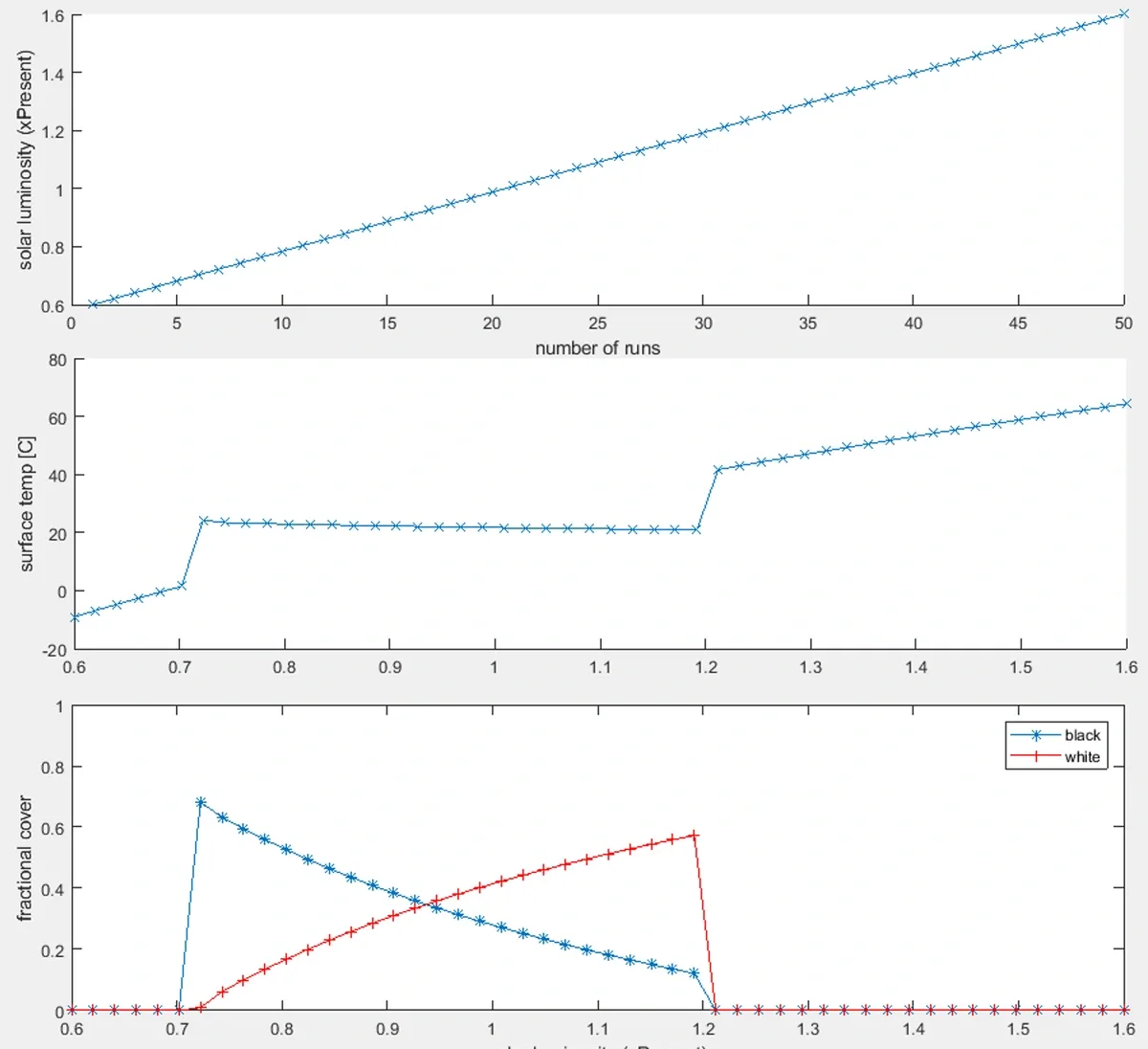
All of this happens through ordinary growth, reproduction, and competition for space. Watson and Lovelock showed that planetary stability can emerge as a consequence of natural processes, with no predetermined goal at all.
The paper played an important role in the Gaia debate because it offered a concrete answer to a common objection: how could planetary regulation ever arise without some impossible cooperation among organisms each acting in their own genetic self-interest? Daisyworld showed that this kind of regulation can emerge from ordinary Darwinian competition.
Critics, however, weren't convinced the model proved anything beyond mathematical possibility. Geomorphologist James W. Kirchner, for one, argued that Daisyworld is essentially an arbitrary picture of how the world works: the model achieves stability because its assumptions and the daisies' properties were specifically tuned to produce exactly that outcome.
In fact, Watson and Lovelock themselves stressed that Daisyworld was never meant to be a faithful model of Earth, but a deliberately artificial world designed to test one particular principle. That's why Daisyworld remains an elegant mathematical proof that planetary self-regulation is logically possible, but not proof that it actually happens on Earth, let alone confirmation of every claim made by the Gaia hypothesis in its broadest form.
From Earth to the Universe: Could the Cosmos Be a Single System?
The Gaia hypothesis is about a single planet. But the question in this article's title goes much further: does something similar exist at the scale of the entire cosmos? To answer that, we need to step away from biology for a moment and look at how the universe itself is structured.
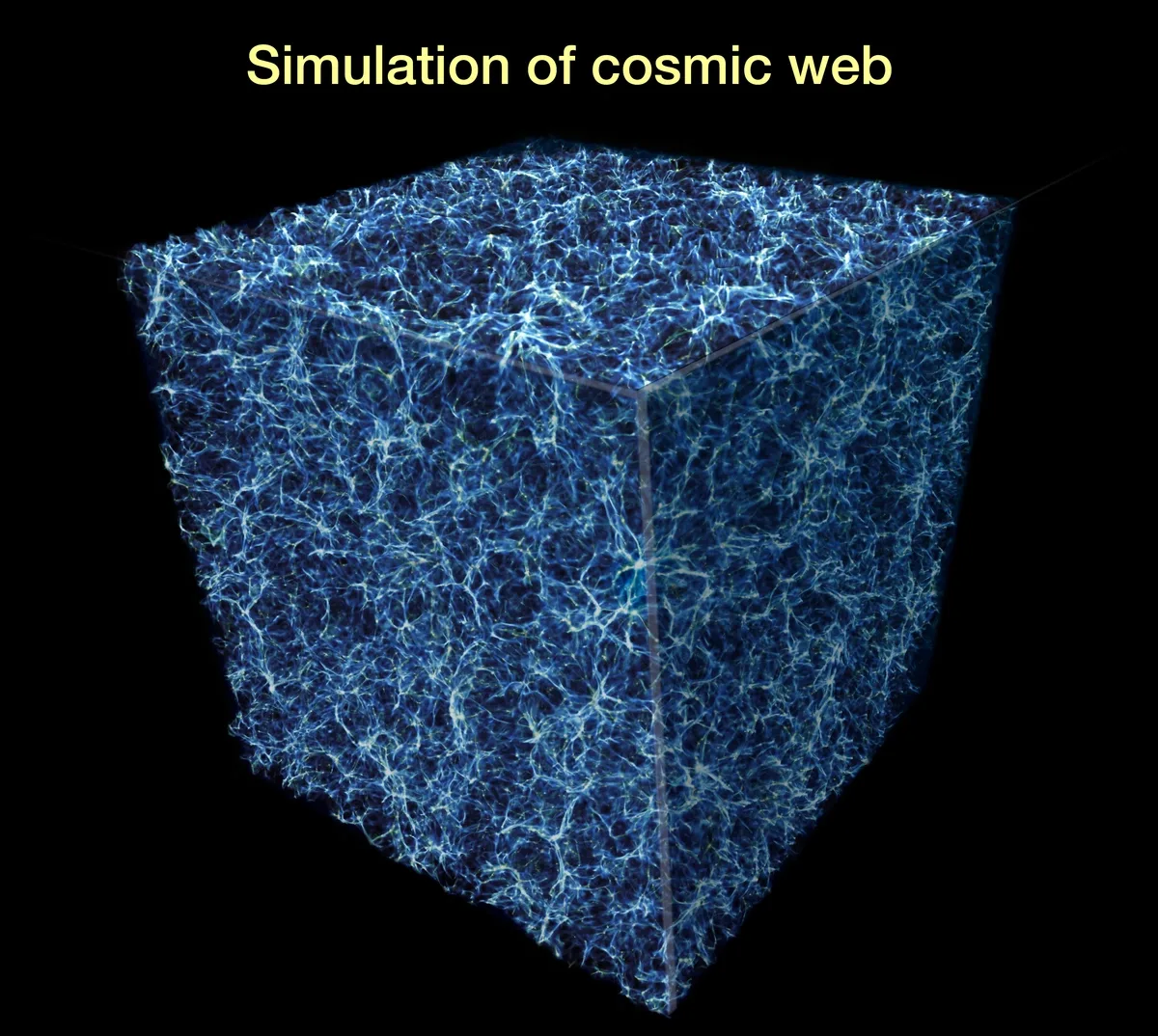
Modern cosmology describes the arrangement of matter in the universe using the concept of the cosmic web: an enormous structure woven together from nodes, filaments, and voids that stretches across distances of hundreds of millions of light-years. Galaxies aren't scattered at random. They cluster along filaments made of dark and ordinary matter, which connect dense nodes, essentially clusters of galaxies, while between them lie vast voids almost completely empty of matter.
This structure isn't random. It formed under the influence of gravity, which over time amplified tiny density differences in matter that were already present in the early universe, long before the first stars formed.
A 2025 review chapter by astronomers Rita Tojeiro and Katarina Kraljic, written for the Encyclopedia of Astrophysics and drawing together results from numerous earlier studies, shows that a galaxy's environment (how close it sits to a filament, a node, or a void) has a measurable effect on its rate of star formation and how it evolves over billions of years.
Inside those filaments and nodes, a process unfolds that is, ultimately, a precondition for life: the birth and evolution of stars. Stars consume hydrogen and helium, and in their interiors, and in the final stages of their lives, they forge heavier elements like carbon, oxygen, nitrogen, and iron. Those elements then scatter into interstellar space and become part of new generations of stars and planets, and eventually, of living organisms.
In that sense, there's a kind of cycle at work: matter passes through generations of stars, gets enriched with the elements necessary for complex chemistry, and eventually, at least in one place we know of, makes life possible.
Does that make the cosmic web alive in any serious scientific sense? This is where caution is warranted.
The comparison between the cosmic web and the brain's neural network shows up often in popular writing, and it really is visually striking: both systems have nodes connected by filaments, and both structures emerge through natural processes. But a similarity in shape doesn't mean a similarity in process.
The cosmic web forms through gravity acting on ordinary and dark matter, with no metabolism, no reproduction, and no biological exchange of information. The comparison can help us picture the sheer scale and interconnectedness of the cosmos, but it isn't scientific proof that the universe is alive in the biological sense of the word.
What Does It Actually Mean for Something to Be Alive?
Before we can seriously discuss whether the universe is alive, we have to come back to a question that looks simple but is actually fiendishly hard: what even is life? Biologists usually point to a handful of traits that track with living organisms: metabolism (exchanging matter and energy with the environment), the capacity to grow and reproduce, responsiveness to stimuli, the maintenance of internal stability, or homeostasis, and, maybe most important, the capacity to evolve through natural selection.
Within NASA's program for the search for life beyond Earth, a working definition took hold during the 1990s. Formulated by NASA's exobiology working group and often credited in the literature to chemist Gerald Joyce, it defines life as a self-sustaining chemical system capable of Darwinian evolution.
It's a working definition, not a universally accepted one, designed mainly as a practical tool for the search for life beyond Earth. Even so, it illustrates nicely why the question of a living universe is far more complicated than it first appears.
The universe as a whole doesn't reproduce. There's no population of universes within which natural selection could favor certain variants, and it doesn't pass through generations in which traits get inherited.
On the other hand, broader definitions treat life as a special case of self-organizing systems: structures that spontaneously create and maintain a certain order by drawing on energy from their surroundings. Such systems can sustain local order despite the general tendency of entropy to increase.
Under such a broad definition, traces of self-organization turn up in countless natural phenomena, from atmospheric vortices to the structure of galaxies, without us considering any of them alive in the biological sense. The difference between such systems and life isn't just a matter of complexity. It also comes down to the presence of heredity, variation, and selection: mechanisms that let systems change and adapt over time rather than simply following the laws of physics.
This is exactly where philosophical reflection parts ways with scientific criteria. You can say the universe is "alive" in a metaphorical, poetic sense: a system of processes that builds ever more complex structures, from particles and atoms up through stars, planets, and eventually biological organisms. But claiming the universe is alive in the strict biological sense, the kind that requires evolution through natural selection, demands a mechanism that no one has yet managed to demonstrate convincingly.
The Limits of the Gaia Hypothesis and Its Scientific Critics
That same tension between metaphor and actual mechanism has followed the Gaia hypothesis almost from the moment it was published.
One of the first serious critiques came in 1981 from Canadian biologist W. Ford Doolittle, in a piece titled Is Nature Really Motherly?. He pointed out that the hypothesis, if taken literally, implies that planetary regulation results from natural selection acting on the entire biosphere.
As an illustration, he pointed to bees in a hive: natural selection shaped their behavior so that they help maintain the right temperature inside the hive. The problem, Doolittle argued, is that the same mechanism at the scale of an entire planet would require organisms that contribute to its stability to have greater reproductive success than those that don't.
No one, including Lovelock and Margulis, has convincingly shown how such an evolutionary advantage could arise. Richard Dawkins raised a similar objection. Unlike a beehive, Earth doesn't belong to a population of reproducing planets among which natural selection could favor those with traits suited to sustaining life.
It was exactly this problem, later known as the "problem of Darwinizing Gaia," that pushed Watson and Lovelock to develop the Daisyworld model. With it, they showed that planetary regulation doesn't need to require selection at the level of the whole planet, but can arise instead from ordinary natural selection among individual organisms.
The model softened one of the most important objections, but didn't fully resolve it. As Kirchner later pointed out, Daisyworld achieves stability precisely because its rules and the properties of its imaginary organisms were set up to produce exactly that outcome.
Geomorphologist James W. Kirchner made one of the most useful contributions to this debate during the 1980s and 1990s. Rather than simply defending or dismissing Gaia, he tried to pull apart the different claims hiding behind the name.
He noted that there are at least five distinct versions of the hypothesis, spread across a wide spectrum: from claims that are nearly self-evident to extremely radical assumptions. At one end sits "weak Gaia," which holds that living organisms influence and alter their environment, a well-established fact.
At the other end is "strong Gaia," which holds that the biosphere actively regulates and optimizes conditions on the planet to keep them suitable for life. It's these stronger versions that became the main target of later scientific criticism.
One of the most comprehensive attempts to test the hypothesis in light of several decades of research in climatology, oceanography, geology, and paleoclimatology came in 2013, when oceanographer Toby Tyrrell published On Gaia: A Critical Investigation of the Relationship Between Life and Earth. His conclusion was largely negative toward the stronger versions of the hypothesis.
Earth really is remarkably well-suited to life as we know it today, but according to Tyrrell, that's mainly because life adapted to existing conditions, not because of some proven mechanism that reliably keeps the planet stable over the long term despite disturbances.
He also warned of a practical danger in believing otherwise: if people come to think the planet has some built-in capacity to heal itself, they might find it easier to disregard the consequences of their own actions.
Interestingly, in 2001, at a conference in Amsterdam, a declaration signed by four major international global change research programs stated plainly that "the Earth System behaves as a single, self-regulating system comprised of physical, chemical, biological and human components."
Eleven years later, in the declaration from the Planet Under Pressure conference, held in London in 2012, that language no longer appears. Instead, the Earth system is described as "a complex, interconnected system," with a warning that crossing certain planetary and regional boundaries could trigger sudden, unfavorable changes.
That shift in wording is interesting, but on its own it doesn't prove the scientific community changed its stance on self-regulation. Still, it shows how important it is to distinguish interconnectedness and feedback loops from the assumption that the whole system necessarily tends toward stability.
Even so, even among its harshest critics, there's a general recognition that the Gaia hypothesis had a major influence on the development of Earth System Science.
It helped spread an approach that studies the planet as a whole, as a network of interconnected physical, chemical, and biological processes, without assuming those processes necessarily tend toward stability.
It's also worth noting that Doolittle himself later returned to the very problem he'd raised back in 1981.
In more recent work, he explored alternative evolutionary mechanisms, in particular what's called selection by differential persistence, as a possible way to explain why certain systems and biogeochemical cycles persist over long stretches of time, even without planets literally reproducing.
Humans Inside the Bigger System
Whichever version of the Gaia hypothesis turns out to be right, one thing remains beyond dispute: the human species now acts as a force of planetary scale, altering the very same carbon, nitrogen, and energy cycles that Lovelock and Margulis described as the foundation of the biosphere's regulation.
In his later writing, Lovelock liked to point to a symbolic moment that, in his view, marked the beginning of the Anthropocene. It wasn't the discovery of nuclear energy. It was 1712, when Thomas Newcomen built the first practical steam engine.
That's when the age began in which humanity started systematically burning fossilized carbon that had accumulated over hundreds of millions of years.
Interestingly, human influence is now one of the most serious challenges facing the stronger versions of the Gaia hypothesis.
If the planet really did have a strong, reliable capacity for self-regulation, it would be hard to explain how a relatively short period of industrialization could trigger such deep, rapid changes to the climate and biogeochemical cycles.
The fact that such changes are possible, and appear to be happening right now, supports Tyrrell's warning: feedback loops in the Earth system aren't all-powerful, and they can be overwhelmed by an external disturbance large and fast enough.
At the same time, that very vulnerability confirms something that's been at the heart of the Gaia hypothesis from the start: the atmosphere, oceans, soil, and living world can't be viewed in isolation. They're parts of one interwoven system, where a change in one place echoes through all the others.
Conclusion: A Living Universe, or a Universe That Creates Life?
Let's return to the question we started with. The research we've covered doesn't give a clear-cut answer, and it probably can't, at least not with what we currently know.
What we do know with reasonable confidence is that Earth isn't just a lifeless rock on which life happened to appear. The biosphere has profoundly and measurably altered the composition of the atmosphere, the chemistry of the oceans, and quite possibly the planet's long-term temperature stability. All of this plays out through a complex web of feedback loops, whose workings Daisyworld illustrates in an interesting way, even if it doesn't prove that kind of regulation exists in full on Earth.
We also know that this regulation isn't all-powerful, and it doesn't operate toward some predetermined goal the way a living creature would. It has its limits, and human activity is putting them to a serious test right now.
When we look at the entire cosmos, the picture gets a lot less certain. The cosmic web has a structure that, at first glance, resembles the networks found in living systems, and the elements that make us up really did form inside stars scattered throughout that web.
But a similarity in form doesn't mean the same process is behind it. For now, we don't have a scientifically grounded mechanism that would let us call the universe as a whole alive, at least not in the strict sense of the word.
Maybe that's why it's more honest to ask the question buried in the second half of this article's title: isn't the universe less a living system and more a space in which matter, given enough time and countless chance circumstances, can create the conditions for life to arise? Maybe life, at least on one planet, is simply one of the possible outcomes of matter's ever-increasing complexity.
Whether this is a rare fluke or something matter can naturally accomplish given enough time, we still don't know. It's a question whose answer is still out there to be found, if it can be found at all.
Cover photo: Earth seen from the International Space Station, October 4, 2003. Photo: NASA, public domain.
SOURCES
- Lovelock, J. E. & Margulis, L. (1974). Atmospheric homeostasis by and for the biosphere: the Gaia hypothesis. Tellus, 26(1-2), 2–10.
- Margulis, L. & Lovelock, J. E. (1974). Biological modulation of the Earth's atmosphere. Icarus, 21(4), 471–489.
- Watson, A. J. & Lovelock, J. E. (1983). Biological homeostasis of the global environment: the parable of Daisyworld. Tellus B, 35(4), 284–289.
- Lovelock, J. E. (1965). A Physical Basis for Life Detection Experiments. Nature, 207, 568–570.
- Hitchcock, D. R. & Lovelock, J. E. (1967). Life Detection by Atmospheric Analysis. Icarus, 7, 149–159.
- Lovelock, J. E. (1972). Gaia as seen through the atmosphere. Atmospheric Environment, 6(8), 579–580.
- Science Museum Group / Roger Highfield, James Lovelock's Greatest Epiphany: Quest for Life on Mars.
- NASA Astrobiology, In Memoriam: James Lovelock.
- Lovelock, J. E. Curriculum Vitae. Jameslovelock.org.
- Lovelock, J. E. (2011). Conjectures of an independent scientist (lecture, Geological Society of London).
- Lovelock, J. E. (2001). The Gaia Theory (interview, Web of Stories).
- NASA, Carl Sagan (1934–1996).
- Leslie Mullen, "Forming a Definition for Life" (interview with Gerald Joyce), NASA Astrobiology, July 25, 2013.
- Lucas J. Mix, "The Origin, Extension, and Future of the 'NASA Definition' of Life", Astrobiology, 2026.
- James Lovelock, Novacene: The Coming Age of Hyperintelligence, Allen Lane, 2019.
- Doolittle, W. F. (1981). Is Nature really motherly?. CoEvolution Quarterly.
- Doolittle, W. F. (2025). Darwinizing Gaia: conceptual approaches. Philosophical Transactions of the Royal Society B, 380(1931).
- Kirchner, J. W. (1989). The Gaia Hypothesis: Can It Be Tested?. Reviews of Geophysics, 27(2), 223–235.
- NZ Skeptics, Beardsley, T. (1991). Gaia Revisited.
- Tyrrell, T. (2013). On Gaia: A Critical Investigation of the Relationship between Life and Earth. Princeton University Press. Review: Turney, J., Times Higher Education.
- Future Earth, Turney, J. (2013). Gaia at 40.
- Amsterdam Declaration on Global Change, 2001.
- State of the Planet Declaration, Planet Under Pressure, London, 2012.
- Richard Dawkins, The Extended Phenotype: The Long Reach of the Gene, Oxford University Press, 1982.
- Tojeiro, R. & Kraljic, K. (2025). Large Scale Structure and the Cosmic Web. Chapter for Encyclopedia of Astrophysics (Elsevier), arXiv:2503.21759.
- Darvish, B. et al. (2014), featured in: ScienceDaily, It's Filamentary: How Galaxies Evolve in the Cosmic Web.
- Lenton, T. (2006). Review of Tim Flannery's book The Weather Makers, with a discussion of the Daisyworld model. Climatic Change, 78, 515–518.
Aron Corvin
Curiosity draws me to stories that lie at the edge of the known and the unknown. I explore mysteries, unusual phenomena, and forgotten events, taking the time to research each subject thoroughly, without sensationalism or unfounded claims. Thank you for reading Anomyst. If you enjoy my work and would like to support it, your support means a great deal to me and helps me continue exploring and sharing new stories.