
5 People Who Vanished Without a Trace, Never Found
Most disappearances, tragic as they are, follow some kind of logic. There's a debt, a conflict, an illness, or at least one witness who can say what happened in those final hours.
The trouble starts when that logic is missing: when someone shows up on camera for the last time in a city they've never visited, or inside a closed system with no way out, and then there's simply nothing more to follow.
The five cases below are exactly that kind. None has ever been officially solved, and for years, in some cases for decades, families and investigators keep coming back to the same footage and the same incomplete evidence.
We've separated what's documented from what's only theory or guesswork, because that line is often the first thing to disappear in stories like these.
Steven Koecher
Steven Thell Koecher was born on November 1, 1979, in Amarillo, Texas, and grew up in a close-knit family belonging to The Church of Jesus Christ of Latter-day Saints.
He worked as a journalist and in advertising, and by 2009 he was living in St. George, Utah, where he'd fallen a few months behind on rent and was looking for work through contacts in his church community.
Trips that never made sense
In the week before he vanished, Steven covered hundreds of miles for no clear reason.
One day he drove almost 1,100 miles across Utah and Nevada, including a visit to his ex-girlfriend's family, where he stayed for lunch. No one ever found an explanation for that trip either.
The day before he disappeared, while handing out flyers for his window-washing business, he helped two young girls who'd gotten locked out of their house. On the evening of Saturday, December 12, 2009, he bought Christmas presents for his family at a Kmart in St. George.
The next morning, Sunday, December 13, he called two friends from his church group to say he was in Las Vegas, about 120 miles from home, and offered to drive back and lead a church service in place of one of them. His friend told him not to bother. They later said they wished they'd asked him why he was there.
The last sighting
At 11:54 a.m., a home security camera in the quiet retirement community of Sun City Anthem in Henderson, Nevada, caught Steven's car pulling into a cul-de-sac.
Six minutes later, someone the family believes was Steven, wearing a white shirt and pants, got out of the car, went back for something, and then walked off down the sidewalk. A second camera caught only his reflection in the car window. From that moment on, there's no trace of him at all.
His phone didn't go dark right away. Five hours after he left the car, a signal ping placed it near Arroyo Grande Boulevard and American Pacific Drive, a few miles farther on.
Two hours after that, another ping came from near Sunset Drive and Stephanie Street, and the next morning, someone checked his voicemail. The signal lingered around U.S. 95 and Russell Road for two more days before it disappeared for good.
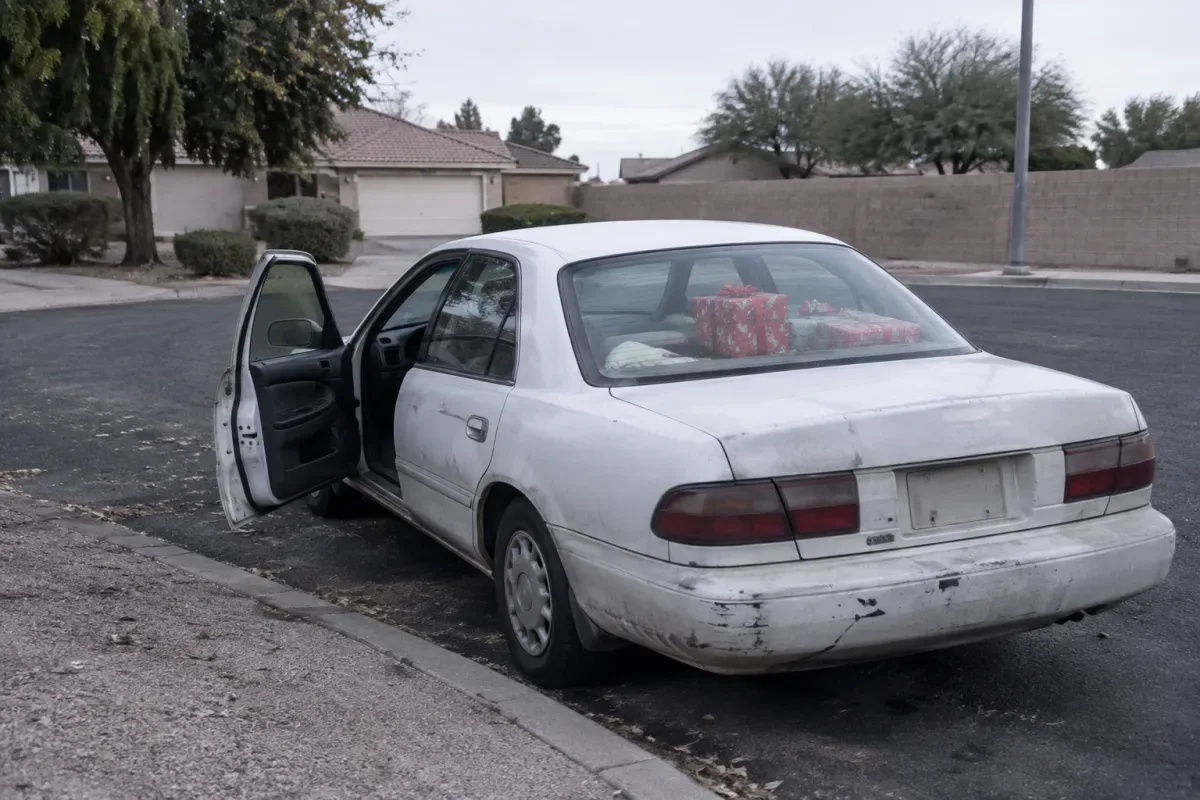
The car itself turned up a few days later, when the community's management reported it as abandoned. Inside were shaving supplies, clothes, pillows, blankets, and the Christmas presents he'd bought days earlier. His phone, wallet, and driver's license were never found, and the gas tank was still half full.
What's known, and what isn't
Police never found evidence of violence, but that doesn't rule out the possibility that something happened to him. His family believes he drove to Henderson that morning for a possible job.
Early speculation that Steven was somehow connected to the disappearance of Susan Powell, who had vanished from Utah a week earlier, was investigated and ruled out; there's no evidence tying the two cases together.
Private investigators who have worked the case in recent years have floated a theory that Steven may have been making some kind of delivery for his landlord, a man with a long criminal record, possibly drug-related.
There's no confirmed evidence for that either, only hints and the investigators' own statements. The case remains open and active.
Jason Jolkowski
Nineteen-year-old Jason Anthony Jolkowski lived with his parents and younger brother in the Benson neighborhood of Omaha, Nebraska. He was enrolled in the broadcasting program at Iowa Western Community College and worked at a Fazoli's restaurant.
A short walk he never finished
On the morning of Wednesday, June 13, 2001, Jason was asked to come in early for work. Since his car was in the shop, he planned to walk eight blocks to Benson High School and meet a coworker there who'd give him a ride.
He was last seen carrying trash cans into the garage with his younger brother. He never made it to the meeting spot; his coworker waited for him, and people at work assumed he'd simply failed to arrange a ride.
Sometime between 11:15 and 11:30 a.m., the coworker called his house, and that's when his family realized he was gone.
A search that turned up nothing
The searches that followed turned up no trace of him. Security footage from Benson High School showed that Jason never reached the building. His bank account sat untouched, and his phone was never used again.
His parents, Kelly and Jim, founded the nonprofit Project Jason to help other families of missing people. Omaha police still list the case as active, though no new leads have surfaced.
Theories, from a random abduction to a simple accident, remain just that: theories. None has ever been backed by evidence.
Ben McDaniel
Ben McDaniel, born in 1980, was the oldest of three sons in a well-off family from Collierville, Tennessee. By 2010 he was going through a rough stretch: he'd gotten divorced, his construction company had collapsed and left him with nearly $50,000 in tax debt, and two years earlier he'd lost his younger brother, Paul.
His parents offered to let him move into their beach house in Santa Rosa Beach, Florida, while he worked through it. There he returned to diving, a hobby he'd had since he was fifteen, and became a regular at Vortex Spring, one of the largest freshwater diving centers in the country.
The restricted part of the cave
Ben didn't hold a cave-diving certification, but he knew the equipment and the technique well. On the day he disappeared, he was diving alone.
Earlier that week he'd visited his parents in Memphis and seemed upbeat. He was looking for work as a diving instructor and had been working on a map of the cave. He'd returned to Florida just a few days before he vanished.
On the evening of August 18, 2010, an employee named Eduardo Taran and a diver named Chuck Cronin were the last people to see him heading down toward the cave entrance.
They later told authorities they'd noticed someone tampering with the gate, likely Ben, who wasn't certified for that section of the system. No one has seen him since.
Tanks that don't fit the story
Two days later, staff noticed his truck was still sitting in the parking lot and called the police. Officers found his wallet with his driver's license, his diving certifications, and about $1,100 in cash.
His detailed dive log and his map of the cave later helped divers reconstruct where he might have gone. His dog, Spooner, was left behind at his apartment.
During an extensive search that drew some of the best divers in the country, two decompression tanks believed to have belonged to Ben were found, but in locations that didn't match standard cave-diving practice.
Edd Sorenson, an experienced rescue diver, went roughly 1,700 feet into the cave, 200 feet past the end of the map, and found no sign that Ben had ever gone that deep.
A reward, and a second death
The family offered a reward that eventually grew to $30,000 for anyone who found the body. Critics warned that it could push untrained divers to risk their lives.
In March 2012, Larry Higginbotham, a 43-year-old diver from Biloxi, died in the cave, likely while trying to reach the reward. The family withdrew it afterward. The State of Florida issued a death certificate in 2013, but the body was never found.
Beyond the theory that he died in an accident deep in an unexplored part of the cave, investigators also considered the possibility of foul play, and the possibility that Ben staged his own disappearance to escape his problems. His family rejects that last theory, pointing out that he left behind both his dog and his girlfriend.
None of these theories has ever been proven.
Rebecca Coriam
Rebecca Coriam, a 24-year-old Briton from Chester, worked as a youth coordinator aboard the Disney Wonder. According to a statement from Bahamian police, the ship was sailing from Mexico to Los Angeles at the time she vanished.
The 5:45 a.m. recording
At 5:45 a.m. on March 22, 2011, interior cameras in a crew area of the ship recorded Rebecca on the phone, looking upset. After she hung up, she walked out of frame and was never seen again.
When she failed to show up for her nine o'clock shift, the ship was searched, and both the U.S. Coast Guard and the Mexican Navy joined the search. Nothing turned up.
An investigation under scrutiny
Because the Disney Wonder was registered in the Bahamas, Bahamian police formally led the investigation. According to British media reports, only one Bahamian officer, Superintendent Paul Rolle, ever boarded the ship.
Member of Parliament Stephen Mosley, who raised the case in the House of Commons, criticized Disney for prioritizing getting the ship back into service over the investigation itself. By the end of March 2011, Bahamian police had closed their inquiry aboard the ship, stating there was no evidence of foul play, though the case remained open.
Disney and the Bahamian investigator later put forward the theory that Rebecca had likely been swept overboard by a wave from deck five, while she was near the crew pool. Her family has never accepted that version of events.
According to her friend Melissa, the flip-flops presented to Rebecca's parents as hers were too big and weren't even her style.
Journalist Jon Ronson of The Guardian boarded the same ship in October 2011 and spoke with crew members who anonymously suggested that more was known about the circumstances of her disappearance than had been publicly acknowledged, though he didn't produce any concrete evidence of his own.
Her family hired a maritime lawyer in Miami and spent years pushing for further answers. Speculation about a possible conflict or personal circumstances that circulated in the media has never been confirmed, so we won't repeat it here as fact. The case remains open, and the family never received the final report Bahamian authorities had promised them.
Brian Shaffer
Brian Randall Shaffer, a 27-year-old second-year medical student at Ohio State University, vanished on the night of March 31 to April 1, 2006, in Columbus, Ohio. Three weeks earlier, his mother, Renee, had died of myelodysplasia, a rare bone marrow disorder.
A bar with one public entrance
That evening, at the start of spring break, Brian had dinner with his father, then met up with his friend and former roommate Clint Florence around 9 p.m. at the Ugly Tuna Saloon, a bar on the second floor of a retail complex on High Street with an escalator as its only public entrance for guests.
The two of them bar-hopped through the area, and after midnight Florence's friend Meredith Reed joined them, later driving them back to the Ugly Tuna for one last drink.
At 1:55 a.m., a camera caught Brian at the top of the escalator talking to two young women, then turning and heading back toward the bar's entrance. That's the last confirmed footage of him.
Florence had lost track of Brian a little earlier, and when he went looking for him, he couldn't find him anywhere. When the bar closed at two o'clock, Florence and Reed waited outside for him, assuming he'd gone home on his own.
Every camera in the building
Police reviewed security footage from every camera in the building and the surrounding businesses and never found a single frame of Brian walking out the main entrance, the bar's only public exit.
His bank account sat untouched, and his cell phone was never used again, except once in September of that year, when it rang three times. The carrier said it was likely a glitch, but the signal was traced to a tower in Hilliard, about 14 miles from where he vanished.
Clint Florence and the refused polygraph
While Brian's father, Randy, and Meredith Reed agreed to polygraph tests and passed them, Clint Florence repeatedly refused to take one, both for police and for a private investigator hired by the family, and hired a lawyer soon after Brian disappeared.
He was never formally named a suspect or charged, and refusing a polygraph isn't on its own evidence of involvement, but it remained the case's most contested detail for years.
A public theory also emerged around the so-called "Smiley Face Killers," an alleged network supposedly tied to a string of drownings of young men across the American Midwest; most investigators dismiss the theory as unsupported.
A photo of a homeless man in Mexico, which had been circulating since 2019, was forwarded in 2020 to the detective on the case, and the FBI determined it wasn't Brian. Columbus police still list the case as open.
What Remains
Steven, Jason, Ben, Rebecca, and Brian weren't risk-takers, and none of them was in an obviously dangerous situation. They disappeared in a residential community's parking lot, on an eight-block walk, at a dive center whose staff knew them, aboard a ship full of cameras, and in a bar with no recorded exit.
What truly connects these five cases isn't a shortage of theories. There are plenty, and some are more convincing than others. It's the absence of anything that could actually confirm one of them.
No body, no confession, no final proof. All that's left are the last known images, incomplete records, and families who, years and sometimes decades later, are still waiting for an answer that may never come.
Cover image: Illustration created using artificial intelligence. It does not depict a real person or a documented event.
SOURCES
- Lee Benson, "About Utah: Powell isn't only missing Utahn", Deseret News, 6. 1. 2010.
- David Charns, "The search for Steven Koecher: Man vanishes from Las Vegas valley neighborhood, phone pings for days miles away", 8 News Now, 21. 11. 2022.
- David Charns, "Last-known person to see Steven Koecher alive in Las Vegas-area neighborhood details odd conversation moments before he vanished", 8 News Now, 19. 12. 2022.
- "Utah man's disappearance in Nevada remains a mystery 15 years later", News 3 (KSNV), 15. 12. 2024.
- NamUs, "Missing Person / NamUs #4889: Steven Thell Koecher".
- Emily Tencer, "'There's no leads, nobody saw anything': 20 years since Jason Jolkowski was last seen", KETV 7, 13. 6. 2021.
- The Charley Project, "Jason Anthony Jolkowski".
- FBI, "Jason Jolkowski", Kidnappings/Missing Persons.
- Ben Montgomery, "When a diver goes missing, a deep cave is scene of a deeper mystery", Tampa Bay Times, 15. 4. 2011.
- "Mississippi Man Killed in Cave Diving Accident", WJHG, March 2012.
- "Collierville parents pull reward for missing diver", The Commercial Appeal, 2012.
- "Another Tragedy at Florida's Vortex Spring", Caving News, 20. 3. 2012.
- The Charley Project, "Benjamin Wayne McDaniel".
- Chrislyn Skippings, "MISSING PERSON: Rebecca Coriam", Royal Bahamas Police Force / The Bahamas Weekly, 16. 12. 2011.
- "Missing cruise worker: No foul play, say Bahamas police" (citing a statement from the RBPF), BBC News, 29. 3. 2011.
- Jon Ronson, "Rebecca Coriam: lost at sea", The Guardian, 11. 11. 2011.
- "Vanished Disney cruise ship worker could have been 'murdered'", BBC News, 30. 10. 2015.
- Scott Johnson, "Disney Settled With Family of Missing Cruise Worker", The Hollywood Reporter, 19. 4. 2016.
- "Is Brian Shaffer alive?", The Lantern, 12. 4. 2009.
- "When missing persons cases go cold", Columbus Monthly, September 2014.
- "What happened to Brian Shaffer? Detectives investigate potential new clue", 614NOW, 2020.
- "Brian Shaffer disappearance: photo shows how OSU student may look now", The Columbus Dispatch, 29. 3. 2021.
- The Charley Project, "Brian Randall Shaffer".
- FBI, "Brian Randall Shaffer - Columbus, Ohio", ViCAP Missing Persons.
- NamUs, "Missing Person / NamUs #1709: Brian Randall Shaffer".
Aron Corvin
Curiosity draws me to stories that lie at the edge of the known and the unknown. I explore mysteries, unusual phenomena, and forgotten events, taking the time to research each subject thoroughly, without sensationalism or unfounded claims. Thank you for reading Anomyst. If you enjoy my work and would like to support it, your support means a great deal to me and helps me continue exploring and sharing new stories.